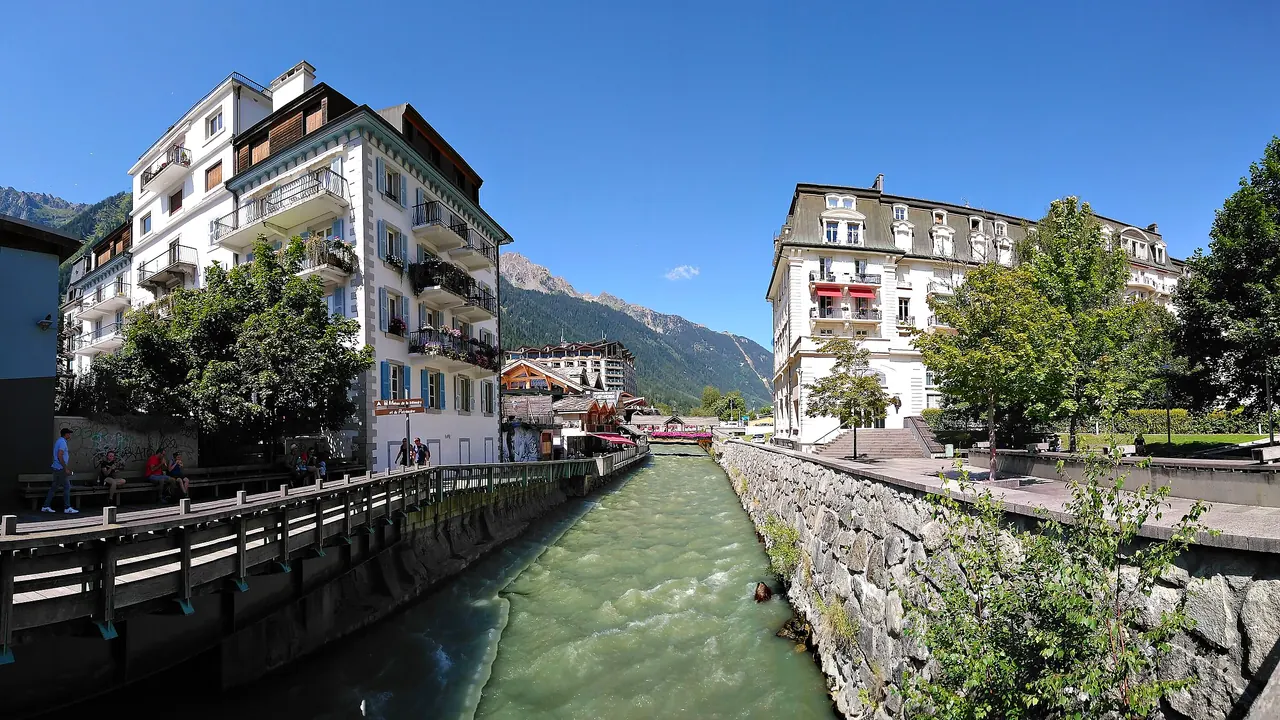
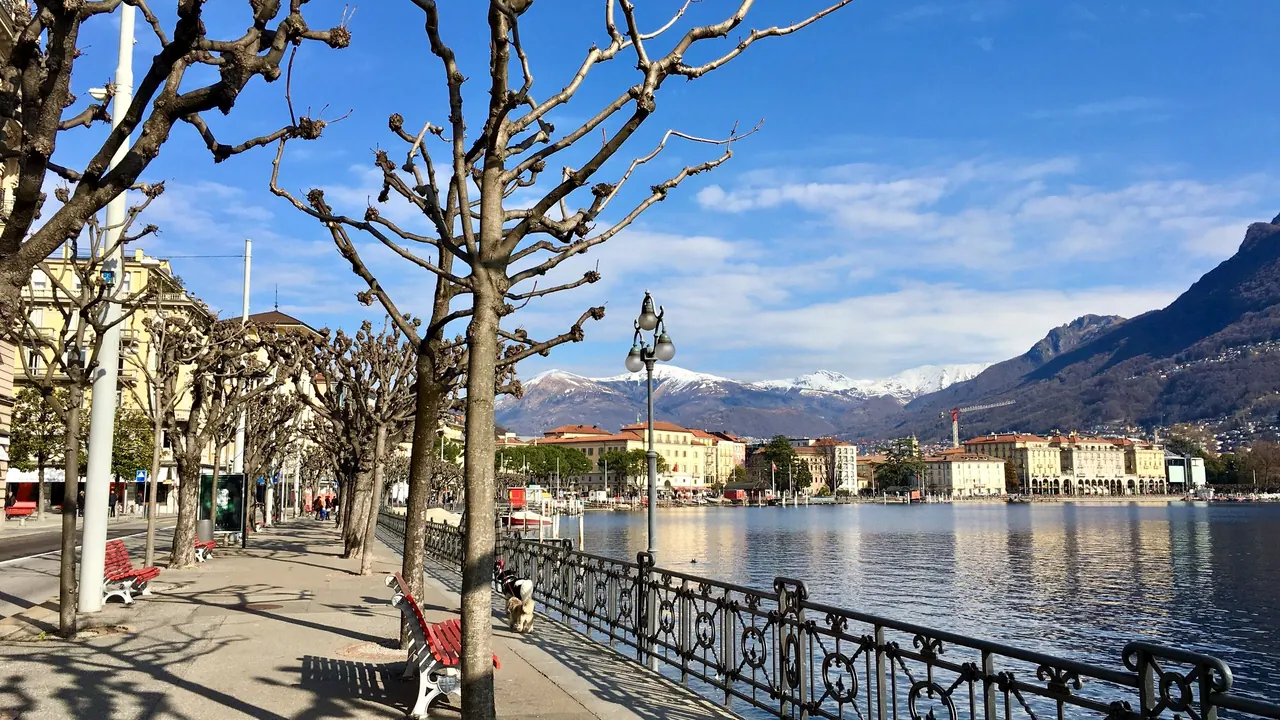
Photos: Chamonix by Tiia Monto, CC BY-SA 3.0, cropped; Lugano by Thomas Woodtli from Zürich, Switzerland, CC BY-SA 2.0, cropped.
Chamonix or Lugano?
Our verdict in twelve categories, each scored against the same fixed benchmark cities, and the climate month by month, so you can choose for your trip.
Choose Chamonix for
- nature and the outdoors
- nightlife
- prices
Chamonix is for travellers who come to use the mountains rather than look at them. Cable cars lift you from the town straight into glacier country, and the trails, ski runs, climbing routes and guides all start on the valley floor. Evenings are livelier than Lugano's, with a young après-ski crowd in winter. Pick it if your days will be spent on foot, skis or rope and you don't need much from the town itself.
Choose Lugano for
- beaches
- live music and the arts
- day trips
Lugano suits a slower, more varied trip where the scenery is a backdrop and not the main activity. It has a swimmable lake with lidos, an arcaded old town, a proper concert hall, and Milan, Como and Bellinzona all within easy train reach. The mountains here are for funicular rides and gentle walks, not for alpinism. It is the better base for couples and anyone who wants lake days, art and day trips on the same vacation.
Scoreboard
Twelve categories on one fixed scale from 0 to 100. The shaded stretch is the gap between the two.
Your match
Pick a travel style or drag the sliders, and both match scores follow your weighting.
Wins on nature and the outdoors and nightlife with your weighting.
Wins on beaches and live music and the arts with your weighting.
What matters to you?
Category by category
What the scores mean for a trip.
Beaches & swimming
Neither town has a beach, but Lugano gives you real lake swimming, with lidos, pools and wooden decks along the shore and boat trips to small village baths. It works well for a hot summer afternoon in the middle of a city stay.
In Chamonix, swimming means the town pool or a drive down to Lac de Passy, and the trip to Lake Annecy takes over an hour. Unless you plan the outing, you probably won't swim.
Food & drink
Both have a strong regional cooking tradition and little range beyond it, but the traditions are very different. Chamonix serves Savoyard cheese dishes such as fondue, raclette and tartiflette, often on terraces at mountain refuges, along with resort bistros whose menus look much alike.
Lugano's food is Ticino's Italian-leaning cooking: polenta, risotto and braised meats served in grotti under chestnut trees, with local Merlot to drink. The Lugano meal is a long, slow lunch, while the Chamonix one is a big plate after a hard day outdoors.
Culture & sights
Lugano has more to see, although a day covers it. The Lombard-style arcaded old town, San Lorenzo cathedral, the Luini Passion fresco and the city art collection split between LAC and Palazzo Reali make a satisfying day of sightseeing.
Chamonix's heritage is the story of alpinism, told at the Musée Alpin and in the statues of the first Mont Blanc climbers. It is interesting if you care about mountains, and you can see it all in a morning.
Nightlife
Chamonix has the better nights out. In winter, après-ski bars fill from the late afternoon, and a narrow old-town lane of pubs keeps guides, seasonal workers and visitors out late, with a couple of small clubs after that. It is loud, young and largely English-speaking, and it gets much quieter in summer.
Lugano's evenings are smarter and calmer: an aperitivo under the arcades or by the lake, then a long dinner, and the town is mostly asleep before midnight. Locals who want a real night out go to Milan.
Nature & outdoors
Chamonix is the stronger choice for anyone who wants real mountains. Mont Blanc rises almost 4km above the valley floor, and cable cars carry you straight up to glaciers and granite needles, with the Aiguille du Midi at 3,842m and the rack railway climbing to the Mer de Glace. Winter brings steep skiing and the Vallée Blanche descent, and summer brings climbing, via ferrata and trails to Lac Blanc and along the Grand Balcon.
Lugano's landscape is gentler and greener. A lake winds between wooded slopes, funiculars run up Monte Brè and San Salvatore, and a lakeside path leads to Gandria. The ridge from Monte Lema to Monte Tamaro and the Verzasca valley make good days out for keen walkers, and kayaks and paddleboards are easy to hire on the lake. There is no ice or high-mountain terrain close by, though.
Day trips
Lugano is the better base for day trips. Milan, Como, the castles of Bellinzona, Lake Maggiore and Bergamo are all easy to reach by train or boat, without a car, and they range from Renaissance art to lakeside villages like Morcote.
From Chamonix, the Mont Blanc Tunnel to Courmayeur and Aosta, the train to Martigny and the drives to Annecy and Geneva make good outings. Once you have done those, you are mostly left with other ski resorts at the end of slow mountain roads.
Good for families
Both are safe, manageable places for children, and both work best for families who like being outdoors. In Chamonix the fun is active: ski schools, sledging, the summer luge, treetop courses and marmots at the Merlet park. The very high cable cars are not for small children, though.
Lugano's family days are gentler and built around the water: lidos with slides, boat trips, funicular rides and the miniature Switzerland park at Melide. Its steep streets are hard work with a pushchair, and neither town has much to offer on a rainy day.
Getting around
Lugano is a little easier, mainly because the Swiss rail network starts at the station, which a short funicular links to the old town, and lake boats and mountain railways fill the gaps. The slope is the only real nuisance.
Chamonix's centre is flat and compact, and the guest card gets you free buses and trains along the valley. In winter, though, the ski areas are spread out, so expect crowded ski buses and thin evening services.
Shopping & style
Lugano has more general shopping, with watchmakers, jewellers and Italian fashion under the porticoes of Via Nassa and a big designer outlet near Mendrisio. It still sends serious shoppers on to Milan.
Chamonix is a specialist: its pedestrian streets are lined with long-established climbing, ski and outdoor shops that are worth saving a gear budget for. Beyond those, it sells cheese, génépi and souvenirs.
Affordability
Both are expensive, but Chamonix gives you more ways to save. Apartments and supermarkets make self-catering easy, many trails start without a lift, the valley transport is free, and the shoulder seasons cost noticeably less.
Lugano charges Swiss prices for nearly everything, from lakeside hotels to boat trips, and there is no real budget way to stay there. Grotti and set lunches help, and some visitors eat across the border in Italy.
Live music & performing arts
Lugano has a real cultural season. LAC's concert hall is home to the Orchestra della Svizzera italiana, and its theatre stages drama and dance, while Estival Jazz fills Piazza della Riforma with free concerts in summer.
Chamonix has a summer jazz festival with some sets played high in the mountains, plus occasional church concerts and mountain film evenings. It has no season to plan a trip around.
Wellness & relaxation
Chamonix has the stronger bathing culture. Its large thermal-style day spa has hot outdoor pools facing the glaciers, and the old springs of Saint-Gervais are just down the valley. The town itself is busy, with early starts and climbers in the streets.
Lugano has no thermal tradition, and its spas are mostly in hotels. What it does offer is a slower pace: lazy afternoons at a lido, benches in Parco Ciani and grotto lunches that last for hours.
When should you go?
Pick your month. The climate figures are measured averages, not a forecast.
Chamonix in July
Lugano in July
Daytime high, °C
Rainfall in the month, mm
Where the figures come from
Chamonix's temperatures are measured 35 km from the centre, at Bourg-St-Maurice.
Chamonix has no rain gauge within 25 km of the centre, so its rainfall comes from a gridded climate dataset read at the city rather than from a gauge further away.
Temperature and rainfall are climate normals, averaged over the years shown. Chamonix: 1999-2020 (rainfall 1991-2020) normals, Bourg-St-Maurice (34.9 km from centre). Lugano: 1991-2020 normals, Lugano (1.2 km from centre).
The two towns have almost the same temperatures, with daytime highs around 27°C in July and single figures in midwinter, but their rain falls in different seasons. In Chamonix it is spread fairly evenly across the year and peaks in late autumn and early winter. Winter belongs to skiing, and July and August are the months for high trails, lake swimming at Passy and long evenings outdoors. June and September are good for walking with milder heat, though the weather on the peaks can change quickly at any time of year.
Lugano is driest in winter, at around 61mm in February, then becomes much wetter from April to November, with May the wettest month at about 178mm. It also gets the most sunshine in summer, with July close to 257 hours, so summer here means hot days broken by heavy showers, and the lidos are open from June to early September. Spring and autumn are the most comfortable months for walking the old town and the hill paths. Winter is mild but grey, with short days.
Which traveller are you?
On an outdoors trip, choose Chamonix. Lugano's funiculars and lakeside paths are lovely, but Chamonix puts you among glaciers and 4,000m peaks, with the Tour du Mont Blanc, mountain guides, ski touring and paragliding starting from town.
For a culture and arts trip, choose Lugano. It has Luini's fresco, the LAC arts centre with its resident orchestra and theatre season, and Milan's great galleries a short train ride away. Chamonix offers alpine history that you can cover in half a day.
On a beach and sun trip, choose Lugano, though neither town is a beach destination. Its lake warms enough for proper swimming from lawned lidos with decks and ladders, and summers are sunny. In Chamonix, swimming means a trip down the valley to a small mountain lake.
Before you go
| Measure | Chamonix | Lugano |
|---|---|---|
| Official language | French | French, German, Italian, Romansh |
| Currency | Euro (EUR) | Swiss Franc (CHF) |
| Sockets | CE230 V, 50 Hz | CJ230 V, 50 Hz |
| Driving side | Right | Right |
| Time zone | UTC+1, UTC+2 in summer | UTC+1, UTC+2 in summer |
| Emergency number | 112 | 112 |
| Elevation | 995 m | 283 m |
| Main airport | Geneva International Airport (GVA)68 km from centre150 non-stop destinations | Milan Malpensa International Airport (MXP)46 km from centre208 non-stop destinations |
| Public holidays this year | 11 days | 15 days |
By the numbers
| Measure | Chamonix | Lugano |
|---|---|---|
| City population | 8,705 | 63,495 |
| People per km² | 75 | 837 |
| Museums within 10 km | 3 | 17 |
| UNESCO World Heritage sites within 50 km | 0 | 5 |
Where else could you go?
Every comparison below shares a destination with this one, so you can follow Chamonix or Lugano somewhere new.