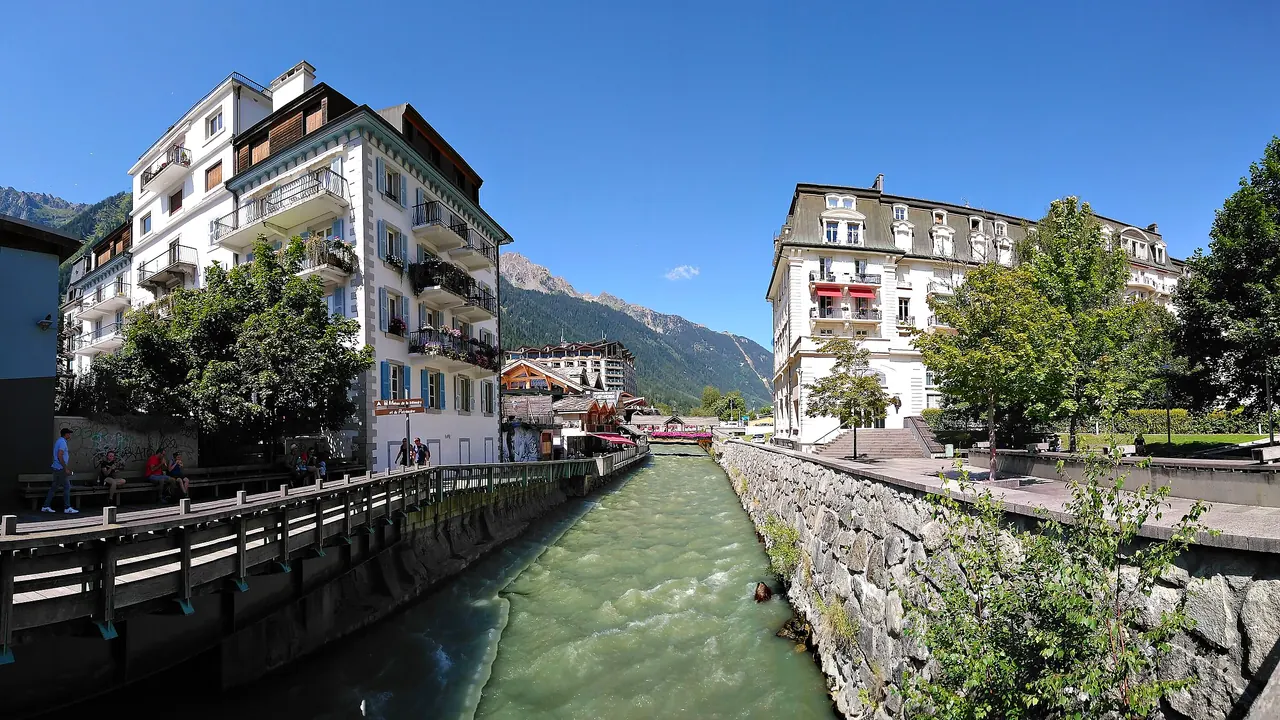
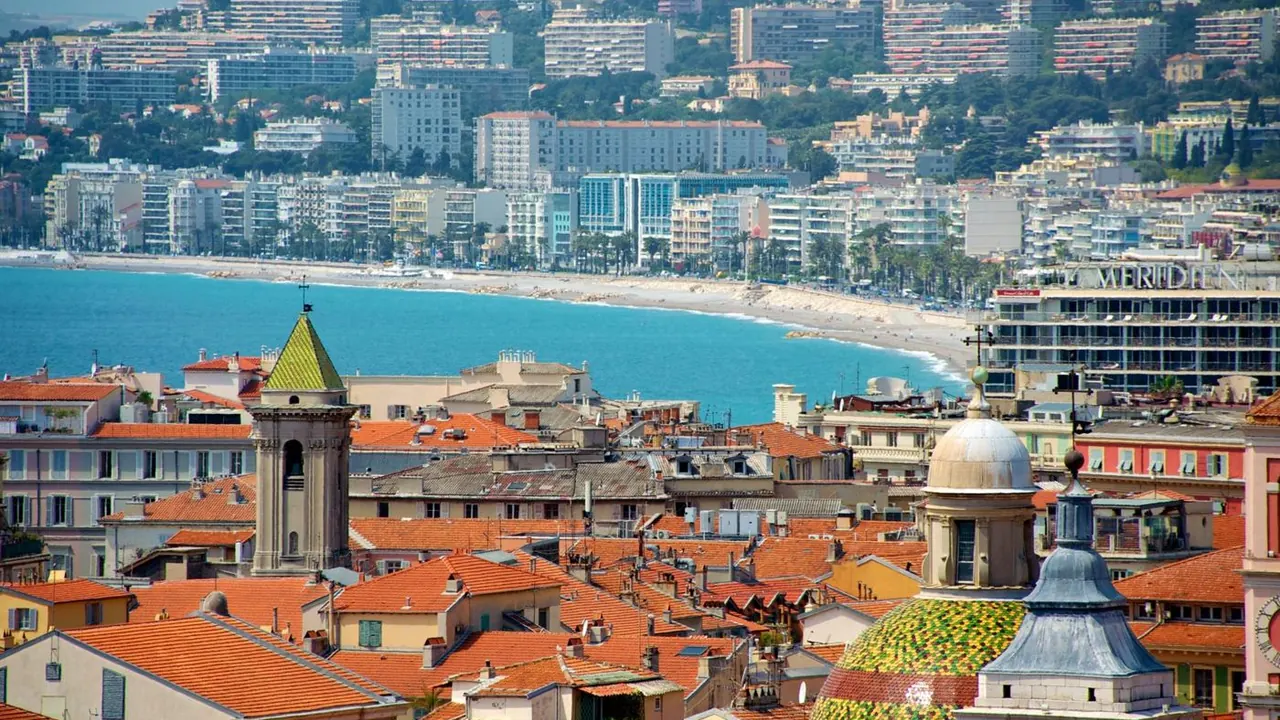
Photos: Chamonix by Tiia Monto, CC BY-SA 3.0, cropped; Nice by Daniel Stockman, CC BY-SA 2.0, cropped.
Chamonix or Nice?
Our verdict in twelve categories, each scored against the same fixed benchmark cities, and the climate month by month, so you can choose for your trip.
Choose Chamonix for
- nature and the outdoors
- wellness
- families
Chamonix is for travellers who want the mountain itself to be the vacation. Cable cars leave from the middle of town and put you among glaciers and granite spires within minutes. Trails, climbing routes and ski runs start on the doorstep, and the day ends in a hot outdoor pool looking up at the ice. In return you accept a small, expensive resort with little in the way of museums, theatre or varied cooking.
Choose Nice for
- beaches
- culture and sights
- live music and the arts
Pick Nice if you want a real city with the sea in front of it. You can swim below the promenade, see the Matisse and Chagall museums in Cimiez, eat socca in the old town and take the coastal train to a different Riviera town each day. It costs less than Chamonix and still has hills and coastal paths close by. What it lacks is the high-mountain drama.
Scoreboard
Twelve categories on one fixed scale from 0 to 100. The shaded stretch is the gap between the two.
Your match
Pick a travel style or drag the sliders, and both match scores follow your weighting.
Wins on nature and the outdoors and wellness with your weighting.
Wins on beaches and culture and sights with your weighting.
What matters to you?
Category by category
What the scores mean for a trip.
Beaches & swimming
These two are far apart on swimming. Chamonix is a high valley with no sea. The best it offers is Lac de Passy, with its grassy shore and view of Mont Blanc, or a drive of a little over an hour to Lake Annecy, and both are only warm enough in July and August.
Nice has a 7km pebble shore right in the city and clear water from June into October. Loungers and water shoes help on the stones. If you want sand, the bays at Villefranche and Beaulieu or the beaches at Juan-les-Pins are an easy trip away.
Food & drink
Chamonix eats like the mountain resort it is: fondue, raclette and tartiflette made with Reblochon and Beaufort, often on a refuge terrace facing a glacier. It is satisfying after a day in the hills, but the menus repeat and many places close between seasons.
Nice gives you more to explore. Socca hot from the oven in the old town, pissaladière, stuffed vegetables and the Cours Saleya market make for a cuisine with real local character. Bellet wine from the hills above the city is a find you will rarely see elsewhere. Avoid the promenade terraces and eating well is easy.
Culture & sights
Chamonix's heritage is the story of alpinism: the 1786 ascent of Mont Blanc, the 1924 Winter Olympics, the Musée Alpin and the climbers' cemetery. It is moving if mountains matter to you, but half a day covers it.
Nice has far more to see. Matisse's museum stands among the Roman ruins of Cimiez, Chagall's biblical cycle hangs nearby, and MAMAC covers Yves Klein and the Nouveau Réalistes. Add the ochre lanes of Vieux Nice and the onion domes of the Russian cathedral, and there are two or three full days of sightseeing.
Nightlife
Neither is a clubbing destination, and Nice has the wider choice. Chamonix's nights are après-ski first: a loud, young, largely English-speaking crowd of seasonal workers and guides in the pubs along one old-town lane, mostly in winter, with a lot shut in the shoulder seasons.
Nice spreads its evenings across the wine and cocktail bars of Vieux Nice, a few more grown-up places at the port and summer beach clubs. The crowd is a broader mix of students, locals and visitors. Dinner and drinks are the usual night out, and Monaco or Cannes are where you go for anything glossier.
Nature & outdoors
Nice has an outdoor range most seaside cities would envy: the coastal paths of Cap Ferrat, cycling on the corniches, the Esterel's red rocks, and the Mercantour about two hours inland. But Chamonix is one of the great mountain bases on earth.
From the Chamonix valley floor the Mont Blanc massif rises almost 4km, and cable cars lift you to 3,842m on the Aiguille du Midi without a single step of climbing. The Vallée Blanche, Lac Blanc, the Grand Balcon trails and the oldest guiding company in the world are all right there. Nice can offer a morning on the ski slopes and an afternoon by the sea, while Chamonix offers high-mountain terrain in every season.
Day trips
Chamonix's outings depend on three borders. Courmayeur and Roman Aosta lie through the tunnel, the Mont Blanc Express runs to Martigny in Switzerland, and Annecy and Geneva are a little over an hour by road. Beyond those, mountain roads mostly lead to other resorts.
Nice is the better base by some distance. Monaco, Èze, Villefranche, Menton, Antibes, Cannes, Grasse and Saint-Paul-de-Vence are almost all under an hour away by train or bus, and Sanremo is just over the Italian border. You could fill a week without hiring a car and without repeating yourself.
Good for families
Both work for families, in quite different ways. Chamonix suits active children: ski schools and sledging in winter, and in summer the luge, treetop courses, the ibex and marmots of the Merlet park and the little red train to the Mer de Glace. The highest cable cars are a poor idea for toddlers, though, and wet days are hard to fill.
Nice is a city break with a beach for children. There are playgrounds and water jets along the Promenade du Paillon, Parc Phoenix, a flat promenade for pushchairs, and Monaco's aquarium close by. Its weak spots are the pebbles under small feet and the strong summer heat.
Getting around
Both are easy to manage without a car. Chamonix's buses and train serve one long valley, and they are free with the guest card. The trade-off is crowded ski buses in winter and thin evening services.
Nice's trams run straight from the airport to the centre and the port, and regional trains serve a whole coastline, so the network takes you much further. Summer crowds on coastal trains are the main nuisance.
Shopping & style
Chamonix's shops have one real strength: technical climbing, ski and outdoor gear, some from family firms going back generations. Serious mountaineers plan purchases around a visit. Otherwise it is cheese, génépi, rock crystals and souvenirs.
Nice offers more general browsing. There is Galeries Lafayette and the chains on avenue Jean Médecin, luxury houses around rue Paradis, Provençal soaps and olive oil in the old town, and the Monday antiques market on the Cours Saleya. It is pleasant rather than a destination in itself.
Affordability
Neither is cheap, but Chamonix is the harder place to keep within a budget. Lift passes, the big cable cars, guides and paragliding all add up fast, and peak-season chalets are expensive. Free valley transport and picnic lunches on the trails soften it.
Nice's costs centre on seafront hotels and private beach loungers in summer. Cheap trams and coastal trains make day trips inexpensive, the city's museums cost little to enter, and socca and market food keep meals modest.
Live music & performing arts
Each town has a jazz festival, and that is where the similarity ends. Chamonix's festival puts some sets high in the mountains in summer, but outside that there are only church concerts and mountain film evenings.
Nice has a full season. The red-and-gold Opéra stages opera, ballet and the Nice Philharmonic, the Théâtre National puts on drama, and the February Carnival with its flower battles is a long tradition. Its July jazz festival is one of Europe's oldest.
Wellness & relaxation
Chamonix does recovery better. Its large day spa on the Italian thermal model has hot outdoor pools facing the glaciers, many chalets have their own saunas, and Saint-Gervais has warm springs in a wooded gorge down the valley. The town itself is early-rising and busy, so the calm comes from soaking rather than from the setting.
Nice has no bathing tradition, and spa time means hotel treatment rooms or thalassotherapy centres along the coast. Its kind of rest is softer: an early swim, a long lunch and a stroll along the bay, which works best outside the hot, crowded summer.
When should you go?
Pick your month. The climate figures are measured averages, not a forecast.
Chamonix in July
Nice in July
Daytime high, °C
Rainfall in the month, mm
Where the figures come from
Chamonix's temperatures are measured 35 km from the centre, at Bourg-St-Maurice.
Chamonix has no rain gauge within 25 km of the centre, so its rainfall comes from a gridded climate dataset read at the city rather than from a gauge further away.
Temperature and rainfall are climate normals, averaged over the years shown. Chamonix: 1999-2020 (rainfall 1991-2020) normals, Bourg-St-Maurice (34.9 km from centre). Nice: 1991-2020 normals, Nice (8 km from centre).
Chamonix has two seasons. Summer runs from June to September, with valley highs around 27°C in July, warm enough for long hikes and the occasional lake swim. Winter is the ski season, cold in the valley and colder at altitude. There is no dry month: rain or snow falls all year, and late autumn and early winter are the wettest. Spring and autumn are cool, damp in-between times.
Nice has a classic Mediterranean year. July has barely 13mm of rain, the sun shines for long hours, and by August the sea reaches about 25°C. The catch is that 28°C afternoons in high summer make midday sightseeing heavy going. Swimming lasts from June into October. Then the autumn rains arrive, peaking at about 138mm in November. Winter stays mild at around 13°C, pleasant for walking the streets while Chamonix is deep in its ski season.
Which traveller are you?
For a beach and sun trip, Nice is the obvious choice. It has kilometres of clear sea below the promenade, sandy coves a short ride east at Villefranche and Beaulieu, and a long dry summer. In Chamonix, swimming means a mountain lake or the town pool.
On an outdoors trip, Chamonix is in a class of its own. The Aiguille du Midi and the Mer de Glace railway leave from town, the Tour du Mont Blanc starts here, and the valley has guides, climbing, paragliding and steep skiing. Nice's hills cannot match that.
On a culture and arts trip, choose Nice. The Matisse, Chagall and MAMAC museums, the baroque lanes of Vieux Nice and an opera house fill several days. Chamonix's mountaineering heritage, told in the Musée Alpin, can be seen in a morning.
Before you go
| Measure | Chamonix | Nice |
|---|---|---|
| Official language | French | French |
| Currency | Euro (EUR) | Euro (EUR) |
| Sockets | CE230 V, 50 Hz | CE230 V, 50 Hz |
| Driving side | Right | Right |
| Time zone | UTC+1, UTC+2 in summer | UTC+1, UTC+2 in summer |
| Emergency number | 112 | 112 |
| Elevation | 995 m | 0 m |
| Main airport | Geneva International Airport (GVA)68 km from centre150 non-stop destinations | Nice-Côte d'Azur Airport (NCE)6 km from centre130 non-stop destinations |
| Public holidays this year | 11 days | 11 days |
By the numbers
| Measure | Chamonix | Nice |
|---|---|---|
| City population | 8,705 | 357,737 |
| People per km² | 75 | 4,975 |
| Museums within 10 km | 3 | 17 |
| UNESCO World Heritage sites within 50 km | 0 | 2 |
| Swim season, months above 21 °C | - | 4 months |
Where else could you go?
Every comparison below shares a destination with this one, so you can follow Chamonix or Nice somewhere new.