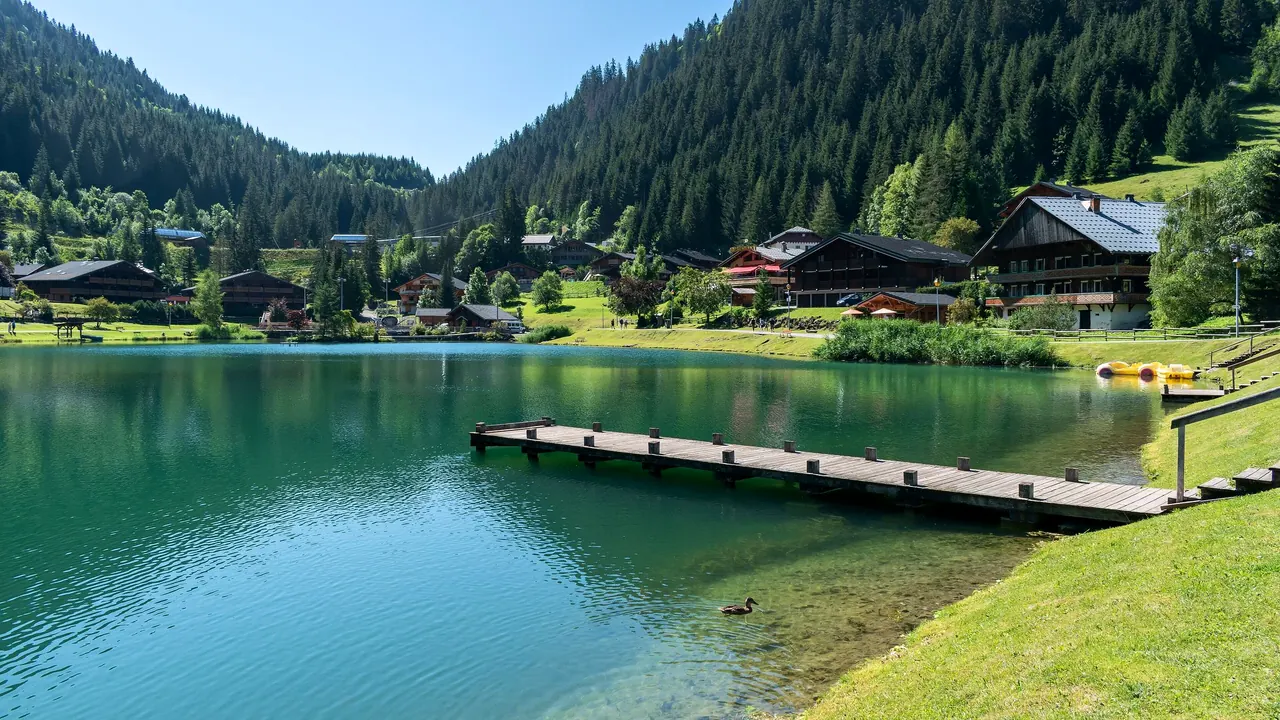
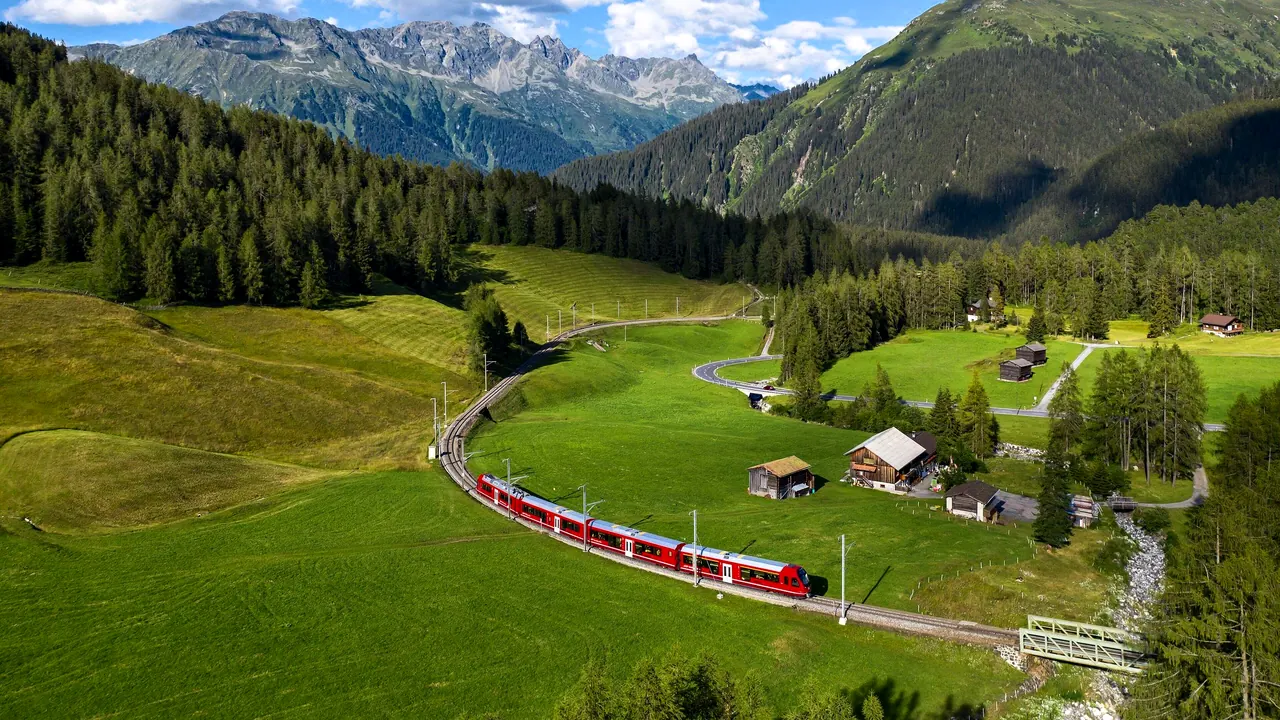
Photos: Châtel by Krzysztof Golik, CC BY-SA 4.0, cropped; Davos by Kabelleger / David Gubler, CC BY-SA 4.0, cropped.
Châtel or Davos?
Our verdict in twelve categories, each scored against the same fixed benchmark cities, and the climate month by month, so you can choose for your trip.
Choose Châtel for
- prices
- families
- beaches
Châtel suits families and anyone watching costs who still wants a big linked ski area or some of Europe's best-known mountain biking. It is easier on the wallet and has plenty organised for children. With a car it also opens up the shores of Lake Geneva, from Évian to Yvoire and across the water to Lausanne.
Choose Davos for
- getting around
- culture and sights
- wellness
Travellers who arrive by train and want the mountains without driving will find Davos the better fit. It is higher and drier in winter, with long cross-country trails and quiet valleys that end below glaciers. Its sanatoria and Kirchner's paintings give it some history, and its spa hotels suit slow days. You pay for all of it, though, and handsomely.
Scoreboard
Twelve categories on one fixed scale from 0 to 100. The shaded stretch is the gap between the two.
Your match
Pick a travel style or drag the sliders, and both match scores follow your weighting.
Too close to call, 2 points apart
Wins on prices and families with your weighting.
Wins on getting around and culture and sights with your weighting.
What matters to you?
Category by category
What the scores mean for a trip.
Beaches & swimming
Neither is a swimming destination, but Châtel has the easier route to a proper swim. Its own Lac de Vonnes is for paddleboards rather than bathing. Lake Geneva at Évian and Thonon is under an hour's drive, though, with pebbly lidos, lawns and water that reaches about 20°C in high summer.
Davos has a lido in town on the Davosersee, with a jetty and lawns, but the lake stays cool even in midsummer and the season is short. Most swimming there happens in the indoor leisure pool or a hotel pool.
Food & drink
Both serve hearty Alpine food with a narrow range, so the difference lies in the region on the plate. Châtel is Savoyard country, and its real draw is Abondance cheese bought straight from the farms and dairies of its own valley, with fondue, tartiflette and raclette in chalet restaurants.
Davos cooks from Graubünden: capuns, pizokel, barley soup and Bündnerfleisch, at their best over a long lunch on a mountain hut terrace, with Nusstorte to finish. In both places many kitchens close between seasons.
Culture & sights
Davos gives the curious visitor rather more to do off the slopes. Its past as a tuberculosis cure resort, the world of Thomas Mann's The Magic Mountain, still shows in old sanatoria like the Schatzalp. The Kirchner Museum holds the largest collection of work by the Expressionist who painted in the valley, and together they fill a day or two.
Châtel's sights are its old farmhouses, the parish church and La Vieille Douane, a small museum about customs officers and smugglers on the border road. That is an hour's interest, and for more you drive down the valley.
Nightlife
In both towns evenings revolve around après-ski and wind down quickly out of season. Davos has a little more late life: a couple of small clubs along the Promenade stay loud past midnight on busy winter weekends, though at Swiss prices. Châtel keeps a family pace, with bars by the lift bases, a few pubs open later in winter and quiet nights after dinner the rest of the year.
Nature & outdoors
Both are first-rate mountain bases, so the choice comes down to what you want to do. Châtel's strength is reach. It connects directly to the Portes du Soleil, so skiers can cross into Switzerland and back in a day, and in summer its bike park and linked trails draw serious downhill and enduro riders.
Davos is higher and more varied for walkers and cross-country skiers. It has five separate ski areas and more than 100km of cross-country trails. Its quiet Sertig and Dischma valleys end below glaciers, with marmots, chamois and ibex, and the Swiss National Park is within reach for a day.
Day trips
Châtel has the richer spread of outings, as long as you drive. Abondance Abbey is just down the valley, and Évian, Thonon and medieval Yvoire line the shore of Lake Geneva. The ferry from Évian puts Lausanne within easy reach, and Montreux and the Château de Chillon are over the pass.
Davos has fewer places within a day's reach, but the journeys are better, all by train. The Rhaetian Railway crosses the Landwasser Viaduct and follows the Albula line to St Moritz. It also runs to old Chur, and through the Vereina tunnel to painted Guarda and Scuol.
Good for families
Châtel is the better-planned choice for children. In winter there are ski schools and gentle slopes. In summer there are a zip line across the valley, pony rides, the aquatic centre, paddleboarding at Lac de Vonnes and easy bike trails, and self-catering chalets keep a family week manageable.
Davos suits families who are happiest outdoors, with the Schatzalp toboggan run, skating on the big natural rink and playgrounds at the top stations. It has less for children who aren't into sport, and the higher altitude can tire them on the first day.
Getting around
Davos is far easier without a car. Dorf and Platz each have a railway station, and guest-card buses run the length of town and out to the side valleys. The Parsenn funicular and Jakobshorn cable car leave from the town itself, so the train from Zurich is all you need.
Châtel has a walkable centre and free shuttle buses to the lifts in season, but no railway, and its hamlets are strung out along the hillsides. Beyond the village a car is close to essential, and in winter it may need chains.
Shopping & style
Neither is a place for a shopping trip, but the Promenade in Davos makes the better evening stroll past the shops. It has ski and outdoor shops, Swiss watch and jewellery stores, a few boutiques and delicatessens selling Bündnerfleisch and Nusstorte. Châtel's main street sticks to hire shops, souvenirs and a handful of chalet-style boutiques, and its best buy is Abondance cheese from the farms themselves.
Affordability
This is where the two differ most. Châtel is a French village resort, and with self-catering chalets, supermarkets and summer passes that bundle lifts and attractions, a family can keep costs in check, especially outside the school-vacation weeks.
Davos charges Swiss resort prices for everything from rooms to lunch on a hut terrace, and the World Economic Forum each January makes beds scarce and dearer still. Guest-card buses and apartments only soften the bill.
Live music & performing arts
Davos has at least one reason to plan a trip around music: its summer classical festival, which puts young musicians in churches, hotels and unusual spots around the valley, along with occasional concerts at the congress centre. Châtel has après-ski bands and village festivities. The most distinctive of these marks the cows' return from the high pastures, and for anything on a stage you go to Montreux or the lake towns.
Wellness & relaxation
Davos was built for rest. The dry, clear air that once drew tuberculosis patients still sets a slow pace on summer days and quiet winter weekdays. Most larger hotels have spas, the leisure pool has a sauna area open to day visitors, and the mineral baths of Scuol are about an hour away through the Vereina tunnel.
Châtel relaxes more simply, with spas in chalet hotels, a wellness area at the aquatic centre and the calm of cowbells and pastures outside the peak weeks. The thermal baths of Évian and Thonon are close by but make an outing of their own.
When should you go?
Pick your month. The climate figures are measured averages, not a forecast.
Châtel in July
Davos in July
Daytime high, °C
Rainfall in the month, mm
Where the figures come from
Châtel's temperatures are measured 72 km from the centre, at Bourg-St-Maurice.
Châtel's station stands 188 m below the city centre, so the centre is likely a little cooler than the figures say.
Châtel has no rain gauge within 25 km of the centre, so its rainfall comes from a gridded climate dataset read at the destination rather than from a gauge further away.
Davos's temperatures are measured 53 km from the centre, at S. Valentino Alla Muta.
Davos has no rain gauge within 25 km of the centre, so its rainfall comes from a gridded climate dataset read at the destination rather than from a gauge further away.
Temperature and rainfall are climate normals, averaged over the years shown. Châtel: 1999-2020 (rainfall 1991-2020) normals, Bourg-St-Maurice (72.3 km from centre). Davos: 1991-2020 normals, S. Valentino Alla Muta (53.4 km from centre).
Châtel is the warmer of the two all year, reaching about 27°C in July against around 20°C in Davos. Summer days in Châtel are properly warm for walking, biking and an afternoon by Lake Geneva, while Davos stays fresh enough for hiking even in high summer. Neither town ever gets too hot to be out and about.
The rain comes in different seasons. Châtel is wet all year and wettest in early winter, with about 167mm in December. September is its driest month and one of its mildest, which makes it the best time there for long walks. Davos is the other way round. Summer is its wet season, with around 140mm a month from June to August, while winter is much drier but cold, with highs near 2°C. For walking in Davos with less rain, October is the better choice. It is cool, but much drier than the summer months.
Which traveller are you?
On a trip on a tight budget, Châtel is the only realistic choice of the two. As a French village resort it lets you cook for yourself and pick quieter weeks, so the mountains stay within reach. In Davos even the basics cost more, and small savings barely dent the bill.
On a family trip with children, Châtel works for more kinds of family. It is built around children, so one who would rather not ski or hike still has plenty to do all week. Davos rewards families who already love the outdoors together, and has less to offer the rest.
For a culture and arts trip, neither town is ideal, but Davos gives a curious traveller more to think about between walks. Its past as a place of cure, the books and paintings that past inspired and its summer music festival give it a story. Châtel's history fills an afternoon.
Before you go
| Measure | Châtel | Davos |
|---|---|---|
| Official language | French | French, German, Italian, Romansh |
| Currency | Euro (EUR) | Swiss Franc (CHF) |
| Sockets | CE230 V, 50 Hz | CJ230 V, 50 Hz |
| Driving side | Right | Right |
| Time zone | UTC+1, UTC+2 in summer | UTC+1, UTC+2 in summer |
| Emergency number | 112 | 112 |
| Elevation | 1,053 m | 1,559 m |
| Main airport | Geneva International Airport (GVA)56 km from centre150 non-stop destinations | Zürich Airport (ZRH)122 km from centre226 non-stop destinations |
| Public holidays this year | 11 days | 9 days |
By the numbers
| Measure | Châtel | Davos |
|---|---|---|
| Population | 1,174 | 10,738 |
| People per km² | 36 | 38 |
| Museums within 10 km | 0 | 3 |
| UNESCO World Heritage sites within 50 km | 3 | 2 |
Where else could you go?
Every comparison below shares a destination with this one, so you can follow Châtel or Davos somewhere new.