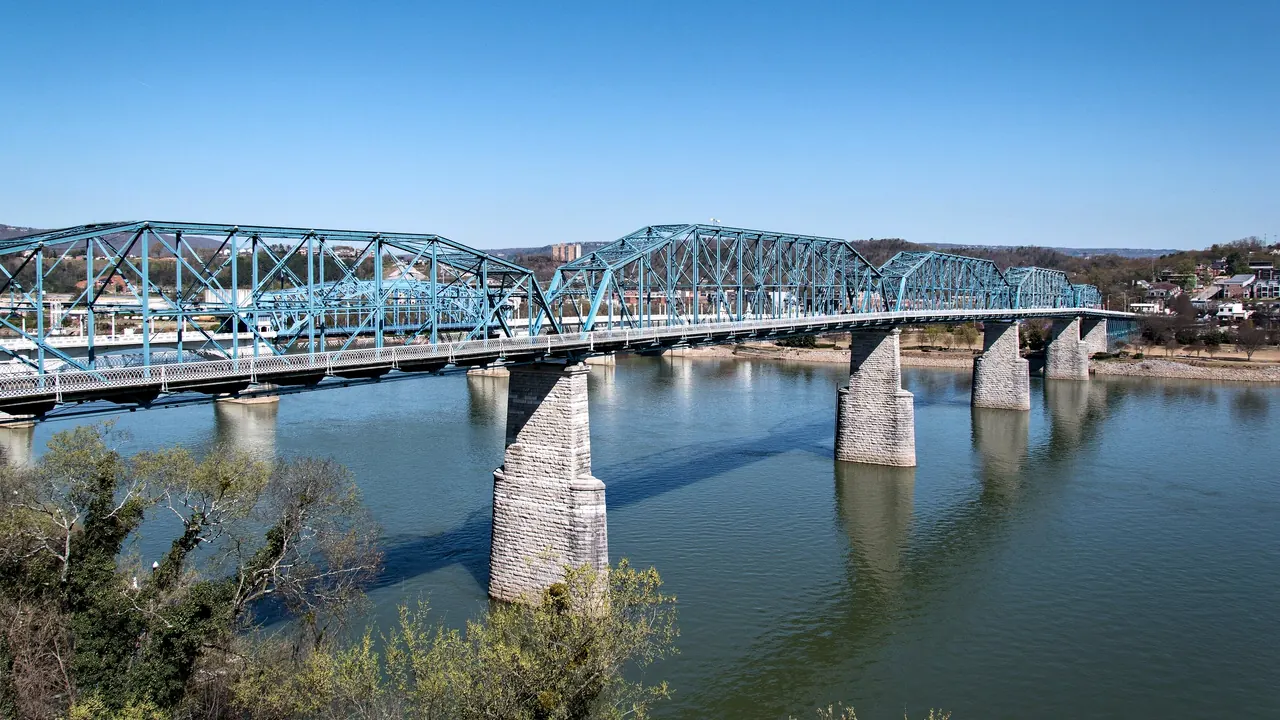

Photos: Chattanooga by Ɱ, CC BY-SA 4.0, cropped; St. Louis by Holly Cheng, CC BY 2.0, cropped.
Chattanooga or St. Louis?
Our verdict in twelve categories, each scored against the same fixed benchmark cities, and the climate month by month, so you can choose for your trip.
Choose Chattanooga for
- nature and the outdoors
- beaches
- wellness
Chattanooga is the pick if you want to spend your days outside. Lookout Mountain, the Tennessee River Gorge and the climbing bluffs begin at the edge of a small, walkable downtown, and the evenings are easy and end early. It suits active couples, climbers, paddlers and families who want the aquarium in the morning and a trail in the afternoon.
Choose St. Louis for
- live music and the arts
- culture and sights
- food and drink
St. Louis gives more to travellers who want the city itself to fill the trip. It has free museums in Forest Park, the Gateway Arch, a highly regarded symphony, musicals at the Muny on summer nights, blues bars in Soulard and dishes you won't find anywhere else. The countryside around it is gentler, so it works best as a city break built around sights, music and food rather than the outdoors.
Scoreboard
Twelve categories on one fixed scale from 0 to 100. The shaded stretch is the gap between the two.
Your match
Pick a travel style or drag the sliders, and both match scores follow your weighting.
Too close to call, 2 points apart
Wins on nature and the outdoors and beaches with your weighting.
Wins on live music and the arts and culture and sights with your weighting.
What matters to you?
Category by category
What the scores mean for a trip.
Beaches & swimming
Neither is a beach destination, but Chattanooga at least lets you swim outdoors. From June to September there are small swimming areas on Chickamauga Lake and at Harrison Bay, and creek pools on the plateau above town. St. Louis has nothing like this close by: its rivers are fast working waterways, so swimming means a pool unless you drive deep into the Ozarks.
Food & drink
St. Louis has the more distinctive and varied food. Toasted ravioli, thin pizza topped with Provel cheese and gooey butter cake are found almost nowhere else. The city also takes its ribs seriously, and you can eat in the Italian trattorias of the Hill or at the Bosnian, Vietnamese and Ethiopian places on South Grand. The Saturday Soulard Market makes a good morning out.
Chattanooga eats well within a narrower Southern range: meat-and-three, fried chicken, brisket and catfish, with craft breweries and chef-led restaurants around the Southside and Main Street. There is little international cooking and no market to browse, so food is a pleasure there rather than a reason to stay longer.
Culture & sights
St. Louis has the longer list of sights. The Gateway Arch and its museum, the Old Courthouse where the Dred Scott case began, the free Saint Louis Art Museum, the mosaics of the Cathedral Basilica and the Wainwright Building give it real weight. Whole streets of Victorian houses in Lafayette Square and Soulard are worth a walk.
Chattanooga's history is narrower and more focused: Civil War battlefields on Lookout Mountain and Missionary Ridge, the old Terminal Station, and the Hunter Museum above the river. The Walnut Street Bridge is a fine landmark, but you get through the city's sights more quickly.
Nightlife
St. Louis gives you more choice after dark, though the bars are spread across separate districts. There are blues bars and old taverns in Soulard, dance bars on Washington Avenue, the Grove for late nights and LGBTQ+ venues, and student bars on the Delmar Loop. Expect to take taxis between them.
Chattanooga keeps things smaller and closer together, with breweries, cocktail bars and patios around the Southside and the short Station Street strip. It is a good town for a few beers, but it winds down early and has almost no clubs.
Nature & outdoors
This is where Chattanooga is far ahead. The Tennessee River cuts through the Cumberland Plateau right at the edge of the city. Climbing bluffs, hang-gliding launches, mountain-bike trails and paddling in the gorge are minutes from downtown, and Ocoee whitewater and Cloudland Canyon are about an hour away.
St. Louis has plenty of green space in Forest Park and easy hiking in Castlewood and Meramec state parks. Bald eagles winter near Alton, and the Katy Trail is good for cycling. The land is rolling rather than steep, though, and nothing near St. Louis compares with Chattanooga's ridges and waterfalls.
Day trips
Both make good bases for day trips by car, but the trips are different. From Chattanooga the big outings are other cities: Nashville, Atlanta and Knoxville, all long days on the road. Closer options are the Space and Rocket Center at Huntsville and the Chickamauga battlefield.
St. Louis has shorter trips with more early history. The UNESCO-listed Cahokia Mounds are just across the river, Ste. Genevieve keeps its French colonial houses, and the German wine towns of Augusta and Hermann sit on the Missouri. Further out are Mark Twain's Hannibal and Lincoln's Springfield.
Good for families
Both are easy, friendly places to bring children; the difference is in the kind of day you have. In Chattanooga it centres on the Tennessee Aquarium and the classic Lookout Mountain trio of the Incline Railway, Ruby Falls and Rock City. Children can cool off at the carousel and fountains in Coolidge Park.
St. Louis is more about climbing, playing and free entry. There is the climbable maze of the City Museum, the free zoo and Science Center in Forest Park, the Magic House and the tram pods up the Arch. In both cities, summer heat and the driving between sights need some planning.
Getting around
Neither city works well without a car, but each has one useful way to get about. Chattanooga's compact downtown, free electric shuttle and the Walnut Street Bridge make the riverfront, Southside and North Shore easy on foot. The mountain attractions and trails need a car.
St. Louis has the MetroLink light rail, which links the airport, Forest Park, downtown and Clayton. Its neighbourhoods are far apart, though, so you need to drive to Soulard, the Hill and South Grand. At least parking is easy and the roads are clear.
Shopping & style
Neither city is worth a trip for shopping, and both are best for browsing small independent shops. Chattanooga's speciality is outdoor gear, with boutiques and galleries along Frazier Avenue and more shops in the converted Warehouse Row. St. Louis has a little more variety: vintage and record shops on Cherokee Street, the student shops of the Loop, boutiques in the Central West End and the stalls of the Soulard Market, with big brands out in suburban malls.
Affordability
In Chattanooga, the things you can do for free are mostly outdoors: the trails, the riverfront walks and the downtown shuttle cost nothing. The aquarium and the Lookout Mountain attractions charge full admission, though, and that adds up quickly for a family.
St. Louis lets you into its zoo, art museum, history museum and science centre in Forest Park for free, and its hotels cost less than those in the big coastal cities. In both cities a hire car, sales tax and tipping add to every day, so neither suits a tight budget.
Live music & performing arts
St. Louis is far ahead for music and theatre. The Saint Louis Symphony plays in Powell Hall, the Fabulous Fox hosts Broadway tours, the open-air Muny stages musicals in summer and the Opera Theatre runs an early-summer festival. Its blues heritage, from Chuck Berry to the National Blues Museum, carries on in bars in Soulard and downtown.
Chattanooga has the gilded Tivoli Theatre, a small symphony and opera company, and bands playing bluegrass and Americana in Southside bars. That is enough for an evening or two, and people who travel for music usually make a separate trip to Nashville.
Wellness & relaxation
Chattanooga's slower pace is the real difference. It is a small, quiet city, and an afternoon on the riverfront or on a porch in Bluff View is as unhurried as a bigger city ever gets.
St. Louis finds its calm in green spaces instead: a slow morning in Forest Park or among the Japanese gardens of the Missouri Botanical Garden. Spas in both cities are limited to hotels and day spas, with no bathing tradition behind them, so neither is the place for a restorative vacation.
When should you go?
Pick your month. The climate figures are measured averages, not a forecast.
Chattanooga in July
St. Louis in July
Daytime high, °C
Rainfall in the month, mm
Temperature and rainfall are climate normals, averaged over the years shown. Chattanooga: 1991-2020 (sunshine 1981-2010) normals, Lovell Field (6.3 km from centre). St. Louis: 2006-2020 (sunshine 1981-2010, rainfall 1991-2020) normals, Cahokia / Maplewood Park (7.2 km from centre).
Both cities have a long, sticky summer, with highs around 32°C in July and August, which makes midday sightseeing and hiking hard work. Spring and autumn are the seasons to aim for in both. April, May, late September and October bring warm days that suit walking the streets and the trails. Chattanooga's late spring is especially bright, with close to 300 hours of sun in May and June.
The real difference is winter and rain. Chattanooga stays milder, with January highs near 11°C against about 5°C in St. Louis, but it is wet all year, with more than 120mm in most winter months. St. Louis is drier from December to February and has its wettest stretch from April to June. A winter trip there is colder but less soggy, and spring visitors should pack an umbrella.
Which traveller are you?
On an outdoors trip, Chattanooga is the clear choice. Climbing on sandstone bluffs, hang gliding off Lookout Mountain, paddling the Tennessee River Gorge and Ocoee whitewater are all within an hour. St. Louis offers gentler Ozark foothills and the Katy Trail.
For a culture and arts trip, St. Louis gives you far more. The Gateway Arch, the free art and history museums in Forest Park, a highly regarded symphony and summer musicals at the Muny fill several days. Chattanooga's Civil War sites and Hunter Museum fill about two.
On a food and nightlife trip, St. Louis wins again. Toasted ravioli, ribs, Bosnian grills on South Grand and the Italian trattorias of the Hill make eating more interesting. Its blues bars in Soulard and late nights in the Grove also outlast Chattanooga's quiet brewery evenings.
Before you go
| Measure | Chattanooga | St. Louis |
|---|---|---|
| Currency | US Dollar (USD) | US Dollar (USD) |
| Sockets | AB120 V, 60 Hz | AB120 V, 60 Hz |
| Driving side | Right | Right |
| Time zone | UTC-5, UTC-4 in summer | UTC-6, UTC-5 in summer |
| Emergency number | 911 | 911 |
| Elevation | 206 m | 149 m |
| Main airport | Chattanooga Metropolitan Airport (Lovell Field) (CHA)6 km from centre15 non-stop destinations | St. Louis Lambert International Airport (STL)20 km from centre64 non-stop destinations |
| Public holidays this year | 13 days | 14 days |
By the numbers
| Measure | Chattanooga | St. Louis |
|---|---|---|
| City population | 181,099 | 301,578 |
| People per km² | 484 | 1,764 |
| Museums within 10 km | 7 | 18 |
| UNESCO World Heritage sites within 50 km | 0 | 1 |
Where else could you go?
Every comparison below shares a destination with this one, so you can follow Chattanooga or St. Louis somewhere new.
- Atlantavs Chattanooga
- Pigeon Forgevs Chattanooga
- Gatlinburgvs Chattanooga
- Nashvillevs Chattanooga
- Ashevillevs Chattanooga
- Bransonvs St. Louis