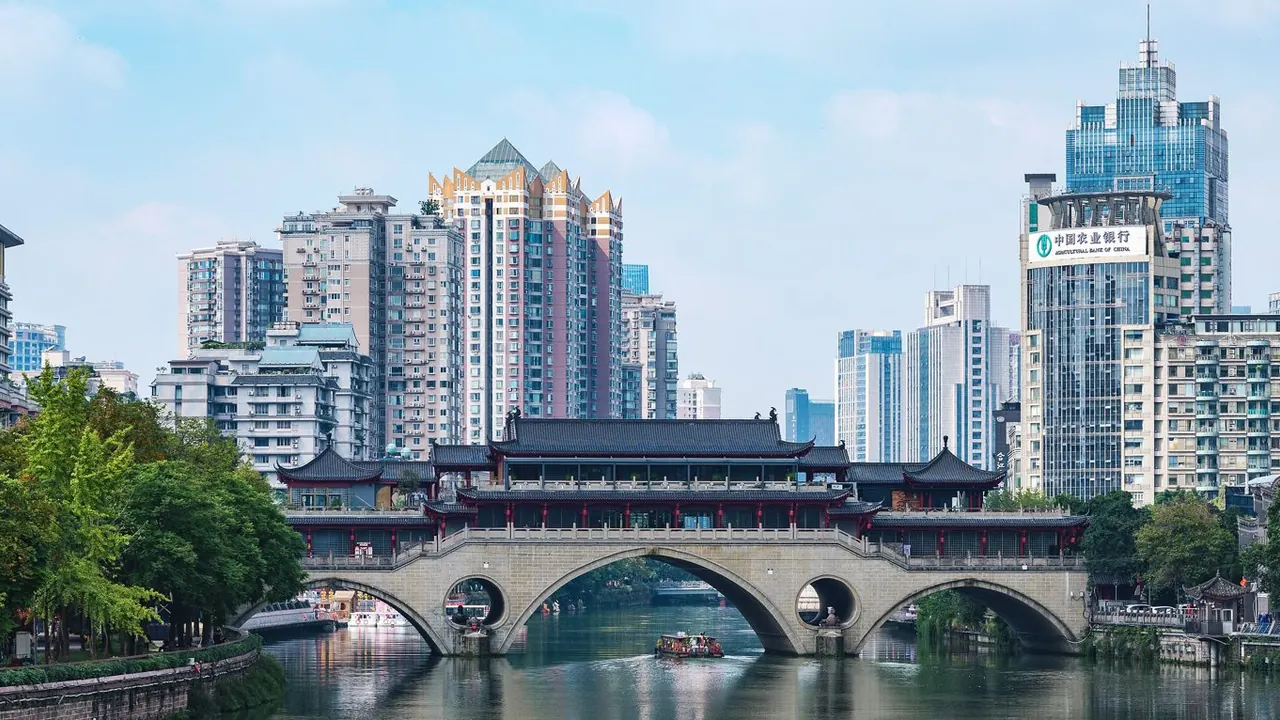
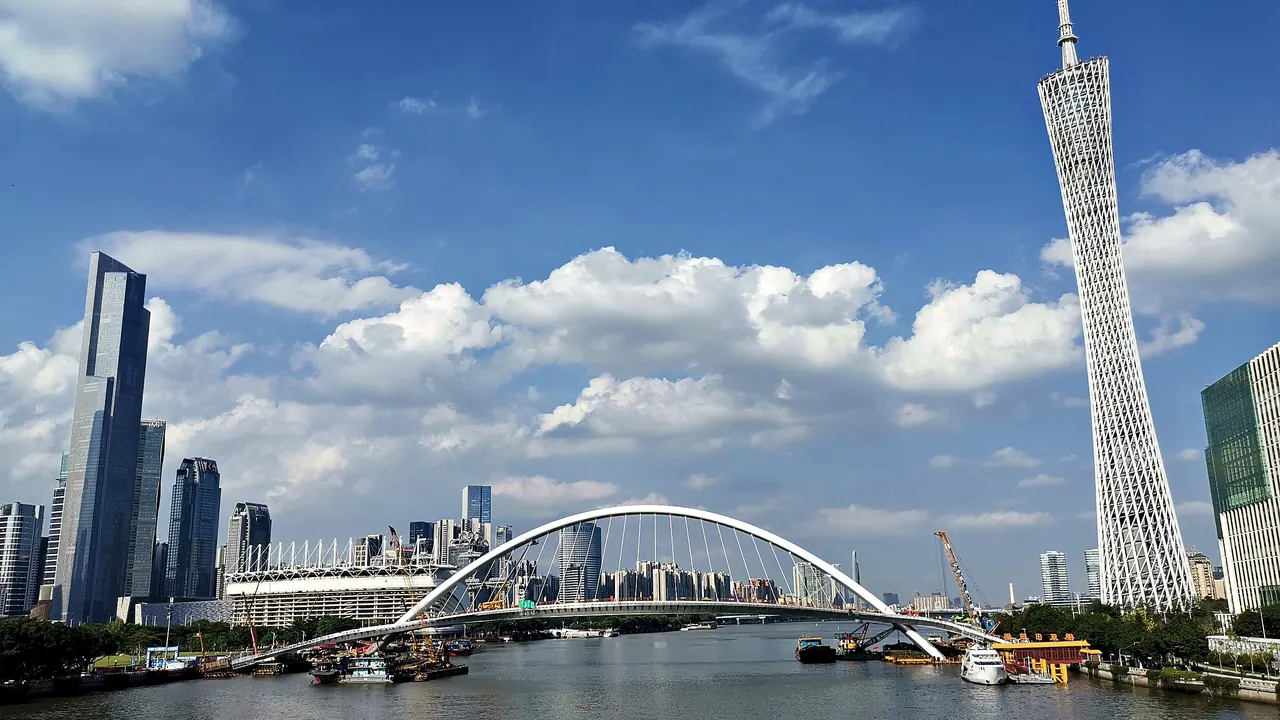
Photos: Chengdu by TurnOnTheNight, CC BY-SA 4.0, cropped; Guangzhou by Cwek, CC BY-SA 4.0, cropped.
Chengdu or Guangzhou?
Our verdict in twelve categories, each scored against the same fixed benchmark cities, and the climate month by month, so you can choose for your trip.
Choose Chengdu for
- nature and the outdoors
- nightlife
- prices
Chengdu suits the traveller who wants the mountains as much as the city. Qingcheng's Taoist trails, the cloud forest of Emeishan and the panda country towards Wolong all lie within reach, and evenings run long over hotpot before the bar streets by the Jin River. Your money also goes a little further here. It is the better pick for adults who like their food fiery, their nights sociable and their days out among temples, carved Buddhas and old market towns.
Choose Guangzhou for
- families
- beaches
- getting around
Families and anyone who can't take chilli will find Guangzhou the easier choice. The Chimelong resort gives children several days of safari, rides and water park, and Cantonese cooking aims at fresh, clean flavour, which young eaters can manage. Its other strong card is position: Hong Kong and Macau are close enough for a day each, so one trip covers three very different places.
Scoreboard
Twelve categories on one fixed scale from 0 to 100. The shaded stretch is the gap between the two.
Your match
Pick a travel style or drag the sliders, and both match scores follow your weighting.
Wins on nature and the outdoors and nightlife with your weighting.
Wins on families and beaches with your weighting.
What matters to you?
Category by category
What the scores mean for a trip.
Beaches & swimming
Neither city works for a beach trip, and in both the swimming is in hotel pools or summer water parks. Chengdu lies deep inside the Sichuan Basin, so the sea has to be a separate leg of the journey. Guangzhou's own estuary shore is muddy and industrial, but the sandy beaches east of Shenzhen are about two hours away, which makes a seaside day possible, if long.
Food & drink
Both cities are worth the trip for the food alone, but the two cuisines pull in opposite directions. Chengdu cooks with the numbing tingle of Sichuan pepper and layers of chilli: mapo tofu, dan dan noodles, cold dishes in red oil and beef-tallow hotpot late into the night. There are milder dishes too, but the heat is the point.
Guangzhou's cooking is about freshness. The day starts with dim sum and pu'er in big tea halls, seafood is picked live and cooked to order, and roast goose and clay-pot rice fill the old Xiguan streets. If spice is a problem for you, Guangzhou is the safer table, and its high-end Cantonese dining in Tianhe goes further than anything formal in Chengdu.
Culture & sights
Neither city has an intact old town, and both reward a few days of travelling between separate sights. Chengdu's are about ancient Shu and classical China: the Jinsha gold and jade, the Wuhou Shrine to Zhuge Liang, Du Fu's garden memorial and two working temples. Its old-style lanes, Kuanzhai Xiangzi and Jinli, are reconstructions.
Guangzhou's history is that of a southern trading port, and more of its old fabric survives. The Chen Clan Ancestral Hall is covered in Lingnan carving, the Nanyue King's tomb holds its jade burial suit, and Shamian Island keeps its colonial villas under the banyans. The arcaded shophouses of Xiguan still show the merchant city.
Nightlife
Chengdu is the better city for a night out as a visitor. Dinner turns into drinks at the neon bar streets around Jiuyanqiao on the Jin River, or at the quieter cocktail and craft-beer places in Yulin, and the snack streets stay open past midnight. The mood is relaxed and easy to join.
Guangzhou's nights are just as long but harder for an outsider to get into. The clubs in Tianhe sell bottle service to groups, karaoke happens in private rooms, and the best local custom, the siu yeh seafood supper at plastic tables, is great fun but closer to a late meal than a night out.
Nature & outdoors
Chengdu has much the better scenery nearby. The city is flat, but forested Qingcheng Mountain is about an hour west, Emeishan offers a full climb through cloud forest past wild monkeys, and the bamboo slopes of the Wolong panda reserves lead on towards the Tibetan plateau.
Guangzhou's green spaces are pleasant rather than dramatic. Baiyun Mountain's low hills sit on the city's edge, and the Dinghu reserve and the Conghua valleys offer waterfalls and subtropical forest. Spring and autumn are the times to hike near Chengdu, while in Guangzhou walking is best from autumn into early winter.
Day trips
Both cities make strong bases, but they lead to different kinds of day. From Chengdu you go back in time: the Leshan Giant Buddha in its cliff, the two-thousand-year-old Dujiangyan waterworks, the bronze masks of Sanxingdui and wooden market towns such as Pingle. Chongqing is there for a taste of a hillside megacity.
From Guangzhou you go across borders. Hong Kong and Macau are each a comfortable day, as long as your visa lets you back into mainland China. Closer to home are Foshan's kung fu and opera heritage, Shunde's cooking, Zhaoqing's limestone crags and the diaolou watchtowers of Kaiping.
Good for families
Guangzhou has more to keep children busy. The Chimelong complex in Panyu combines a drive-through safari park with pandas and koalas, a theme park, a water park and a circus, and there are also a science centre and evening river boats. The metro has lifts throughout.
Chengdu's great draw is the Panda Base, best on an early morning visit. Beyond it there are the zoo, an aquarium park and the city parks. Both cities have hot summers and few English signs, but in Chengdu every meal also has to be ordered with less chilli.
Getting around
Getting around is easy in both, with clean metros signed in English that reach the airports and fast-train stations, and in both you need a mobile payment app set up before you arrive. Chengdu's streets are flat, so shared bikes are a real option, and the area around Tianfu Square and Chunxi Road is pleasant on foot.
Guangzhou's network is larger, and river ferries add a pleasant way to cross the city. Distances are longer, though, with forty-minute rides between districts common, and the wide roads make walking unappealing outside Xiguan and Yuexiu.
Shopping & style
Chengdu is the place for fashion malls and regional crafts, Guangzhou for wholesale markets. In Chengdu the big malls on Chunxi Road and the traditional-style quarter beside the Daci Temple draw a style-conscious local crowd. The things worth carrying home are Shu brocade, Sichuan embroidery, chilli bean paste and green teas from the mountains, bought in the tea markets on the city's edge.
Guangzhou's most memorable shopping is in its trading districts, where whole streets deal in clothing, leather, fabric or electronics and many stalls will still sell a single piece. Tea lovers can spend hours tasting pu'er and oolong in Fangcun, and the Hualin jade street runs through the old western quarter. Neither city has much to offer in independent design.
Affordability
Both are cheap compared with Western capitals, but your money goes a bit further in Chengdu. Good hotels cost less there, a counter meal costs very little, and most temples charge little or nothing. Train fares to Leshan and the other big sights are the main extra cost.
Guangzhou's street food and metro are just as easy on the wallet. Hotel rates, though, jump during the big spring and autumn trade fairs, so check the fair dates before you book.
Live music & performing arts
The two are much alike here, each with its own opera tradition. Chengdu's Sichuan opera is put on nightly as a variety show with face-changing and fire-spitting, easy to enjoy without understanding a word. The city's livehouses, home to indie bands and Sichuan-dialect hip-hop, give it the livelier small-venue scene.
Guangzhou has the stronger formal stages: the sculpted Opera House on the river and the Xinghai Concert Hall, home to the symphony orchestra. Cantonese opera here is played for Chinese-speaking audiences in neighbourhood halls, which makes it more authentic but harder for a visitor to follow.
Wellness & relaxation
Chengdu's way of resting is to spend a whole afternoon in a teahouse. In People's Park and the temple gardens you sit in a bamboo chair while your cup keeps being refilled, watch the mahjong games and perhaps have your ears cleaned by a roving specialist. The city's unhurried reputation is real, but you find it in these pockets rather than out on the busy streets.
Guangzhou slows down earlier in the day, as older locals linger over morning tea and newspapers in the parks, and its massage parlours stay open late into the evening. Both cities have hot-spring resorts outside town: Chengdu's are on the outskirts and in the hills towards Qingcheng, and Guangzhou's are at Conghua, about an hour north, where mineral pools in wooded hills make a good overnight stay in the cooler months.
When should you go?
Pick your month. The climate figures are measured averages, not a forecast.
Chengdu in July
Guangzhou in July
Daytime high, °C
Rainfall in the month, mm
Temperature and rainfall are climate normals, averaged over the years shown. Chengdu: 1991-2020 normals, Chengdu (4.5 km from centre). Guangzhou: 1991-2020 normals, Guangzhou (8.5 km from centre).
Chengdu has a real winter, grey and cool, with January highs around 10°C and very little sun. Summer is hot, muggy and wet, and August brings about 211mm of rain. The best months for walking the city and hiking the nearby mountains are April and May, then late September and October. Even then the sky is often hazy, because the basin sees little sunshine at any time of year.
Guangzhou is subtropical. Winter stays mild, with highs near 19°C in January, and spring turns into a long, heavy rainy season. June is the wettest month, at about 357mm. From July the heat stays in the low thirties, which makes walking any distance hard work. October to December is the best season by a wide margin, with dry, sunny days and comfortable warmth. Neither city is a beach destination in any month.
Which traveller are you?
For a food and nightlife trip, Chengdu has the edge. The two kitchens are equally good, but a Chengdu evening flows naturally from a long hotpot dinner to the bars along the Jin River. Guangzhou's nights out are aimed more at local groups.
On an outdoors trip, choose Chengdu. Qingcheng Mountain is about an hour away and Emeishan rises above 3,000m through cloud forest. Guangzhou's Baiyun hills and the Dinghu reserve are green and pleasant but much gentler.
On a family trip with children, Guangzhou is the easier city. Chimelong's drive-through safari park, theme park and water park can fill several days, the metro copes well with buggies, and Cantonese food is mild, while Chengdu's is spicy by default.
Before you go
| Measure | Chengdu | Guangzhou |
|---|---|---|
| Official language | Putonghua | Putonghua |
| Currency | Yuan Renminbi (CNY) | Yuan Renminbi (CNY) |
| Sockets | ACI220 V, 50 Hz | ACI220 V, 50 Hz |
| Driving side | Right | Right |
| Time zone | UTC+8 | UTC+8 |
| Emergency number | Police 110, ambulance 120, fire 119 | Police 110, ambulance 120, fire 119 |
| Elevation | 500 m | 21 m |
| Main airport | Chengdu Shuangliu International Airport (CTU)16 km from centre77 non-stop destinations | Guangzhou Baiyun International Airport (CAN)29 km from centre195 non-stop destinations |
| Public holidays this year | 6 days | 6 days |
By the numbers
| Measure | Chengdu | Guangzhou |
|---|---|---|
| City population | 20,937,757 | 18,676,605 |
| People per km² | 1,456 | 2,576 |
| Museums within 10 km | 10 | 21 |
| UNESCO World Heritage sites within 50 km | 0 | 0 |
Where else could you go?
Every comparison below shares a destination with this one, so you can follow Chengdu or Guangzhou somewhere new.
- Shenzhenvs Guangzhou
- Macauvs Guangzhou
- Hong Kongvs Guangzhou
- Chongqingvs Chengdu
- Yangshuovs Guangzhou
- Guilinvs Guangzhou