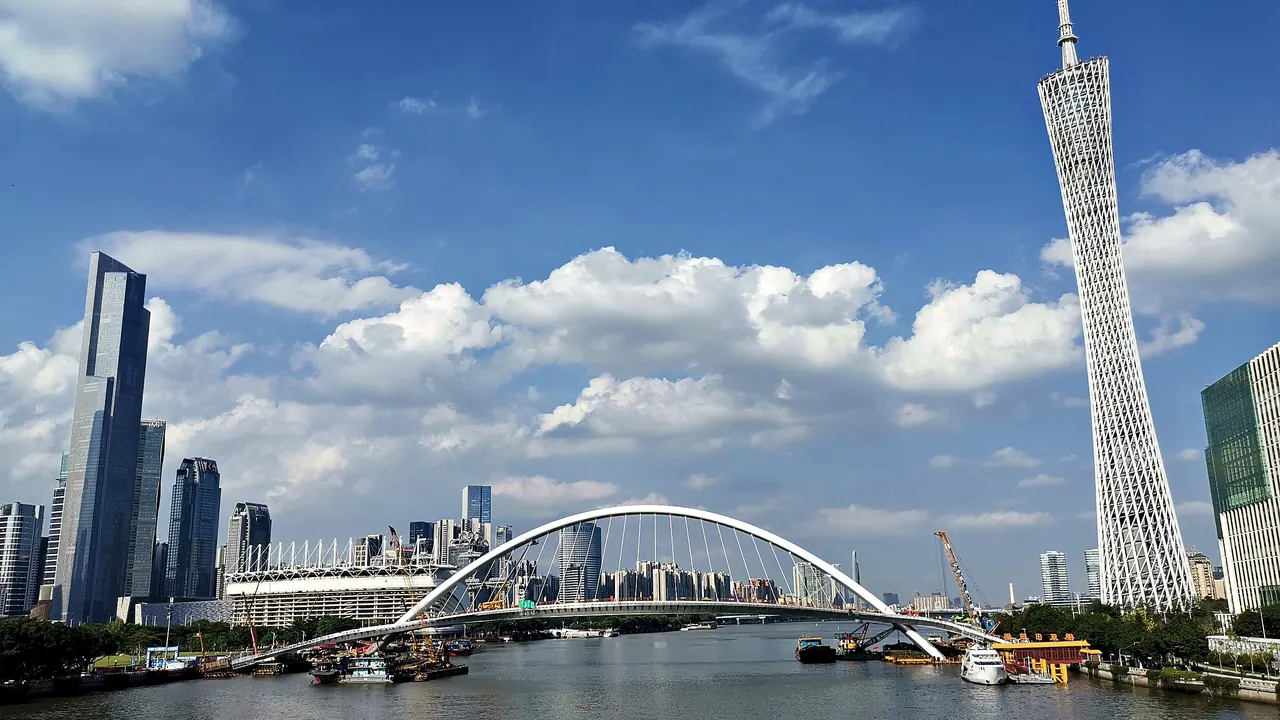
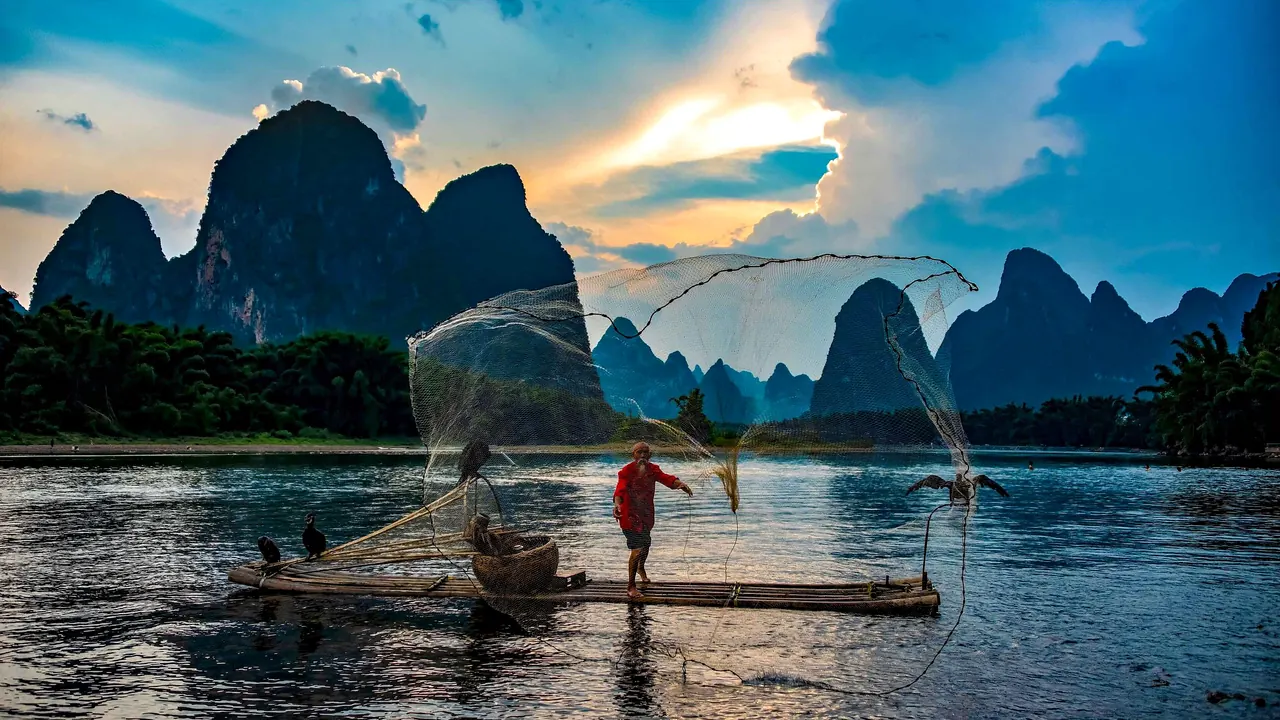
Photos: Guangzhou by Cwek, CC BY-SA 4.0, cropped; Yangshuo by Rod Waddington from Kergunyah, Australia, CC BY-SA 2.0, cropped.
Guangzhou or Yangshuo?
Our verdict in twelve categories, each scored against the same fixed benchmark cities, and the climate month by month, so you can choose for your trip.
Choose Guangzhou for
- food and drink
- getting around
- shopping
Guangzhou suits travellers who plan their days around eating. It is the home of Cantonese cooking, with morning dim sum halls, roast meat shops and late supper stalls, and a large metro links the temples, museums and wholesale markets. Fast trains run on to Hong Kong and Macau. It makes a rewarding city break with real depth, and the Chimelong parks make it the easier choice with children.
Choose Yangshuo for
- nature and the outdoors
- prices
- beaches
If the landscape matters more than the menu, pick Yangshuo. Karst peaks rise at the edge of town, so the days go on rafting the Yulong, cycling between villages, walking beside the Li or climbing limestone, and day-to-day costs are low. You will need a bike or a driver, and there is little in the way of museums, cooking or shopping. That rarely bothers people who came to be outside.
Scoreboard
Twelve categories on one fixed scale from 0 to 100. The shaded stretch is the gap between the two.
Your match
Pick a travel style or drag the sliders, and both match scores follow your weighting.
Wins on food and drink and getting around with your weighting.
Wins on nature and the outdoors and prices with your weighting.
What matters to you?
Category by category
What the scores mean for a trip.
Beaches & swimming
Neither city is a beach destination. Guangzhou's estuary shore is muddy and industrial, so swimming there means a hotel pool, a water park, or a trip of about two hours to the sands east of Shenzhen.
Yangshuo has no sea either, but it does have river swimming. In summer people get in from the gravel banks of the Yulong and in calm stretches of the Li after a day on a raft or a bike. That is a pleasant extra, not proper beach time.
Food & drink
Guangzhou is one of China's great food cities, and Yangshuo cannot compete. There is morning tea in the big dim sum halls, roast goose and char siu in the small shops of Xiguan and Liwan, live seafood cooked to order and congee long after midnight. You could eat for a week without repeating yourself, and the refined Cantonese restaurants of Tianhe sit at the top.
Yangshuo has a handful of dishes worth trying: beer fish, stuffed snails and tofu, and Guilin rice noodles for breakfast. They are best in the side streets and riverside villages rather than on West Street. Beyond those the choice is narrow, and there is no fine dining.
Culture & sights
Guangzhou has the sights. They include the densely carved Chen Clan Ancestral Hall, the Nanyue King's tomb with its jade burial suit, some of southern China's oldest Buddhist temples, the colonial villas of Shamian Island and the Guangdong Museum. They are spread across the city, but two or three days on the metro reward anyone interested in history.
Yangshuo's town is mostly rebuilt and has no significant museums. Its heritage is small in scale, such as the brick villages along the Yulong and the Ming-era Dragon Bridge, and it is best seen in passing on a bike ride.
Nightlife
Guangzhou offers the wider night out. It has clubs along the river, cocktail and craft beer bars in Tianhe and Zhujiang New Town, karaoke everywhere, and siu yeh, the late supper of seafood and beer at plastic tables. Much of it is geared to local groups, but there is far more choice.
Yangshuo has one main event, West Street. There, bars with open fronts, stage dancers and loud music draw crowds of domestic tourists until well past midnight. Step away from it and the villages are silent, which many visitors prefer.
Nature & outdoors
Guangzhou's green spaces are pleasant but modest. There are the forested low hills of Baiyun Mountain on the northern edge, the river promenades and Haizhu wetland. Conghua's forest streams and the waterfalls of Dinghu Mountain lie an hour or more out. They give you a break from the city, not a reason to travel.
In Yangshuo the landscape is the whole point. Karst peaks rise from rice fields and bamboo at the edge of town, so a bike ride along the Yulong lanes starts almost at your door. The Li walk from Yangdi to Xingping and the climb up Laozhai Hill mean a minibus or a driver first, and both are well worth it. Hundreds of bolted limestone routes also make it one of Asia's great climbing bases.
Day trips
Guangzhou is much the better base for excursions. Foshan is a metro ride away, Zhaoqing's limestone crags are an hour by train, and Kaiping's diaolou watchtowers make a full day out. Hong Kong and Macau are both within reach by fast rail, as long as your visa lets you back into mainland China.
From Yangshuo the trips are smaller. There are the old quarters of Xingping, Fuli and Daxu, the better-preserved Ming and Qing town of Huangyao, and Guilin's lakes and Reed Flute Cave. They are pleasant, but much of their appeal repeats what you already see around Yangshuo.
Good for families
Guangzhou has the attractions children ask for. The Chimelong resort in Panyu has a huge drive-through safari park with pandas and koalas, plus a theme park, a water park and a circus. The zoo, the science centre and evening river boats fill other days, and the metro is easy with a buggy, although summer heat and school-break crowds wear people down.
Yangshuo suits older children who enjoy being outdoors, with bamboo rafts, caves with mud pools and gentle village bike rides. Nothing there is built for children, and the roads are busy, so it is harder with toddlers.
Getting around
Guangzhou's huge metro is signed in English and runs to the airport and the rail stations, which makes a sprawling city manageable. Rides of forty minutes are routine, though, and a mobile payment app is close to essential.
Yangshuo is the opposite. Its small centre is easy to walk, but the scenery is out in the countryside and you reach it by hired bicycle, electric scooter, minibus or driver. Beyond town most signs are in Chinese, and the high-speed rail station is a drive away.
Shopping & style
Guangzhou is a trading city with serious shopping. There are wholesale districts for clothing, leather and electronics, the vast Fangcun tea market where you can taste for hours, and Hualin's jade street. The Beijing Road and Shangxiajiu pedestrian streets cover the mid-market, and the malls of Tianhe hold the luxury labels.
Yangshuo has souvenir stalls along West Street, much of it mass-produced. The genuine local craft is the hand-painted fans from the workshops at Fuli, and tea or osmanthus products make simple gifts.
Affordability
Both are inexpensive, and Yangshuo is the cheaper day to day. Village guesthouses, rice-noodle breakfasts and hired bikes cost very little. Li River cruises, rafts, cave entries and the night show add up, though, and room rates jump during Golden Week and the Spring Festival.
Guangzhou's dim sum, street food and metro also keep costs low, and most temples and museums are free or cheap to enter. Hotels rise sharply during the spring and autumn trade fairs, and imported drinks are expensive.
Live music & performing arts
Guangzhou has proper venues. The Opera House on the river presents touring opera and ballet, the Xinghai Concert Hall is home to the city's orchestra, and Cantonese opera is staged in theatres and old neighbourhood halls in the western districts. Most programmes assume a Chinese-speaking audience.
Yangshuo's one big show is Zhang Yimou's outdoor spectacle on the Li River, with hundreds of performers lit against the floodlit peaks. Beyond that there are only cover bands on West Street and staged dance shows for tour groups.
Wellness & relaxation
Guangzhou gives you more to work with. The hot-spring resorts of Conghua are an hour north, cheap massage is found on almost every block until late, and there is the slow ritual of morning tea in the parks and teahouses. The city around all this is loud and fast, though.
Yangshuo has fewer facilities: a few spas, massage, tai chi and qigong classes, and a warm mud pool in one of the caves. What it does have is a guesthouse in the Yulong valley looking over paddies and peaks, which is calmer than anything in Guangzhou, so stay out of town if rest is the aim.
When should you go?
Pick your month. The climate figures are measured averages, not a forecast.
Guangzhou in July
Yangshuo in July
Daytime high, °C
Rainfall in the month, mm
Where the figures come from
Yangshuo's temperatures are measured 64 km from the centre, at Guilin.
Yangshuo has no rain gauge within 25 km of the centre, so its rainfall comes from a gridded climate dataset read at the city rather than from a gauge further away.
Temperature and rainfall are climate normals, averaged over the years shown. Guangzhou: 1991-2020 normals, Guangzhou (8.5 km from centre). Yangshuo: 1991-2020 normals, Guilin (64.4 km from centre).
Both cities have a hot, very wet summer and a drier, clearer autumn. In July and August they are level, with highs around 33°C in each. The difference shows in the cooler half of the year. Guangzhou stays mild through winter and spring, near 19°C in January, and is comfortable for walking the streets then, although late winter and early spring are grey with little sun. Its rain is heavy from May to September and peaks at around 357mm in June. October to December is its best stretch, dry and sunny and pleasant for long days on foot.
Yangshuo drops to about 12°C in January, so winter days in the countryside are fresh rather than warm. Its rains also peak in May and June but ease sooner, falling to about 80mm by September while Guangzhou is still wet. From September to November the heat fades and the skies clear, which makes it the best time for cycling, climbing and clear views of the peaks. River swimming in the Yulong belongs to the hot months, from June to September.
Which traveller are you?
For a food and nightlife trip, Guangzhou is the clear choice. You can have dim sum in the early morning, roast goose at lunch and siu yeh suppers past midnight, with clubs, cocktail bars and karaoke in between. Yangshuo has a few local dishes and one bar street.
On an outdoors trip, choose Yangshuo. Rafting the Yulong, walking the Li to Xingping, cycling among karst peaks and climbing limestone routes all start near your guesthouse door. Guangzhou has little more to offer than Baiyun Mountain and its riverside promenades.
For a culture and arts trip, Guangzhou has far more to see and hear: the Chen Clan Ancestral Hall, the Nanyue tomb, ancient Buddhist temples, Shamian Island, the Opera House and Cantonese opera. Yangshuo's town is largely rebuilt and has no significant museums.
Before you go
| Measure | Guangzhou | Yangshuo |
|---|---|---|
| Official language | Putonghua | Putonghua |
| Currency | Yuan Renminbi (CNY) | Yuan Renminbi (CNY) |
| Sockets | ACI220 V, 50 Hz | ACI220 V, 50 Hz |
| Driving side | Right | Right |
| Time zone | UTC+8 | UTC+8 |
| Emergency number | Police 110, ambulance 120, fire 119 | Police 110, ambulance 120, fire 119 |
| Elevation | 21 m | 118 m |
| Main airport | Guangzhou Baiyun International Airport (CAN)29 km from centre195 non-stop destinations | Guilin Liangjiang International Airport (KWL)67 km from centre43 non-stop destinations |
| Public holidays this year | 6 days | 6 days |
By the numbers
| Measure | Guangzhou | Yangshuo |
|---|---|---|
| City population | 18,676,605 | 273,124 |
| People per km² | 2,576 | 190 |
| Museums within 10 km | 21 | 0 |
| UNESCO World Heritage sites within 50 km | 0 | 1 |
Where else could you go?
Every comparison below shares a destination with this one, so you can follow Guangzhou or Yangshuo somewhere new.
- Guilinvs Yangshuo
- Shenzhenvs Guangzhou
- Macauvs Guangzhou
- Hong Kongvs Guangzhou
- Guilinvs Guangzhou
- Macauvs Yangshuo