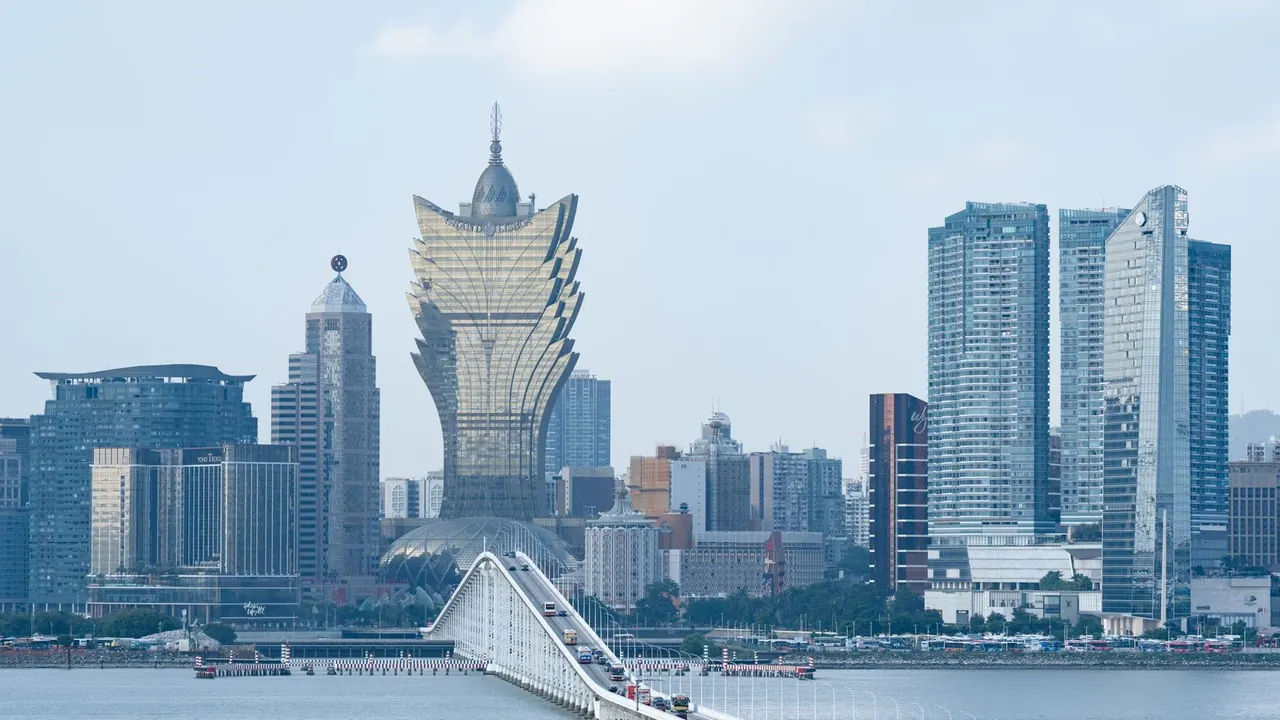
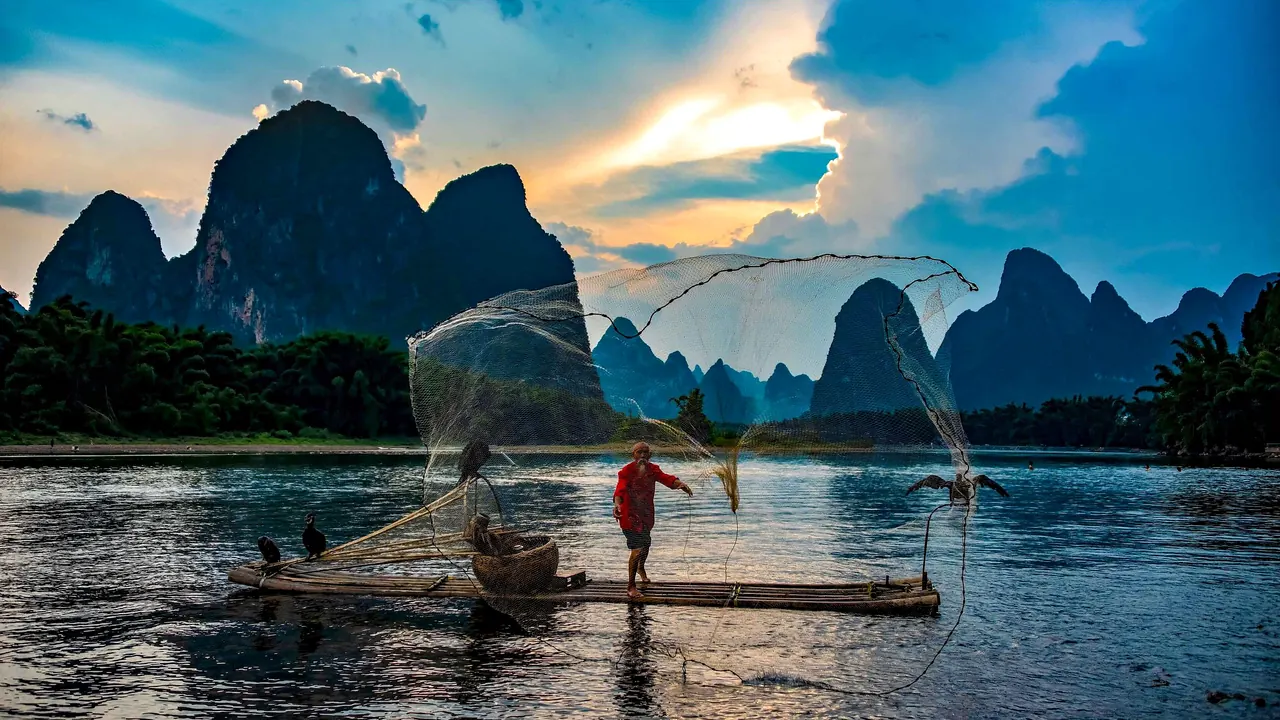
Photos: Macau by tian Jin, Pexels License; Yangshuo by Rod Waddington from Kergunyah, Australia, CC BY-SA 2.0, cropped.
Macau or Yangshuo?
Our verdict in twelve categories, each scored against the same fixed benchmark cities, and the climate month by month, so you can choose for your trip.
Choose Macau for
- culture and sights
- food and drink
- shopping
Macau suits a traveller who wants to eat well and walk through history in a small, easy place. Its Macanese cooking is found almost nowhere else, the UNESCO-listed old centre fills a day or two, and resort malls, spas and pools sit within half an hour. It works best as a short city stay, often paired with Hong Kong, for someone who wants comfort more than landscape.
Choose Yangshuo for
- nature and the outdoors
- prices
- wellness
Anyone who wants scenery should pick Yangshuo. Karst peaks rise straight out of the rice fields at the edge of town, and the days go on rafting the Yulong, walking the Li, cycling between villages or climbing limestone. It also costs far less from day to day. The trade-off is plainer food, few sights and a countryside you need a bike or a driver to explore.
Scoreboard
Twelve categories on one fixed scale from 0 to 100. The shaded stretch is the gap between the two.
Your match
Pick a travel style or drag the sliders, and both match scores follow your weighting.
Wins on culture and sights and food and drink with your weighting.
Wins on nature and the outdoors and prices with your weighting.
What matters to you?
Category by category
What the scores mean for a trip.
Beaches & swimming
Neither is a beach destination, but Macau at least has sand. Hac Sa and Cheoc Van on Coloane give you dark sand and warm water, although the Pearl River leaves it silty, and most actual swimming happens in the Cotai resort pools.
Yangshuo is far inland. Its version is a dip from the gravel banks of the Yulong or a calm reach of the Li after a day of rafting or cycling. That is pleasant in summer, but not a reason to go.
Food & drink
Macau is far ahead on food. Its Creole Macanese cooking, with dishes such as minchi and African chicken, sits alongside Portuguese dining rooms, serious Cantonese cooking, egg tarts in the lanes and a cluster of high-end resort restaurants. You could plan a stay around meals alone.
Yangshuo eats well but narrowly. Beer fish, the stuffed dishes and Guilin rice noodles are worth trying, and the riverside villages often do them better than West Street does. Beyond that there is no fine dining and no wine culture.
Culture & sights
Macau's heritage is the real thing: four centuries of Portuguese and Chinese life laid out in churches, temples, fortresses and the mosaic sweep of Senado Square. It is compact enough for a day or two of steady sightseeing.
Yangshuo's centre is largely rebuilt. What history it has lies in the brick villages along the Yulong, the Ming-era Dragon Bridge and the ancient banyan tree. Here the landscape is the main event, not the monuments.
Nightlife
Both offer a fairly limited night out, of very different kinds. Macau's evenings centre on casinos that never close and polished lounges inside the resorts, best for a cocktail with the lit towers outside. The old centre goes quiet by late evening.
Yangshuo puts everything on West Street: loud bars, stage dancers and crowds of domestic tourists until well past midnight. If you want that, you will find it straight away. If not, the countryside is dark and silent.
Nature & outdoors
Here Yangshuo is in a different league. Hundreds of limestone peaks stand among rice fields at the edge of town, with rafting on the Yulong, the walk from Yangdi to Xingping and viewpoints from Moon Hill and Laozhai Hill. It is also one of Asia's major rock-climbing bases, with kayaking and caving on top.
Macau is almost entirely built up or reclaimed. The Coloane hills, Seac Pai Van Park and the loop around Guia Hill are a breath of air, not a landscape to travel for.
Day trips
Macau's day trips are slightly better, mainly because one of them is Hong Kong, an hour away by ferry or over the sea bridge. Zhuhai, Zhongshan and Guangzhou lie beyond the land border, though every outing means passport control and possibly a visa.
Yangshuo's outings are small and close by: the old quarter at Xingping, the fan workshops of Fuli, Daxu's merchant street, the better-preserved town of Huangyao, and Guilin about an hour away. It is a pleasant list, but none of it matches a day in Hong Kong.
Good for families
The two are evenly matched for families, but they suit different children. Macau offers built attractions: the Science Center with its planetarium, the panda pavilion on Coloane and elaborate resort pools. Its stairways and casino focus suit a short stop better than a long stay.
Yangshuo is for older, active children who will enjoy a bamboo raft, a tandem ride through the villages or a mud pool in a show cave. There is nothing purpose-built, and the busy country roads call for care.
Getting around
Macau is much easier to get around. The old peninsula is walkable, though hilly, and buses, the Taipa light rail and free resort shuttles mean nothing is more than half an hour away and no car is needed.
In Yangshuo the town is easy, but the reason to come is out in the countryside. You will rely on a hired bike or scooter, local minibuses or a driver. The rail station is outside town and signs are mostly in Chinese beyond the centre.
Shopping & style
Macau is the clear pick for shopping, as long as you mean luxury houses, watches and jewellery in the themed arcades of the Cotai malls. Outside them the choice narrows to cookies, jerky, Portuguese tiles and tinned fish.
Yangshuo offers mostly mass-produced souvenirs along West Street. The exception is the hand-painted fans of Fuli, a real craft worth the short trip, with local tea and osmanthus products as simple gifts.
Affordability
The widest gap is in where you sleep. In Macau the room is usually the largest part of the bill, and a resort stay is only good value on weeknights, while a village guesthouse in Yangshuo stays modest for most of the year. Meals follow the same pattern: an egg tart or a bowl of noodles in Macau is cheap, but a sit-down dinner inside a casino is not, and in Yangshuo a plate of beer fish in a riverside village barely dents the budget.
The free parts differ too. Macau's heritage costs almost nothing to walk and the resort shuttles cost nothing, while Yangshuo's scenery is free to cycle through but the rafts, river cruises and caves need tickets. Both get dearer in the same weeks, Chinese New Year and October Golden Week, when much of China travels and room rates in each jump, so avoiding those dates pays off in either place.
Live music & performing arts
Macau has rather more on stage. The Macao Orchestra plays at the Cultural Centre and the historic Dom Pedro V Theatre, an autumn music festival and a spring arts festival bring visiting companies, and the Cotai arenas host Cantonese and Mandarin pop stars. You still need to check listings before you go.
Yangshuo's one big draw is Zhang Yimou's outdoor show on the Li River, with hundreds of performers lit against the floodlit peaks. It is a memorable spectacle, but beyond it there are only tour-group dance shows and cover bands.
Wellness & relaxation
Both can be restful, in opposite ways. Macau's rest happens indoors, in large resort spas with pools, saunas and long treatment menus, plus foot massage in the old town. Coloane village offers the only real calm outside.
Yangshuo's rest comes from the setting. A guesthouse in the Yulong valley or near Xingping means rice-field views, slow cycling, river swims, tai chi classes and quiet terrace evenings. You need to stay well away from West Street for it to work.
When should you go?
Pick your month. The climate figures are measured averages, not a forecast.
Macau in July
Yangshuo in July
Daytime high, °C
Rainfall in the month, mm
Where the figures come from
Yangshuo's temperatures are measured 64 km from the centre, at Guilin.
Yangshuo has no rain gauge within 25 km of the centre, so its rainfall comes from a gridded climate dataset read at the city rather than from a gauge further away.
Temperature and rainfall are climate normals, averaged over the years shown. Macau: 1991-2020 normals, Taipa (3.9 km from centre). Yangshuo: 1991-2020 normals, Guilin (64.4 km from centre).
Macau stays mild through winter, with highs around 19°C from December to February and little rain, so walking the old centre is comfortable then. From May to September heat, humidity and heavy rain take over, with June bringing about 369mm, and the hilly stairways become hard work. The sea is warm enough for swimming from May to October and reaches about 29°C in midsummer. October is the best month, with the rain largely over and the sea still warm. October to December are also much sunnier than the grey stretch from February to April.
Yangshuo has a much cooler winter, with January highs near 12°C. That is fine for cycling but chilly for time on the river. Its rains build from April to a June peak of about 326mm, then ease earlier than Macau's, so July and August are hot rather than drenched and September is fairly dry. October and November are dry and mild, the best time for walking and climbing among the peaks. April and May are greener but wetter. In winter Macau is the warmer of the two, and in autumn both are at their best.
Which traveller are you?
For an outdoors trip, choose Yangshuo without hesitation. The karst peaks, rivers and village lanes begin at the guesthouse door, with rafting, cycling, kayaking and hundreds of bolted climbing routes. In Macau the outdoors comes down to a few short trails on Coloane.
On a culture and arts trip, Macau is the stronger choice. Its UNESCO-listed centre runs from the Ruins of St Paul's to A-Ma Temple, and it has museums, Lou Kau Mansion and a historic theatre. Yangshuo has a few old villages and bridges, and no significant museums.
On a tight budget, Yangshuo goes much further. Village guesthouses, rice-noodle breakfasts, bike hire and minibuses all cost little, and only the ticketed boat trips and shows add up. In Macau, resort rooms climb at weekends and the casino restaurants are expensive.
Before you go
| Measure | Macau | Yangshuo |
|---|---|---|
| Official language | Portuguese, Cantonese, Standard Chinese | Putonghua |
| Currency | Pataca (MOP) | Yuan Renminbi (CNY) |
| Sockets | FGM220 V, 50 Hz | ACI220 V, 50 Hz |
| Driving side | Left | Right |
| Time zone | UTC+8 | UTC+8 |
| Emergency number | 999 | Police 110, ambulance 120, fire 119 |
| Elevation | 22 m | 118 m |
| Main airport | Macau International Airport (MFM)7 km from centre41 non-stop destinations | Guilin Liangjiang International Airport (KWL)67 km from centre43 non-stop destinations |
| Public holidays this year | - | 6 days |
By the numbers
| Measure | Macau | Yangshuo |
|---|---|---|
| City population | 682,100 | 273,124 |
| People per km² | 5,916 | 190 |
| Museums within 10 km | 28 | 0 |
| UNESCO World Heritage sites within 50 km | 1 | 1 |
| Swim season, months above 21 °C | 8 months | - |
Where else could you go?
Every comparison below shares a destination with this one, so you can follow Macau or Yangshuo somewhere new.
- Guilinvs Yangshuo
- Hong Kongvs Macau
- Shenzhenvs Macau
- Guangzhouvs Macau
- Guangzhouvs Yangshuo
- Shenzhenvs Yangshuo