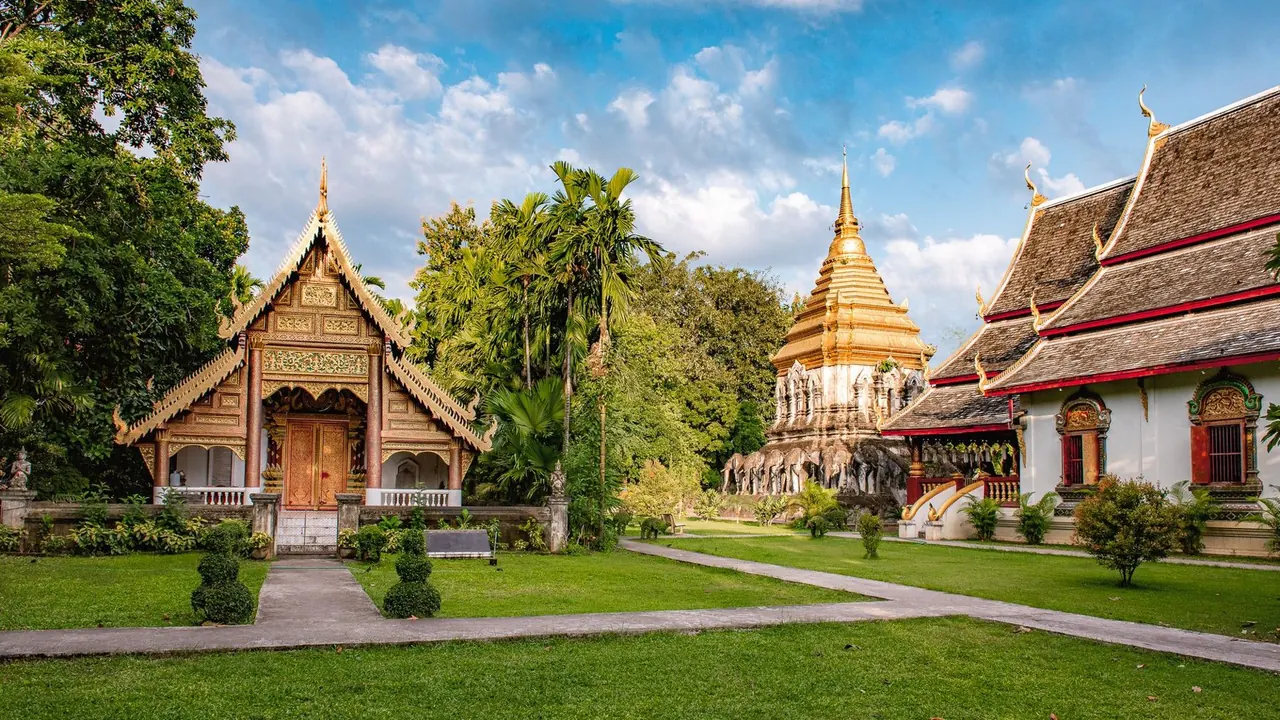
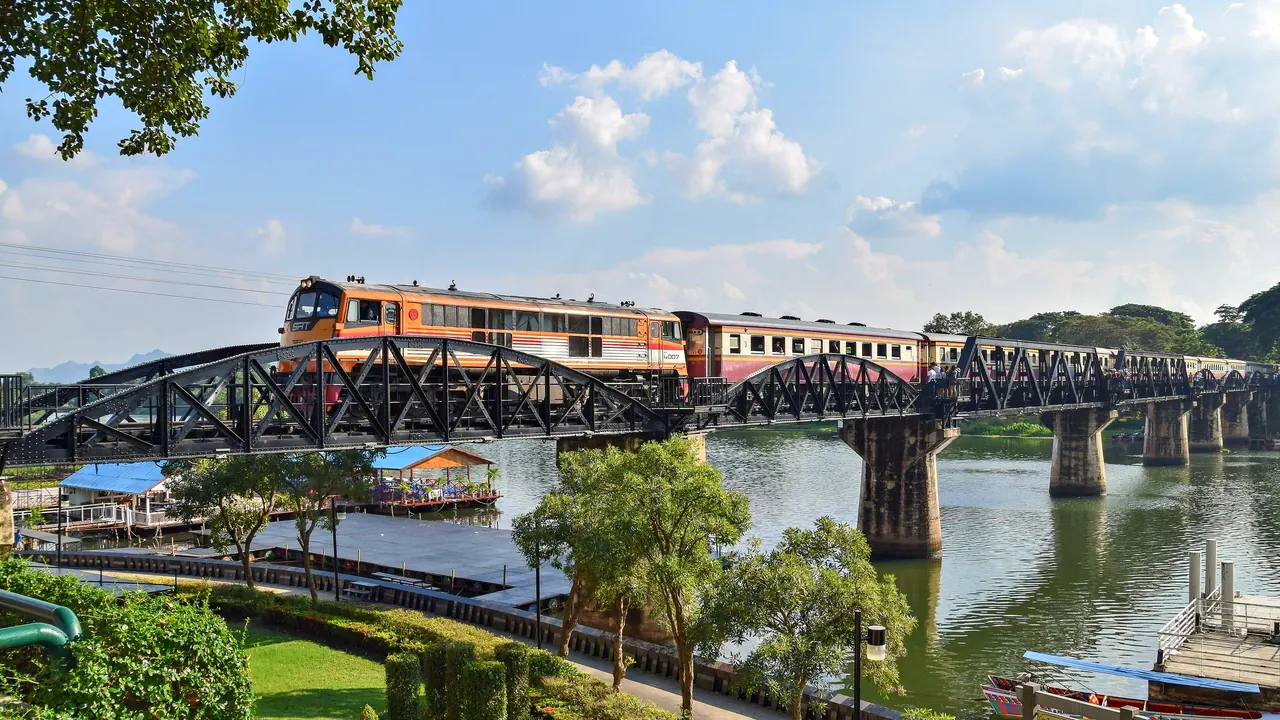
Photos: Chiang Mai by Gije Cho, Pexels License; Kanchanaburi by Krzysztof Golik, CC BY-SA 4.0, cropped.
Chiang Mai or Kanchanaburi?
Our verdict in twelve categories, each scored against the same fixed benchmark cities, and the climate month by month, so you can choose for your trip.
Choose Chiang Mai for
- shopping
- food and drink
- culture and sights
Chiang Mai is the better all-round base. It suits travellers who want a few slow days of temple walks in a moated old city, northern Thai cooking at morning markets and evening stalls, craft markets on weekend nights and a massage or a meditation retreat at the end of the day. The mountains begin at the edge of town, so a long stay mixes city comfort with forest, waterfalls and hill villages.
Choose Kanchanaburi for
- beaches
- day trips
Kanchanaburi is a narrower, quieter choice, and the right one for travellers drawn by the history of the Thailand-Burma railway. The bridge, the war cemeteries and Hellfire Pass make a moving journey, and the raft houses, Erawan's waterfalls and the river give it an easy outdoor rhythm. Expect simple food, early nights and little shopping. It works well as a few days added to a Bangkok stay rather than as the centre of a long trip.
Scoreboard
Twelve categories on one fixed scale from 0 to 100. The shaded stretch is the gap between the two.
Your match
Pick a travel style or drag the sliders, and both match scores follow your weighting.
Wins on shopping and food and drink with your weighting.
Wins on beaches and day trips with your weighting.
What matters to you?
Category by category
What the scores mean for a trip.
Beaches & swimming
Neither is a place for sand or sea, and both are hours from the coast. The swimming is fresh water in each, though of different kinds.
Chiang Mai's locals cool off at the Huay Tung Tao reservoir under Doi Suthep, at old quarry lakes and in hotel pools. Kanchanaburi has the more memorable dip: the turquoise tiered pools of Erawan, where small fish nibble your feet, and lazy floats on the River Kwai straight off a raft house.
Food & drink
Chiang Mai is the place to travel for food. Northern cooking has its own dishes, such as khao soi with its crisp noodles, grilled sai ua sausage and green chilli dip with sticky rice, and you find them at Warorot market, the stalls at Chang Phueak Gate and along the weekend walking streets. Coffee grown in the surrounding hills gives the city a café culture few Thai cities can match.
Kanchanaburi feeds you well but plainly: noodle soups at shophouse counters, the night market by the station and river fish such as snakehead served at open-air restaurants over the water. A sunset meal on a floating raft restaurant is the local pleasure, but there is no regional cuisine to seek out and little range.
Culture & sights
Chiang Mai gives you far more to see. Its moated old city is dotted with temples, from the ruined chedi of Wat Chedi Luang and the Lanna halls of Wat Phra Singh to the silver Wat Sri Suphan, with Doi Suthep looking down from the mountain. Two or three days of temple walks hardly exhaust it, though museums are few.
Kanchanaburi tells one powerful story instead: the wartime railway built by prisoners and Asian labourers. The bridge, the War Cemetery's long rows of graves, the Thailand-Burma Railway Centre and the JEATH museum fill a moving day, but there is little old architecture beyond a few cave temples.
Nightlife
Chiang Mai has the livelier evenings, though even here most places close around midnight. Nimmanhaemin draws a student crowd to cocktail and craft beer bars, the old city around Tha Phae Gate is full of backpacker bars and rooftops, and Loi Kroh Road is the rowdier strip.
Kanchanaburi's night out is a short row of riverside bars with pool tables and the odd cover band. At weekends Thai groups hire karaoke rafts that drift noisily downstream, but most evenings end after the night market.
Nature & outdoors
Both sit at the edge of wild country, but the landscapes differ. Chiang Mai is ringed by green mountains: Doi Suthep-Pui begins at the western edge of town, and Doi Inthanon, Thailand's highest peak, offers cloud forest and birdlife about an hour and a half away, with rafting, ziplines and hill-village treks in the valleys between.
Kanchanaburi is limestone, jungle and river rather than high peaks. Erawan's seven tiers of waterfalls, the falls and caves of Sai Yok, kayaking on the dam reservoirs and bamboo rafting make it a watery, lower-lying outdoors. Its forests are greenest just after the rains, whereas Chiang Mai's hills are best in the cool months before the spring haze.
Day trips
The outings are about equally good, but Kanchanaburi's carry a stronger thread. The old railway runs north along cliffs above the river to Nam Tok, Hellfire Pass has its memorial trail, and Nakhon Pathom's great chedi and the canal markets of Damnoen Saduak and Amphawa lie east.
From Chiang Mai the best trips are to older Lanna towns: Lamphun's gilded chedi half an hour south and Lampang with its carriages and teak mansions. Chiang Rai and Pai are both too far for a comfortable day and are better as overnight stops.
Good for families
Chiang Mai keeps children busy for longer. Elephant sanctuaries where families feed and walk with the animals, the zoo on Doi Suthep's slopes, the Night Safari, quarry swimming parks and ziplines fill several days, though broken pavements and traffic around the moat make moving about tiring.
Kanchanaburi has some lovely moments for children, from splashing in the Erawan pools to riding the slow train over wooden trestles and sleeping in a raft house. But the town's main sights are cemeteries and museums, and nearly every outing involves a minivan in the heat.
Getting around
Getting around takes effort in both, but the problems differ. In Chiang Mai the old city inside the moat is compact enough to walk, and red songthaews and ride-hailing apps make the hop to Nimmanhaemin easy, though there is no metro or tram.
Kanchanaburi strings its guesthouses, bridge and cemeteries along the river for several kilometres, so a bicycle or short songthaew ride beats walking. Further out, the slow train and sparse buses are scenic but slow, and in both places a scooter or hired driver is the usual way into the countryside.
Shopping & style
Chiang Mai is one of the best places in Thailand to buy handmade things. The Sunday Walking Street on Ratchadamnoen, the Saturday market on Wualai Road and the nightly Night Bazaar sell textiles, carved wood and hill-tribe embroidery, while Bo Sang paints paper umbrellas and San Kamphaeng weaves silk.
Kanchanaburi has a night market, souvenir stalls by the bridge and some sapphire shops where you need to know what you are buying. It is not a reason to go.
Affordability
Both are among the cheapest places in Thailand to spend a week, with inexpensive guesthouses, cheap market meals and low-cost local transport. Where the money goes differs. In Chiang Mai it is cooking classes, sanctuary visits, treks and the hill resorts, while daily massages stay affordable. In Kanchanaburi the local train is almost free, but national park entry for foreigners, private drivers and the upriver resorts add up.
Live music & performing arts
Neither has opera, classical concerts or much theatre, but Chiang Mai has a real small-scale music life. Jazz and blues jam sessions near the old city's north gate run nightly, bands play in Nimmanhaemin, and khantoke dinners pair a northern meal with Lanna dance. Muay Thai nights and the lantern festival of Yi Peng add more.
Kanchanaburi has no regular scene beyond cover bands in riverside bars. Its one big occasion is River Kwai Bridge Week, around late November and early December, when a sound-and-light show with fireworks restages the bombing of the bridge.
Wellness & relaxation
Chiang Mai is the stronger choice for a restorative stay. It is Thailand's best-known place to learn Thai massage, with long-established schools, and temples such as Wat Umong and Wat Suan Dok run meditation retreats. The San Kamphaeng hot springs are under an hour away, and spas in old teak houses are easy to find.
Kanchanaburi relaxes you through stillness instead: hammocks on raft houses over the upper River Kwai, cheap massages in town and spas at the bigger riverside resorts. Its only hot springs, at Hin Dat, are about two hours north.
When should you go?
Pick your month. The climate figures are measured averages, not a forecast.
Chiang Mai in July
Kanchanaburi in July
Daytime high, °C
Rainfall in the month, mm
Temperature and rainfall are climate normals, averaged over the years shown. Chiang Mai: 1991-2020 normals, Chiang Mai (0.6 km from centre). Kanchanaburi: 1961-1990 (rainfall 1981-2010) normals, Kanchanaburi (0.4 km from centre).
Both cities are at their best from December to February, but each has its own timing. Chiang Mai is the cooler of the two in the dry season, with highs around 29°C in December and long, sunny days, which makes temple walks and hill treks comfortable. Kanchanaburi runs a little hotter all year and builds to about 38°C in April, when walking between the bridge and the cemeteries is hard going. March and April are draining in both.
The rains also fall differently. In Chiang Mai they set in from May and peak in August at around 234mm, with sunshine dropping sharply, and they ease by November, which is already a pleasant month. Kanchanaburi's wet season peaks later, at about 236mm in September with October almost as wet, and November is still fairly rainy, so it reaches dry weather a few weeks after Chiang Mai, in December and January.
Which traveller are you?
On a shopping trip, Chiang Mai is the clear choice. Its weekend walking streets, the nightly Night Bazaar and the weaving and umbrella villages nearby are full of handmade textiles, silver and ceramics, while Kanchanaburi offers little beyond a night market and souvenir stalls.
For a food and nightlife trip, Chiang Mai again wins. Khao soi, herb-heavy sausage and a deep café culture give every meal a reason, and Nimmanhaemin's cocktail bars and old-city jazz jams carry the evening on. Kanchanaburi eats simply and goes quiet after dinner.
Travellers drawn by Second World War history should choose Kanchanaburi. The Bridge over the River Kwai, the war cemeteries, the railway museums and Hellfire Pass tell the story of the Death Railway where it happened, something Chiang Mai has no equivalent of.
Before you go
| Measure | Chiang Mai | Kanchanaburi |
|---|---|---|
| Official language | Thai | Thai |
| Currency | Baht (THB) | Baht (THB) |
| Sockets | ABCF220 V, 50 Hz | ABCF220 V, 50 Hz |
| Driving side | Left | Left |
| Time zone | UTC+7 | UTC+7 |
| Emergency number | Police 191, ambulance 1669, fire 199 | Police 191, ambulance 1669, fire 199 |
| Elevation | 310 m | 30 m |
| Main airport | Chiang Mai International Airport (CNX)3 km from centre28 non-stop destinations | Suvarnabhumi Airport (BKK)137 km from centre150 non-stop destinations |
By the numbers
| Measure | Chiang Mai | Kanchanaburi |
|---|---|---|
| City population | 1,198,000 | 25,651 |
| People per km² | 2,958 | - |
| Museums within 10 km | 6 | 2 |
| UNESCO World Heritage sites within 50 km | 0 | 0 |
Where else could you go?
Every comparison below shares a destination with this one, so you can follow Chiang Mai or Kanchanaburi somewhere new.
- Paivs Chiang Mai
- Bangkokvs Kanchanaburi
- Ayutthayavs Kanchanaburi
- Chiang Raivs Chiang Mai
- Hua Hinvs Kanchanaburi
- Pattayavs Kanchanaburi