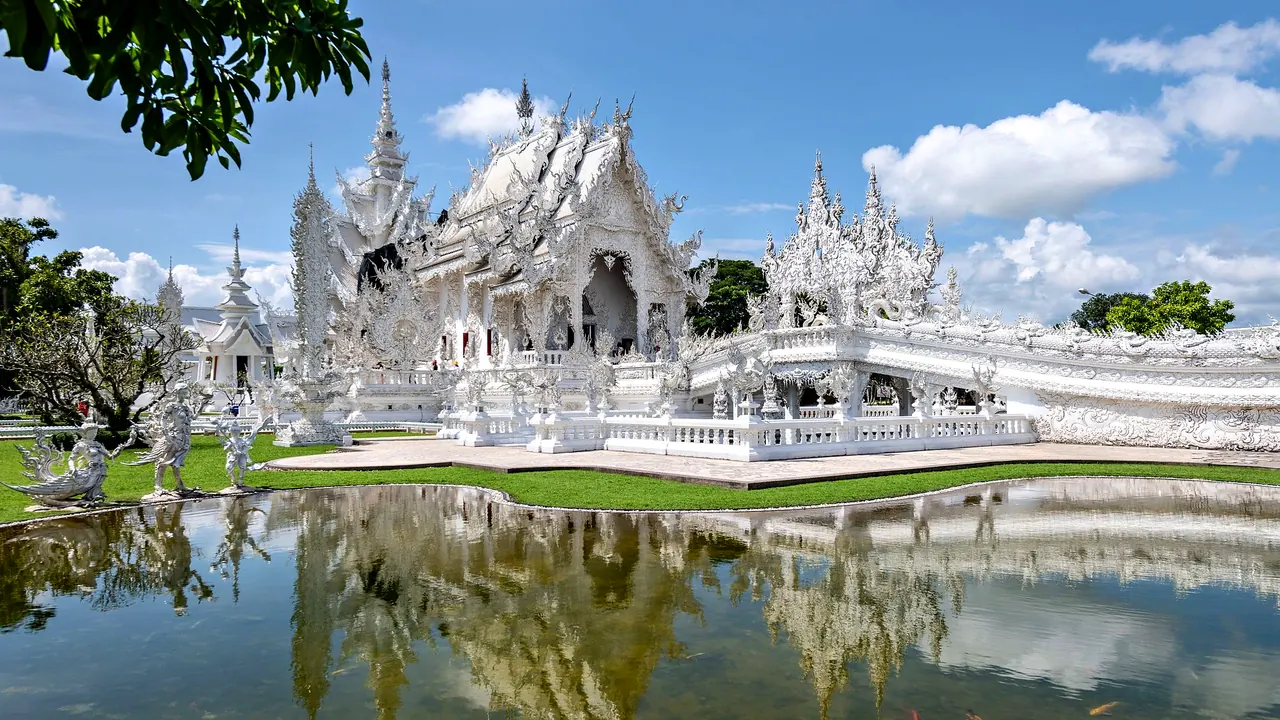
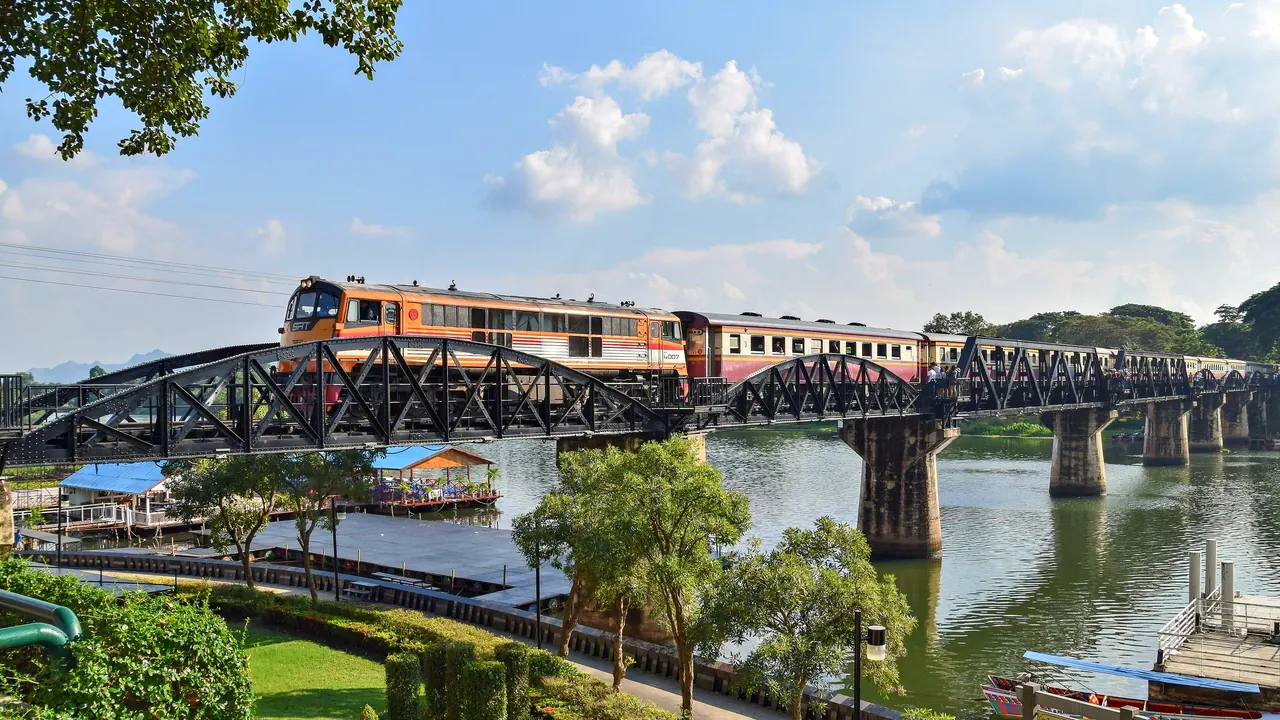
Photos: Chiang Rai by Kirandeep Singh Walia, Pexels License; Kanchanaburi by Krzysztof Golik, CC BY-SA 4.0, cropped.
Chiang Rai or Kanchanaburi?
Our verdict in twelve categories, each scored against the same fixed benchmark cities, and the climate month by month, so you can choose for your trip.
Choose Chiang Rai for
- shopping
- culture and sights
- food and drink
Chiang Rai is the better pick if you want a town with its own character to explore. The White Temple, the Blue Temple and Baan Dam give it a modern artistic streak found nowhere else in Thailand. Northern cooking and hill-grown coffee make the meals more distinctive, and the hills around it, with tea terraces, Mekong viewpoints and sunrise ridges on the Lao border, give the countryside some height and variety. It suits travellers who want temples, cafés and mountain scenery at a slow pace.
Choose Kanchanaburi for
- beaches
- nature and the outdoors
- families
Kanchanaburi suits a trip built around one powerful story and plenty of water. Its sights are the Bridge over the River Kwai, the war cemeteries and the railway up to Hellfire Pass, and they are sobering and worth seeing even though there are few of them. The rest of the stay is spent in the river and jungle country: Erawan's turquoise pools, raft houses over the river and boat trips on the reservoirs. It is also within reach of Bangkok and the canal markets, so it fits easily onto a central Thailand route.
Scoreboard
Twelve categories on one fixed scale from 0 to 100. The shaded stretch is the gap between the two.
Your match
Pick a travel style or drag the sliders, and both match scores follow your weighting.
Wins on shopping and culture and sights with your weighting.
Wins on beaches and nature and the outdoors with your weighting.
What matters to you?
Category by category
What the scores mean for a trip.
Beaches & swimming
Neither town has a coast, and either needs a separate stop in the south if you want sand and salt water. The freshwater swimming is different in kind. Kanchanaburi has the more memorable option in the tiered turquoise pools of Erawan, where fish nibble your feet, plus lazy floats on the River Kwai from the raft houses. In Chiang Rai you swim in forest waterfall pools, a reservoir or a hotel pool.
Food & drink
Chiang Rai is the more rewarding place to eat, because it has a regional cuisine of its own. Khao soi, sour nam ngiao, sai ua sausage and chilli dips with sticky rice fill the night bazaar and walking-street markets. The surrounding hills supply a large café culture of local coffee and oolong, often served in gardens.
Kanchanaburi's cooking is honest central Thai food served at shophouse counters and the night market by the station. Its one local habit is eating river fish at open-air restaurants or on floating rafts at sunset. Neither town offers fine dining or much beyond Thai food.
Culture & sights
Chiang Rai has more to see and a more unusual character. Its modern temple art, from the mirrored white plaster of Wat Rong Khun to the sapphire Blue Temple and the dark teak halls of Baan Dam, is unlike anything else in the country. Wat Phra Kaew, where the Emerald Buddha was found, adds some older history.
Kanchanaburi's sightseeing tells a single story: the building of the Thailand-Burma railway by prisoners and labourers in the Second World War. You can walk across the bridge, and the rows of graves at the war cemetery and the Railway Centre are deeply moving. Once you have seen them, though, there is little else, apart from a few cave temples.
Nightlife
Evenings are equally quiet in both, and neither has a club worth seeking out. The difference is in the setting. In Chiang Rai you go to the short strip of small bars by the clock tower, with reggae or acoustic sets, or linger at the beer tables by the night bazaar stage. In Kanchanaburi you drink on the riverside backpacker road, with pool tables and cover bands, and weekends get noisier when Thai groups hire karaoke rafts that drift down the river.
Nature & outdoors
Both are good bases for the outdoors, but the landscapes differ. Chiang Rai is hill country: tea terraces on Doi Mae Salong, the gardens of Doi Tung, the sea of cloud at sunrise from Phu Chi Fa and the wide Mekong at the Golden Triangle. Its weak point is the smoke haze from burning fields in late winter and spring.
Kanchanaburi has lower limestone jungle along the Burmese border, with more water to enjoy. The trail climbs past Erawan's seven tiers of falls, and there are caves at Sai Yok and Lawa and kayaking on the dam reservoirs. Here the waterfalls run thin late in the dry season, so both are at their best just after the rains.
Day trips
There are about as many outings from each, and the difference is what they show you. From Chiang Rai you head to the borders: the ruined chedis of Chiang Saen on the Mekong, the Golden Triangle viewpoint and its opium museum, the market at Mae Sai and the Yunnanese tea village of Doi Mae Salong.
Kanchanaburi's best outing is the old railway itself, running along the cliffs to Nam Tok and on to the cutting at Hellfire Pass. It also faces east towards the centre of the country, with the great chedi at Nakhon Pathom, the canal markets of Damnoen Saduak and Amphawa, and even Bangkok for a long day.
Good for families
Both towns are friendly to children but have little built for them, and in both you spend a lot of time in vehicles. Kanchanaburi has more hands-on fun: splashing in the Erawan pools, sleeping in a raft house and riding the slow train, although the war cemeteries mean little to young children. In Chiang Rai the main outing is the open space of Singha Park with its tea fields and lakes, and the colourful temples hold children's attention for a morning. Avoid the smoky spring season there.
Getting around
Getting around is about equally awkward, for different reasons. Chiang Rai's centre around the clock tower is small enough to walk, and a local bus runs to the White Temple, but everything else needs a tuk-tuk, a driver or a scooter. Kanchanaburi is spread out along the river for several kilometres, so a bicycle is the easiest way to get about. In return, its slow train up the Death Railway is a sight in itself as well as a way to travel.
Shopping & style
Chiang Rai is the better place to shop, even though it is mostly markets. The nightly bazaar and the longer Saturday walking street on Thanalai Road sell hill-tribe textiles, silver and carved wood, and Doi Mae Salong oolong and local coffee are worth packing.
Kanchanaburi has only the night market, the souvenir stalls by the bridge and a few gem shops selling the province's blue sapphires. Those shops are only worth trying if you know how to judge stones.
Affordability
Both are among the cheapest stops in Thailand, with guesthouses, market meals and massages costing very little. The spending adds up in different places. In Chiang Rai the big cost is reaching sights that lie far out in the hills, which usually means a driver, a hire car or a tour. In Kanchanaburi the local train and buses cost almost nothing, but foreigner entry fees at the national parks and the comfortable resorts upriver add up.
Live music & performing arts
Neither town has theatre or a concert season, but Chiang Rai offers a little more on an ordinary evening. Lanna dance and folk music play on the night bazaar stage, and khantoke dinners pair northern dishes with traditional dancing. Kanchanaburi's live music is cover bands in the riverside bars. Its one real show is River Kwai Bridge Week, a sound-and-light restaging of the wartime bombing of the bridge, held around late November and early December.
Wellness & relaxation
Chiang Rai suits a wellness trip with a little more structure. You can soak in the simple hot spring pools at Pong Phrabat north of town or at Mae Kachan on the road south, and join a meditation or yoga retreat in the surrounding countryside. It is best avoided in the smoky late-winter and spring months.
In Kanchanaburi, relaxing means doing very little on the upper River Kwai, in a hammock on a raft house or riverside resort with jungle on the far bank. Its only hot springs, at Hin Dat, are two hours away. In both towns a cheap Thai massage is never far off.
When should you go?
Pick your month. The climate figures are measured averages, not a forecast.
Chiang Rai in July
Kanchanaburi in July
Daytime high, °C
Rainfall in the month, mm
Temperature and rainfall are climate normals, averaged over the years shown. Chiang Rai: 1991-2020 (sunshine 1961-1990) normals, Chiang Rai (1 km from centre). Kanchanaburi: 1961-1990 (rainfall 1981-2010) normals, Kanchanaburi (0.4 km from centre).
Chiang Rai is at its best from November to February. These months are dry and sunny, and in December the days are mild at around 28°C, with misty mornings in the hills. Kanchanaburi's dry season is shorter and runs from December to February, because November there still brings about 106mm of rain. Its winter afternoons are always a few degrees hotter than Chiang Rai's, so they feel warm rather than mild, but January is almost rainless and is the most comfortable month for walking in either town.
From March both towns heat up quickly. Kanchanaburi reaches 38°C in April, which is too hot for long walks or sightseeing in the middle of the day, and Chiang Rai is only slightly cooler. The rains then follow different patterns. In Chiang Rai the monsoon is heavier and peaks at 390mm in August, with much less sunshine, before easing in October. In Kanchanaburi the rain is lighter through the summer and is at its heaviest in September and October.
Which traveller are you?
On a culture and arts trip, Chiang Rai keeps you busy for two or three days, and its sights go from Lanna history to modern religious art. Kanchanaburi is better for a traveller who cares about Second World War history. You can see its main sights in a single moving day.
For a shopping trip, Chiang Rai is the clear choice. Two evening markets sell handmade northern crafts, and hill-grown tea and coffee make good gifts. Kanchanaburi offers far less, and in both towns the malls are ordinary, with no boutique scene.
On a food and nightlife trip, Chiang Rai gives you a regional cuisine to explore cheaply over several days, and the coffee is good in the daytime. Kanchanaburi's food is ordinary central Thai cooking, apart from river fish at sunset. Nights end early in both towns, so the food decides it.
Before you go
| Measure | Chiang Rai | Kanchanaburi |
|---|---|---|
| Official language | Thai | Thai |
| Currency | Baht (THB) | Baht (THB) |
| Sockets | ABCF220 V, 50 Hz | ABCF220 V, 50 Hz |
| Driving side | Left | Left |
| Time zone | UTC+7 | UTC+7 |
| Emergency number | Police 191, ambulance 1669, fire 199 | Police 191, ambulance 1669, fire 199 |
| Elevation | 390 m | 30 m |
| Main airport | Mae Fah Luang - Chiang Rai International Airport (CEI)8 km from centre4 non-stop destinations | Suvarnabhumi Airport (BKK)137 km from centre150 non-stop destinations |
By the numbers
| Measure | Chiang Rai | Kanchanaburi |
|---|---|---|
| City population | 70,610 | 25,651 |
| People per km² | 1,159 | - |
| Museums within 10 km | 4 | 2 |
| UNESCO World Heritage sites within 50 km | 0 | 0 |
Where else could you go?
Every comparison below shares a destination with this one, so you can follow Chiang Rai or Kanchanaburi somewhere new.
- Bangkokvs Kanchanaburi
- Ayutthayavs Kanchanaburi
- Chiang Maivs Chiang Rai
- Paivs Chiang Rai
- Hua Hinvs Kanchanaburi
- Pattayavs Kanchanaburi