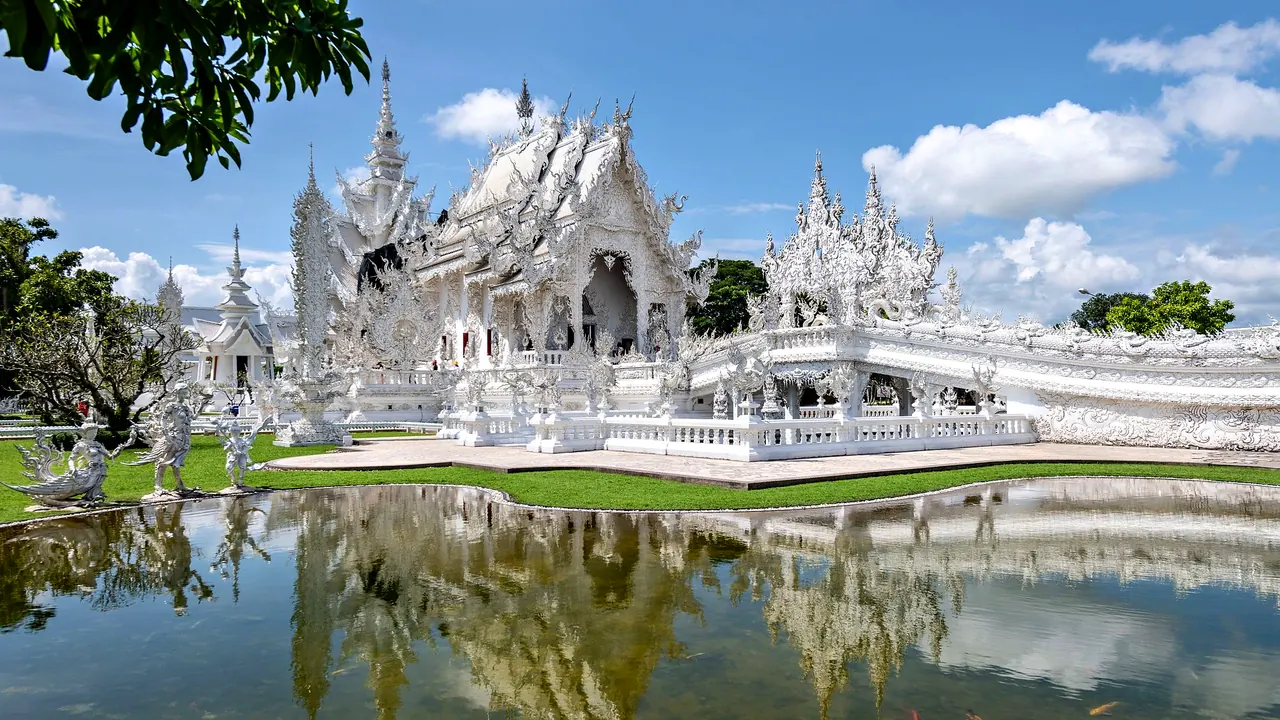
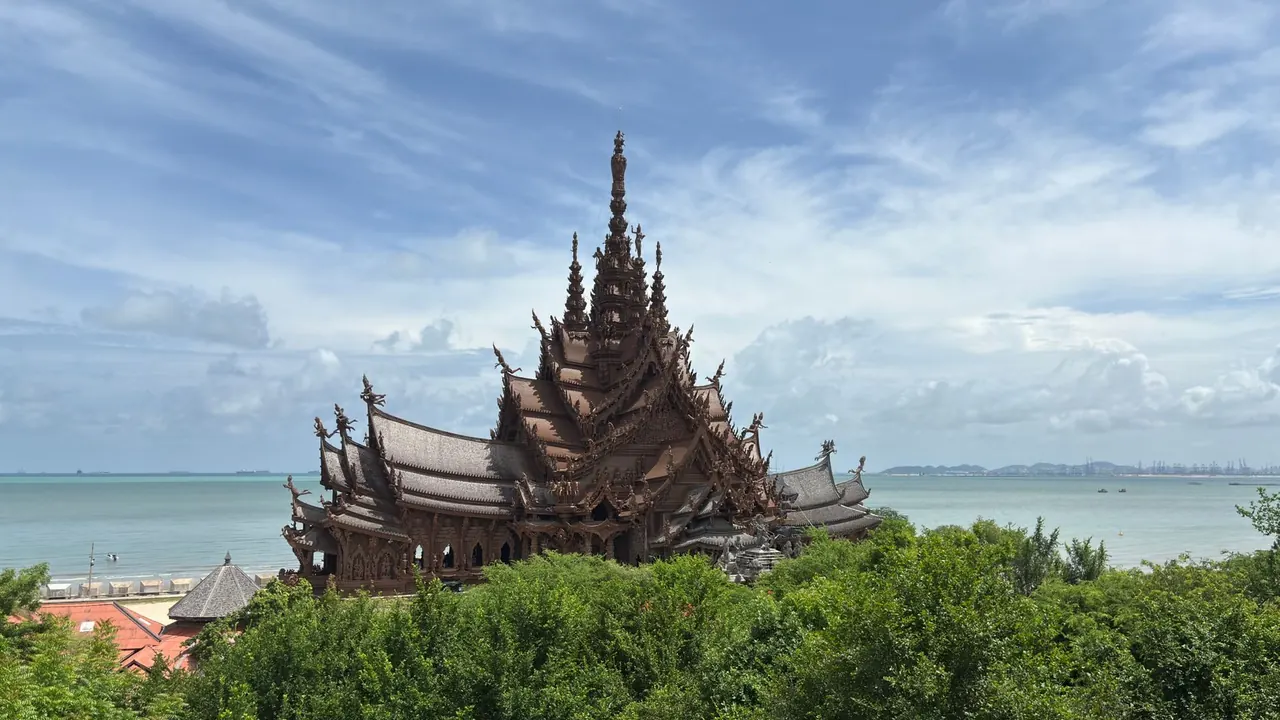
Photos: Chiang Rai by Kirandeep Singh Walia, Pexels License; Pattaya by Matrix, Pexels License.
Chiang Rai or Pattaya?
Our verdict in twelve categories, each scored against the same fixed benchmark cities, and the climate month by month, so you can choose for your trip.
Choose Chiang Rai for
- nature and the outdoors
- culture and sights
- prices
Chiang Rai suits travellers who would rather have temples and hills than sand. The White Temple, the Blue Temple and Baan Dam give it a modern religious art you will not find on the coast. The green valleys around it lead to tea terraces, waterfalls and the Mekong. Evenings are quiet and days cost very little, so it rewards a slow few days of looking and walking.
Choose Pattaya for
- beaches
- nightlife
- families
For a warm sea and late nights, Pattaya is the better pick. You can swim at Jomtien and on the island beaches of Koh Larn in any month. Walking Street and the bar sois keep going into the small hours, and water parks and a zoo give families more to do. Heritage is thin, so go for the coast and the evenings rather than the sights.
Scoreboard
Twelve categories on one fixed scale from 0 to 100. The shaded stretch is the gap between the two.
Your match
Pick a travel style or drag the sliders, and both match scores follow your weighting.
Wins on nature and the outdoors and culture and sights with your weighting.
Wins on beaches and nightlife with your weighting.
What matters to you?
Category by category
What the scores mean for a trip.
Beaches & swimming
Only Pattaya offers a beach vacation. Chiang Rai lies far inland in the northern hills, so swimming there means a hotel pool or a cool pool below a forest waterfall.
Pattaya's main beach is better for deckchairs than swimming, with cloudy water and jet skis. Jomtien is calmer, though, and the ferry to Koh Larn reaches clear sea at Tien and Samae. The water stays warm all year.
Food & drink
The two are close for eating, but the cooking is different. Chiang Rai is the place for northern dishes such as khao soi, nam ngiao and sai ua sausage, eaten cheaply at the night bazaar and the walking-street markets, with hill-grown coffee in garden cafés as a bonus.
Pattaya's strength is seafood, chosen by weight on the Naklua waterfront and in the fishing villages to the south. It also has far more international food for long-stay visitors, though the quality is patchy. Neither city has much fine dining.
Culture & sights
Chiang Rai has much more to see. Its modern temple art is unlike anything on the coast: the white plaster and mirrored glass of Wat Rong Khun, the sapphire Blue Temple and the dark teak halls of Baan Dam. Wat Phra Kaew and the Lanna temples add older history.
Pattaya grew from a fishing village and has almost no historic architecture. The carved teak Sanctuary of Truth at Naklua is well worth a visit, but beyond Big Buddha Hill the attractions are illusion galleries and wax museums.
Nightlife
Chiang Rai's evenings are modest: a short street of small bars near the clock tower and beer tables at the night bazaar, with no clubs to speak of and the town asleep by midnight.
Pattaya is in another league. Walking Street, the beer-bar sois off Second Road, big dance clubs and rooftop bars keep going into the small hours. The sex trade is a visible part of much of this, so couples who want quieter nights tend to stay in Jomtien or Naklua.
Nature & outdoors
Chiang Rai is the stronger choice outdoors. The Kok River valley is ringed by forested ranges, with waterfalls such as Khun Korn, hill-tribe trekking, the tea terraces of Doi Mae Salong and sunrise over the clouds at Phu Chi Fa. Go in the cool months, because the spring smoke spoils the views.
In Pattaya, the outdoors is mostly offshore: snorkelling around Koh Larn and Koh Sak, dives on sunken naval ships and kitesurfing at Na Jomtien. Inland the land is flat and built up, and the heat limits walking.
Day trips
Both have a fair range of outings, but of different kinds. From Chiang Rai the trips head into the border country: the walled town of Chiang Saen, the Golden Triangle above the Mekong, the market at Mae Sai and the Yunnanese tea village of Doi Mae Salong.
Pattaya's big outing is Bangkok, about two hours away. It makes a long day but brings the royal palace and the riverside temples within reach. Koh Samet's beaches and the small island of Koh Si Chang are the coastal alternatives.
Good for families
Pattaya has more for children. Water parks on the edge of town, an aquarium with a walk-through tunnel and the night safari at Khao Kheow Open Zoo can fill several days, as long as you stay in Jomtien, away from the bar streets.
Chiang Rai welcomes children but has little built for them beyond the open space of Singha Park and the elephant sanctuaries. Long drives to the sights and the smoky spring also count against it.
Getting around
Chiang Rai's centre around the clock tower, the night bazaar and the bus station is small and flat enough to cover on foot, but the temples and hills lie well outside it. Days out depend on tuk-tuks, songthaews, a hired driver or a scooter, though a local bus does run south to the White Temple.
Pattaya stretches along the coast instead, and the shared songthaews that loop Beach Road and Second Road and run out to Jomtien and Naklua cover most of a beach stay once you know to flag one down. Walking is harder there, with broken pavements and heavy traffic, and the zoo, the gardens and the water parks still need a taxi.
Shopping & style
Chiang Rai's shopping happens at markets. The night bazaar and the Saturday walking street on Thanalai Road sell hill-tribe textiles, silver and carved wood, and oolong from Doi Mae Salong or hill-grown coffee makes the best thing to take home.
Pattaya is a little easier for practical shopping, with large air-conditioned malls on Beach Road and Second Road and tailors who will make a suit or shirts in a few days. Its night markets lean towards clothes and branded copies rather than local craft, and there are few boutiques in either town.
Affordability
Both are cheap, but your money goes further in Chiang Rai. Guesthouses, market meals and garden cafés cost very little and many temples charge little or nothing to enter, though drivers and tours to the outlying sights add up.
In Pattaya, a large surplus of rooms keeps hotels cheap, especially in the wet season. Beachfront resorts, imported drinks, speedboat trips and water parks push the bill up, and jet ski and taxi prices need agreeing before you set off.
Live music & performing arts
Neither city has a theatre or concert season, and Pattaya has more to watch. Chiang Rai's performances are small and traditional: Lanna dance on the night bazaar stage, khantoke dinners and music at temple festivals and Loy Krathong.
In Pattaya, ladyboy cabaret plays nightly in large theatres, dinner shows add Thai dance and martial arts, and cover bands fill Walking Street. It is entertainment staged for visitors rather than a local arts life.
Wellness & relaxation
For rest the two are level, but the setting differs. Chiang Rai's calm comes from the town itself, slow and quiet, with massage on every street and simple hot-spring pools at Pong Phrabat and Mae Kachan, though the smoky spring breaks the spell.
Pattaya has fuller spas at the resorts in Naklua, Na Jomtien and on Pratamnak, but the centre stays loud late into the night. How restful a stay is depends on where you sleep, and there is no hot-spring tradition.
When should you go?
Pick your month. The climate figures are measured averages, not a forecast.
Chiang Rai in July
Pattaya in July
Daytime high, °C
Rainfall in the month, mm
Where the figures come from
Pattaya's temperatures are measured 31 km from the centre, at Sattahip.
Pattaya has no rain gauge within 25 km of the centre, so its rainfall comes from a gridded climate dataset read at the city rather than from a gauge further away.
Pattaya's sunshine is measured 86 km from the centre, at Bangna Agromet / Ban Khlong Samrong.
Temperature and rainfall are climate normals, averaged over the years shown. Chiang Rai: 1991-2020 (sunshine 1961-1990) normals, Chiang Rai (1 km from centre). Pattaya: 1971-2000 (sunshine 1961-1990, rainfall 1991-2020) normals, Sattahip (31.2 km from centre).
Chiang Rai is at its best from November to February. The rains have gone, the skies are clear and December highs sit around 28°C, which is comfortable for temple visits and hill walks. From March the heat climbs to about 35°C and field burning fills the valleys with smoke haze. From May the monsoon takes over, and August is the wettest month at 390mm.
Pattaya is hot all year, with highs that barely move between 31°C and 33°C, and the sea is warm enough to swim in every month. Its dry, sunniest spell also runs from December to February, but its wet season comes later than Chiang Rai's, with the heaviest rain in September and October, when the sea gets rougher. December and January suit both cities well.
Which traveller are you?
On a beach and sun trip, Pattaya is the only real option. The sea stays warm all year, Jomtien is calm enough for a proper swim and Koh Larn's clear water is a short ferry away. Chiang Rai offers nothing beyond pools and waterfalls.
For an outdoors trip, Chiang Rai wins clearly. Treks through hill-tribe country, forest waterfalls, the tea terraces of Doi Mae Salong and sunrise over the clouds at Phu Chi Fa are all within reach. In Pattaya, being outdoors mostly means snorkelling and boat trips.
On a food and nightlife trip, Pattaya is the better base. Seafood on the Naklua waterfront and long night markets lead on to bars and clubs that run well past midnight. Chiang Rai's northern cooking is good, but the town goes to sleep early.
Before you go
| Measure | Chiang Rai | Pattaya |
|---|---|---|
| Official language | Thai | Thai |
| Currency | Baht (THB) | Baht (THB) |
| Sockets | ABCF220 V, 50 Hz | ABCF220 V, 50 Hz |
| Driving side | Left | Left |
| Time zone | UTC+7 | UTC+7 |
| Emergency number | Police 191, ambulance 1669, fire 199 | Police 191, ambulance 1669, fire 199 |
| Elevation | 390 m | 35 m |
| Main airport | Mae Fah Luang - Chiang Rai International Airport (CEI)8 km from centre4 non-stop destinations | Suvarnabhumi Airport (BKK)83 km from centre150 non-stop destinations |
By the numbers
| Measure | Chiang Rai | Pattaya |
|---|---|---|
| City population | 70,610 | 119,532 |
| People per km² | 1,159 | - |
| Museums within 10 km | 4 | 0 |
| UNESCO World Heritage sites within 50 km | 0 | 0 |
| Swim season, months above 21 °C | - | 12 months |
Where else could you go?
Every comparison below shares a destination with this one, so you can follow Chiang Rai or Pattaya somewhere new.
- Bangkokvs Pattaya
- Hua Hinvs Pattaya
- Chiang Maivs Chiang Rai
- Luang Prabangvs Chiang Rai
- Siem Reapvs Pattaya
- Phnom Penhvs Pattaya