Chile
Valparaiso
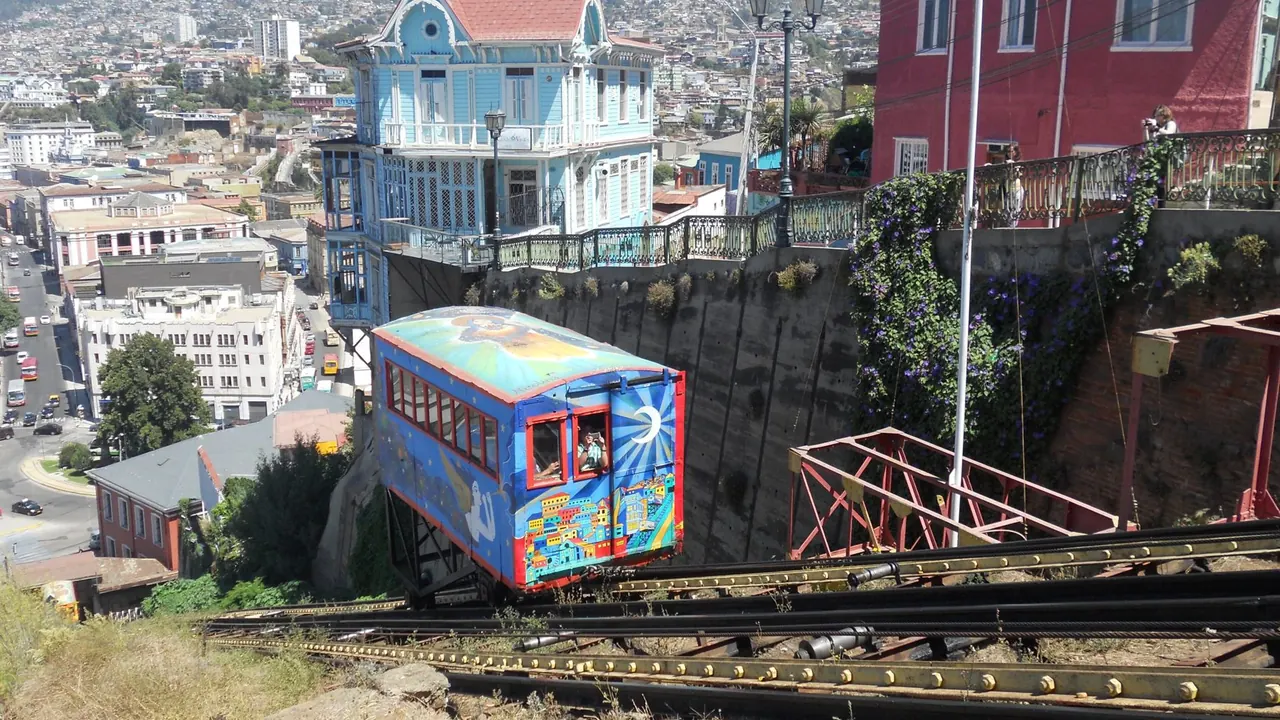
A painted funicular on the hillside
- Day trips63
- Culture & sights62
- Nature & outdoors60
Photo: Maclemo, CC BY-SA 3.0, cropped
Match
46
Every category weighted equally
- Beach & sun44
- Culture & arts49
- Food & nightlife47
- Family trip46
- Outdoors49
- Relax & unwind43
- Shopping & style44
- On a budget47
Valparaiso in twelve categories
Our verdict on each, scored 0 to 100 against the same fixed benchmark cities, so a score means the same thing on every page.
Beaches & swimming. Scores 36 out of 100.
Food & drink. Scores 50 out of 100.
Culture & sights. Scores 62 out of 100.
Nightlife. Scores 56 out of 100.
Nature & outdoors. Scores 60 out of 100.
Day trips. Scores 63 out of 100.
Good for families. Scores 33 out of 100.
Getting around. Scores 44 out of 100.
Shopping & style. Scores 30 out of 100.
Affordability. Scores 60 out of 100.
Live music & performing arts. Scores 38 out of 100.
Wellness & relaxation. Scores 18 out of 100.
Valparaiso category by category
Beaches & swimming
36Valparaíso is a working port, and its own waterfront is docks, breakwaters and rocks rather than sand. The beach life is next door in Viña del Mar, a short ride on the coastal train, and beyond it at Reñaca and Concón, where wide sandy beaches fill with Chilean families through January and February.
The catch is the water. The Humboldt Current keeps the Pacific at about 14-17°C even in midsummer, and strong waves and currents close some beaches to swimming. Most people sunbathe, walk the sand and take a quick, bracing dip. The summers are dry and sunny, so a beach afternoon is easy to fit in, but it adds to a city stay rather than shaping one.
Food & drink
50Eating here is built on the sea and the port. Fishermen's coves such as Caleta Portales sell the morning catch, and simple picadas serve fried fish, machas, conger eel soup and seafood empanadas. The chorrillana, a heap of fries topped with beef, onions and egg made for sharing over beer, belongs to the city's old port bars. The large produce market near the lower town shows how the city shops.
On Cerros Alegre and Concepción, restaurants with harbour views do more ambitious Chilean cooking and pour whites from the Casablanca Valley, less than an hour inland. It is a good, characterful place to eat, but the choice is narrow and quality varies a lot between the hills and the tourist strips.
Culture & sights
62Valparaíso is itself the main sight: an amphitheatre of steep hills covered in brightly painted houses clad in corrugated iron, linked by stairways, alleys and the old funicular lifts that have climbed the cliffs since the late 19th century. The historic quarter around Cerros Alegre and Concepción and the old port is a UNESCO World Heritage Site, with the European merchant houses, churches and banks of the city's 19th-century boom.
La Sebastiana, Pablo Neruda's tall house on Cerro Bellavista, is the best-known museum, and the Open Air Museum murals, the naval and maritime museum on Cerro Artillería and the old prison turned cultural park add more. The pleasure is in wandering the cerros for street art and views rather than in a long list of collections. Two or three days covers it well.
Nightlife
56Universities and a bohemian streak give Valparaíso a livelier night than its size suggests. Evenings start in wine and cocktail bars on Cerro Alegre and Cerro Concepción, then move down to the old port bars and the clubs around Subida Ecuador and the lower town, where students stay out until dawn at weekends. New Year's Eve, when fireworks light up the whole bay, is the biggest night of the year.
It is a scene with character rather than polish, and some of the lower streets feel rough late at night, so taxis between areas make sense. Neighbouring Viña del Mar adds a more conventional club and casino side.
Nature & outdoors
60The landscape is a Pacific coast of rocky headlands, dunes and fishing coves backed by dry coastal hills. Coastal walks run along the cliffs toward Laguna Verde and Quintay, the Concón dunes look over the ocean, and surfers ride the beaches of Ritoque and Maitencillo to the north. Boat trips around the bay pass sea lions on the rocks, and the islets off Cachagua hold Humboldt penguins.
Inland, La Campana National Park, about an hour and a half away, has palm forests and a summit hike Charles Darwin made famous. The high Andes and their ski fields are too far for a comfortable day. Spring brings green hills, while late summer is dry and brown, with fire risk.
Day trips
63Viña del Mar is close enough to feel like part of the same city, with its gardens, palaces and the Fonck museum's Easter Island moai. Santiago, the capital, is about an hour and a half by bus and makes a full day of museums, markets and colonial streets.
The Casablanca Valley, under an hour inland, is cool-climate wine country with many wineries open for tastings. South along the coast, Neruda's house at Isla Negra stands on the rocks above the ocean, and the old whaling cove of Quintay is close by. North, the resort towns of Zapallar and Cachagua have elegant villas and seafood lunches. It is a good, varied list, though few of these are major destinations on their own.
Good for families
33Children tend to love the old funicular lifts, the boat trips round the harbour and the murals on the hills. Viña del Mar next door adds sandy beaches, the Quinta Vergara park and a seafront fun fair in summer. Chileans are warm toward children, and families are welcome in restaurants.
The city itself is tiring with them, though. Getting around means endless steep stairs, broken pavements unsuitable for buggies, traffic on narrow streets and many street dogs, and parts of the lower town need care. There is little made especially for children, so many families stay in Viña and visit Valparaíso for the day.
Getting around
44Valparaíso is compact but vertical. The flat lower town along the bay is easy on foot, while every cerro means steep streets and long stairways, so walking between neighbourhoods is a real workout. The historic funiculars save some climbs, but they do not always run, and local buses and shared colectivo taxis, which follow fixed routes up the hills, do the rest.
The historic trolleybuses still run along the flat streets of the lower town, and the coastal train runs along the shore to Viña del Mar and beyond. No car is needed in the city, and parking on the hills is a challenge. Buses run often to Santiago.
Shopping & style
30Shopping is small-scale and artistic. Galleries and craft studios on Cerros Alegre and Concepción sell prints, ceramics, jewellery and lapis lazuli pieces, and the weekend antiques and flea market near Plaza O'Higgins is good for old maps, vinyl, nautical bric-a-brac and oddities. Few visitors come here to shop, and for malls, chain fashion and anything bigger, people go to Viña del Mar or Santiago.
Affordability
60Day-to-day costs are moderate, and a visitor who lives like a local spends little. The flat lower town and the less-visited hills have many hostels and family-run guesthouses. Simple picadas serve a set lunch of soup, a main course and a drink for very little, and buses, colectivos and funicular rides cost next to nothing. The main sights are cheap to see: much of the pleasure is free, in the stairways, murals and viewpoints, and the house museums charge only a modest entry.
Prices go up on Cerros Alegre and Concepción. Boutique hotels with bay views and the more ambitious restaurants there charge prices closer to international levels, and wine with dinner adds up. Chile is not a budget country by South American standards, so this is a fairly priced city rather than a cheap one. It is best value for travellers who eat in the port and stay in guesthouses rather than on the polished hilltops.
Live music & performing arts
38The most distinctive live music is the city's own: cueca porteña, the port version of Chile's national dance, along with boleros and old waltzes played in traditional bars, often with locals joining in. Street musicians work the cerros, and small bars put on folk, rock and cumbia bands.
Formal culture is limited. The Teatro Municipal hosts concerts, ballet and touring productions, and the arts centre in the old prison stages theatre, dance and exhibitions. Viña del Mar's international song festival each February is a major national event. Anyone looking for opera or a full classical season will need to go to Santiago.
Wellness & relaxation
18This is not a place for spa days. There is no bathing tradition, the sea is too cold for lingering, and wellness amounts to a few massage rooms in boutique hotels plus the larger hotel spas in Viña del Mar. The city is noisy, steep and gritty. Its restful moments are quieter ones: a slow morning on a guesthouse terrace above the bay, or a late afternoon on one of the cliff-edge promenades watching the ships.
When should you go?
Pick a month to see what it is like. The climate figures are measured averages, not a forecast.
Valparaiso in July
Daytime high, °C
Rainfall in the month, mm
The whole year
Shaded against this city’s own year: the deepest cell is its best month for that figure and the palest its weakest.
Where the figures come from
Valparaiso has no rain gauge within 25 km of the centre, so its rainfall comes from a gridded climate dataset read at the city rather than from a gauge further away.
Temperature and rainfall are climate normals, averaged over the years shown. Valparaiso: 2010-2025 (rainfall 1991-2020) normals, Viña Del Mar / Montemar (17 km from centre).
Before you go
| Measure | Valparaiso |
|---|---|
| Official language | Spanish |
| Currency | Chilean Peso (CLP) |
| Sockets | CL220 V, 50 Hz |
| Driving side | Right |
| Time zone | UTC-4, UTC-3 in summer |
| Emergency number | Police 133/134, ambulance 131, fire 132 |
| Elevation | 21 m |
| Main airport | Comodoro Arturo Merino Benítez International Airport (SCL)87 km from centre67 non-stop destinations |
| Public holidays this year | 16 days |
By the numbers
| Measure | Valparaiso |
|---|---|
| City population | 296,655 |
| People per km² | 6,180 |
| Museums within 10 km | 17 |
| UNESCO World Heritage sites within 50 km | 1 |
| Swim season, months above 21 °C | None |
Compare Valparaiso with
Every comparison with a written verdict behind it.