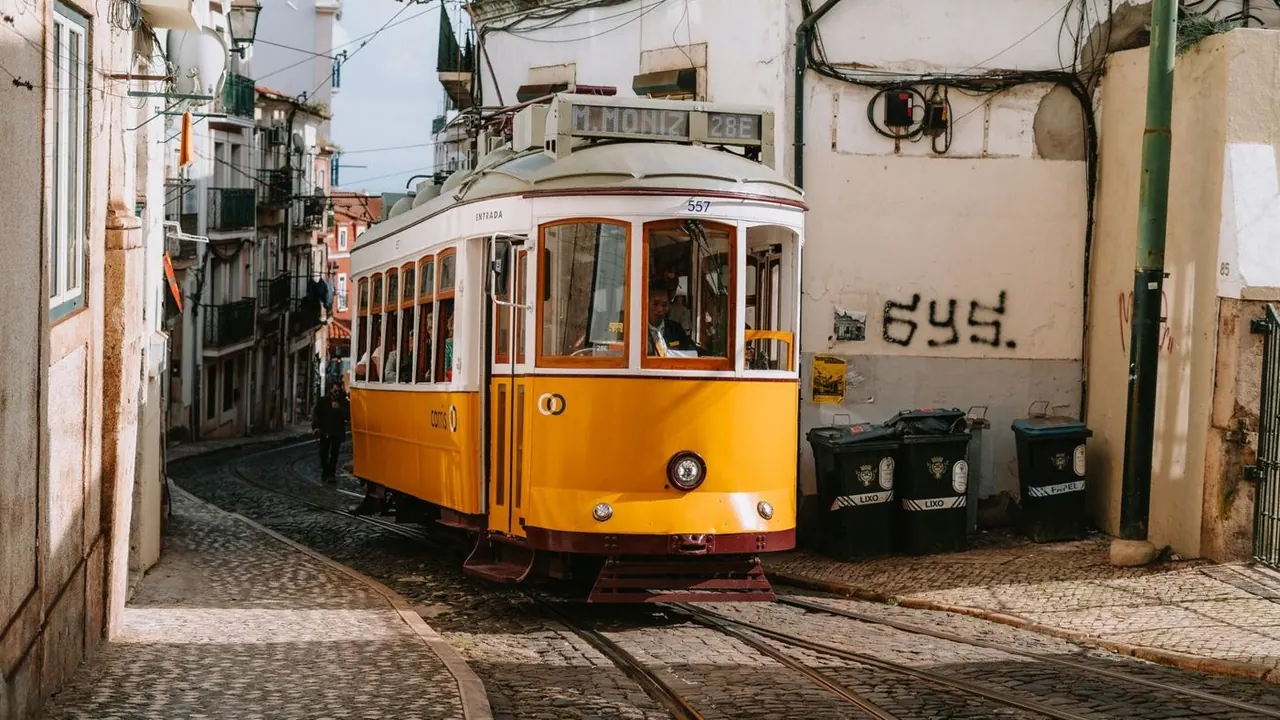

Photos: Lisbon by Riccardo Toso, Pexels License; Valparaiso by Maclemo, CC BY-SA 3.0, cropped.
Lisbon or Valparaiso?
Our verdict in twelve categories, each scored against the same fixed benchmark cities, and the climate month by month, so you can choose for your trip.
Choose Lisbon for
- shopping
- families
- food and drink
Lisbon is the better choice for most trips. It has more to see, better food and wine, a later and larger night out, and a long list of day trips from Sintra to the monasteries of the north. It is also much easier with children and simpler to get around, thanks to the metro and suburban trains. Pick it for a first trip, a family trip or a stay that mixes city sightseeing with beaches and palaces.
Choose Valparaiso for
- prices
Valparaíso suits travellers who care more about atmosphere than about a list of sights. The whole city is the attraction: painted houses on steep hills, old funicular lifts, murals, Neruda's house and port bars where cueca is still danced. It works best as two or three days within a wider trip to Chile, paired with Santiago and the Casablanca wineries, for people who don't mind a rough edge, steep stairs and cold sea.
Scoreboard
Twelve categories on one fixed scale from 0 to 100. The shaded stretch is the gap between the two.
Your match
Pick a travel style or drag the sliders, and both match scores follow your weighting.
Wins on shopping and families with your weighting.
Wins on prices with your weighting.
What matters to you?
Category by category
What the scores mean for a trip.
Beaches & swimming
Neither city has a beach of its own, but Lisbon's are better for swimming and easier to choose between. The Cascais train passes the surf at Carcavelos and the calmer bays of Estoril, Costa da Caparica has miles of sand across the river, and the Arrabida coves have the clearest water. The Atlantic stays cool, but a swim is a real swim from June to September.
Valparaíso's waterfront is all docks and rocks, so beach days mean Viña del Mar, Reñaca or Concón. The sand is wide and sunny, but the Humboldt Current keeps the Pacific a few degrees colder than Lisbon's sea, and strong waves close some beaches, so most people sunbathe and take a quick dip.
Food & drink
Both cities eat from the sea, but Lisbon has much more depth. Family tascas, seafood beer halls, bacalhau cooked many ways, pastelarias on every corner and markets such as Campo de Ourique give plenty of choice, and good Alentejo and Douro wine is poured cheaply almost everywhere.
Valparaíso's cooking is plainer and more tied to the port: fried fish and conger eel soup at simple picadas, the morning catch at Caleta Portales and chorrillana to share over beer. The harbour-view restaurants on Cerro Alegre do more ambitious cooking with Casablanca whites, but the choice is narrow and quality is uneven.
Culture & sights
Lisbon has the stronger sightseeing. The Manueline monuments of Belem, the rebuilt Baixa grid, the castle above Alfama, and museums such as the Gulbenkian and the National Tile Museum fill three or four days.
Valparaíso works the other way round. Its UNESCO-listed hills of painted iron-clad houses, funiculars and murals are the main attraction, and there are fewer collections to visit, with La Sebastiana the highlight. It suits wandering more than museum-going, and two or three days is enough.
Nightlife
Lisbon's nights are bigger and go on later. Crowds fill the lanes of Bairro Alto outside door-hatch bars, then move down to Cais do Sodre, and the riverside warehouse clubs at Santos and Alcantara run until morning. Principe Real adds quieter cocktail bars and the gay scene.
Valparaíso has a student and bohemian night that is lively for a city its size, from the wine bars on Cerro Concepción down to Subida Ecuador. It is rougher, though, and taxis between areas are wise late at night.
Nature & outdoors
Lisbon puts more kinds of landscape within easy reach. The misty Sintra hills, the cliffs at Cabo da Roca, the kitesurfing beach at Guincho, the surf reserve at Ericeira and the limestone ridges of Arrabida, with dolphins in the Sado estuary nearby, each make an easy outing, and the Monsanto forest park gives shaded trails inside the city.
Valparaíso's outdoors is a rockier Pacific shore: cliff walks towards Laguna Verde and Quintay, the Concón dunes, sea lions in the bay and Humboldt penguins off Cachagua. For a proper hike you go to La Campana's palm forests and Darwin's summit, a longer trip inland, and in late summer the hills are dry and brown.
Day trips
Lisbon has one of the best lists of day trips in Europe. Sintra's palaces are a short train ride away, and further out are walled Evora, the UNESCO monasteries of Alcobaca, Batalha and Tomar, and Obidos and Nazare.
Valparaíso's day trips are varied but less impressive. Viña del Mar is almost part of the city, Santiago gives a full day of museums, the Casablanca Valley wineries are close inland, and Neruda's house at Isla Negra sits on the rocks to the south. Few of them would justify a trip on their own.
Good for families
Lisbon is far easier with children. The Oceanário's huge central tank, the science centre and cable car at the Parque das Nacoes, the zoo, and rides on trams and the Santa Justa lift give plenty to do, even though the hills are hard work with a pushchair.
Valparaíso's funiculars and harbour boats please children, but there is little else made for them. Broken pavements, traffic on narrow streets and street dogs make the city tiring, which is why many families stay in Viña del Mar and visit for the day.
Getting around
Lisbon has far more ways to spare your legs. Its four metro lines, the trams, three funiculars, a street lift, suburban trains and river ferries all run on one card, though the metro misses Belem and the steepest old quarters, so some climbing is unavoidable.
Valparaíso has no metro or tram network up its cerros. The coastal train runs along the shore to Viña and trolleybuses work the flat lower town, but the hills rely on funiculars that do not always run, local buses and fixed-route colectivo taxis, and walking between neighbourhoods means long stairways.
Shopping & style
Lisbon is the better place to shop. It ranges from the luxury boulevard of Avenida da Liberdade and the old shops of Chiado to designers in Principe Real and the LX Factory, and its crafts are worth bringing home: azulejos, cork, Burel wool and port.
Valparaíso's shopping is limited to galleries and studios on Cerros Alegre and Concepción, which are good for prints and lapis lazuli, and the weekend flea market near Plaza O'Higgins. For anything bigger, people go to Viña or Santiago.
Affordability
Costs are broadly similar, but they fall in different places. In Lisbon, coffee, tasca lunches, wine and transport are cheap, while central rooms cost as much as elsewhere in southern Europe, especially in summer.
In Valparaíso the gap is between parts of the city. Hostels and guesthouses in the lower town and quieter hills are cheap, and set lunches, buses and funicular rides cost little. The boutique hotels and restaurants on Cerros Alegre and Concepción charge close to international prices.
Live music & performing arts
Each city has a music of its own: fado in Lisbon and cueca porteña with boleros in Valparaíso's port bars. Lisbon's fado houses in Alfama and Mouraria are easier to find on any night.
Lisbon also has a fuller formal programme, with the Gulbenkian orchestra, opera at the Sao Carlos and the Centro Cultural de Belem. Valparaíso has the Teatro Municipal and the arts centre in the old prison, but for opera or a full classical season you have to go to Santiago.
Wellness & relaxation
Neither city has a bathing tradition, so a spa vacation belongs elsewhere. Lisbon still does rest better: hotel spas along the Estoril coast, shady gardens such as the Gulbenkian and Estrela, and quiet nights in the Sintra hills.
Valparaíso has only a few massage rooms in boutique hotels, plus the spas of Viña del Mar. Its restful moments are a terrace above the bay or a cliff-edge promenade watching the ships.
When should you go?
Pick your month. The climate figures are measured averages, not a forecast.
Lisbon in July
Valparaiso in July
Daytime high, °C
Rainfall in the month, mm
Where the figures come from
Valparaiso has no rain gauge within 25 km of the centre, so its rainfall comes from a gridded climate dataset read at the city rather than from a gauge further away.
Temperature and rainfall are climate normals, averaged over the years shown. Lisbon: 1991-2020 normals, Lisboa / Geof (1.1 km from centre). Valparaiso: 2010-2025 (rainfall 1991-2020) normals, Viña Del Mar / Montemar (17 km from centre).
The two cities have opposite seasons. Lisbon is warm and very sunny from June to September, with highs around 28°C, almost no rain and the Atlantic at its warmest, still only about 19°C. July and August can be hot for climbing the hills, so May, June and September are better for walking. Rain sets in from October, the wettest months run from October to January, and winter is mild but often grey.
Valparaíso never gets hot. Its summer runs from December to March, when it is dry and highs reach about 22°C, which is comfortable for the stairways but only just warm enough for a beach afternoon, with the Pacific at around 17°C at best. The southern winter brings the rain, peaking at about 120mm in June, and cool, damp days from May to August. Spring, from September to November, is dry again and the hills turn green.
Which traveller are you?
On a family trip with children, Lisbon wins clearly. Its main attractions for children sit together at the Parque das Nações, on the metro, so a day there takes little planning. In Valparaíso the endless stairs and rough pavements make most days a struggle.
On a trip on a tight budget, Valparaíso has a slight edge if you sleep in a lower-town guesthouse, eat set lunches at picadas and spend the days on its free stairways, murals and viewpoints. In Lisbon, a central room uses up much of what you save on cheap meals and fares.
For a short city break, Lisbon is the easier choice. The metro runs from the airport into the centre, a few days cover the main sights, and Sintra makes an easy last day by train. Valparaíso is better as part of a longer trip through Chile.
Before you go
| Measure | Lisbon | Valparaiso |
|---|---|---|
| Official language | Portuguese | Spanish |
| Currency | Euro (EUR) | Chilean Peso (CLP) |
| Sockets | CF230 V, 50 Hz | CL220 V, 50 Hz |
| Driving side | Right | Right |
| Time zone | UTC, UTC+1 in summer | UTC-4, UTC-3 in summer |
| Emergency number | 112 | Police 133/134, ambulance 131, fire 132 |
| Elevation | 100 m | 21 m |
| Main airport | Lisbon Humberto Delgado Airport (LIS)7 km from centre156 non-stop destinations | Comodoro Arturo Merino Benítez International Airport (SCL)87 km from centre67 non-stop destinations |
| Public holidays this year | 14 days | 16 days |
By the numbers
| Measure | Lisbon | Valparaiso |
|---|---|---|
| City population | 545,796 | 296,655 |
| People per km² | 5,453 | 6,180 |
| Museums within 10 km | 80 | 17 |
| UNESCO World Heritage sites within 50 km | 3 | 1 |
| Swim season, months above 21 °C | None | None |
Where else could you go?
Every comparison below shares a destination with this one, so you can follow Lisbon or Valparaiso somewhere new.