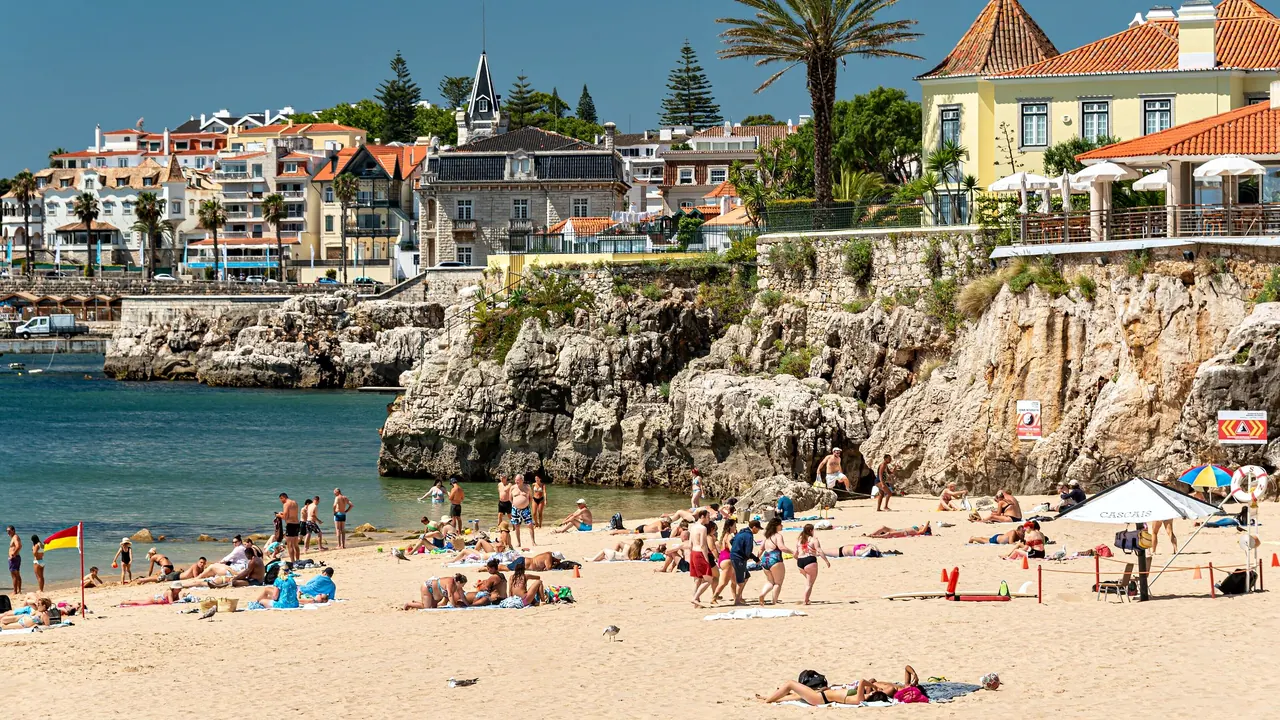

Photos: Cascais by Jorge Franganillo, CC BY 2.0, cropped; Lisbon by Riccardo Toso, Pexels License.
Cascais or Lisbon?
Our verdict in twelve categories, each scored against the same fixed benchmark cities, and the climate month by month, so you can choose for your trip.
Choose Cascais for
- wellness
- beaches
- nature and the outdoors
Cascais suits travellers who want the sea outside the door and a quiet place to come back to. The coves sit right below the old centre, the wild coast towards Guincho and Cabo da Roca is a walk or a bike ride away, and evenings end early. It works best as a calm seaside base, with Lisbon as an easy train ride for the sights and the dinners the town itself lacks.
Choose Lisbon for
- nightlife
- culture and sights
- live music and the arts
Choose Lisbon if the city itself is the reason for the trip. Belém's monuments, the lanes of Alfama, the Gulbenkian, fado in the neighbourhoods where it grew up, tasca cooking and late nights in Bairro Alto all outclass anything Cascais has. Everyday costs are also lower. The beaches are a train ride away instead of a stroll, and the hills and crowds make it a more tiring place to rest.
Scoreboard
Twelve categories on one fixed scale from 0 to 100. The shaded stretch is the gap between the two.
Your match
Pick a travel style or drag the sliders, and both match scores follow your weighting.
Wins on wellness and beaches with your weighting.
Wins on nightlife and culture and sights with your weighting.
What matters to you?
Category by category
What the scores mean for a trip.
Beaches & swimming
Cascais has the edge because the beach is part of the town. Conceição, Duquesa and Rainha sit just below the old centre in a south-facing bay with calm water, and the promenade leads on to Estoril. Lisbon, on the estuary, has no beach of its own, so every swim begins with the train out along the same coast, or a trip across the river.
What Lisbon gains is range. Costa da Caparica's long Atlantic sand is across the river, and the sheltered Arrábida coves are about an hour by car. The sea is equally cool from both, never much above 19°C.
Food & drink
Lisbon is far the stronger place to eat. Its family tascas, seafood beer halls, bifana counters, warm custard tarts and Alentejo or Douro wine poured cheaply by the glass give real depth, and the best meals are in residential quarters away from Baixa.
Cascais does one thing well: fish from its own harbour, grilled simply, plus long seafront lunches on the road to Guincho and the Mercado da Vila for produce. Beyond that, tourist menus dominate the old centre, and keen eaters take the train into the capital for dinner.
Culture & sights
Cascais has an attractive small-town heritage but few major sights. The villas of the aristocrats who followed the royal family's summers give the seafront its look, with the Citadel guarding the bay and the red pyramid towers of the Casa das Histórias Paula Rego nearby. Add the wave-patterned cobbles of the old centre and you have one easy day on foot.
Lisbon has far more to see. Belém has the Manueline Jerónimos Monastery and its tower from the age of discovery. The Baixa is the grid of streets rebuilt after the 1755 earthquake, and medieval Alfama climbs to the castle. With the Gulbenkian and the National Tile Museum as well, three or four full days of sightseeing pass easily.
Nightlife
Lisbon is the place for a night out. Bairro Alto's lanes fill with people drinking outside small bars, Cais do Sodré runs later, Príncipe Real has the cocktail bars and gay scene, and the riverside warehouse clubs fill after 2am.
Cascais keeps to wine bars, pubs and summer terraces in a few old-centre streets, with the Estoril casino for a dressier evening. Outside high summer it is quiet by midnight, and a night in Lisbon means watching the last train home.
Nature & outdoors
Both share the same outdoor country: the misty Sintra hills, Cabo da Roca and the wind-blown dunes and surf of Guincho. The difference is distance. From Cascais you reach Boca do Inferno and Guincho on foot or by the coastal cycle path, while from Lisbon the wild coast is a day out.
Lisbon makes up for it with Monsanto forest park and the long riverside path within the city. It is also better placed for the south bank, where the Arrábida ridges, kayaking and the Sado dolphins boat trips from Setúbal lie.
Day trips
Both are excellent bases, but the outings differ. From Cascais, the main day trip is Lisbon itself, about 40 minutes by train past Belém, with Sintra just over the ridge and Ericeira and Mafra close by.
Lisbon sits at the centre of the rail and road network. That puts Évora, the monasteries of Alcobaça and Batalha, Tomar, Óbidos and Nazaré within a more comfortable day, while from Cascais the further of them are a stretch.
Good for families
Each works for families, but in opposite ways. Cascais is easy to be in: small and calm, with shallow coves, a flat promenade for scooters and pushchairs, and a park with peacocks and a playground. What it lacks is anything built for children.
Lisbon has those attractions: the Oceanário, the science centre and cable car at Parque das Nações, the zoo, and trams and funiculars to ride. The cost is the steep hills, stairways and slippery pavements that make every outing with a buggy harder work.
Getting around
Cascais is a compact town you can walk. The harbour, the coves and the old centre are a short stroll apart, the seafront path carries on to Estoril, and the coastal train runs straight along the shore into Lisbon. Getting around beyond the town is harder. Buses to the wild coast and the Sintra hills are slower and less frequent, so a car is worth having.
Lisbon is a hilly city with a full transport network. A clear metro, historic trams, funiculars, the Santa Justa lift, suburban trains and river ferries all run on one card. Even so, much of the sightseeing still means climbing on foot over stone pavements that get slippery, and the old trams are slow and crowded.
Shopping & style
Lisbon offers far more. Avenida da Liberdade has the luxury houses, Chiado the old shops, bookshops and glove makers, Príncipe Real its designers and antiques, and the Feira da Ladra and LX Factory add flea-market finds and independent shops.
Cascais sells some of the same crafts, such as tiles, cork and tinned fish, alongside beachwear and surf brands in its pedestrian streets. That makes it good for a browse, and anything more serious means the train to the capital.
Affordability
Lisbon is the cheaper stay. Coffee, tasca lunches, house wine and transport cost little, and although central rooms are not cheap, staying a little outside the centre keeps the bill down.
Cascais is an upmarket resort, with seafront hotels and harbour restaurants priced high for Portugal, especially in July and August. Set lunches in the back streets help, and coming outside high summer makes the biggest difference.
Live music & performing arts
Lisbon has fado every night in Alfama, Mouraria and Bairro Alto, sung in places ranging from polished dining rooms to tiny neighbourhood rooms. Behind it come the Gulbenkian orchestra, opera at São Carlos and the programme at the Centro Cultural de Belém.
Cascais has little to compare. There are Portuguese-language plays by the long-running Teatro Experimental, cabaret at the Estoril casino and summer outdoor concerts with a jazz tradition. For fado or opera, you go into Lisbon.
Wellness & relaxation
Cascais is the better place to unwind. Its days are slow, with seafront walks and early nights, and Estoril's history as a thermal-spring resort lives on in its spas, thalassotherapy and yoga by the sea. Summer weekends do bring crowds from the capital.
Lisbon's calm comes in pockets, such as the Gulbenkian and Estrela gardens or an afternoon at a viewpoint, but the old quarters are noisy and steep. Its own spa options largely point back to the hotels along the Estoril coast. Neither place has a public bathing tradition.
When should you go?
Pick your month. The climate figures are measured averages, not a forecast.
Cascais in July
Lisbon in July
Daytime high, °C
Rainfall in the month, mm
Temperature and rainfall are climate normals, averaged over the years shown. Cascais: 1991-2020 normals, Lisboa / Geof (23.6 km from centre). Lisbon: 1991-2020 normals, Lisboa / Geof (1.1 km from centre).
Both places share the same weather, so the question is less when to go than what you do once you are there. Beach weather runs from June to September, when the days are dry and long and the Atlantic reaches about 19°C at best. It is fresh enough that a swim stays short in either place. July and August are hot at around 28°C. That is pleasant on the flat seafront at Cascais, but harder work climbing Lisbon's hills and stairways in the afternoon.
For walking, May and late September are the sweet spot, with highs near 23°C and little rain. They suit the city sightseeing and the trails of the Sintra hills and the Guincho coast equally well. The rain returns in October and peaks in November at around 121mm. Winter stays mild at about 15°C, which makes it fine for museums in Lisbon but leaves a quiet beach town like Cascais with less to do.
Which traveller are you?
On a culture and arts trip, Lisbon is the clear choice. The Jerónimos Monastery, the Gulbenkian, the Tile Museum and nightly fado in Alfama fill several days, while Cascais has a pleasant day of villas and the Paula Rego museum, then sends you to the capital.
For a food and nightlife trip, stay in Lisbon. Neighbourhood tascas, seafood beer halls and cheap wine by the glass are followed by street drinking in Bairro Alto and riverside clubs until morning, while Cascais offers harbour fish and is mostly asleep by midnight.
On a relaxing and wellness trip, Cascais suits better. The pace is slow, the seafront promenade invites unhurried mornings, and Estoril's spa and thalassotherapy tradition is close by, whereas Lisbon's old quarters are noisy, crowded and steep.
Before you go
| Measure | Cascais | Lisbon |
|---|---|---|
| Official language | Portuguese | Portuguese |
| Currency | Euro (EUR) | Euro (EUR) |
| Sockets | CF230 V, 50 Hz | CF230 V, 50 Hz |
| Driving side | Right | Right |
| Time zone | UTC, UTC+1 in summer | UTC, UTC+1 in summer |
| Emergency number | 112 | 112 |
| Elevation | 0 m | 100 m |
| Main airport | Lisbon Humberto Delgado Airport (LIS)26 km from centre157 non-stop destinations | Lisbon Humberto Delgado Airport (LIS)7 km from centre157 non-stop destinations |
| Public holidays this year | 14 days | 14 days |
By the numbers
| Measure | Cascais | Lisbon |
|---|---|---|
| City population | 214,124 | 545,796 |
| People per km² | 2,198 | 5,453 |
| Museums within 10 km | 6 | 80 |
| UNESCO World Heritage sites within 50 km | 3 | 3 |
| Swim season, months above 21 °C | None | None |
Where else could you go?
Every comparison below shares a destination with this one, so you can follow Cascais or Lisbon somewhere new.
- Sintravs Cascais
- Sintravs Lisbon
- Coimbravs Lisbon
- Lagos, Portugalvs Lisbon
- Coimbravs Cascais
- Lagos, Portugalvs Cascais