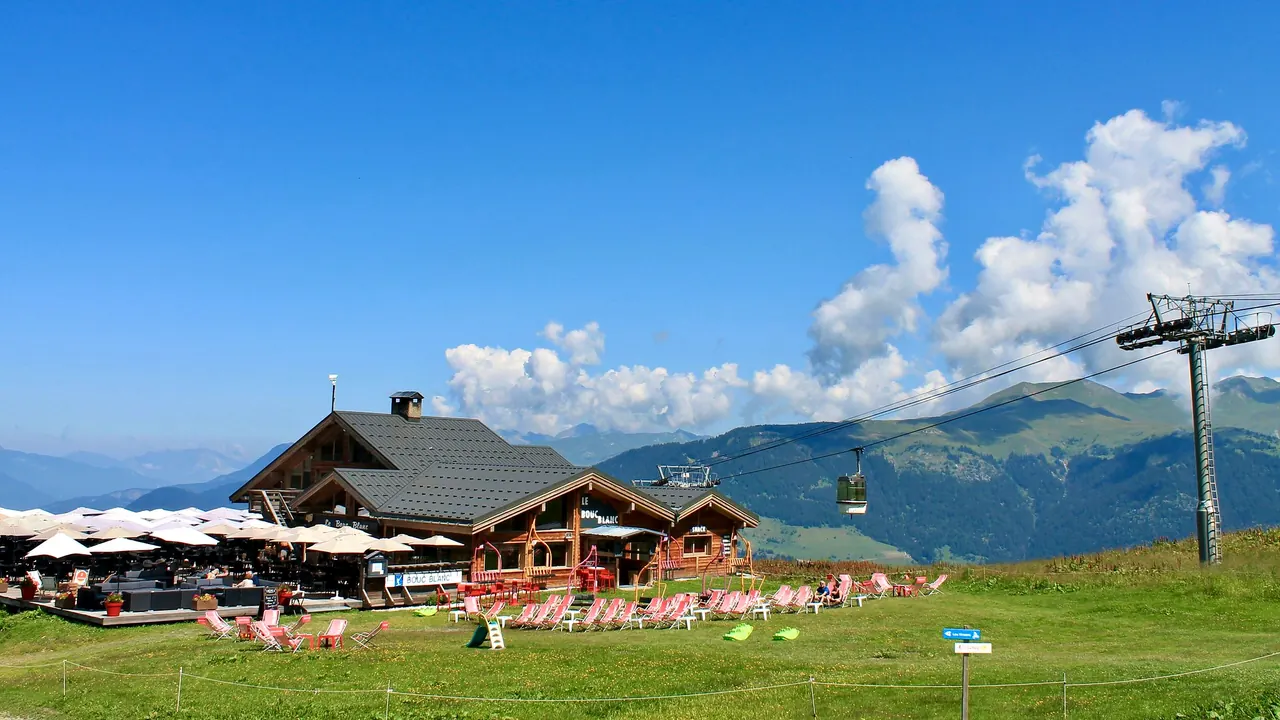
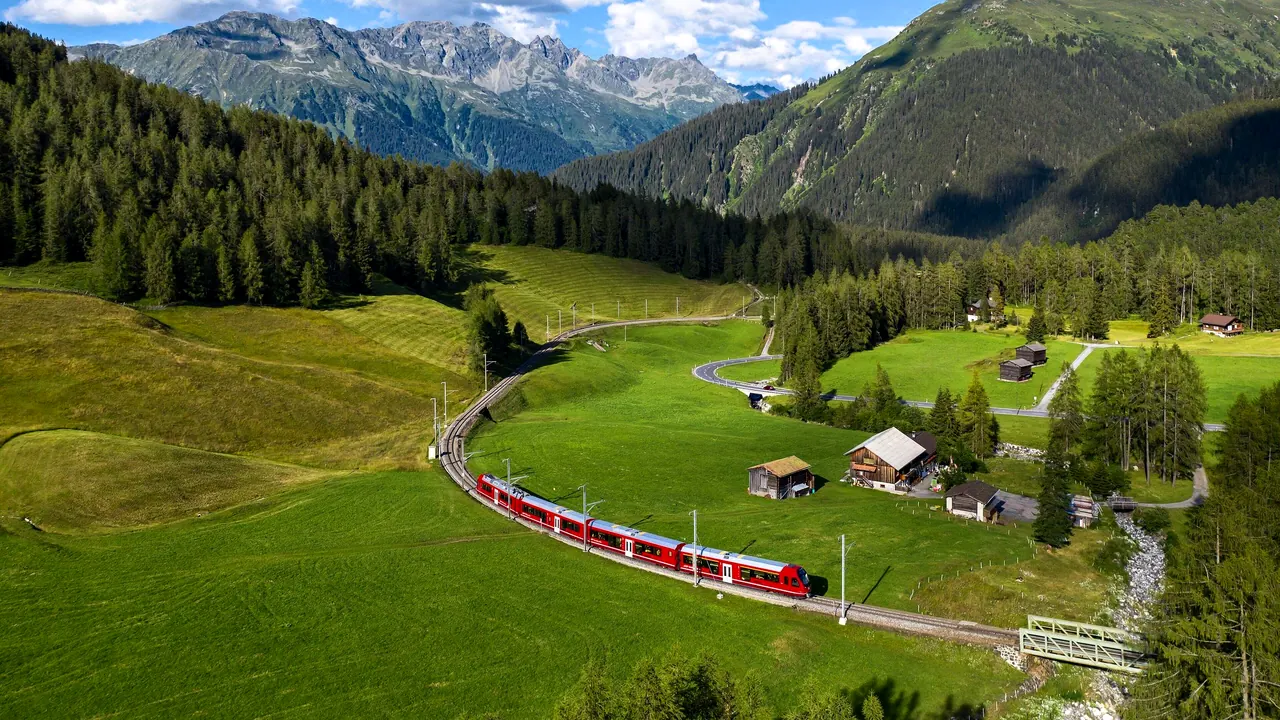
Photos: Courchevel by B. Brassoud, CC BY-SA 4.0, cropped; Davos by Kabelleger / David Gubler, CC BY-SA 4.0, cropped.
Courchevel or Davos?
Our verdict in twelve categories, each scored against the same fixed benchmark cities, and the climate month by month, so you can choose for your trip.
Choose Courchevel for
- food and drink
- shopping
- nightlife
Courchevel is the choice for a ski week where the evenings matter as much as the pistes. You step straight into Les 3 Vallées, the largest linked ski area in the world, and come back to starred dining, slope-side terraces and late clubs in 1850. It suits skiers with a generous budget who want to stay put, ski hard and eat very well, and who have no plans to leave the mountain.
Choose Davos for
- getting around
- day trips
- culture and sights
Davos makes more sense if you want a working mountain town rather than a pure resort. It is easier to reach and get around without a car, the Rhaetian Railway opens up St Moritz, Chur and the Engadine for days off, and there is a layer of history in the sanatoria and the Kirchner Museum. Cross-country skiers, summer hikers and travellers who like a little culture with their mountains will feel more at home here.
Scoreboard
Twelve categories on one fixed scale from 0 to 100. The shaded stretch is the gap between the two.
Your match
Pick a travel style or drag the sliders, and both match scores follow your weighting.
Too close to call, 1 point apart
Wins on food and drink and shopping with your weighting.
Wins on getting around and day trips with your weighting.
What matters to you?
Category by category
What the scores mean for a trip.
Beaches & swimming
Neither has anything like beach life, and the swimming in each is roughly as limited. What differs is the setting. Davos has a proper lido on the Davosersee at the edge of town, with lawns and a jetty. Courchevel's summer swim is the small, chilly Lac de la Rosière above Moriond, more for a paddle and a lie on the grass. In both, the indoor pools are what you will actually use.
Food & drink
Courchevel eats in a different league. The palace hotels of 1850 hold some of France's most celebrated starred kitchens, and lunch on the slopes is a long affair of grilled meats, seafood and serious wine. Savoyard fondue, tartiflette and Beaufort cover the everyday side.
Davos is more modest. The pleasure there is regional: capuns, pizokel, barley soup and Bündnerfleisch, best eaten in mountain huts and the side valleys. In town the range drops to hotel dining, pizza and raclette.
Culture & sights
Davos has a real if short list of sights, enough for a day or two. The old sanatoria such as the Schatzalp recall its tuberculosis era and The Magic Mountain, and the Kirchner Museum holds the largest collection of the Expressionist painter's work. The church of St Johann and a winter sports museum round it out.
Courchevel was built for skiing after the war and offers little beyond the 1992 Olympic ski jumps at Le Praz, some modernist chalets and a few hamlet chapels.
Nightlife
In winter Courchevel has the bigger night out, though a narrow one. In 1850 après-ski on the terraces leads into hotel bars and a few lavish clubs running on champagne until the early hours, aimed squarely at big spenders.
Davos is more pub than club. Après-ski at the foot of the Jakobshorn and Parsenn carries on in hotel bars and a couple of small clubs along the Promenade, and it is lively mainly at weekends. In summer both towns go quiet after dinner.
Nature & outdoors
Both are first-rate mountain bases, but they suit different kinds of outdoor days. Courchevel is a downhill skier's place. It sits in Les 3 Vallées, where linked pistes run for hundreds of kilometres to Méribel and Val Thorens and back, with immaculate grooming and steep couloirs off the Saulire. In summer the Vanoise National Park, with its glaciers and ibex, is on the doorstep.
Davos spreads its appeal wider. Parsenn, Jakobshorn and its other separate ski areas sit alongside more than 100km of cross-country trails reaching into the Sertig and Dischma valleys. Its summer is the stronger one, with lifts serving a dense network of hiking and biking routes and the Swiss National Park within a day's reach.
Day trips
Davos is the better base for days off the slopes, largely thanks to the train. The Albula line over the Landwasser Viaduct to St Moritz, medieval Chur and the painted houses of Guarda are all within an hour or two, and the journey itself is part of the outing.
From Courchevel, every trip begins with the winding road down to Moûtiers. Conflans, Beaufort, Chambéry and Annecy are rewarding, but few skiers bother to make the effort.
Good for families
For a ski week with young children, Courchevel has a slight edge. The sunny beginner slopes at Moriond and Village are easy, the lifts are free for beginners and the ski schools are big. Away from the snow it has little for children, and 1850 is built around adult luxury.
Davos is the better all-year family town. It has toboggan runs from the Schatzalp, a large natural ice rink, mountain playgrounds and the lakeside lido in summer, and free buses make it easy to get about.
Getting around
Davos is much the easier of the two, from arrival onwards. It has two railway stations on the line from Zurich, buses that are usually free with the guest card, and a funicular and cable car leaving from town. A car is unnecessary, though the 4km length is long on foot.
Courchevel is simple once you are there, thanks to free shuttles, a gondola from Le Praz and ski-in, ski-out chalets. Getting there is another matter: the 25km climb of hairpins from Moûtiers can need snow chains.
Shopping & style
Courchevel 1850 has more to browse, mostly at the top end. A short run of luxury fashion houses, jewellers and watchmakers opens for winter beside very good ski shops, and Savoyard cheese and wooden crafts make the souvenirs. Davos's Promenade covers ski gear, some Swiss watches and delicatessens selling Nusstorte and Bündnerfleisch, a pleasant evening stroll rather than a reason to come.
Affordability
Both are about as expensive as mountain vacations get, so the question is where the cost falls. In Courchevel it is the rooms in 1850 and the full 3 Vallées lift pass. Le Praz, Village and La Tania soften it a little. In Davos the expense is Swiss pricing across the board, and the World Economic Forum week in January is especially costly. The free buses and the cheaper early summer and autumn seasons help.
Live music & performing arts
Neither is a place for a night at the theatre, but Davos has a little more. Its summer classical festival brings young musicians to churches and hotels around the valley, and the congress centre hosts the odd concert. Courchevel's offer stops at occasional seasonal events and live bands during après-ski.
Wellness & relaxation
Courchevel's idea of wellness is the palace-hotel spa, and few mountain resorts do it more lavishly. Expect pools under timber roofs, hammams and treatments designed for the end of a ski day, and many of these spas take non-residents. The aquatic centre in Courchevel Village has a plainer sauna and steam room with mountain views. There is no thermal tradition, and summer is the calmest time to come.
Davos starts from its past as a health resort, when patients came for the dry, clear air, and that air is still half the point. Hotel spas and the sauna area at the leisure pool are what you use day to day. The mineral baths of Scuol, about an hour away through the Vereina tunnel, add the proper thermal soak that Courchevel lacks.
When should you go?
Pick your month. The climate figures are measured averages, not a forecast.
Courchevel in July
Davos in July
Daytime high, °C
Rainfall in the month, mm
Where the figures come from
Courchevel has no weather station within reach, so its figures come from a gridded climate model rather than a measured record, and read a broad area rather than one spot.
Davos's temperatures are measured 53 km from the centre, at S. Valentino Alla Muta.
Davos has no rain gauge within 25 km of the centre, so its rainfall comes from a gridded climate dataset read at the destination rather than from a gauge further away.
Temperature and rainfall are climate normals, averaged over the years shown. Courchevel: 2001-2020 normals, NASA POWER reanalysis grid, no weather station within 90 km. Davos: 1991-2020 normals, S. Valentino Alla Muta (53.4 km from centre).
Both are mountain places first, and neither is ever warm enough for a beach trip. Courchevel is the colder of the two by a clear margin: daytime highs stay below freezing from December to February, around -4°C in January, which keeps the snow reliable for a long winter season. Davos, lower down, reaches about 2°C on winter days. That is still proper ski weather, and a little kinder for walking the Promenade between runs.
Summer is short in both. Highs peak around 18°C in Courchevel and 20°C in Davos in July and August, comfortable for hiking. The difference is the rain. Davos turns distinctly wet from June to September, with around 140mm in August, so expect afternoon showers on the trails. Courchevel's wettest month is May, and its summer is drier. Late spring and November are the dull in-between months in both.
Which traveller are you?
On a food and nightlife trip, Courchevel is the stronger pick. Its 1850 village has a cluster of Michelin-starred hotel kitchens, long terrace lunches on the slopes and a glamorous late scene in winter. Davos offers good Graubünden mountain cooking but a small night out.
For a culture and arts trip, Davos gives you more to do between outdoor days. There is the Kirchner Museum, the sanatorium history behind The Magic Mountain and a summer classical festival. Courchevel has little beyond the Olympic ski jumps at Le Praz.
For a short city break, Davos is far easier. The train from Zurich takes a little over two hours, the town runs on free buses and lifts leave from the streets. Reaching Courchevel means a long climb by road from Moûtiers before the stay even begins.
Before you go
| Measure | Courchevel | Davos |
|---|---|---|
| Official language | French | French, German, Italian, Romansh |
| Currency | Euro (EUR) | Swiss Franc (CHF) |
| Sockets | CE230 V, 50 Hz | CJ230 V, 50 Hz |
| Driving side | Right | Right |
| Time zone | UTC+1, UTC+2 in summer | UTC+1, UTC+2 in summer |
| Emergency number | 112 | 112 |
| Elevation | 1,757 m | 1,559 m |
| Main airport | Geneva International Airport (GVA)100 km from centre150 non-stop destinations | Zürich Airport (ZRH)122 km from centre226 non-stop destinations |
| Public holidays this year | 11 days | 9 days |
By the numbers
| Measure | Courchevel | Davos |
|---|---|---|
| Population | - | 10,738 |
| People per km² | - | 38 |
| Museums within 10 km | 0 | 3 |
| UNESCO World Heritage sites within 50 km | 0 | 2 |
Where else could you go?
Every comparison below shares a destination with this one, so you can follow Courchevel or Davos somewhere new.
- Méribelvs Courchevel
- Klostersvs Davos
- La Plagnevs Courchevel
- Arosavs Davos
- Les Menuiresvs Courchevel
- Val Thorensvs Courchevel