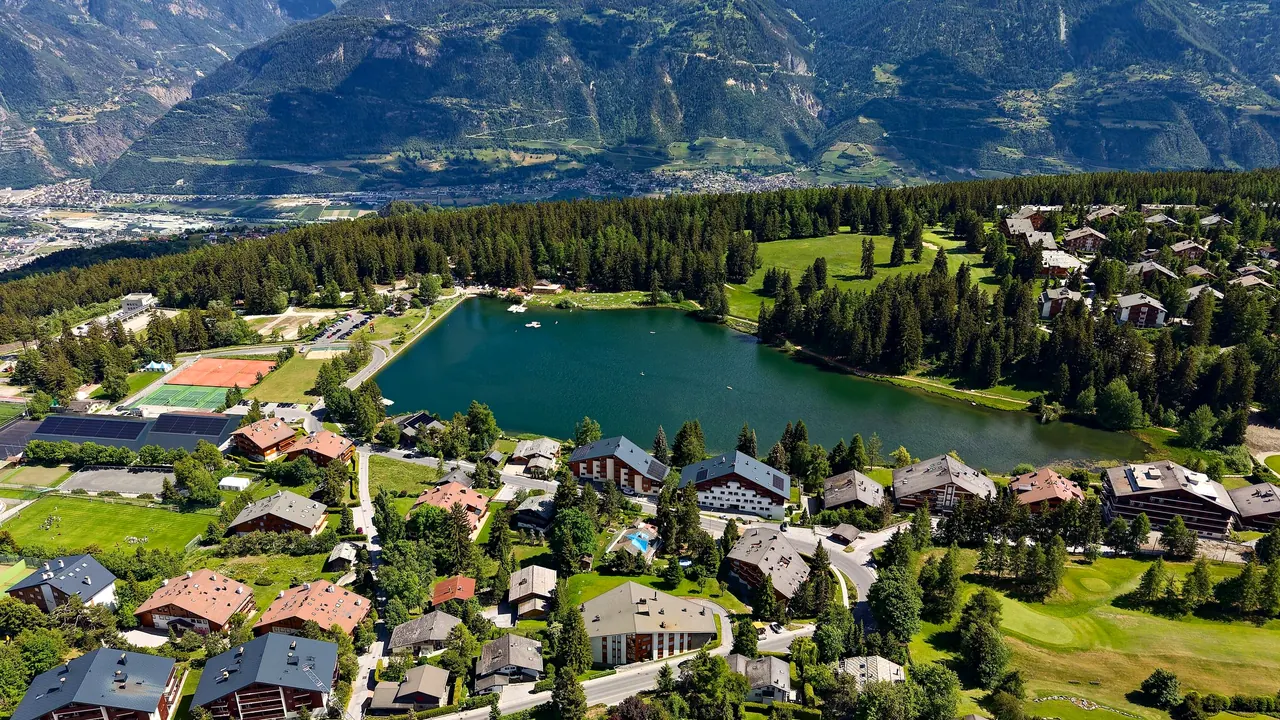
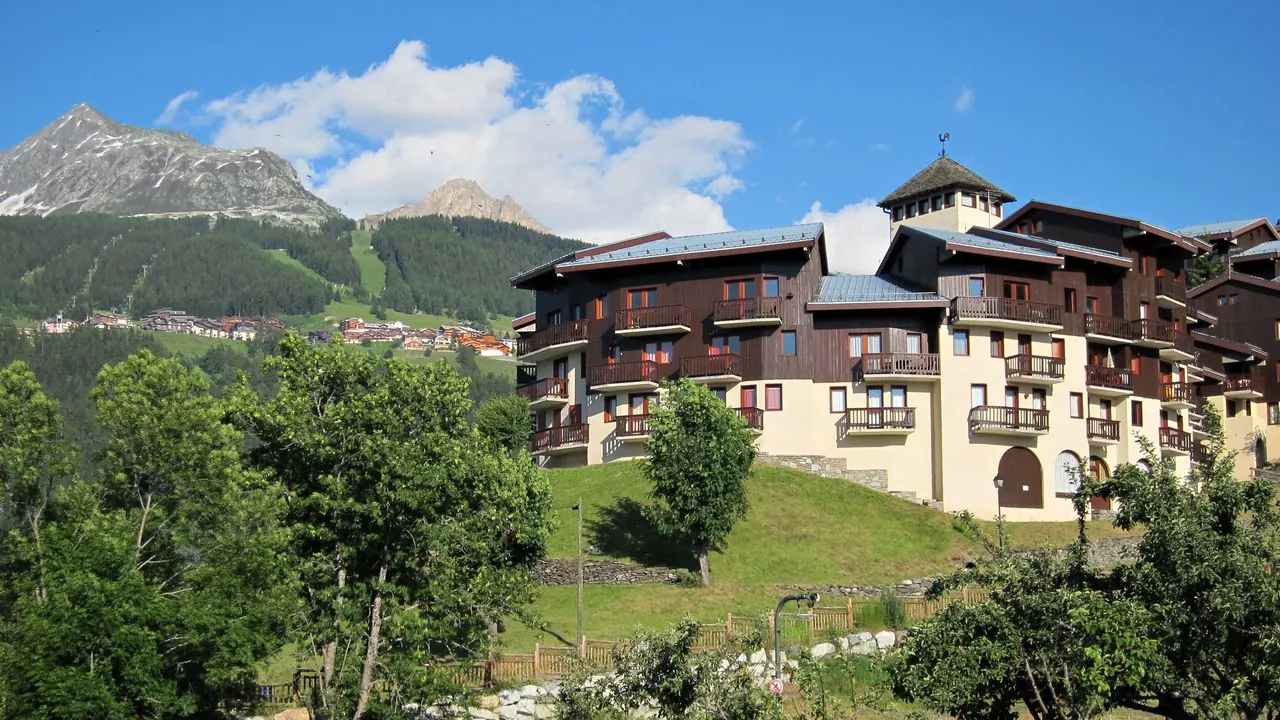
Photos: Crans-Montana by Daniel Reust, CC BY-SA 4.0, cropped; La Plagne by Henk Monster, CC BY 3.0, cropped.
Crans-Montana or La Plagne?
Our verdict in twelve categories, each scored against the same fixed benchmark cities, and the climate month by month, so you can choose for your trip.
Choose Crans-Montana for
- shopping
- day trips
- live music and the arts
Crans-Montana suits travellers who want an alpine stay with polish and the option to leave the mountain. The funicular to the Rhône valley railway brings Sion's castles, the vineyards and Lake Geneva within reach, and the resort adds hotel spas, upmarket boutiques and festival weeks of music. It is the better choice for couples and adults who want comfort as well as pistes and paths, as long as cost is not a worry.
Choose La Plagne for
- prices
- families
- nature and the outdoors
La Plagne is built for the ski week itself, especially with children. Car-free villages sit on the snow, ski schools run big programmes for little ones, and the Paradiski link gives keen skiers enormous terrain to cover. Self-catering apartments keep the bill more manageable than on the Swiss side, but there is less to do once you are off the slopes, and leaving the resort really needs a car.
Scoreboard
Twelve categories on one fixed scale from 0 to 100. The shaded stretch is the gap between the two.
Your match
Pick a travel style or drag the sliders, and both match scores follow your weighting.
Wins on shopping and day trips with your weighting.
Wins on prices and families with your weighting.
What matters to you?
Category by category
What the scores mean for a trip.
Beaches & swimming
Neither is a swimming destination, but Crans-Montana has the edge. In July and August Lac Moubra and Lac Grenon on the plateau warm up enough for a proper dip, with lawns and pontoons for an afternoon. La Plagne's mountain lakes stay too cold for most people, so swimming there means the heated pools at the resort's leisure centres.
Food & drink
Both kitchens are cheese-led mountain cooking, Valais raclette and dried meat on one side, Savoyard tartiflette, Beaufort and Reblochon on the other. Crans-Montana pulls slightly ahead thanks to the vineyards just below, where Petite Arvine and Cornalin are worth ordering, and a few ambitious gastronomic tables kept going by wealthy guests.
La Plagne is at its best at lunch on a sunny chalet terrace between runs. In the villages it is mostly pizzerias and crêperies, and many visitors simply cook in their apartments.
Culture & sights
Neither resort has much to offer here, and from both you go down to the valley for history. What they do have comes from different eras. Crans-Montana grew out of sanatoriums and grand hotels and keeps a few buildings from that time. La Plagne was built from scratch for skiing in the 1960s, and its curiosities are the beached-liner block of Aime 2000 and the Olympic bob track.
Nightlife
The scenes are similar in size but not in mood. Crans-Montana moves from terrace après-ski to piano lounges, hotel bars and a couple of late clubs for a smart, moneyed crowd, busiest at Christmas and in February.
La Plagne is more pubs and loud bars at the foot of the slopes in Plagne Centre and Belle Plagne, with a small club or two. Its family clientele tends to call it a night early. Out of season both are very quiet.
Nature & outdoors
Both are first-rate mountain bases, so the choice comes down to scale against scenery. La Plagne, as part of Paradiski and linked to Les Arcs by the Vanoise Express, offers far more skiing, plus wildlife in the Vanoise National Park via Champagny-le-Haut.
Crans-Montana has around 140km of sunny, gentler pistes up to the Plaine Morte glacier and a wide panorama from the Matterhorn to Mont Blanc. Its summer has things La Plagne does not, such as walks along the level bisse channels and some very scenic golf.
Day trips
Crans-Montana is far better for outings. The funicular to Sierre joins the main valley railway, so Sion's hilltop castles, Martigny, Saint-Maurice abbey and even the Lavaux terraces and Chillon on Lake Geneva are all easy without a car.
From La Plagne everything starts with the long drive down the mountain. Aime's basilica and walled Conflans are close, but Chambéry, Annecy and summer runs over the passes into the Beaufortain or Aosta Valley need a car and a full day.
Good for families
La Plagne was designed around families, and it shows. Ski-in villages with no cars let children walk straight onto gentle slopes, and ski schools, snow gardens and kids' clubs work on a large scale.
Crans-Montana works well for families who ski or hike, with children's areas at the ski schools and pedalos at the lakes. Its villages are spread over a hillside, though, so with toddlers you depend on the shuttles more.
Getting around
Crans-Montana is easier to reach, as the funicular from Sierre ties straight into Swiss mainline trains, so you can come and go without a car. Once there, its spread-out villages rely on free shuttle buses.
La Plagne turns that round. Inside the resort it is effortless, ski-in ski-out with compact villages and the lifts doing the work, but the approach is a bus or drive up a winding road from Aime, often with snow chains, and the valley is awkward to reach without your own wheels.
Shopping & style
Crans-Montana stands well apart here. Its few central streets hold fashion labels, Swiss watchmakers, jewellers and designer ski wear, plus delicatessens selling Valais wine and dried meats.
La Plagne's shops are purely practical: ski hire, outdoor gear and groceries. The best things to take home are Beaufort, génépi and honey from the produce counters.
Affordability
Both are expensive, but Crans-Montana is the harder one on the wallet. Lodging, lift passes and even simple terrace meals sit far above most of Europe, and going out of season barely helps.
La Plagne is pricey in winter too, but its many self-catering apartments are a real way to cut costs, and summer or quieter ski weeks bring noticeable savings.
Live music & performing arts
Crans-Montana at least has its festival weeks: Caprices brings electronic music to the slopes at the end of the ski season, and a summer chamber and classical series fills its churches and halls. La Plagne has little beyond après-ski bands, torchlight descents and the odd open-air concert, with Chambéry the nearest place for theatre.
Wellness & relaxation
Crans-Montana is the more restful of the two. It began as a place to convalesce, its large hotels run full spas that welcome outside guests, and Leukerbad's alpine hot pools are under an hour away.
La Plagne's spas and aquatic centres are mostly for soaking after skiing, and a ski week there is active rather than restful. For thermal water you drive down to Brides-les-Bains or La Léchère.
When should you go?
Pick your month. The climate figures are measured averages, not a forecast.
Crans-Montana in July
La Plagne in July
Daytime high, °C
Rainfall in the month, mm
Where the figures come from
Crans-Montana has no weather station within reach, so its figures come from a gridded climate model rather than a measured record, and read a broad area rather than one spot.
La Plagne has no weather station within reach, so its figures come from a gridded climate model rather than a measured record, and read a broad area rather than one spot.
Temperature and rainfall are climate normals, averaged over the years shown. Crans-Montana: 2001-2020 normals, NASA POWER reanalysis grid, no weather station within 90 km. La Plagne: 2001-2020 normals, NASA POWER reanalysis grid, no weather station within 90 km.
Both resorts are below freezing at midday from December to February, so that is the core snow season, with March still wintry and La Plagne, being higher, holding its cold a little longer. Crans-Montana's sunny terrace runs slightly milder all year, around -2°C in January against -4°C at La Plagne. April, May, October and November are the in-between months in both places, when many lifts and kitchens close.
Summer peaks at about 18°C in July and August in both, which is ideal for hiking and biking rather than for heat. That is also the only stretch when Crans-Montana's small lakes are warm enough to swim in. The main difference is rain: Crans-Montana gets well over 120mm a month from May to August, often as afternoon storms, while La Plagne's summers are noticeably drier at nearer 80mm.
Which traveller are you?
On a relaxing and wellness trip, Crans-Montana is the calmer option. Such a trip needs slow days, sunshine and comfortable places to unwind, and the Swiss plateau gives you all three. La Plagne's days are set by first lifts and ski-school mornings, which makes for an active week rather than a restful one.
On a family trip with young children, La Plagne is the easier choice. Small children need short distances and everything close to the door, and this resort was planned around beginners and ski schools. Crans-Montana also works for families, but its spread-out layout means more planning for parents.
For a trip on a tight budget, La Plagne is the more realistic of two costly resorts. Cooking for yourself is easy and common there, and avoiding the peak winter weeks makes a real difference. The Swiss resort gives you far fewer ways to bring the bill down.
Before you go
| Measure | Crans-Montana | La Plagne |
|---|---|---|
| Official language | French, German, Italian, Romansh | French |
| Currency | Swiss Franc (CHF) | Euro (EUR) |
| Sockets | CJ230 V, 50 Hz | CE230 V, 50 Hz |
| Driving side | Right | Right |
| Time zone | UTC+1, UTC+2 in summer | UTC+1, UTC+2 in summer |
| Emergency number | 112 | 112 |
| Elevation | 1,495 m | 1,974 m |
| Main airport | Geneva International Airport (GVA)106 km from centre150 non-stop destinations | Geneva International Airport (GVA)92 km from centre150 non-stop destinations |
| Public holidays this year | 9 days | 11 days |
By the numbers
| Measure | Crans-Montana | La Plagne |
|---|---|---|
| Population | 10,447 | - |
| People per km² | 175 | - |
| Museums within 10 km | 3 | 2 |
| UNESCO World Heritage sites within 50 km | 1 | 0 |
Where else could you go?
Every comparison below shares a destination with this one, so you can follow Crans-Montana or La Plagne somewhere new.
- Courchevelvs La Plagne
- Les Arcsvs La Plagne
- Leukerbadvs Crans-Montana
- Méribelvs La Plagne
- Tignesvs La Plagne
- La Rosièrevs La Plagne