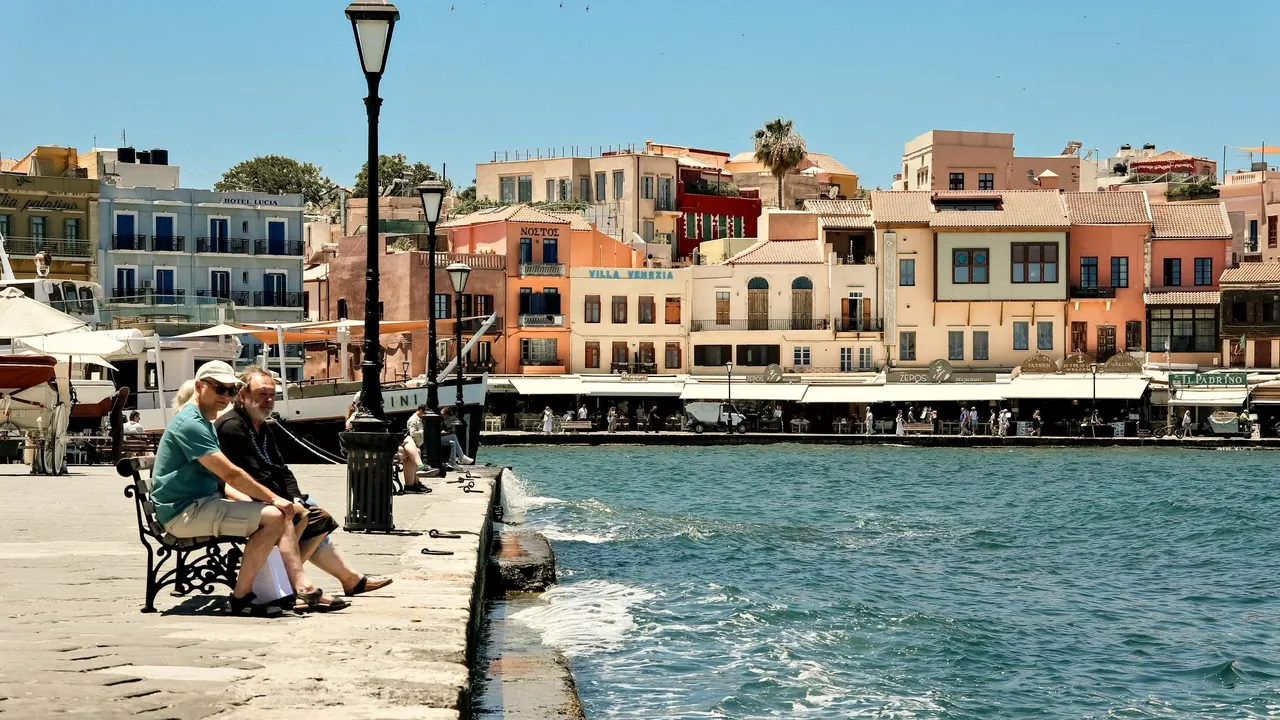
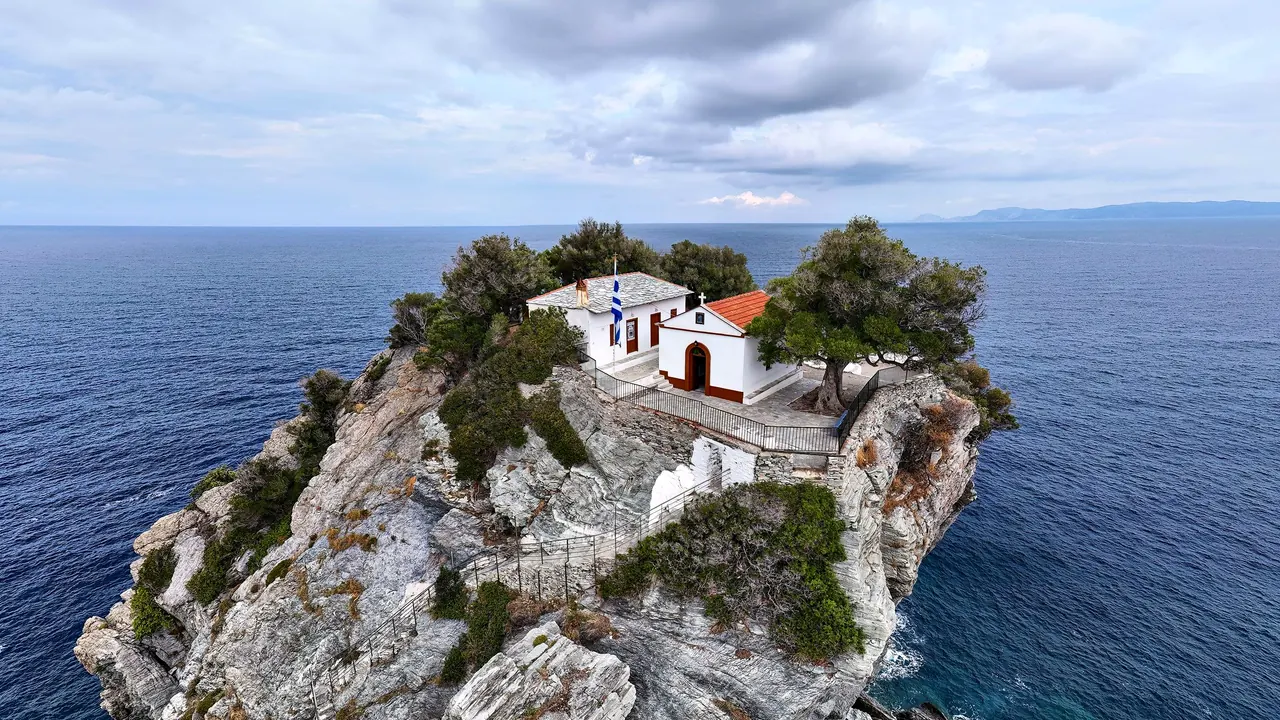
Photos: Crete by Piotr Baranowski, Pexels License; Skopelos by Giles Laurent, CC BY-SA 4.0, cropped.
Crete or Skopelos?
Our verdict in twelve categories, each scored against the same fixed benchmark cities, and the climate month by month, so you can choose for your trip.
Choose Crete for
- culture and sights
- nightlife
- food and drink
Crete is the stronger choice for most trips, and the gap is widest away from the beach. It combines Minoan palaces, Venetian harbour towns, high mountains with deep gorges and one of the Mediterranean's great regional kitchens, so it suits travellers who want plenty of variety and don't mind driving to get it. A week barely covers one end of the island, which makes it a good place for a long stay or a return visit.
Choose Skopelos for
Skopelos does not lead in any category we score.
Skopelos is for people who want a small, green island and very little else to do. You get pine woods down to clear water, a different cove each day, one whitewashed harbour town and quiet evenings. It asks less of you than Crete, because there are fewer sights to chase and fewer long drives. In return it has much less to offer once you have had your fill of swimming and walking.
Scoreboard
Twelve categories on one fixed scale from 0 to 100. The shaded stretch is the gap between the two.
Your match
Pick a travel style or drag the sliders, and both match scores follow your weighting.
Wins on culture and sights and nightlife with your weighting.
Has no clear advantage with the weighting you have chosen.
What matters to you?
Category by category
What the scores mean for a trip.
Beaches & swimming
Crete has the more famous beaches and more kinds of them. In the far west you find the pale sand and lagoons of Elafonissi, the turquoise bay of Balos and the long open strand of Falassarna. Vai has its palm grove, the south coast has remote pebble coves, and the north coast has long, easy resort beaches. The price is crowds at the best-known western beaches in high summer.
Skopelos is more uniform. It has a string of pine-backed bays along its south and west coasts, mostly fine pebble or mixed sand and pebble, with Limnonari among the sandier ones. The water is very clear and the coves are small and calm, often with just one taverna. It suits a slow beach-hopping week rather than a search for the island's one perfect beach.
Food & drink
Crete is the better place to eat by a wide margin. Its cooking is a regional cuisine in its own right, built on the island's own olive oil, wild greens, graviera and mizithra, slow-cooked lamb and dakos. It is at its best in village tavernas and the backstreets of Chania and Rethymno, and the wine country south of Heraklion is worth a visit.
Skopelos has a few local specialities: the coiled cheese pie, fried rather than baked, dishes made with the island's plums, and almond sweets. Beyond those, it is standard Greek island taverna food, well done but with little variety, and many kitchens shut once summer ends.
Culture & sights
The two are not in the same class. Crete was the home of the Minoans, and Knossos, Phaistos, Malia and the finds in the Heraklion Archaeological Museum make it one of the most important archaeological destinations in Europe. On top of that come Roman Gortyn, Chania's Venetian harbour, Rethymno's fortress and Ottoman balconies, and Spinalonga.
On Skopelos the sight is mostly the town itself: tiers of houses with grey slate roofs climbing to a Venetian castle, a small folk museum, and the monasteries on Mount Palouki. The Agios Ioannis chapel on its rock is a striking place to stand, famous from Mamma Mia, rather than a historic site.
Nightlife
Crete has something for two very different crowds. Malia and Hersonissos are loud, late party strips for young groups. Chania, Rethymno and Heraklion's old centre are where locals and students fill the cocktail bars and terraces after midnight.
Skopelos has neither. A night out means a long dinner, then a drink on the harbour or in a small bar in the lanes, sometimes with Greek music in high summer. There are no clubs, which is exactly why some couples choose it.
Nature & outdoors
Crete's landscapes are on a much larger scale. The White Mountains and Psiloritis rise above 2,400m, the Samaria gorge runs down to the Libyan Sea, and the E4 path and the coast walk between Loutro and Agia Roumeli are serious hikes. You can also climb at Agiofarago and cycle on the Lasithi plateau.
Skopelos is gentler and greener. It is pine forest almost from shore to summit, with mule tracks linking monasteries and bays. Its real draw is the sea: the marine park next door, home to monk seals and dolphins, can be explored by boat or kayak.
Day trips
From Crete there are more places to go and more variety. You can visit the island's other towns, the wine villages around Peza and Archanes, Anogia and the Amari valley, or take a boat to Chrissi or Gramvousa. The fast ferry to Santorini makes a long but memorable day.
On Skopelos the choice comes down to a few boat trips: Skiathos for a livelier port, or Alonissos and its hilltop old village, often combined with swimming stops in the marine park. The mainland is too far for a day out, and outside summer the boats run much less often.
Good for families
Crete is set up for families. There are resort hotels with pools and kids' clubs, gently shelving sandy beaches along the north coast and near Chania, the warm shallow lagoon at Elafonissi, waterparks and the aquarium at Gournes. The drawbacks are long drives on winding roads and the midsummer heat.
Skopelos is good for a simple beach week with small children, in sheltered bays such as Panormos and Agnontas with a taverna close by. Once the beach palls there is nothing else laid on, and the stepped lanes of the town and the ferry journey there both take some effort.
Getting around
Both islands are much easier with your own wheels, but the problem is different on each. On Crete it is the size of the island. A car is close to essential, the roads to the south coast are steep and slow, and crossing from one end to the other takes most of a day, although buses run reliably along the north coast.
On Skopelos the harder part is getting there. There is no airport, so you arrive by boat, usually via Skiathos. Once you are on the island, one main road with a summer bus reaches the best-known beaches, and a scooter covers the rest within a short ride.
Shopping & style
Neither island is a shopping destination, but Crete has more worth buying. Chania has its leather-makers' lane, knife-makers and covered market hall, Heraklion's market street sells cheese, herbs and raki, and the potters of Margarites sell their own work. Skopelos amounts to an evening's browse in the lanes behind the harbour, looking at ceramics, linen, prunes and almond sweets.
Affordability
The two cost about the same, a middle price for a Greek island, but the money goes on different things. On Crete the unavoidable cost is the hire car, which gets dearer in July and August, while rooms and village tavernas stay good value as long as you avoid Elounda and the busiest western beaches.
On Skopelos the extras pile up: the ferry, a scooter and boat excursions. There are also fewer cheap places to stay, and rooms become scarce in high summer. On both islands, June and September give the best balance of warm sea and lower prices.
Live music & performing arts
Crete has more to hear, mostly because its music is a living local tradition. You can hear lyra and lute in the music tavernas of Rethymno and Chania, at village saints' day festivals, and above all in Anogia, and there are summer festivals in Heraklion's and Chania's fortresses. Skopelos offers rebetiko and island songs in town tavernas on summer nights and dancing at August festivals, which are pleasant when you come across them but little more.
Wellness & relaxation
For proper treatments, Crete is the better bet. Its serious resort spas are concentrated around Elounda and the Gulf of Mirabello, and it also has slow, car-free corners such as Loutro. Skopelos relaxes you through its pace alone, with a few hotel spas and seasonal massage, and its quiet villages and shaded tavernas are at their calmest in June and September.
When should you go?
Pick your month. The climate figures are measured averages, not a forecast.
Crete in July
Skopelos in July
Daytime high, °C
Rainfall in the month, mm
Where the figures come from
Skopelos's temperatures are measured 68 km from the centre, at Skyros Airport.
Skopelos has no rain gauge within 25 km of the centre, so its rainfall comes from a gridded climate dataset read at the destination rather than from a gauge further away.
Temperature and rainfall are climate normals, averaged over the years shown. Crete: 1991-2020 normals, Heraklion Airport (3.6 km from centre). Skopelos: 1998-2025, 11 years observed (rainfall 1991-2020) normals, Skyros Airport (67.7 km from centre).
The two islands follow a similar summer pattern, but Crete warms up sooner. By May it is already 24°C and almost dry, while Skopelos is a little cooler and still gets some rain. On both islands the sea is warm enough to swim from June. July and August reach about 29°C on each, which is too hot for walking the lanes or the hills in the middle of the day. Crete also has exceptionally long, sunny days in high summer.
In October the rain comes back to both islands in much the same amounts, but Crete's sea keeps its warmth for longer. It is still about 23°C in October, against 21°C off Skopelos, so late-season swimming is better on Crete. Winters are mild on both, though Crete is the wetter of the two, with about 96mm in December. For walking, spring and autumn suit both islands best.
Which traveller are you?
On a culture and arts trip, choose Crete. Knossos, the Heraklion Archaeological Museum, Phaistos and the Venetian old towns of Chania and Rethymno could fill a week. Skopelos offers a pretty harbour town and a few monasteries, which take a day or two.
For a food and nightlife trip, Crete is clearly better. Its village tavernas, mountain cheeses and Heraklion's market street go well beyond Skopelos's narrow island menu. In the evenings Chania's harbour bars or Malia's clubs beat a quiet drink on the Skopelos waterfront.
On a family trip with children, Crete gives more to do: Elafonissi's shallow lagoon, waterparks along the north coast and the aquarium at Gournes. Skopelos has gentle sheltered bays but no attractions made for children, and its stepped lanes are hard going with a pushchair.
Before you go
| Measure | Crete | Skopelos |
|---|---|---|
| Official language | Greek | Greek |
| Currency | Euro (EUR) | Euro (EUR) |
| Sockets | CF230 V, 50 Hz | CF230 V, 50 Hz |
| Driving side | Right | Right |
| Time zone | UTC+2, UTC+3 in summer | UTC+2, UTC+3 in summer |
| Emergency number | 112 | 112 |
| Main airport | Heraklion International Nikos Kazantzakis Airport (HER)129 non-stop destinations | Skiathos Island National Airport (JSI)37 non-stop destinations |
| Public holidays this year | 15 days | 15 days |
By the numbers
| Measure | Crete | Skopelos |
|---|---|---|
| Population | 623,065 | - |
| People per km² | 75 | - |
| Swim season, months above 21 °C | 5 months | 5 months |
Where else could you go?
Every comparison below shares a destination with this one, so you can follow Crete or Skopelos somewhere new.
- Skiathosvs Skopelos
- Halkidikivs Skopelos
- Santorinivs Crete
- Folegandrosvs Crete
- Aeginavs Skopelos
- Iosvs Crete