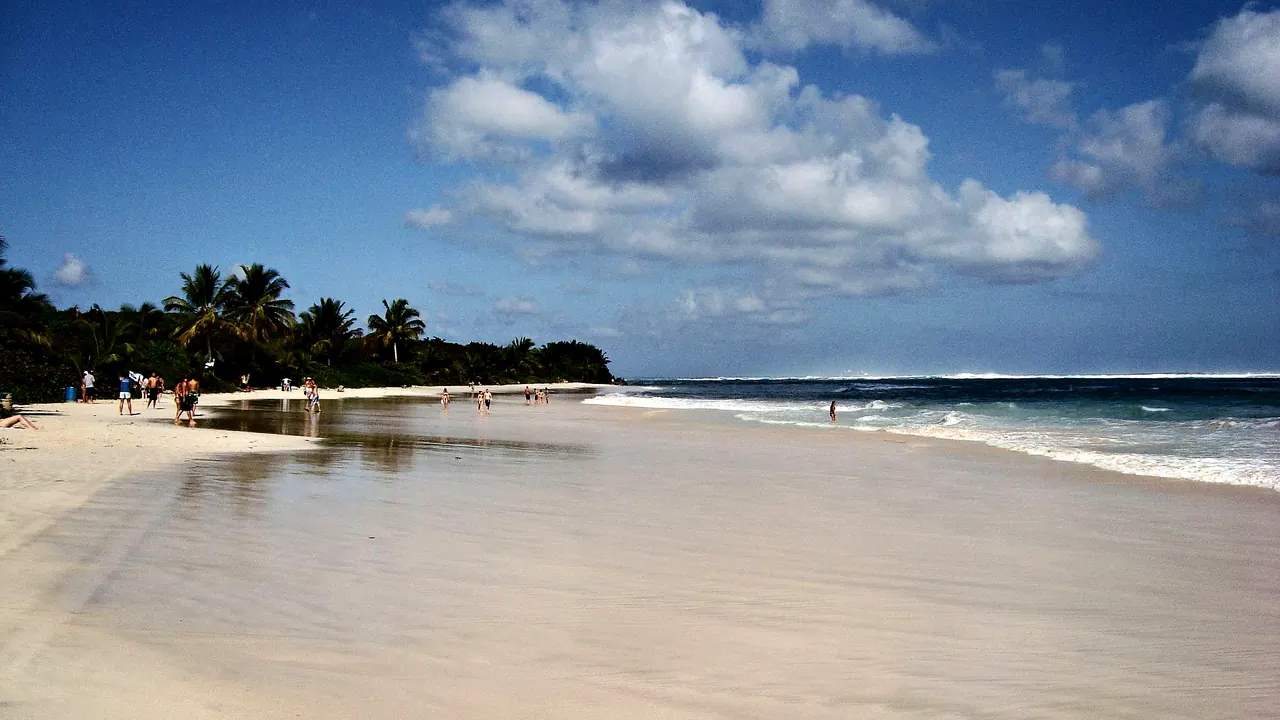
Photos: Culebra by Jose L. Dominguez, CC BY-SA 3.0, cropped.
Culebra or Guadeloupe?
Our verdict in twelve categories, each scored against the same fixed benchmark cities, and the climate month by month, so you can choose for your trip.
Choose Culebra for
- beaches
Culebra is for travellers who want one thing done superbly: white sand, clear water and turtles a few strokes from shore, with nothing else asking for attention. It suits couples and sea-loving families who are happy to swim, snorkel, eat simply and be asleep early, and who don't mind that the island offers almost nothing beyond its beaches and reefs.
Choose Guadeloupe for
- day trips
- food and drink
- live music and the arts
Guadeloupe makes the better choice for a fuller, more varied trip. Its lagoon beaches are almost as good, and around them it adds Creole cooking and rum distilleries, a rainforest volcano to climb, hot springs, drumming nights and carnival, and ferries to Les Saintes and Marie-Galante. Expect to drive and plan more, and to get much more variety back for it.
Scoreboard
Twelve categories on one fixed scale from 0 to 100. The shaded stretch is the gap between the two.
Your match
Pick a travel style or drag the sliders, and both match scores follow your weighting.
Wins on beaches with your weighting.
Wins on day trips and food and drink with your weighting.
What matters to you?
Category by category
What the scores mean for a trip.
Beaches & swimming
Both islands have outstanding beaches, but Culebra's are slightly better and more concentrated. Flamenco is a single postcard bay of fine white sand and calm, clear water, with the old painted tanks at one end, and Tamarindo, Melones and Tortuga on Culebrita each add reefs, seagrass or turtles within easy reach. Facilities are minimal, so you bring your own shade and water.
Guadeloupe spreads its beaches across two distinct coasts: reef-sheltered white lagoons along Grande-Terre's south from Le Gosier to Saint-François, and wilder golden or dark sand on Basse-Terre at Grande Anse and Malendure. Sargassum can reach some east- and south-facing shores, so it helps to be able to switch coasts.
Food & drink
On Culebra, eating is mostly practical. A few casual seafood places, food trucks with mofongo and empanadillas, and kiosks at Flamenco cover it, and with most produce arriving by ferry, many visitors stock a cooler from the grocery stores.
Guadeloupe has a cuisine worth travelling for: accras, colombo curries, court-bouillon and bokit from roadside vans, covered markets full of vanilla and spices, and agricultural rum tasted at the distilleries on Basse-Terre and Marie-Galante. Fine dining is thin even here, but day to day the gap is wide.
Culture & sights
Culebra's heritage fits into an afternoon: the canal-side fishing town of Dewey, a small museum in an old navy powder magazine on the bombing-range years, and the ruined lighthouse on Culebrita.
Guadeloupe has much more to see, led by the Mémorial ACTe on the Pointe-à-Pitre waterfront, a serious museum of slavery and Caribbean history. Forts above Basse-Terre and on Terre-de-Haut, Amerindian rock carvings, Hindu temples and the sugar estates of Marie-Galante make a worthwhile layer on a beach trip, if not a reason to come on their own.
Nightlife
Culebra goes to bed early. A handful of open-air bars in Dewey fill at sunset and sometimes have a band at weekends, and there are no clubs at all. Guadeloupe has a real, if limited, night out: bars, a casino and zouk and dancehall clubs in Le Gosier, waterfronts in Sainte-Anne and Saint-François busy until around midnight, and carnival season, when the whole island stays up. You will need a car or a driver to get to most of it.
Nature & outdoors
Underwater, the two are close. Culebra's Luis Pena reserve and the reefs at Tamarindo and Carlos Rosario bring green turtles and rays within reach of a snorkeller, seabirds crowd the outer cays and turtles nest on remote beaches. Ashore, though, the island is low, dry scrub.
Guadeloupe adds a whole volcanic landscape. Basse-Terre's national park covers rainforest, the Carbet falls, the Route de la Traversée under giant trees and the steaming summit of La Soufrière. It also has the Cousteau Reserve for diving, mangroves in the Grand Cul-de-Sac Marin and the windswept cliffs of Pointe des Châteaux.
Day trips
From Culebra, outings mean boat rides to the uninhabited cays and Culebrita, and reaching Vieques or the main island takes enough effort that most visitors stay put.
Guadeloupe is a base for proper excursions. Ferries run to the painted village and bay of Terre-de-Haut in Les Saintes, to the windmills and distilleries of Marie-Galante and to quiet La Désirade, and a longer crossing reaches Dominica. On the main island, Deshaies and Sainte-Anne each fill an easy afternoon.
Good for families
Culebra works for school-age children who love the sea, since Flamenco is shallow and calm and the turtles at Tamarindo can be seen from waist-deep water. There is nothing else for them, medical care is limited, and the ferry or small plane makes toddlers hard work.
Guadeloupe copes better with young families. The knee-deep lagoons at Sainte-Anne are ideal, and the aquarium at Le Gosier, the zoo at Parc des Mamelles and the botanical garden at Deshaies fill rainy mornings. French healthcare and familiar food help too, though most outings mean time in the car.
Getting around
Neither is easy, but the difficulty sits in different places. On Culebra, the hard part is getting there, on a ferry from Ceiba that fills up and runs late, or a small plane. Once there, distances are short, with shared vans to Flamenco and a golf cart or jeep for the rest.
Guadeloupe is simple to reach but large, so a hire car is close to essential, and traffic around Pointe-à-Pitre and the bridges between the two wings encourages staying on one side. Ferries to the outer islands are straightforward, and a scooter does there.
Shopping & style
There is almost nothing to buy on Culebra beyond beachwear, a few local paintings and groceries. Guadeloupe still isn't a shopping destination, but it offers more to take home: the covered spice market in Pointe-à-Pitre with vanilla, punches and madras cloth, and rum from the distilleries, as well as French supermarkets and malls for practical needs.
Affordability
Both are expensive by Caribbean standards, for the same reason: almost everything is shipped in. Culebra charges US prices, its few guesthouses and rentals fill early in winter, and a golf cart or jeep adds to the daily spend. The beaches and snorkelling are free, though.
Guadeloupe runs at French prices or above, with a hire car as a fixed extra and the winter months costing most. It does have more ways to eat cheaply, at bokit vans, markets and lolos. On both islands, a rental with a kitchen is the main way to save.
Live music & performing arts
Culebra has no performing arts beyond an occasional weekend bar band and music at its patron saint festival. In Guadeloupe, music is part of daily life: gwoka drumming at léwòz evenings, zouk everywhere, weeks of carnival parades with drums and conch shells, plus theatre and dance at L'Artchipel in Basse-Terre and the Terre de Blues festival on Marie-Galante.
Wellness & relaxation
Culebra relaxes you by having so little going on: no big resorts, little traffic and long, empty afternoons, with only the odd massage or guesthouse yoga class.
Guadeloupe offers that slow pace too, in Deshaies, Les Saintes and on Marie-Galante, and it adds volcanic hot water. You can soak in the Bains Jaunes on the way up La Soufrière, in the warm shoreline pools near Bouillante or at the small thermal spa at Ravine Chaude.
When should you go?
Pick your month. The climate figures are measured averages, not a forecast.
Culebra in July
Guadeloupe in July
Daytime high, °C
Rainfall in the month, mm
Where the figures come from
Culebra's temperatures are measured 34 km from the centre, at C. Amalie / St. Thomas Airport.
Culebra has no rain gauge within 25 km of the centre, so its rainfall comes from a gridded climate dataset read at the destination rather than from a gauge further away.
Culebra's sunshine is measured 75 km from the centre, at San Juan / Int., Puerto Rico.
Temperature and rainfall are climate normals, averaged over the years shown. Culebra: 1991-2020 normals, C. Amalie / St. Thomas Airport (33.7 km from centre). Guadeloupe: 1991-2020 normals, Le Raizet, Guadeloupe (7.3 km from centre).
Culebra is hot all year, with highs of 29°C in winter rising to 32°C from June to September, and the sea is warm enough to swim in every month. Walking around Dewey in the middle of the day is hard work in summer, but the heat never keeps you off the beach. The island is driest from February to April and sunniest from March to July. From August to November the rain picks up and the days turn cloudier.
Guadeloupe's temperatures and sea follow almost the same curve, so the real difference is rain and sun. Its figures are wetter than Culebra's in every month and have fewer hours of sunshine. Rain builds from May to a peak of around 211mm in October. It also varies across the island, and the volcanic heights of Basse-Terre are often in cloud and rain. February and March are the driest months, and January to April is the best time for both the beaches and the hiking trails. On both islands, late winter and spring are the safest choice.
Which traveller are you?
On a beach and sun trip, Culebra edges ahead. Flamenco's sheltered white horseshoe and the reef beaches near Dewey are the island's whole purpose, the weather is sunnier and drier, and the absence of everything else keeps the focus on the sand.
For a food and nightlife trip, Guadeloupe wins easily. It has Creole cooking at lolos and markets, agricultural rum straight from the distilleries, and bars and zouk clubs in Le Gosier, while on Culebra the evening ends with a fish dinner and a sunset drink.
On an outdoors trip, choose Guadeloupe for its range: the climb up La Soufrière, rainforest trails to waterfalls, mangrove kayaking and diving in the Cousteau Reserve. Culebra matches it underwater in the Luis Pena reserve but has little on land beyond short scrubby hikes.
Before you go
| Measure | Culebra | Guadeloupe |
|---|---|---|
| Official language | Spanish, English | - |
| Currency | US Dollar (USD) | Euro (EUR) |
| Sockets | AB120 V, 60 Hz | CE230 V, 50 Hz |
| Driving side | Right | Right |
| Time zone | UTC-4 | UTC-4 |
| Emergency number | 911 | 112 |
| Main airport | Luis Munoz Marin International Airport (SJU)59 non-stop destinations | Maryse Condé International Airport (PTP)21 non-stop destinations |
| Public holidays this year | 21 days | 12 days |
By the numbers
| Measure | Culebra | Guadeloupe |
|---|---|---|
| Population | - | 384,160 |
| People per km² | - | 236 |
| Swim season, months above 21 °C | 12 months | 12 months |
Where else could you go?
Every comparison below shares a destination with this one, so you can follow Culebra or Guadeloupe somewhere new.
- Viequesvs Culebra
- St Thomasvs Culebra
- US Virgin Islandsvs Culebra
- St Johnvs Culebra
- British Virgin Islandsvs Culebra
- St Croixvs Culebra