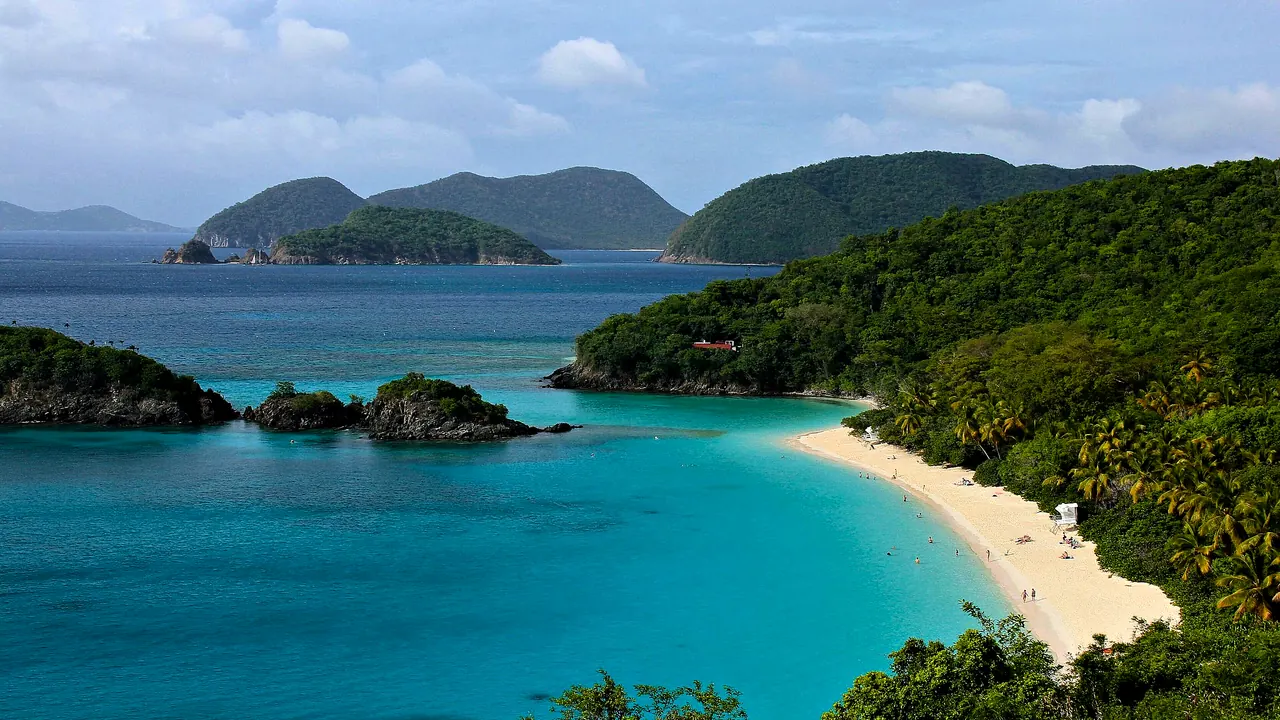
Photos: US Virgin Islands by Navin75, CC BY-SA 2.0, cropped.
Culebra or US Virgin Islands?
Our verdict in twelve categories, each scored against the same fixed benchmark cities, and the climate month by month, so you can choose for your trip.
Choose Culebra for
- prices
Culebra suits travellers who want one small island and very little else: a day on Flamenco's white sand, snorkelling with turtles a few metres from shore, a fish dinner in Dewey and an early night. It is simpler and somewhat less costly than its neighbour, but you give up almost everything beyond the water. Food, sights, shops and evenings out are all thin, and nearly every day ends up looking the same, which is the point.
Choose US Virgin Islands for
- shopping
- day trips
- culture and sights
The US Virgin Islands are the better choice if you want the same quality of beach with more around it. Three islands give you St John's national park and its trails, the Danish towns of Christiansted and Charlotte Amalie, West Indian cooking, lively bar strips and ferries to the British Virgin Islands. Families and anyone who gets restless after a few beach days will find more to fill the week, though it costs more.
Scoreboard
Twelve categories on one fixed scale from 0 to 100. The shaded stretch is the gap between the two.
Your match
Pick a travel style or drag the sliders, and both match scores follow your weighting.
Wins on prices with your weighting.
Wins on shopping and day trips with your weighting.
What matters to you?
Category by category
What the scores mean for a trip.
Beaches & swimming
These are two of the finest beach destinations in the Caribbean, and they are evenly matched. The difference is in how the beaches are spread. Culebra's centrepiece is Flamenco, a single long horseshoe with its painted tanks. Around it are snorkelling beaches at Tamarindo and Melones near Dewey, and Tortuga on Culebrita, reachable only by water taxi or kayak. There are few facilities, so you bring your own shade.
The US Virgin Islands spread their beaches across three islands. St John's north shore, with Trunk, Cinnamon and Maho Bays inside the national park, is the best stretch, Magens Bay is St Thomas's sheltered curve, and St Croix adds Sandy Point. When winter swell hits the north shores on both, the US Virgin Islands also have calmer south-facing coves to fall back on.
Food & drink
On Culebra you eat to refuel. Dewey has a handful of casual seafood places and food trucks selling mofongo and empanadillas, menus are short because supplies come by ferry, and many visitors stock a cooler from the grocery stores.
The US Virgin Islands give you much more to try. There is a real West Indian kitchen of kallaloo, fungi, saltfish and pates at roadside stands and festival food fairs, the best local cooking is in Christiansted and Frederiksted, and St Croix has rum distilleries. It is still not a destination for food lovers, and the resort menus on St Thomas lean American.
Culture & sights
Culebra offers little beyond the charm of Dewey's canal and drawbridge, a small museum in an old navy powder magazine telling the story of the bombing years, and the ruined lighthouse on Culebrita.
The US Virgin Islands carry nearly two centuries of Danish rule. Christiansted's arcaded streets and yellow fort, the red Fort Christian and the sand-floored synagogue of 1833 in Charlotte Amalie, and plantation ruins such as Annaberg on St John make for several good half-days of history, though not a cultural trip.
Nightlife
On Culebra the night out is a sunset drink at an open-air bar near the ferry dock, perhaps with a band at the weekend, and then bed.
The US Virgin Islands have real bar strips. Red Hook and Cruz Bay fill with charter crews and visitors spilling into the street, and Christiansted's boardwalk is St Croix's evening centre. It is still bars rather than clubs, but the St Thomas carnival and the Crucian Christmas festival bring weeks of late street parties.
Nature & outdoors
Both are strong on the outdoors, with a difference in kind. Culebra's nature is underwater and on the outer cays: the Luis Pena marine reserve's healthy reefs, turtles and rays off Tamarindo and Carlos Rosario, seabird colonies, and turtles nesting in spring and summer. On land it is low, dry scrub with a few short hikes.
The US Virgin Islands add green hills and sailing. St John's national park has forest trails such as Reef Bay, past petroglyphs, and the sheltered waters suit day sails and charters. Buck Island's snorkel trail and the bioluminescence of Salt River Bay add evening and boat outings that Culebra lacks.
Day trips
From Culebra, the outings are boat trips to Culebrita and the empty cays. Vieques and Fajardo are possible but take real effort, so most people never leave.
The US Virgin Islands offer far more choice. St Thomas and St John are a short ferry apart, Water Island is minutes from Charlotte Amalie, and with a passport you can reach Jost Van Dyke, Tortola or Virgin Gorda in the British Virgin Islands in about an hour. Almost all of these are still islands and beaches, so the trips vary the scenery more than the type of day.
Good for families
Culebra works for school-age children who love the sea. Flamenco is calm and shallow and the turtles at Tamarindo start in waist-deep water, but there are no attractions, few shops, limited medical care, and you have to manage the ferry or a small plane.
The US Virgin Islands are easier with children. Maho Bay offers the same shallow turtle snorkelling, Coki Point adds touch pools and an underwater observatory, and resorts with their own beach on the east end of St Thomas cut out the travel. American families need no passport. The steep roads can still tire younger children.
Getting around
Neither is easy, but the difficulty comes at a different point. With Culebra, the hard part is getting there: the ferry from Ceiba fills up and runs late, or you take a small plane. Once you arrive, the island is compact, with shared vans to Flamenco and a golf cart for the rest.
In the US Virgin Islands, the effort is in moving around. You drive on the left on steep, narrow roads with few pavements, rely on safari taxis, and need a long ferry or a flight to reach St Croix. In exchange, the Red Hook to Cruz Bay ferry makes it easy to combine St Thomas and St John.
Shopping & style
Culebra has a few souvenir and beachwear shops and some local artists in Dewey, and you are told to buy anything you need before the crossing.
The US Virgin Islands have a real shopping street. Main Street in Charlotte Amalie runs through old Danish warehouses full of duty-free jewellers and watch dealers, and you will find island-made pottery and art in Cruz Bay and Christiansted, plus St Croix's hook bracelets. It is a draw if you want gems or a watch, though there is no fashion scene.
Affordability
Neither is cheap, and both price everything at US levels plus the cost of shipping it in. Culebra comes out somewhat easier because there are no big resorts. You stay in guesthouses, inns and rentals, and cooking in your own kitchen keeps daily spending down, although hiring a golf cart or jeep adds to it.
The US Virgin Islands cost more, especially in the winter high season, when resorts and villas on St John and the east end of St Thomas are expensive and per-person taxi fares add up. St Croix and St John's campgrounds are the gentler options, and rates fall in summer and autumn.
Live music & performing arts
Culebra's music is the occasional weekend band in a Dewey bar and the yearly patron saint festival.
The US Virgin Islands have a living tradition of their own. Quelbe scratch bands, steel pan and calypso, and mocko jumbie stilt dancers at carnival all have roots in the islands, and the university amphitheatre on St Thomas hosts touring concerts. You mostly catch these by timing your visit, not by checking a programme.
Wellness & relaxation
Culebra's rest comes from what is missing: no resorts, little traffic, early nights. Beyond that there are only a few independent massage therapists and yoga in some guesthouses.
The US Virgin Islands give you the same slow pace on St John and St Croix's east end, plus proper spas at the larger resorts on St Thomas and St John. That makes it easier to combine a quiet stay with a massage or a treatment.
When should you go?
Pick your month. The climate figures are measured averages, not a forecast.
Culebra in July
US Virgin Islands in July
Daytime high, °C
Rainfall in the month, mm
Where the figures come from
Culebra's temperatures are measured 34 km from the centre, at C. Amalie / St. Thomas Airport.
Culebra has no rain gauge within 25 km of the centre, so its rainfall comes from a gridded climate dataset read at the destination rather than from a gauge further away.
Culebra's sunshine is measured 75 km from the centre, at San Juan / Int., Puerto Rico.
Temperature and rainfall are climate normals, averaged over the years shown. Culebra: 1991-2020 normals, C. Amalie / St. Thomas Airport (33.7 km from centre). US Virgin Islands: 1991-2020 normals, C. Amalie / St. Thomas Airport (5.6 km from centre).
The two share almost identical warmth. Daytime highs sit around 29°C from December to March and reach 32°C from June to September, which makes summer afternoons heavy for walking Christiansted or Charlotte Amalie, though the beaches stay pleasant. The sea never drops much below 26°C, so swimming is good in every month in both places.
The difference lies in the rain. Late winter and early spring are the driest and most settled time in both. Culebra's wet season peaks earlier, with around 143mm in September and a damp autumn after it. On the US Virgin Islands the rain builds more slowly and peaks in November at about 159mm. On Culebra the sunniest stretch runs from March to August, while November and December are noticeably duller.
Which traveller are you?
On a trip on a tight budget, Culebra is the easier of the two expensive options. Guesthouses and rentals with kitchens let you cook for yourself, the ferry costs little, and the best things on the island, the beaches and reefs, are free.
For a food and nightlife trip, the US Virgin Islands win clearly. You get West Indian cooking and rum distilleries on St Croix, and open-air bar strips in Red Hook and Cruz Bay that stay busy, where Culebra's few bars in Dewey are quiet soon after dinner.
On a family trip with children, the US Virgin Islands are better equipped. Coki Point's marine park, resorts with their own beaches and glass-bottom boat trips give children more to do than Culebra, which has calm water but few facilities and limited medical care.
Before you go
| Measure | Culebra | US Virgin Islands |
|---|---|---|
| Official language | Spanish, English | English |
| Currency | US Dollar (USD) | US Dollar (USD) |
| Sockets | AB120 V, 60 Hz | - |
| Driving side | Right | Left |
| Time zone | UTC-4 | UTC-4 |
| Emergency number | 911 | 911 |
| Main airport | Luis Munoz Marin International Airport (SJU)59 non-stop destinations | Cyril E. King Airport (STT)26 non-stop destinations |
| Public holidays this year | 21 days | 18 days |
By the numbers
| Measure | Culebra | US Virgin Islands |
|---|---|---|
| Population | - | 87,146 |
| People per km² | - | 252 |
| Swim season, months above 21 °C | 12 months | 12 months |
Where else could you go?
Every comparison below shares a destination with this one, so you can follow Culebra or US Virgin Islands somewhere new.
- Viequesvs Culebra
- British Virgin Islandsvs US Virgin Islands
- St Thomasvs Culebra
- St Johnvs Culebra
- Viequesvs US Virgin Islands
- British Virgin Islandsvs Culebra