
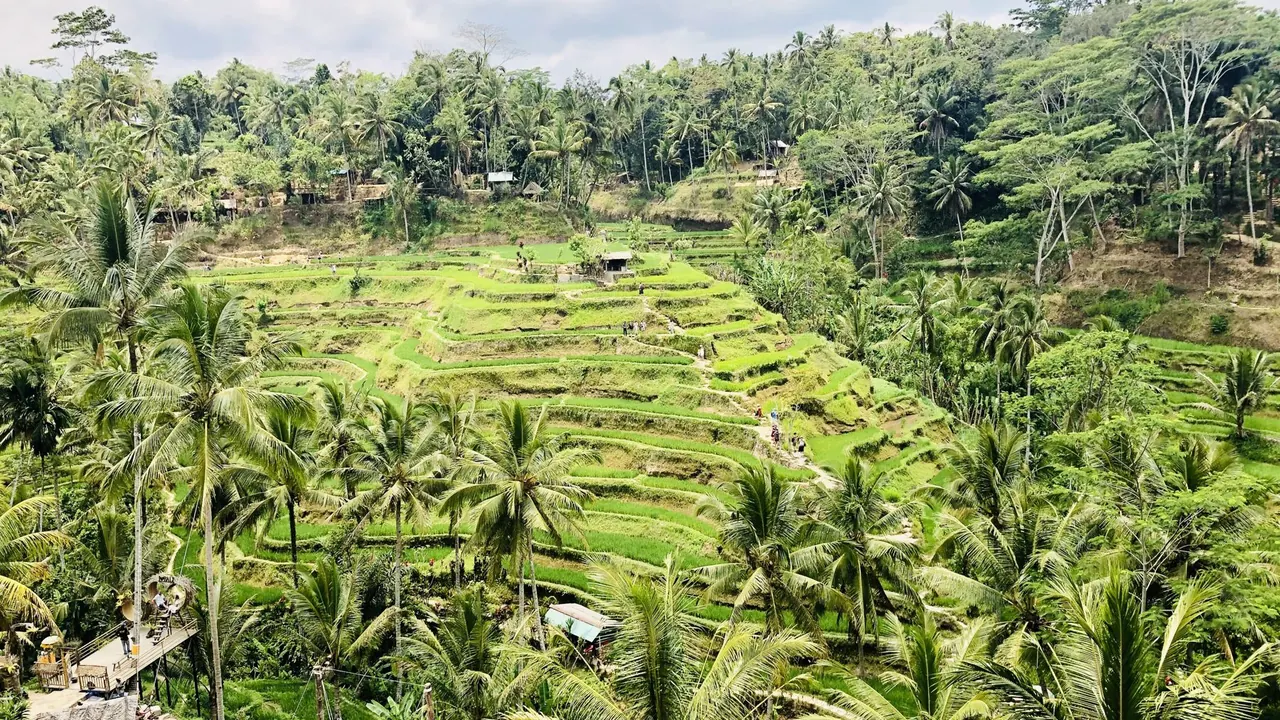
Photos: Da Nang by Nghia Tran, Pexels License; Ubud by Pinterpandai, CC BY-SA 3.0, cropped.
Da Nang or Ubud?
Our verdict in twelve categories, each scored against the same fixed benchmark cities, and the climate month by month, so you can choose for your trip.
Choose Da Nang for
- beaches
- nightlife
- getting around
Da Nang is the pick for a beach vacation with easy excursions. The long sandy shore runs through the city, the sea is warm and mostly calm from spring to late summer, and Hoi An, My Son and Hue are close enough for days of heritage. It is also the cheaper of the two, easier to get around, livelier after dark and simpler with young children. The trade-offs are that the city itself has few sights and the autumn monsoon closes the beach.
Choose Ubud for
- wellness
- live music and the arts
- culture and sights
Travellers who want to slow down should look to Ubud. Yoga, massage and retreats set the pace of the whole town, rice terraces and river gorges start at its edge, and temple life, Balinese painting and nightly dance give it a culture of its own. There is no beach, evenings end early, and getting anywhere means a car or scooter on slow roads. It suits couples and solo travellers better than families with toddlers or anyone looking for nights out.
Scoreboard
Twelve categories on one fixed scale from 0 to 100. The shaded stretch is the gap between the two.
Your match
Pick a travel style or drag the sliders, and both match scores follow your weighting.
Wins on beaches and nightlife with your weighting.
Wins on wellness and live music and the arts with your weighting.
What matters to you?
Category by category
What the scores mean for a trip.
Beaches & swimming
This is the widest gap between the two. Da Nang's single long beach runs almost the length of the city, and at My Khe and Non Nuoc you get broad pale sand and warm, mostly calm water from spring to late summer. The catch is the October to December monsoon, when strong surf and red flags often stop swimming.
Ubud is inland among the hills, so a sea swim means nearly an hour's drive to the reef-sheltered water at Sanur. The closer black-sand Gianyar beaches are better for watching surfers than for swimming. On most days here, a pool with a rice-field view takes the place of the beach.
Food & drink
Both are good places to eat local food cheaply, and Da Nang goes deeper. Its central Vietnamese cooking is spicy and robust, from Mi Quang and bun cha ca to banh xeo, and the tanks of clams, crab and fish behind the beach make seafood dinners a daily habit. Upscale and international dining is thin.
Ubud's Balinese cooking has fewer dishes, with babi guling at lunch counters and slow-cooked bebek betutu as the highlights. On top of that the town has a wide international mix of plant-based cafés and tasting menus. The best Balinese food is a lane or two away from the main street.
Culture & sights
Da Nang is a modern city with a short list of sights. The Museum of Cham Sculpture has the finest collection of its kind, and the Marble Mountains have cave shrines, but beyond those there are only the pink cathedral and the Lady Buddha on Son Tra. Two days covers it, and the region's real heritage lies in Hoi An and Hue.
Ubud has far more within the town itself, and much of it is part of daily life. You see offerings on every doorstep and processions in the streets, and the royal palace and Pura Taman Saraswati stand in the centre. The Puri Lukisan, Neka and ARMA museums trace Balinese painting since the 1930s, and the Elephant Cave of Goa Gajah is on the edge of town.
Nightlife
Da Nang has a real night out, if a relaxed one. Evenings start with walks along the river under the lit bridges, then move to rooftop bars and open-air beer halls serving grilled shellfish. Behind the beach, An Thuong has craft beer and cocktail bars, and a few clubs near the river get loud at weekends.
Ubud keeps early hours to suit its dawn yoga and volcano treks. An evening means a long dinner, a garden bar and perhaps a band. For clubs, you face the long drive to Seminyak or Canggu.
Nature & outdoors
Both have striking scenery close by, but in Ubud it is right outside the door. Da Nang has the forested Son Tra peninsula with its douc langurs, the ride over the Hai Van Pass, the cable car up the Ba Na Hills and rainforest trails at Bach Ma. It also has snorkelling off the Cham Islands and winter surf, though the heat and autumn rain limit serious hiking.
In Ubud you can walk from town into the rice terraces along the Campuhan Ridge or through the paddies to the north. You can raft the Ayung gorge, reach jungle waterfalls in a short drive, and climb Mount Batur in the dark to see the sunrise over the crater lake.
Day trips
Da Nang has the stronger set of day trips within easy reach. Hoi An's lantern-lit old town is about three quarters of an hour away and worth more than one visit. The Cham ruins of My Son take about an hour and a half, and Hue's citadel and royal tombs make a long but rewarding day over the Hai Van Pass.
Ubud's outings are rich in temples: Tirta Empul, Gunung Kawi, Besakih, Tanah Lot and the UNESCO-listed terraces of Jatiluwih. Almost every trip needs a hired driver, though, and Bali's slow roads limit how much fits into a day.
Good for families
Da Nang is the easier choice with children. The long beach gives them room to play, and many resorts have pools and children's clubs. For other days there are the Ba Na Hills cable car, the Golden Bridge, an indoor amusement park, a riverside Ferris wheel and water parks. The downsides are the motorbike traffic, rough pavements and the rainy autumn.
Ubud welcomes children just as warmly, but it has no beach, few pavements, macaques that grab at bags, and most outings mean time in a car. It works better for older children who enjoy rafting, rice-field walks and dance shows than for toddlers.
Getting around
Neither town has a metro or buses worth relying on, but Da Nang is much simpler to get around. App-booked cars and motorbike taxis are everywhere and the land is flat. The river centre, the beach, the Marble Mountains and Hoi An are all short rides apart along a straight coastal road.
In Ubud, distances are longer than they look, the roads climb steeply in and out of the river valleys, and pavements are narrow and broken. Days have to be planned around a driver or a hotel shuttle, and if you want to walk to dinner, stay near the centre.
Shopping & style
Shopping in Da Nang is practical. Han and Con markets sell coffee, dried seafood and fabrics, the malls carry international chains, and the workshops of Non Nuoc carve stone figures of every size. For tailoring, lanterns and leather, most people go to Hoi An.
Ubud is better for things to take home. The Art Market faces the palace, and each village on the road into town has its own craft: woodcarving in Mas, silver in Celuk and painting in Batuan. Jalan Hanoman adds small boutiques selling linen, yoga wear and natural cosmetics. Neither place is for luxury or fashion.
Affordability
Both are cheap, but Da Nang makes a budget go further. Street noodles, app taxis, massages and mid-range hotels a block from the beach all cost little. Only the big resorts and the Ba Na Hills charge international rates.
Ubud's homestays, warungs and day drivers are also good value, but it is easy to slip into the town's pricier side. The luxury jungle resorts above the gorges, the cafés aimed at visitors and heavily taxed imported wine can push costs close to European levels.
Live music & performing arts
Da Nang has little to see on stage. Tuong classical theatre is performed only now and then and mainly for locals, and the bars near the beach have cover bands. The big events are the summer fireworks festival over the Han River and the staged shows and bai choi singing games in Hoi An.
Ubud has something to watch every evening. Legong, Barong and Kecak dances are performed to live gamelan in the palace courtyard, at Pura Taman Saraswati and in village temples, by troupes with long traditions of their own. Beyond dance there is little else, and there is no theatre or concert hall.
Wellness & relaxation
Da Nang is a good place to unwind. There are massage parlours on most streets near the beach and resort spas on Son Tra, with a hot springs park about 30km out. The pace is easy, with early swims and long coffees, but rest is not the reason people come.
In Ubud, rest is the reason people come. Yoga runs from dawn to dusk, retreats last up to several weeks, and sound healing and traditional healers are part of ordinary life. Many visitors also join the purification ritual at Tirta Empul. Even near the noisy main road, a few steps into the paddies are enough to find quiet.
When should you go?
Pick your month. The climate figures are measured averages, not a forecast.
Da Nang in July
Ubud in July
Daytime high, °C
Rainfall in the month, mm
Where the figures come from
Ubud's temperatures are measured 29 km from the centre, at Denpasar / Ngurah-Rai.
Ubud's station stands 209 m below the city centre, so the centre is likely a little cooler than the figures say.
Ubud has no rain gauge within 25 km of the centre, so its rainfall comes from a gridded climate dataset read at the city rather than from a gauge further away.
Temperature and rainfall are climate normals, averaged over the years shown. Da Nang: 1991-2020 normals, Da Nang (4.9 km from centre). Ubud: 1991-2020 normals, Denpasar / Ngurah-Rai (29 km from centre).
Da Nang has two clear seasons. February to August is mostly dry and sunny, and from May the sea is warm enough for long swims. By June and July, though, afternoons reach 35°C, so February to April is the better time for walking around Hoi An and the Marble Mountains. The rain builds from September and peaks in October at about 726mm, bringing rough surf and red flags until the end of the year. December and January are cooler and grey.
Ubud is warm and steady all year, so you plan around the rain there rather than the heat. May to September is the drier, sunnier stretch, and August is the driest month at 36mm, which is ideal for rice-terrace walks and the dawn climb up Mount Batur. April and October are shoulder months with moderate rain on either side of it. From November to March, heavy downpours of up to 297mm in January make the trails muddy and the landscape its greenest. Through the year, May to August suits both, though Da Nang is far hotter. In September and October Ubud is drying or only moderately wet while Da Nang has its heaviest rain. November and December are wet in both. In February and March Da Nang is dry and pleasant while Ubud is still in its rainy season, and by April both are good to visit.
Which traveller are you?
On a beach and sun trip, Da Nang is the clear choice. My Khe and Non Nuoc offer wide pale sand in the city itself and warm, calm water from spring to late summer. From Ubud, the nearest good swimming at Sanur is nearly an hour's drive away.
For a relaxing and wellness trip, Ubud is hard to beat. Yoga pavilions, retreats, flower baths, traditional healers and villas facing quiet rice fields make rest the point of the stay. Da Nang offers cheap massages and calm mornings, but nothing on that scale.
On a food and nightlife trip, Da Nang gives more. You can eat Mi Quang and seafood grilled from the tanks behind the beach, then move on to rooftop bars, beer halls and late pubs in An Thuong. Ubud is mostly asleep well before midnight.
Before you go
| Measure | Da Nang | Ubud |
|---|---|---|
| Official language | Vietnamese | Indonesian |
| Currency | Dong (VND) | Rupiah (IDR) |
| Sockets | ACFG220 V, 50 Hz | CF50 Hz |
| Driving side | Right | Left |
| Time zone | UTC+7 | UTC+8 |
| Emergency number | Police 113, ambulance 115, fire 114 | 112 |
| Elevation | 19 m | 210 m |
| Main airport | Da Nang International Airport (DAD)3 km from centre47 non-stop destinations | Denpasar I Gusti Ngurah Rai International Airport (DPS)29 km from centre64 non-stop destinations |
By the numbers
| Measure | Da Nang | Ubud |
|---|---|---|
| City population | 2,819,900 | - |
| People per km² | 238 | - |
| Museums within 10 km | 2 | 14 |
| UNESCO World Heritage sites within 50 km | 2 | 1 |
| Swim season, months above 21 °C | 12 months | 12 months |
Where else could you go?
Every comparison below shares a destination with this one, so you can follow Da Nang or Ubud somewhere new.