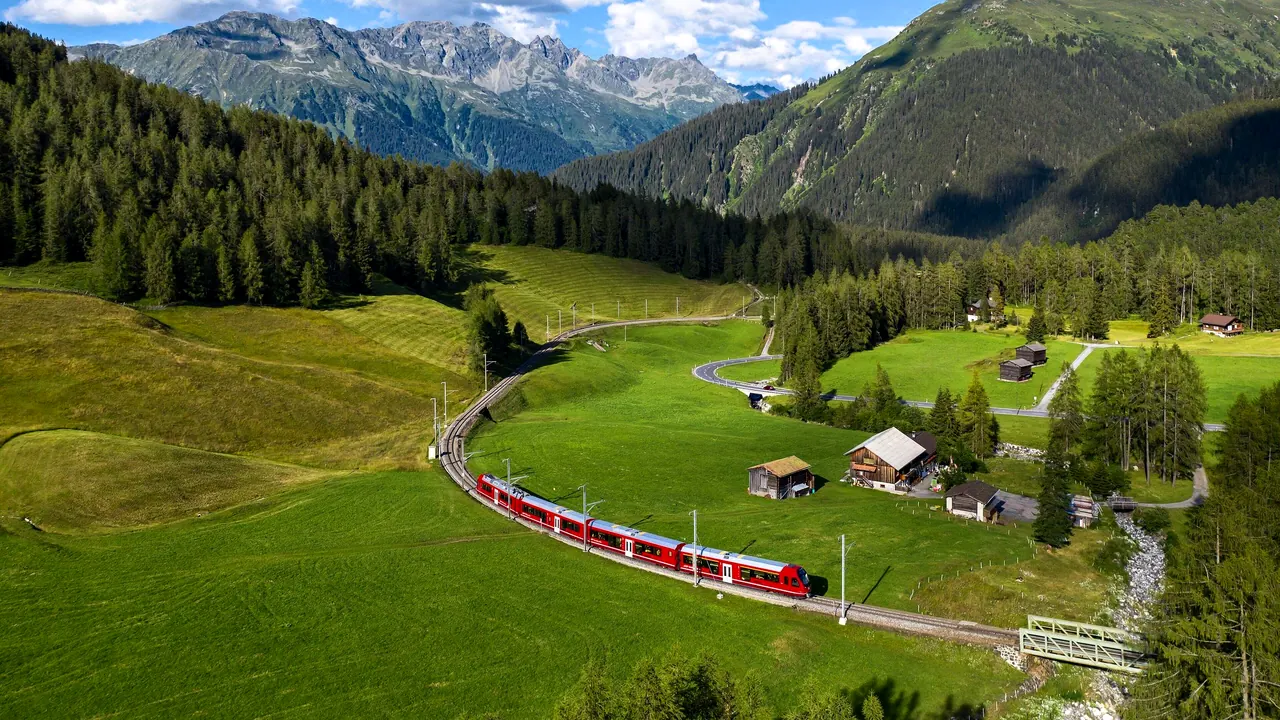
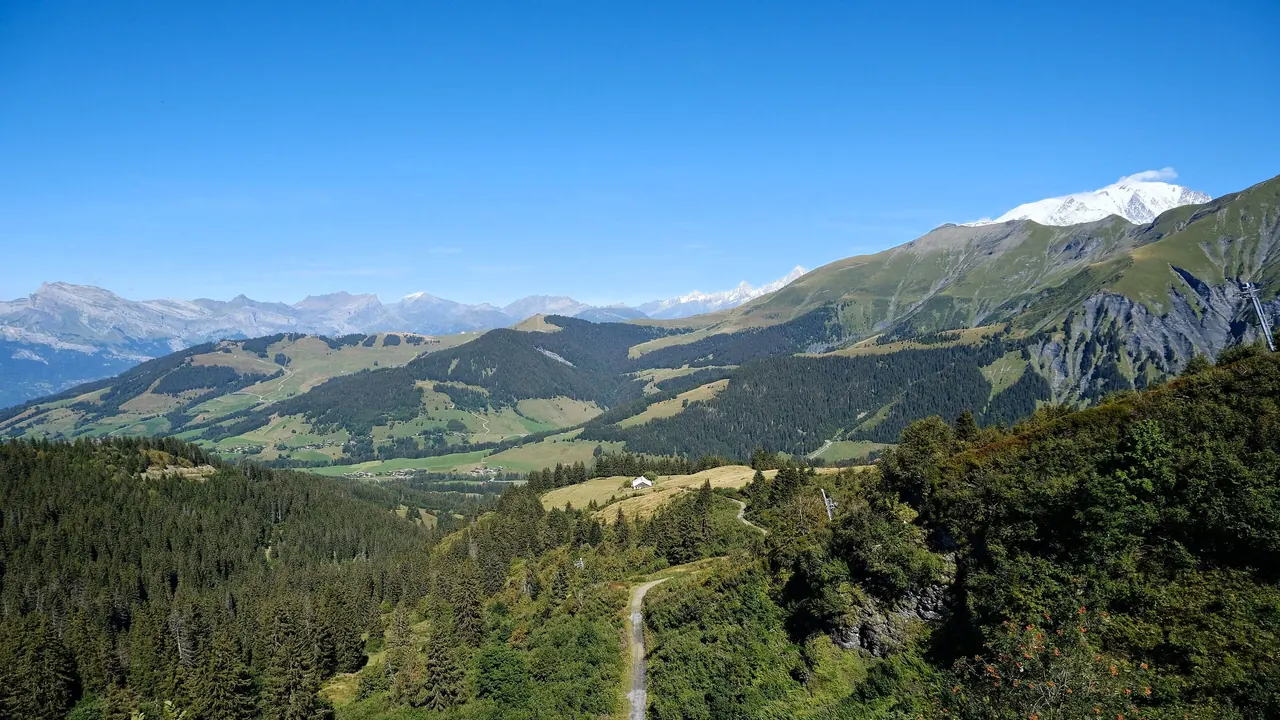
Photos: Davos by Kabelleger / David Gubler, CC BY-SA 4.0, cropped; Megève by Guilhem Vellut, CC BY 2.0, cropped.
Davos or Megève?
Our verdict in twelve categories, each scored against the same fixed benchmark cities, and the climate month by month, so you can choose for your trip.
Choose Davos for
- getting around
- culture and sights
- nature and the outdoors
Davos suits travellers who want serious mountains without a car. The train brings you into town, buses and lifts start from the street, and the high valley gives you five ski areas, long cross-country trails and summer routes up to the glaciers. It also has more of a story, from the sanatorium era of The Magic Mountain to the Kirchner Museum, as long as you're content with simple dinners and quiet evenings.
Choose Megève for
- shopping
- food and drink
- day trips
Choose Megève if the table and the setting matter as much as the skiing. It has starred kitchens, cobbled lanes of boutiques, fireside bars and Mont Blanc across the valley, and Chamonix, Annecy, Geneva and Aosta are all a drive away. Plan to hire a car, and expect gentler, lower pistes where snow at the bottom can vary from year to year.
Scoreboard
Twelve categories on one fixed scale from 0 to 100. The shaded stretch is the gap between the two.
Your match
Pick a travel style or drag the sliders, and both match scores follow your weighting.
Wins on getting around and culture and sights with your weighting.
Wins on shopping and food and drink with your weighting.
What matters to you?
Category by category
What the scores mean for a trip.
Beaches & swimming
Neither is a place to come for swimming, but Davos offers less. Its lido on the Davosersee stays cool even in midsummer, so most visitors end up in the indoor leisure pool or a hotel pool.
Megève's warmer summers make a swim more tempting. There are natural bathing ponds in the neighbouring valleys and indoor and outdoor pools at the Palais. Lake Annecy, clear and comfortably warm in high summer, is about an hour's drive away.
Food & drink
Davos eats in a hearty Graubünden way: capuns, pizokel, barley soup and Bündnerfleisch, best over a long lunch in a mountain hut. Back in town the choice narrows to hotel dining, fondue and pizza.
Megève is clearly the better place to eat. Its Savoyard cooking of tartiflette, diots and Reblochon is backed by a fine-dining tier rare in the Alps, with starred tables in the village and on Mont d'Arbois. Both lack range beyond mountain cooking, and in Megève a cheap, casual meal is especially hard to find.
Culture & sights
Davos has the richer past to explore. It was a tuberculosis resort, the setting of Thomas Mann's novel, and old sanatoria like the Schatzalp still show their sun balconies. The Kirchner Museum is a real reason to visit, and with the church of St Johann and a few smaller museums there is enough for a day or two.
Megève's sights are more about atmosphere than collections. You can walk the medieval street plan around Saint-Jean-Baptiste, climb the chapels of the Calvaire and look at Le Même's interwar chalets. All of that fits into a morning.
Nightlife
In Davos, evenings mean après-ski at the foot of the Jakobshorn and Parsenn runs, followed by pubs and a couple of small clubs on the Promenade. On peak winter weekends that goes on past midnight.
Megève's nights are smarter and give you a little more to choose from. There are fireside hotel bars, piano bars and wine bars in the cobbled centre, plus a few late clubs in peak weeks, but the older crowd mostly lingers over dinner. Both towns go almost silent between seasons.
Nature & outdoors
Both are excellent mountain bases. What differs is height and character. Davos is higher and wilder, with five ski areas, more than 100km of cross-country trails, side valleys that end below glaciers, ibex and marmots, and the Swiss National Park within a day's reach.
Megève is about views and easy skiing. It has wide wooded pistes for intermediates in the Évasion Mont-Blanc area, with the massif straight ahead, though its lower slopes make the snow less reliable. Summer adds paragliding, golf and hikes up Mont Joly, and Chamonix's glaciers are under an hour away.
Day trips
Days out from Davos are all about the railway. You can ride over the Landwasser Viaduct and the Albula line to St Moritz, visit medieval Chur, or take the Vereina tunnel to painted Guarda and Scuol. Zurich and Lucerne are too far to do comfortably.
Megève offers more variety, across two countries. Chamonix, Annecy with its canals and lake, Geneva's museums and, through the Mont Blanc tunnel, Roman Aosta are all within about an hour or so. The catch is that almost every one needs a car.
Good for families
Both towns are equally good for families, as long as the children like being outside, and neither has zoos or theme parks. Davos is better in bad weather thanks to its large indoor pool with slides. It also has the long toboggan run from the Schatzalp and free buses along the valley.
Megève's car-free centre and ski kindergartens suit very young children, and sleigh rides and pony rides add charm. On a rainy day, though, there is less to fall back on.
Getting around
Davos is the far easier place to manage without a car. Davos Dorf and Davos Platz each have a station, the guest card covers the buses, and the Parsenn funicular and Jakobshorn cable car leave from town. The 4km length of the valley is the only real stretch.
Megève's pedestrian centre is walkable in minutes, and winter shuttles link the lifts. But the nearest station is down at Sallanches, many chalets sit up steep hillside roads, and most visitors end up hiring a car.
Shopping & style
Shopping in Davos is practical. The Promenade covers ski gear, rentals, watches and delicatessen goods like Nusstorte to take home, and not much else.
Megève is the better place to browse. Its cobbled lanes hold designer ski-wear, cashmere, jewellers and galleries of Alpine interior design, and Allard, the family ski-wear house founded in the village, gives it a local flavour. It is still only a few streets, with no bargains.
Affordability
Davos is at its most expensive in January, when the World Economic Forum fills the rooms during the peak ski weeks. Savings there come from within the town: free buses with the guest card, rental apartments and cooking for yourself. Early summer and autumn cost less, though some hotels and restaurants close then.
In Megève, the quieter weeks of January are among the gentler times, and prices peak instead over Christmas and the February school weeks. A cheap meal is hard to find in any season. The main way to save is to sleep in the valley towns below and drive up, which means you can't take the car-free approach that works in Davos.
Live music & performing arts
Neither town is a place for an evening of theatre or opera. The difference is in the music. Davos has its summer classical festival, with young musicians playing in churches and hotels around the valley, and for anything more you would need to go to Zurich.
Megève leans towards jazz, with live sets in a cellar or piano bar in season and a few open-air concerts in summer.
Wellness & relaxation
For a restful stay the two are close, and what differs is how you unwind. In Davos, rest comes mostly from the thin, dry mountain air and from the spa floors of its hotels, with the sauna at the public leisure pool for anyone staying in an apartment. Proper mineral bathing means a train ride through the Vereina tunnel to Scuol, about an hour each way, so it becomes a day out rather than an evening soak. Summer and quiet winter weekdays are when the town feels least hurried.
Megève puts more emphasis on being pampered. Its upmarket hotels and chalets try to outdo one another with hammams and Alpine-themed treatments, and the Palais opens its saunas and pools to everyone. The village has no hot springs of its own, but the long-established thermal baths at Saint-Gervais are a twenty-minute drive, close enough for an afternoon. With sleigh rides and snowy evenings in a car-free centre as well, Megève suits a slow, indulgent week, while Davos suits a stay where the rest comes from fresh air and long walks.
When should you go?
Pick your month. The climate figures are measured averages, not a forecast.
Davos in July
Megève in July
Daytime high, °C
Rainfall in the month, mm
Where the figures come from
Davos's temperatures are measured 53 km from the centre, at S. Valentino Alla Muta.
Davos has no rain gauge within 25 km of the centre, so its rainfall comes from a gridded climate dataset read at the destination rather than from a gauge further away.
Megève's temperatures are measured 29 km from the centre, at Bourg-St-Maurice.
Megève's station stands 162 m below the city centre, so the centre is likely a little cooler than the figures say.
Megève has no rain gauge within 25 km of the centre, so its rainfall comes from a gridded climate dataset read at the destination rather than from a gauge further away.
Temperature and rainfall are climate normals, averaged over the years shown. Davos: 1991-2020 normals, S. Valentino Alla Muta (53.4 km from centre). Megève: 1999-2020 (rainfall 1991-2020) normals, Bourg-St-Maurice (29.1 km from centre).
Davos is the colder of the two all year. Winter highs stay around 2°C, and those are also its drier months, which makes them good for skiing and cross-country. Summer only climbs to about 20°C, which is good for hiking but rarely for swimming. It is also the wettest time of year, with August bringing about 140mm, so mountain days need an eye on the afternoon weather. By November the valley is cold and quiet again.
Megève sits lower and is warmer in every month, reaching about 27°C in July, warm enough for lake afternoons and long meadow walks. Its pattern runs the other way. Summer is its drier season, while winter brings the most rain, peaking at about 140mm in December. Spring and early autumn are mild there for walking, while the same weeks in Davos are still cool.
Which traveller are you?
On a culture and arts trip, Davos gives you more to see. You have the sanatoria of The Magic Mountain, the Schatzalp and the largest Kirchner collection anywhere. Megève's medieval centre and chalet architecture fill only a morning.
For a food and nightlife trip, Megève is the better choice. Savoyard cooking sits beside several Michelin-starred kitchens, and evenings move from après-ski terraces to piano bars and wine bars in the cobbled centre. Davos offers hearty hut lunches but little range after dark.
For a short city break without a car, Davos is the easier stay. You arrive by train from Zurich, buses run the length of the valley and the lifts leave from town. Megève has no station and its hillside chalets usually need a hire car.
Before you go
| Measure | Davos | Megève |
|---|---|---|
| Official language | French, German, Italian, Romansh | French |
| Currency | Swiss Franc (CHF) | Euro (EUR) |
| Sockets | CJ230 V, 50 Hz | CE230 V, 50 Hz |
| Driving side | Right | Right |
| Time zone | UTC+1, UTC+2 in summer | UTC+1, UTC+2 in summer |
| Emergency number | 112 | 112 |
| Elevation | 1,559 m | 1,027 m |
| Main airport | Zürich Airport (ZRH)122 km from centre226 non-stop destinations | Geneva International Airport (GVA)58 km from centre150 non-stop destinations |
| Public holidays this year | 9 days | 11 days |
By the numbers
| Measure | Davos | Megève |
|---|---|---|
| Population | 10,738 | 2,893 |
| People per km² | 38 | 66 |
| Museums within 10 km | 3 | 2 |
| UNESCO World Heritage sites within 50 km | 2 | 1 |
Where else could you go?
Every comparison below shares a destination with this one, so you can follow Davos or Megève somewhere new.
- Klostersvs Davos
- Saint-Gervais-les-Bainsvs Megève
- Arosavs Davos
- La Clusazvs Megève
- Le Grand-Bornandvs Megève
- Flainevs Megève