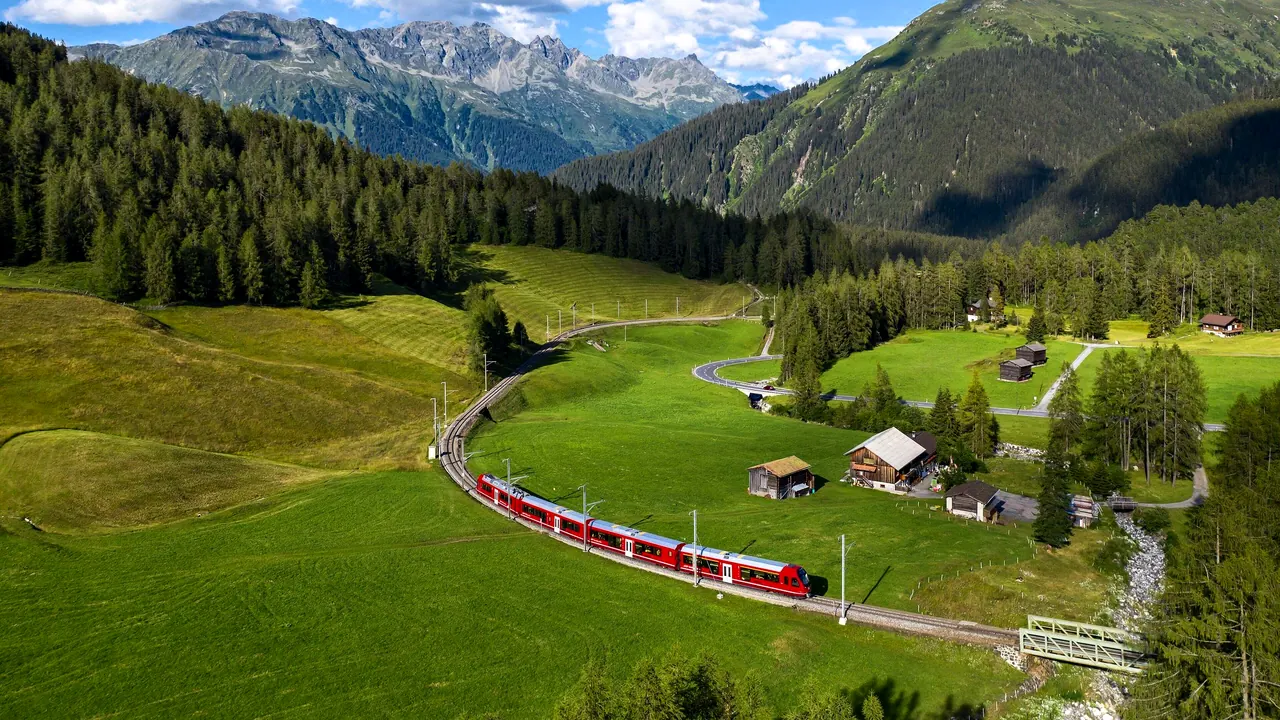
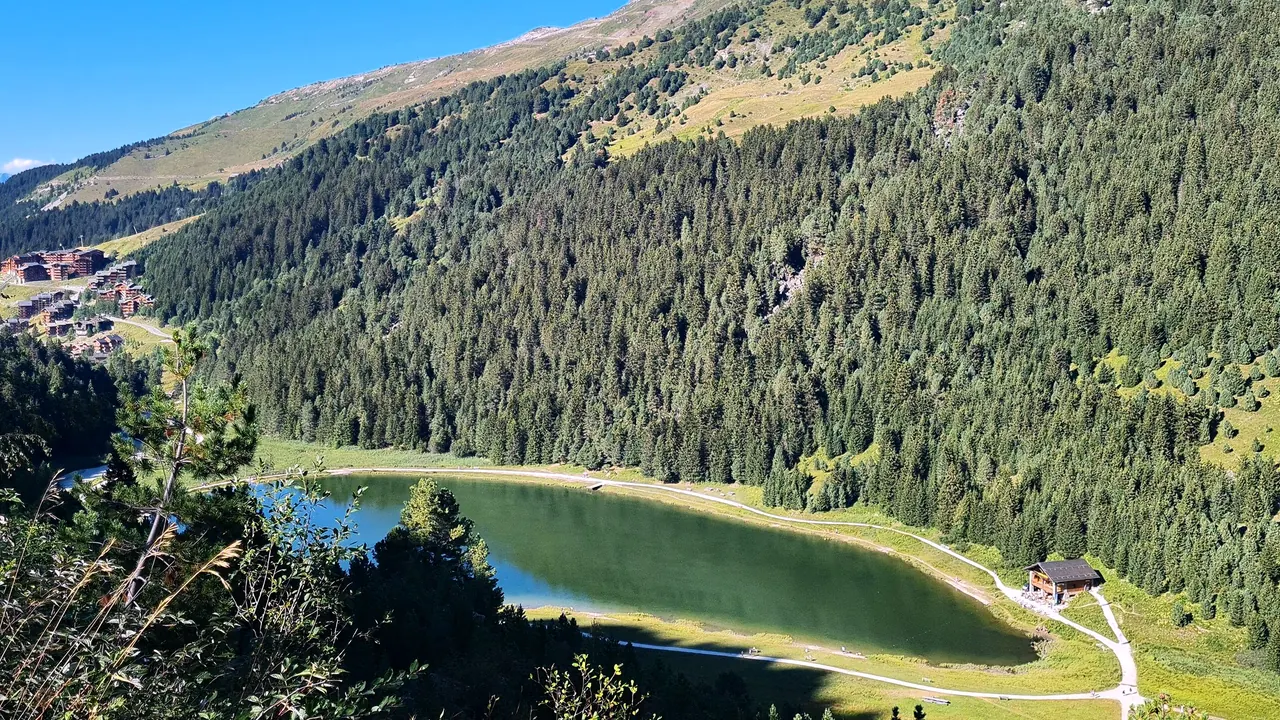
Photos: Davos by Kabelleger / David Gubler, CC BY-SA 4.0, cropped; Méribel by Augustin Cléchet, CC BY-SA 3.0, cropped.
Davos or Méribel?
Our verdict in twelve categories, each scored against the same fixed benchmark cities, and the climate month by month, so you can choose for your trip.
Choose Davos for
- getting around
- culture and sights
- day trips
Davos suits travellers who want the mountains plus a little more to do. It is a proper valley town with two railway stations, lifts that leave from the streets and free buses, so you can arrive by train and never need a car. Between days outdoors there is the Kirchner Museum, the sanatorium history behind The Magic Mountain and some of the finest railway journeys in the Alps. It is the better pick for cross-country skiers, summer hikers and anyone who prefers a quieter evening.
Choose Méribel for
- nightlife
- food and drink
- prices
Méribel is the place for skiers who want to spend the whole week on the snow and then go out afterwards. From the village you can ski across the 3 Vallées to Courchevel and Val Thorens without taking your skis off. Après-ski starts on the mountain and carries on in the village pubs, and the lunches on the pistes are a big part of the day. Off the slopes it has little to offer, and getting there means a transfer up from the valley.
Scoreboard
Twelve categories on one fixed scale from 0 to 100. The shaded stretch is the gap between the two.
Your match
Pick a travel style or drag the sliders, and both match scores follow your weighting.
Wins on getting around and culture and sights with your weighting.
Wins on nightlife and food and drink with your weighting.
What matters to you?
Category by category
What the scores mean for a trip.
Beaches & swimming
Neither is a swimming destination, but Davos has a real lake to swim in. The lido on the Davosersee has lawns and a jetty, though the water rarely gets much above 16°C to 18°C even in high summer. In Méribel the mountain lakes are for walking around, not bathing, so swimming means the pool at the Olympic Park, or a drive of more than an hour to the large lakes of Savoie.
Food & drink
Both serve hearty Alpine cooking and are best at lunch on a sunny terrace, but Méribel has a little more range. Its piste restaurants run from rustic huts serving croûtes to polished places with long wine lists, and there are ambitious hotel kitchens across the 3 Vallées. Evenings are Savoyard: tartiflette, diots and Beaufort.
Davos has the more unusual regional dishes, such as capuns, pizokel, barley soup and Bündnerfleisch, best eaten in the side-valley huts. In town, though, it is mostly hotel dining, fondue and pizza. Both resorts cut back sharply out of season.
Culture & sights
Davos has a real if short list of sights. It was a tuberculosis resort from the late nineteenth century and the setting for Thomas Mann's The Magic Mountain, and old sanatoria such as the Schatzalp still have their sun balconies. The Kirchner Museum holds the largest collection of the Expressionist painter's work, and the church of St Johann and the local museums fill a day or two.
Méribel's main sight is the resort itself, a village of timber and stone chalets built from the 1930s to a strict style, plus a small chapel and some 1992 Olympic history. For anything older you go down the valley.
Nightlife
Méribel is clearly the livelier of the two. The party starts with dancing on tables at the mountain bars as the lifts close, moves on to village pubs with a large British crowd, and on busy weeks a couple of late bars and a small club keep going into the early hours.
Davos has après-ski at the bottom of the Jakobshorn and Parsenn runs, and a few pubs and small clubs along the Promenade, but nights out are more spread out and quieter. Out of season, both towns go almost silent.
Nature & outdoors
Both are top-class mountain bases, but they suit different kinds of skier. Méribel sits in the middle of the 3 Vallées, so downhill skiers get huge linked mileage, couloirs and off-piste bowls, and the snow is reliable because so much of the skiing lies high. Davos spreads its skiing across several separate areas, from Parsenn to Madrisa, and adds more than 100km of cross-country trails into the Sertig and Dischma valleys.
In summer, Davos's quiet side valleys climb to glaciers, and the Swiss National Park is within a day's reach. Méribel has the Tueda reserve, whose old arolla pine forest leads into the Vanoise National Park, where ibex are common, as well as big lift-served bike trails.
Day trips
Davos has the better day trips, and you don't need a car for them. The Rhaetian Railway crosses the Landwasser Viaduct and follows the UNESCO-listed Albula line to St Moritz, Chur's medieval centre is reached by train, and the Vereina tunnel brings Guarda's painted houses and Scuol within about an hour.
From Méribel, nearly every outing starts with the winding road down to Moûtiers. Annecy's canals, Chambéry's ducal castle and Conflans are rewarding, but in winter snowy roads make each trip longer.
Good for families
Both work well for families who ski, with children's ski schools, nursery slopes, ice rinks and sledging. Davos is the easier town to manage, being flat with free buses, and has an indoor leisure pool with slides for bad days and more to do in summer around the Davosersee.
Méribel has more help for parents, as many chalets offer childcare, and adds dog-sledding and snowshoe outings. The downside is the steep, icy roads between chalets and lifts, and there is little for very young children once the snow has gone.
Getting around
Davos is much simpler. It stretches along a flat valley floor between two railway stations, buses on the guest card run its length and out to the side valleys, and the Parsenn funicular and Jakobshorn cable car leave from town. You can arrive from Zurich by train and stay car-free.
In Méribel the lifts and free shuttles work well inside the 3 Vallées, but the village climbs a steep hillside with icy pavements, many chalets are a bus ride from the centre, and the nearest station is about half an hour below at Moûtiers.
Shopping & style
Neither is worth a trip for the shopping, and both stick mostly to ski gear and local food to take home. Davos's Promenade has a few Swiss watch and jewellery shops and makes for a pleasant browse in the evening. Méribel's boutiques lean towards ski wear and chalet-style homeware, and its delicatessens sell Beaufort and Savoie wine instead of Bündnerfleisch and Nusstorte.
Affordability
Both are among the most expensive places in the Alps, and neither is cheap in any season. Davos charges Swiss resort prices across the board and is at its most expensive during the World Economic Forum in January. The guest card's free buses and self-catering help only a little.
Méribel is just as costly in the weeks when European schools are off, but has clearer ways to spend less: self-catering apartments in Mottaret, staying down at Brides-les-Bains, or coming in summer, which is noticeably cheaper.
Live music & performing arts
Neither has a theatre or concert season. Davos at least has its summer classical festival, where young musicians play in churches and hotels around the valley. In Méribel, live music mostly means cover bands and DJs in the après-ski bars. For serious music or theatre you would go to Zurich from Davos, or make the long drive to Chambéry or Annecy from Méribel.
Wellness & relaxation
Both offer similar relaxation, mostly hotel saunas and pools, but proper thermal bathing is closer to Méribel. The Olympe gondola runs straight down to the old spa town of Brides-les-Bains. From Davos, the mineral baths of Scuol are about an hour away through the Vereina tunnel.
Davos makes up for it with its history as a place to recover, its dry mountain air and its unhurried summers. Méribel's winter is a busy round of early lifts and late après-ski, so calm comes more easily there in early summer or September.
When should you go?
Pick your month. The climate figures are measured averages, not a forecast.
Davos in July
Méribel in July
Daytime high, °C
Rainfall in the month, mm
Where the figures come from
Davos's temperatures are measured 53 km from the centre, at S. Valentino Alla Muta.
Davos has no rain gauge within 25 km of the centre, so its rainfall comes from a gridded climate dataset read at the destination rather than from a gauge further away.
Méribel has no weather station within reach, so its figures come from a gridded climate model rather than a measured record, and read a broad area rather than one spot.
Temperature and rainfall are climate normals, averaged over the years shown. Davos: 1991-2020 normals, S. Valentino Alla Muta (53.4 km from centre). Méribel: 1991-2020 normals, TerraClimate 4 km grid at the town, no weather station within 90 km.
Temperatures are almost the same in the two resorts. Winter days stay around freezing in both, and summer highs reach about 20°C in July and August, which is good walking weather rather than heat. The difference is the rain. Davos is driest from January to April and wettest from May to September, with about 142mm in August, so summer hikes often run into afternoon showers. Méribel is the reverse. Its heaviest precipitation comes in November and December, up to about 153mm, which is what builds its snowpack, and July and August are its driest months.
For winter sports, both are at their best from January to March, and Davos is the drier of the two. In summer, Méribel's July and August are more reliable for long days in the hills. In Davos the settled spell for walking comes in October, when rain eases to about 87mm and days are still around 12°C. Late autumn is wet and grey in Méribel, while Davos is cold then but not especially wet.
Which traveller are you?
On a culture and arts trip, Davos is the clear choice. The Kirchner Museum, the old sanatoria such as the Schatzalp and a summer classical festival give you a few days of history and art. Méribel has a chalet-style village and a small amount of Olympic history.
For a food and nightlife trip, Méribel is better. Après-ski starts with dancing at the mountain bars, moves on to the village pubs and late bars, and the long Savoyard dinners and white-tablecloth piste restaurants give you more choice than Davos's hotel-led evenings.
For a short city break, Davos is far easier. Trains from Zurich take a little over two hours with one change at Landquart and no road transfer, and the lifts and the Promenade are right in town. Méribel needs a transfer up from Moûtiers.
Before you go
| Measure | Davos | Méribel |
|---|---|---|
| Official language | French, German, Italian, Romansh | French |
| Currency | Swiss Franc (CHF) | Euro (EUR) |
| Sockets | CJ230 V, 50 Hz | CE230 V, 50 Hz |
| Driving side | Right | Right |
| Time zone | UTC+1, UTC+2 in summer | UTC+1, UTC+2 in summer |
| Emergency number | 112 | 112 |
| Elevation | 1,559 m | 1,447 m |
| Main airport | Zürich Airport (ZRH)122 km from centre226 non-stop destinations | Geneva International Airport (GVA)100 km from centre150 non-stop destinations |
| Public holidays this year | 9 days | 11 days |
By the numbers
| Measure | Davos | Méribel |
|---|---|---|
| Population | 10,738 | - |
| People per km² | 38 | - |
| Museums within 10 km | 3 | 0 |
| UNESCO World Heritage sites within 50 km | 2 | 0 |
Where else could you go?
Every comparison below shares a destination with this one, so you can follow Davos or Méribel somewhere new.
- Courchevelvs Méribel
- Klostersvs Davos
- Les Menuiresvs Méribel
- Val Thorensvs Méribel
- Arosavs Davos
- La Plagnevs Méribel