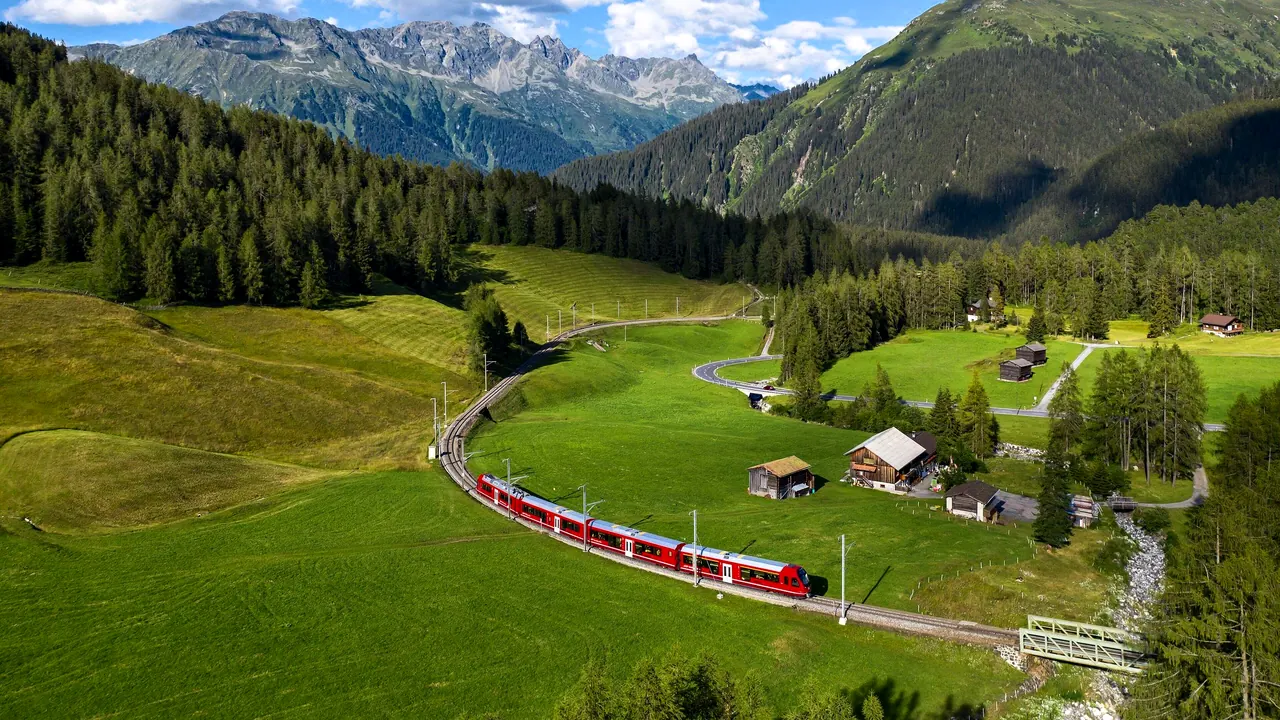
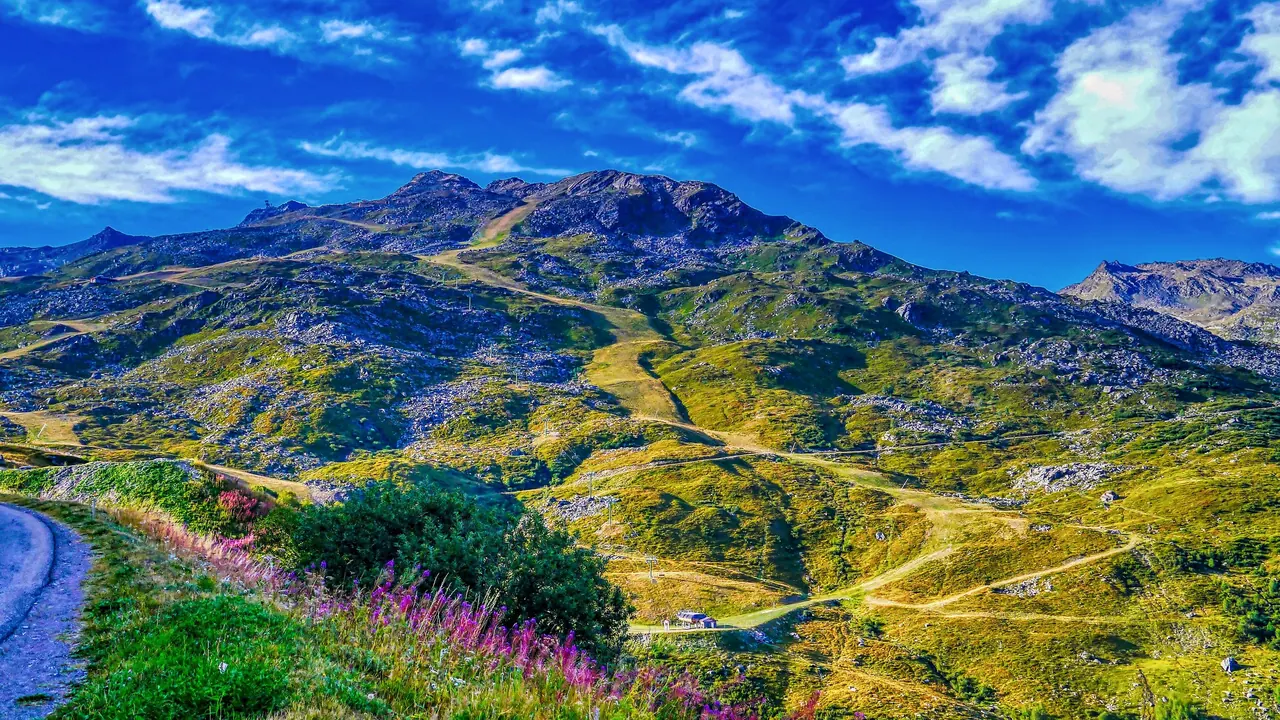
Photos: Davos by Kabelleger / David Gubler, CC BY-SA 4.0, cropped; Val Thorens by Zairon, CC BY-SA 4.0, cropped.
Davos or Val Thorens?
Our verdict in twelve categories, each scored against the same fixed benchmark cities, and the climate month by month, so you can choose for your trip.
Choose Davos for
- day trips
- wellness
- culture and sights
Davos suits travellers who want an Alpine vacation with more to it than the slopes. Its five ski areas and long cross-country trails sit alongside summer hiking, a real town with a sanatorium past and the Kirchner Museum, scenic railway outings and hotel spas. It is calmer, better for families and easier to reach by train, and it works in summer as well as winter.
Choose Val Thorens for
- nightlife
- prices
- food and drink
Val Thorens is the choice for a dedicated ski week with a lively social side. You are at the top of the Three Valleys with snow from late November into May, and the après-ski runs late into the night with a young crowd. It is built almost entirely for winter sport, so anyone who wants sights, quiet evenings or a varied summer trip will find little else there.
Scoreboard
Twelve categories on one fixed scale from 0 to 100. The shaded stretch is the gap between the two.
Your match
Pick a travel style or drag the sliders, and both match scores follow your weighting.
Wins on day trips and wellness with your weighting.
Wins on nightlife and prices with your weighting.
What matters to you?
Category by category
What the scores mean for a trip.
Beaches & swimming
Neither place is for swimmers, but Davos at least has a summer lido on the Davosersee, with lawns and a jetty and water that warms to a bracing 16°C to 18°C in July and August. Val Thorens has only glacier-fed tarns far too cold to swim in, so your swimming there is limited to the sports centre pool or your hotel.
Food & drink
Both kitchens are hearty mountain cooking, Graubünden in one and Savoyard in the other. Davos has capuns, pizokel, Bündnerfleisch and Nusstorte, best eaten in huts on the runs and in the side valleys, but the range in town stops at hotel dining, fondue and pizza.
Val Thorens eats a little better for its size. Alongside the fondue, tartiflette and Beaufort there are a few ambitious gastronomic kitchens in its upmarket hotels. Most menus still repeat themselves, though, and a lot of guests cook in their apartments.
Culture & sights
Davos has a story to tell. It was a tuberculosis resort, and old sanatoria such as the Schatzalp still show the world of Thomas Mann's The Magic Mountain. The Kirchner Museum holds the largest collection of the Expressionist painter's work, and there are smaller museums and the church of St Johann, enough for a day or two.
Val Thorens has nothing comparable. It was built as a ski station in the 1970s and has no old town and no museums, so for Savoyard heritage you have to drive down to the valley towns.
Nightlife
Val Thorens has the bigger party. Its après-ski reputation is one of the strongest in the Alps, with table-dancing on slope terraces at lift closing, crowded village bars and a well-known underground club going until the early hours, mostly for students and groups of friends.
Evenings in Davos are more grown-up and more spread out. You get hotel bars, a few pubs and a couple of small clubs on the Promenade, busy at winter weekends. Out of season, both resorts go quiet.
Nature & outdoors
Both are outstanding mountain destinations, but the landscapes differ. Val Thorens is high, treeless ground of rock, snowfields and glacier, where the snow is reliable well into spring and you can ski across the whole Three Valleys to Méribel and Courchevel on skis.
Davos is a wider, greener valley with five separate ski areas, over 100km of cross-country trails into the Sertig and Dischma valleys, and a much fuller summer of hiking and singletrack, with the Swiss National Park in day-trip range.
Day trips
From Davos the trips are easy and memorable, largely thanks to the Rhaetian Railway. You can ride over the Landwasser Viaduct and along the Albula line to St Moritz, reach medieval Chur in just over an hour, or go through the Vereina tunnel to the painted houses of Guarda.
Leaving Val Thorens means a long hairpin road down to Moûtiers and Conflans. Annecy and Chambéry are worth it but take about two hours each way by car, so most visitors stay put.
Good for families
Davos is the easier family base. It has nursery slopes, the Schatzalp toboggan run and a big natural ice rink in winter, then lakeside walks, playgrounds at the top stations and an indoor pool with slides for wet summer days, all in a town where the altitude is gentle on small children.
Val Thorens works well for families who ski, with a car-free village, ski-in lodging and good children's clubs. Its height brings biting wind, lift closures and restless nights for little ones, though, and the party crowd sets the mood.
Getting around
Both resorts work fine without a car once you arrive. The big difference is the journey there. You reach Davos by train from Zurich in a little over two hours, with stations at both Dorf and Platz and lifts leaving from town, although its 4km length can feel long in ski boots.
Val Thorens is compact and often ski-in, ski-out, with free shuttles. Getting there, though, means about an hour's bus or taxi ride up from Moûtiers, and there is little public transport for exploring beyond the resort.
Shopping & style
Davos gives you more to browse. Along the Promenade, Swiss watch and jewellery stores and a few fashion boutiques sit among the ski and outdoor shops, and delicatessens sell Bündnerfleisch, mountain cheese and Nusstorte to take home. It makes a pleasant evening stroll, though not a reason to plan a trip.\n\nIn Val Thorens the shops serve the ski week and little else: hire, technical gear, resort clothing and small supermarkets for self-catering. The Savoyard cheese and charcuterie from its delis are the souvenirs worth packing.
Affordability
A week in Davos costs more mainly because it is in Switzerland, and the high price level runs through everything, from the hotel room and the evening meal in town to the lift pass and a lunch at a mountain hut, where the view adds to the bill. January is the hardest month, when the World Economic Forum fills the town and beds become scarce. Early summer and autumn ease the cost, but with fewer places open.
Val Thorens is never a budget trip either. Lift pass, hire, ski school and slope-side lunches add up quickly, and French school vacation weeks are the dearest. Its advantage is how it is built: much of the village is apartment blocks, so a group can share the rent and cook in, a saving that is harder to make in hotel-led Davos. It is also a less polished address than Courchevel at the other end of the Three Valleys.
Live music & performing arts
Davos has a modest offering, mainly its summer classical festival, where young musicians play in churches and hotels around the valley, plus the odd concert at the congress centre. In Val Thorens live music means cover bands and DJs at après-ski bars, and there is nothing in the way of theatre or concerts.
Wellness & relaxation
Davos changes pace with the calendar. In the peak ski weeks the town is full, but on winter weekdays and through most of the summer it slows right down. A non-skier can still fill a gentle day there, with cleared winter walking paths along the valley floor, a lift up to a hut lunch in the sun, and the public leisure pool, whose sauna area is open to day visitors even if your hotel has no spa.
Val Thorens offers much less to anyone who is not skiing. While everyone else is on the mountain, a non-skier is left with the hotel or residence spa and the sports centre pool, and there is little else at the top of the road. The nearest real spa town, Brides-les-Bains, is about an hour down the valley, so it is a day out rather than something you can fit into the week as a matter of course.
When should you go?
Pick your month. The climate figures are measured averages, not a forecast.
Davos in July
Val Thorens in July
Daytime high, °C
Rainfall in the month, mm
Where the figures come from
Davos's temperatures are measured 53 km from the centre, at S. Valentino Alla Muta.
Davos has no rain gauge within 25 km of the centre, so its rainfall comes from a gridded climate dataset read at the destination rather than from a gauge further away.
Val Thorens has no weather station within reach, so its figures come from a gridded climate model rather than a measured record, and read a broad area rather than one spot.
Temperature and rainfall are climate normals, averaged over the years shown. Davos: 1991-2020 normals, S. Valentino Alla Muta (53.4 km from centre). Val Thorens: 1991-2020 normals, TerraClimate 4 km grid at the town, no weather station within 90 km.
Davos has two good seasons. From December to March daytime highs sit around freezing to single figures, which is what you want for skiing and skating. June to August bring mild days of about 20°C for hiking, biking and a cool dip in the lake, though this is also the wettest stretch, with around 140mm in August falling mostly as summer showers and storms. Late spring and November are muddy and quiet.
Val Thorens is far colder all year, with January highs of about -3°C and even August rarely passing 16°C. Its heaviest precipitation comes in November and December, up to 180mm, and falls largely as snow that sets up a long ski season running into May. Summer is short and fresh, good for high walks but never warm, so outside winter Davos is the more comfortable of the two.
Which traveller are you?
For a food and nightlife trip, Val Thorens is the livelier pick. Après-ski starts with dancing on mountain terraces and moves on to clubs open until the early hours, and the village has a few serious hotel kitchens alongside its Savoyard cheese dishes.
On a culture and arts trip, Davos is the only real option. It has the Kirchner Museum, the sanatorium history behind The Magic Mountain, a summer classical festival and the Albula railway line, while Val Thorens is a 1970s ski station with no museums.
For a relaxing and wellness trip, Davos offers dry mountain air, hotel spas, quiet summer weeks and the mineral baths of Scuol an hour away. Val Thorens has good hotel saunas, but its days and nights are geared to skiing hard and partying.
Before you go
| Measure | Davos | Val Thorens |
|---|---|---|
| Official language | French, German, Italian, Romansh | French |
| Currency | Swiss Franc (CHF) | Euro (EUR) |
| Sockets | CJ230 V, 50 Hz | CE230 V, 50 Hz |
| Driving side | Right | Right |
| Time zone | UTC+1, UTC+2 in summer | UTC+1, UTC+2 in summer |
| Emergency number | 112 | 112 |
| Elevation | 1,559 m | 1,710 m |
| Main airport | Zürich Airport (ZRH)122 km from centre226 non-stop destinations | Geneva International Airport (GVA)111 km from centre150 non-stop destinations |
| Public holidays this year | 9 days | 11 days |
By the numbers
| Measure | Davos | Val Thorens |
|---|---|---|
| Population | 10,738 | - |
| People per km² | 38 | - |
| Museums within 10 km | 3 | 0 |
| UNESCO World Heritage sites within 50 km | 2 | 1 |
Where else could you go?
Every comparison below shares a destination with this one, so you can follow Davos or Val Thorens somewhere new.
- Les Menuiresvs Val Thorens
- Klostersvs Davos
- Méribelvs Val Thorens
- Arosavs Davos
- Courchevelvs Val Thorens
- Lenzerheidevs Davos