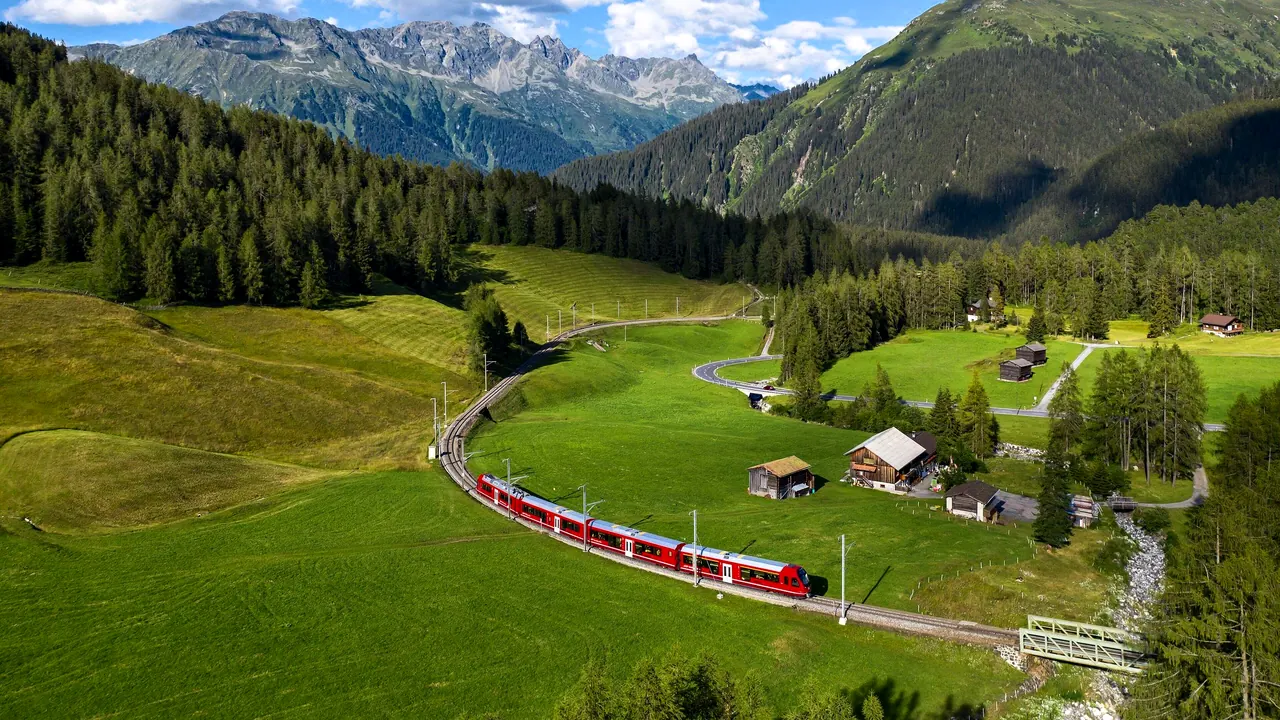
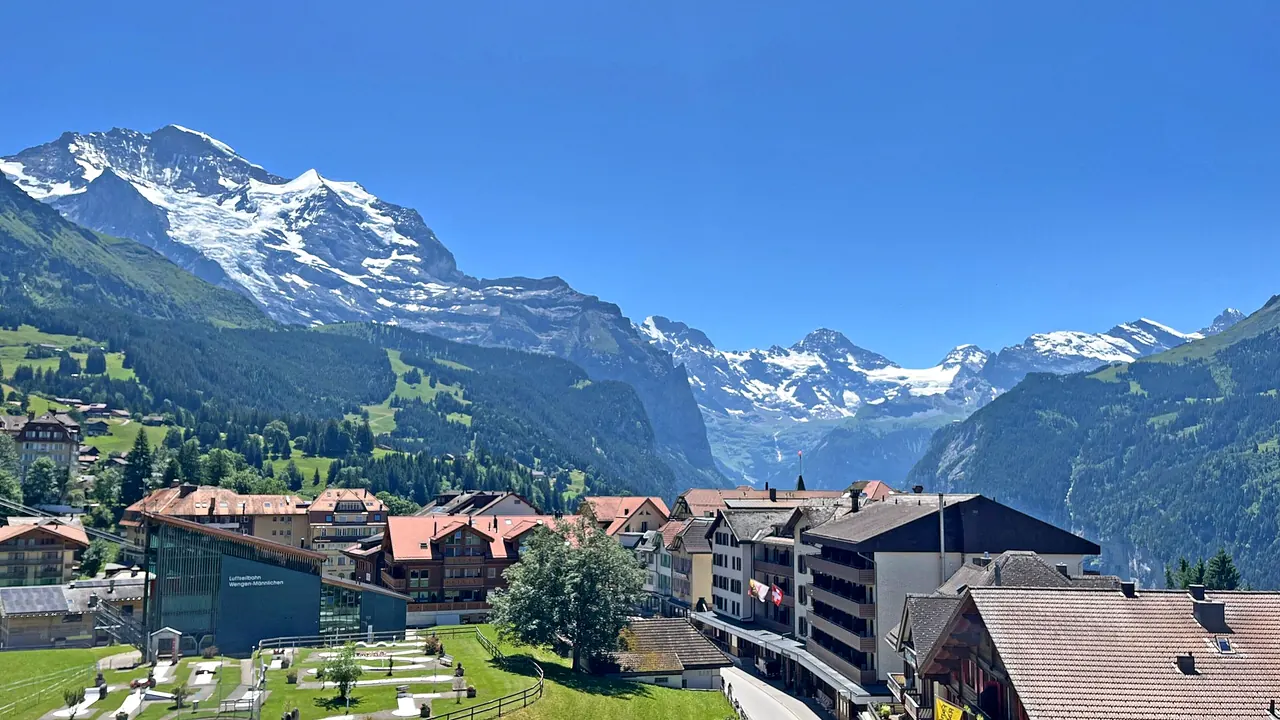
Photos: Davos by Kabelleger / David Gubler, CC BY-SA 4.0, cropped; Wengen by Charles J. Sharp, CC BY-SA 4.0, cropped.
Davos or Wengen?
Our verdict in twelve categories, each scored against the same fixed benchmark cities, and the climate month by month, so you can choose for your trip.
Choose Davos for
- culture and sights
- food and drink
- shopping
Davos is the better pick if you want a mountain vacation that still feels like a small town. It has five ski areas and long cross-country trails, and a real evening scene in winter. It also has the Kirchner Museum and the sanatorium history of The Magic Mountain, plus hotel spas and a public wellness area. Eating out has more range here, and on rest days the Albula line and the Engadine are close by. Choose it for variety, or for a group with mixed interests.
Choose Wengen for
- day trips
- beaches
- nature and the outdoors
Wengen is for travellers who want the mountains and very little else. It is a car-free village on a ledge facing the Jungfrau, with the Lauterbrunnen waterfalls below and trails starting at the door. Evenings are quiet and early, and there is almost nothing to see in town. What you get is calm and one of the great Alpine views, with Interlaken, the lakes and Bern within reach for a day.
Scoreboard
Twelve categories on one fixed scale from 0 to 100. The shaded stretch is the gap between the two.
Your match
Pick a travel style or drag the sliders, and both match scores follow your weighting.
Wins on culture and sights and food and drink with your weighting.
Wins on day trips and beaches with your weighting.
What matters to you?
Category by category
What the scores mean for a trip.
Beaches & swimming
Neither town is a place to swim, so this is a small difference in kind. Davos has a lido on its own lake, the Davosersee, at the edge of town, plus a large indoor pool. The lake water is cold even in August.
From Wengen there is no water in the village at all. The lidos on Lake Thun are an hour's train ride away, but in a warm July they are a little milder than the Davosersee.
Food & drink
Davos gives you more to eat. Graubünden has a regional cooking tradition with capuns, pizokel, barley soup and air-dried Bündnerfleisch. The huts in the Sertig and Dischma valleys serve it well, and the town has a few more ambitious kitchens besides the fondue and pizza.
In Wengen, eating out mostly means the hotel dining room on a half-board deal, with rösti, veal in cream sauce and a terrace lunch where the Jungfrau matters more than the menu. For anything different you have to go down to Interlaken.
Culture & sights
Davos has a short but real list of sights. The Kirchner Museum holds the largest collection of the Expressionist's work, and the old sanatoria such as the Schatzalp tell the story behind Thomas Mann's novel. A winter sports museum and the church of St Johann fill out a day or two.
Wengen has almost no sights to visit. Its Belle Époque hotels and small church are pleasant to pass on a stroll, but any museum or historic town means taking the train down the mountain.
Nightlife
Davos has a small but real winter scene. Après-ski starts at the foot of the Jakobshorn and Parsenn runs, then moves to pubs and a couple of clubs on the Promenade, and at weekends it goes on past midnight.
Wengen has a few slope-side bars at the end of the ski day and one big party, on the weekend of the Lauberhorn race. In summer both towns are quiet at night, but Wengen goes to bed earlier.
Nature & outdoors
Both are outstanding mountain bases, but the landscapes are different. Davos is about breadth. It has five ski areas, more than 100km of cross-country trails, singletrack for mountain bikers, and quiet side valleys ending below glaciers where you may see ibex and marmots. The Swiss National Park is close enough for a day.
Wengen is about drama at close range. The village looks straight at the Jungfrau, with the Eiger and Mönch behind, above the sheer walls and waterfalls of the Lauterbrunnen valley. The railway climbs to the glacier at the Jungfraujoch. Walkers who want famous views will prefer it, while cross-country skiers and cyclists will find more room in Davos.
Day trips
Wengen has a slightly better choice of outings, even though every trip starts with the slow rack railway down to Lauterbrunnen. Interlaken, the castles of Thun, Spiez and Oberhofen by lake steamer, and the Ballenberg open-air museum are all within an hour or so. Bern's arcaded old town is a full but worthwhile day.
From Davos the train ride is often the outing itself. You cross the Landwasser Viaduct and follow the Albula line to St Moritz, or go through the Vereina tunnel to the painted houses of Guarda. Chur's medieval centre is the nearest real town.
Good for families
Both work for outdoor families, though in different ways. Davos has more to fall back on: a large indoor pool with slides for rainy days, a natural ice rink, the long toboggan run from the Schatzalp, and free buses along its length.
Wengen's main advantage is that there are no cars, so children can walk about freely and the nursery slopes are next to the hotels. In return, the lanes are steep for buggies and there is little to do when it rains.
Getting around
You can manage without a car in either town, but the layouts are very different. Davos is a long valley town, about 4km from Dorf to Platz. It has two railway stations, and free buses run along the main road and out to the side valleys. The funicular and cable car start in town.
Wengen is a compact car-free village you can cross on foot in minutes, with steep lanes that can be icy. The mountain lifts are easy to reach, but every trip down to the valley takes time.
Shopping & style
Neither town is worth a shopping trip, but Davos has more to browse. Its Promenade has watch and jewellery shops, a few fashion boutiques and delicatessens where you can buy Bündnerfleisch and Nusstorte to take home. Wengen's short main street has little beyond ski hire, chocolate counters and a grocery.
Affordability
Both are among the most expensive places in Europe for a vacation, so the question is only where the costs fall. In Davos, peak winter weeks and the World Economic Forum in January push room rates up, while the guest card covers the local buses.
In Wengen, the mountain railways and the Jungfraujoch train add a large cost to almost every day out. In both towns, self-catering chalets or apartments and regional rail passes help a little.
Live music & performing arts
Davos has the one thing worth planning around: its summer classical festival, where young musicians play in churches, hotels and unusual spots around the valley. The congress centre also hosts the occasional concert. Wengen offers little more than the odd evening of alphorn or yodelling in a hotel, so serious music means going down to Interlaken or Bern.
Wellness & relaxation
Davos is the better place for a proper spa stay. The town was built for recovery, the larger hotels have pools and treatment rooms, the public leisure pool has a sauna area, and Scuol's mineral baths are an hour away.
Wengen offers a different kind of rest: no cars, the sound of cowbells and distant waterfalls, and long afternoons on a balcony facing the Jungfrau. Its spas are limited to the larger hotels, and there are no public thermal baths.
When should you go?
Pick your month. The climate figures are measured averages, not a forecast.
Davos in July
Wengen in July
Daytime high, °C
Rainfall in the month, mm
Where the figures come from
Davos's temperatures are measured 53 km from the centre, at S. Valentino Alla Muta.
Davos has no rain gauge within 25 km of the centre, so its rainfall comes from a gridded climate dataset read at the destination rather than from a gauge further away.
Wengen has no weather station within reach, so its figures come from a gridded climate model rather than a measured record, and read a broad area rather than one spot.
Temperature and rainfall are climate normals, averaged over the years shown. Davos: 1991-2020 normals, S. Valentino Alla Muta (53.4 km from centre). Wengen: 1991-2020 normals, TerraClimate 4 km grid at the town, no weather station within 90 km.
Both towns have two seasons worth planning around: snow from December to March, and walking from June to September. Davos is the warmer of the two in summer, with highs of about 20°C in July and August against about 16°C in Wengen. Neither is ever too hot for walking the streets or the trails. In winter Davos stays a degree or two above freezing by day and is the drier town, especially in December and January. Wengen's winter days hover around freezing, and from October to December it gets about 100mm of rain or snow a month.
In summer the pattern reverses. Davos gets its heaviest rain from June to August, up to 140mm a month, so an afternoon on the trails can easily turn wet. Wengen's summer rainfall is lower and fairly even. In both towns late spring and November are the dull months. They are too wet and slushy for good hiking, and there is no skiing.
Which traveller are you?
For a relaxing and wellness trip, Davos comes out ahead, ideally in summer or on quiet winter weekdays outside the peak ski weeks, when the dry mountain air and long terrace lunches set an unhurried pace. Wengen suits plain stillness in early summer or autumn.
On a food and nightlife trip, Davos wins clearly. You can try Graubünden dishes such as capuns and pizokel, and in winter there is après-ski on the Promenade with a couple of small clubs. Wengen's evenings end after a half-board dinner, apart from the Lauberhorn race weekend.
For an outdoors trip built around scenery and walking, Wengen has the edge. The trails start in the village and lead to Männlichen, Kleine Scheidegg and the foot of the Eiger, and the railway runs on to the Jungfraujoch. Davos has more space for cross-country skiers and mountain bikers.
Before you go
| Measure | Davos | Wengen |
|---|---|---|
| Official language | French, German, Italian, Romansh | French, German, Italian, Romansh |
| Currency | Swiss Franc (CHF) | Swiss Franc (CHF) |
| Sockets | CJ230 V, 50 Hz | CJ230 V, 50 Hz |
| Driving side | Right | Right |
| Time zone | UTC+1, UTC+2 in summer | UTC+1, UTC+2 in summer |
| Emergency number | 112 | 112 |
| Elevation | 1,559 m | 1,274 m |
| Main airport | Zürich Airport (ZRH)122 km from centre226 non-stop destinations | Zürich Airport (ZRH)106 km from centre226 non-stop destinations |
| Public holidays this year | 9 days | 10 days |
By the numbers
| Measure | Davos | Wengen |
|---|---|---|
| Population | 10,738 | 1,116 |
| People per km² | 38 | 31 |
| Museums within 10 km | 3 | 2 |
| UNESCO World Heritage sites within 50 km | 2 | 1 |
Where else could you go?
Every comparison below shares a destination with this one, so you can follow Davos or Wengen somewhere new.
- Mürrenvs Wengen
- Klostersvs Davos
- Grindelwaldvs Wengen
- Arosavs Davos
- Lenzerheidevs Davos
- Adelbodenvs Wengen