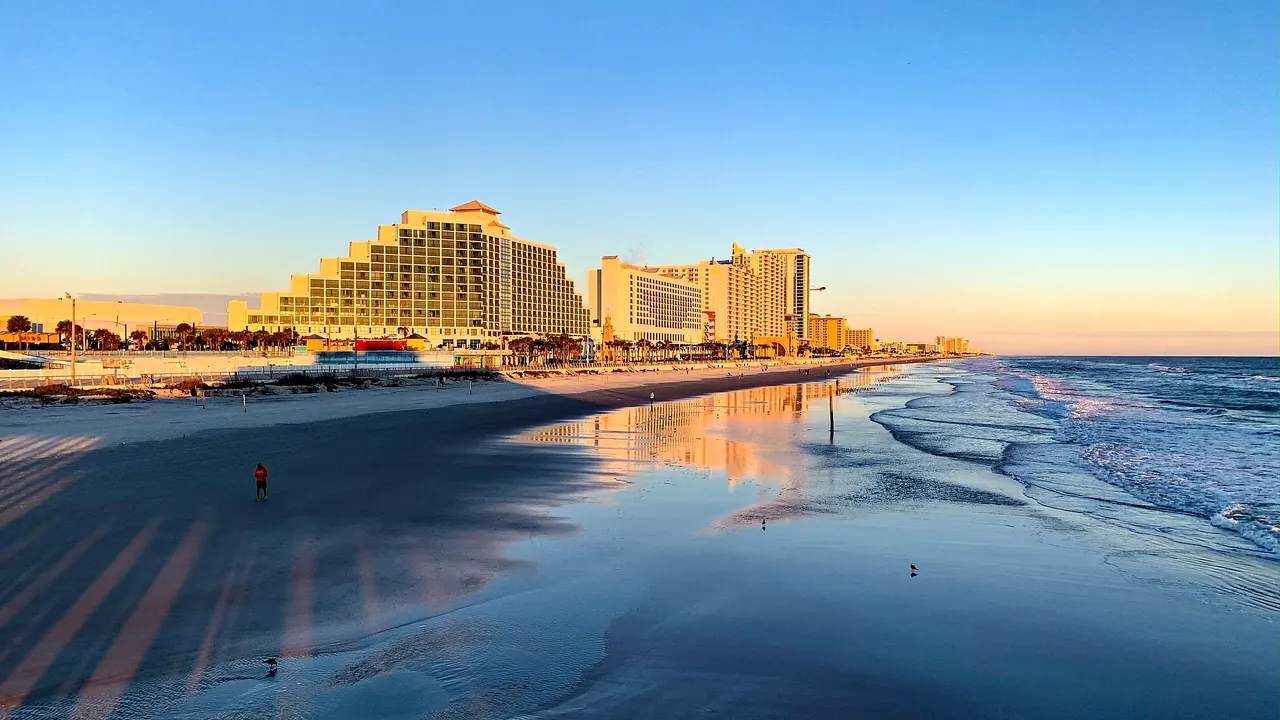
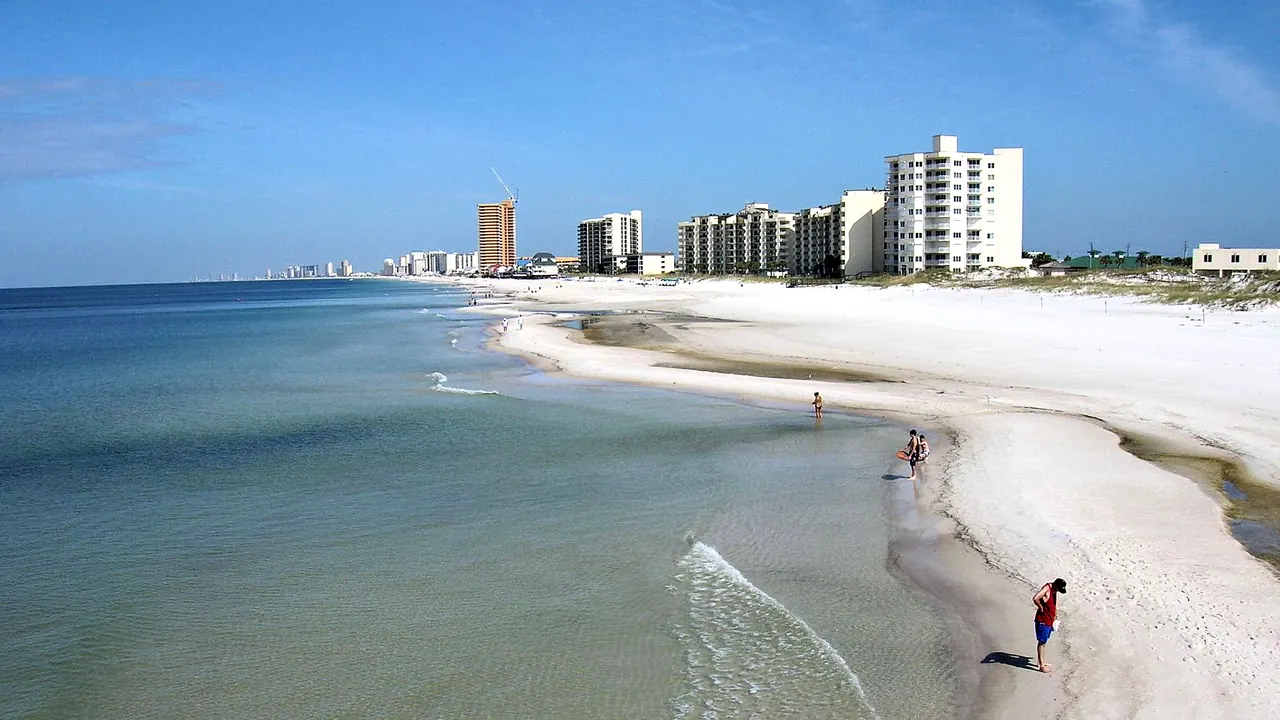
Photos: Daytona Beach by Han Zheng, CC BY-SA 2.0, cropped; Panama City Beach by j.s. clark/ "Image by jsclark.net.", CC BY-SA 2.0, cropped.
Daytona Beach or Panama City Beach?
Our verdict in twelve categories, each scored against the same fixed benchmark cities, and the climate month by month, so you can choose for your trip.
Choose Daytona Beach for
- day trips
- culture and sights
- live music and the arts
Daytona Beach suits travellers who want a beach base with more to do off the sand. The Speedway, the lighthouse and an art museum fill a day of sightseeing, and St Augustine, Kennedy Space Center and Orlando are each about an hour away, so it works well for a road-trip vacation that mixes the coast with outings. Its winters are milder too, and the bars have more going on, especially during the big event weeks.
Choose Panama City Beach for
- families
- beaches
- shopping
Choose Panama City Beach when the beach itself is the whole plan. Its powder-white quartz sand and clear green Gulf water make for prettier swimming than Daytona's firmer sand and greener Atlantic. The town is built around families, with sheltered lagoon swimming at St. Andrews State Park, a marine park, a water park and mini-golf along the strip. There is little culture and the outings are fewer and gentler, so come between late spring and autumn and stay put.
Scoreboard
Twelve categories on one fixed scale from 0 to 100. The shaded stretch is the gap between the two.
Your match
Pick a travel style or drag the sliders, and both match scores follow your weighting.
Wins on day trips and culture and sights with your weighting.
Wins on families and beaches with your weighting.
What matters to you?
Category by category
What the scores mean for a trip.
Beaches & swimming
Both towns are one long ribbon of sand, but the sand and the water differ. Daytona's 37km of hard-packed sand is so firm that cars drive on marked stretches. The Atlantic in front of it is greenish and wavy, with surf breaks near Ponce Inlet.
Panama City Beach has the more beautiful shore, with powder-white quartz sand and shallow Gulf water that turns clear green on calm days. The lagoon at St. Andrews State Park and the empty sand of Shell Island give quieter swimming than Daytona's busy central stretch by the pier. Rip currents are a real hazard on both coasts, so swim near lifeguards and watch the flags.
Food & drink
Neither town is a reason to travel for food. Both rely on fried and blackened seafood eaten casually, and chain restaurants fill the main roads. What differs is the setting. Daytona's best meals are at old fish camps on the Halifax River and towards Ponce Inlet, with smoked fish dip and Southern breakfasts as local touches. Panama City Beach centres on Gulf grouper, shrimp baskets and bay oysters at open-air shacks, and a few more careful kitchens sit near the lagoon and at the western end.
Culture & sights
Daytona has real sightseeing, if not much of it. The Speedway tour tells a history of speed that began with land-speed records on the beach itself. The Museum of Arts and Sciences holds a notable collection of Cuban art, and you can climb the Ponce de Leon Inlet Lighthouse, the tallest in Florida.
Panama City Beach offers far less: the small Man in the Sea Museum, which covers diving and the navy's underwater research, and the older streets of St. Andrews across the bay. Daytona's sights take a day or two. At Panama City Beach an afternoon is plenty.
Nightlife
Daytona has the livelier and more varied night out. Alongside the beach bars and tiki decks are the biker saloons of Main Street, which overflow onto the street during Bike Week, Biketoberfest and race weeks. Panama City Beach is mostly frozen drinks at sunset, cover bands and dockside bars around Pier Park. It is quiet by mid-evening outside summer and rowdy only during spring break in March.
Neither town has a club or cocktail-bar culture, so dancing late into the night is a slim prospect in both.
Nature & outdoors
Both are flat coastal country where the outdoors mostly means the water, but the emphasis differs. Daytona's strength is wildlife: you can kayak the Mosquito Lagoon in Canaveral National Seashore, go birding at Merritt Island and see manatees at Blue Spring in winter. Panama City Beach looks more to the sea, with snorkelling in the St. Andrews lagoon, dolphin trips on St. Andrew Bay and diving on wrecks and artificial reefs offshore, plus the rare coastal dune lake at Camp Helen.
Day trips
Daytona is the better base for outings, with three major ones each about an hour away: St Augustine's Spanish fort and old streets, the rockets at Kennedy Space Center and Orlando's theme parks. Winter Park and DeLand make quieter days.
From Panama City Beach the choice is gentler and smaller. You can visit the pastel planned towns along Highway 30A, such as Seaside and Rosemary Beach, the old oyster port of Apalachicola, or Pensacola's historic district near the two-hour mark. You need a car for all of these from either town.
Good for families
Daytona works for a family beach stay. It has arcades and small rides by the boardwalk, a planetarium for wet afternoons and Orlando's parks an hour inland, but the Atlantic surf is rougher for small swimmers.
Panama City Beach is the more complete family resort. It has shallow summer water, a sheltered lagoon at St. Andrews State Park for first snorkels, a marine park with dolphin shows, a small zoo, a water park and go-karts, all close together. Each town has noisy weeks to avoid: Bike Week and race weekends in Daytona, and spring break in March at Panama City Beach.
Getting around
Both are car towns strung along long roads, and in neither is the bus service worth planning around. Daytona has a little more to offer on foot, because its firm beach doubles as a walking and cycling route and the area by the boardwalk is walkable. Panama City Beach spreads over some 43km, with patchy pavements and a slow trolley-bus, and Front Beach Road crawls in summer much as Daytona's roads jam during big events.
Shopping & style
Neither town is a place to shop, and both cover mainstream brands and beachwear. Daytona has an outlet centre, a regional mall, the biker gear of Main Street and a few galleries on Beach Street. Panama City Beach has the open-air chain stores of Pier Park and souvenir warehouses with shark-mouth entrances, and the boutiques of the 30A towns are a drive west for anything more individual.
Affordability
Costs are close, and both sit at the cheaper end of American beach resorts. Condo kitchens help keep meals down, and you need a car in either town. The timing differs: Daytona's rates jump around the Daytona 500, Bike Week and other events, while Panama City Beach is dearest in summer and spring break and much cheaper for long winter stays.
Live music & performing arts
Daytona has more to hear and see. A long-established winter series brings visiting orchestras and soloists, the Peabody Auditorium hosts touring Broadway shows, a community playhouse stages plays and musicals, and the oceanfront bandshell has free concerts in summer.
Panama City Beach is largely cover bands and acoustic sets on bar decks, with a modest season of touring shows at the restored historic theatre across the bay in Panama City. Neither has opera or a theatre district.
Wellness & relaxation
Neither town has a spa tradition, so in both, wellness means resort spas, day spas and the calm of the sand. What differs is when the calm comes. Daytona is restful for much of the year but loses its peace to engines in race weeks and Bike Week. Panama City Beach is quietest from autumn to spring, when the beach empties for long sunset walks, and loud through summer and spring break.
When should you go?
Pick your month. The climate figures are measured averages, not a forecast.
Daytona Beach in July
Panama City Beach in July
Daytime high, °C
Rainfall in the month, mm
Where the figures come from
Panama City Beach has no rain gauge within 25 km of the centre, so its rainfall comes from a gridded climate dataset read at the city rather than from a gauge further away.
Temperature and rainfall are climate normals, averaged over the years shown. Daytona Beach: 1991-2020 normals, Daytona Beach / Mansfield Mobile Home Park (4.9 km from centre). Panama City Beach: 1971-2000 (rainfall 1991-2020) normals, Tyndall Air Force Base (24.6 km from centre).
Daytona Beach is the warmer of the two through the cooler half of the year. Winter highs are around 21°C, against about 16°C on the Gulf, so from November to April its streets and sights are comfortable to walk, though the sea is too cool for most swimmers. December to February and April are its driest months. The Atlantic warms through May and sits near 28°C from June to September, and October is still mild enough for a swim. Those same summer months bring heavy heat for walking and afternoon storms, and the rain peaks in September.
Panama City Beach follows the same sea calendar. The water warms through May, is at its warmest from June to September, when the Gulf runs a degree or so above the Atlantic, and is still pleasant in October. Its winters are cooler and wetter than Daytona's, so the beach is a place to walk rather than swim, and summer is its wettest spell, with about 220mm of rain in August. On both coasts, late May and October are warm and drier than high summer, which makes them the easiest months to combine the beach with time away from it.
Which traveller are you?
For a beach and sun trip in summer, Panama City Beach wins: its calm Gulf water is the prettier swim and nothing else competes for your time. In winter, though, Daytona's milder days make time on the sand far more pleasant.
On a family trip with young children, Panama City Beach is easier, because its children's attractions sit together along one strip and the days need little driving. Just avoid March. Daytona suits families who want a few days in Orlando's theme parks.
On a culture and arts trip, Daytona Beach is clearly the better base. Its museum and lighthouse, a winter run of visiting orchestras and St Augustine an hour north fill several days, while Panama City Beach sends you driving towards Pensacola for history.
Before you go
| Measure | Daytona Beach | Panama City Beach |
|---|---|---|
| Currency | US Dollar (USD) | US Dollar (USD) |
| Sockets | AB120 V, 60 Hz | AB120 V, 60 Hz |
| Driving side | Right | Right |
| Time zone | UTC-5, UTC-4 in summer | UTC-6, UTC-5 in summer |
| Emergency number | 911 | 911 |
| Elevation | 4 m | 3 m |
| Main airport | Daytona Beach International Airport (DAB)5 km from centre8 non-stop destinations | Northwest Florida Beaches International Airport (ECP)20 km from centre19 non-stop destinations |
| Public holidays this year | 11 days | 11 days |
By the numbers
| Measure | Daytona Beach | Panama City Beach |
|---|---|---|
| City population | 72,647 | 18,094 |
| People per km² | 440 | 375 |
| Museums within 10 km | 6 | 0 |
| UNESCO World Heritage sites within 50 km | 0 | 0 |
| Swim season, months above 21 °C | 9 months | 7 months |
Where else could you go?
Every comparison below shares a destination with this one, so you can follow Daytona Beach or Panama City Beach somewhere new.
- Destinvs Panama City Beach
- St. Augustinevs Daytona Beach
- Orlandovs Daytona Beach
- Cocoa Beachvs Daytona Beach
- Pensacolavs Panama City Beach
- Orange Beachvs Panama City Beach