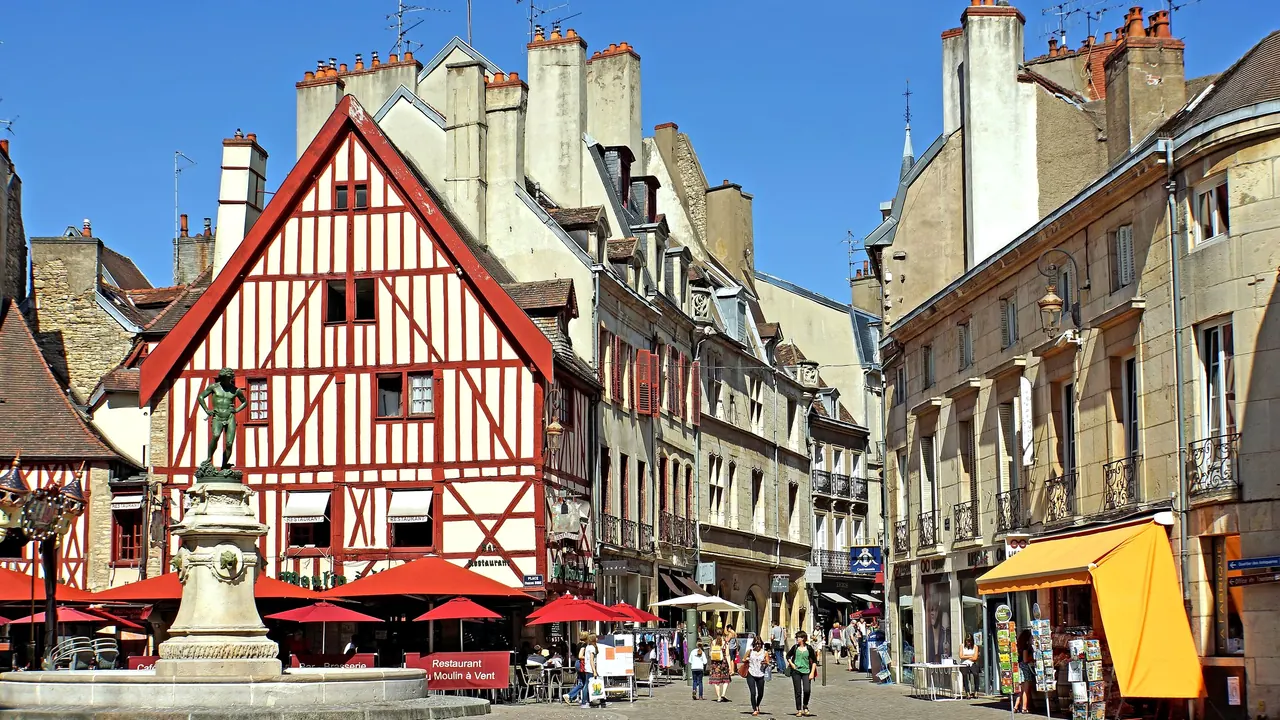
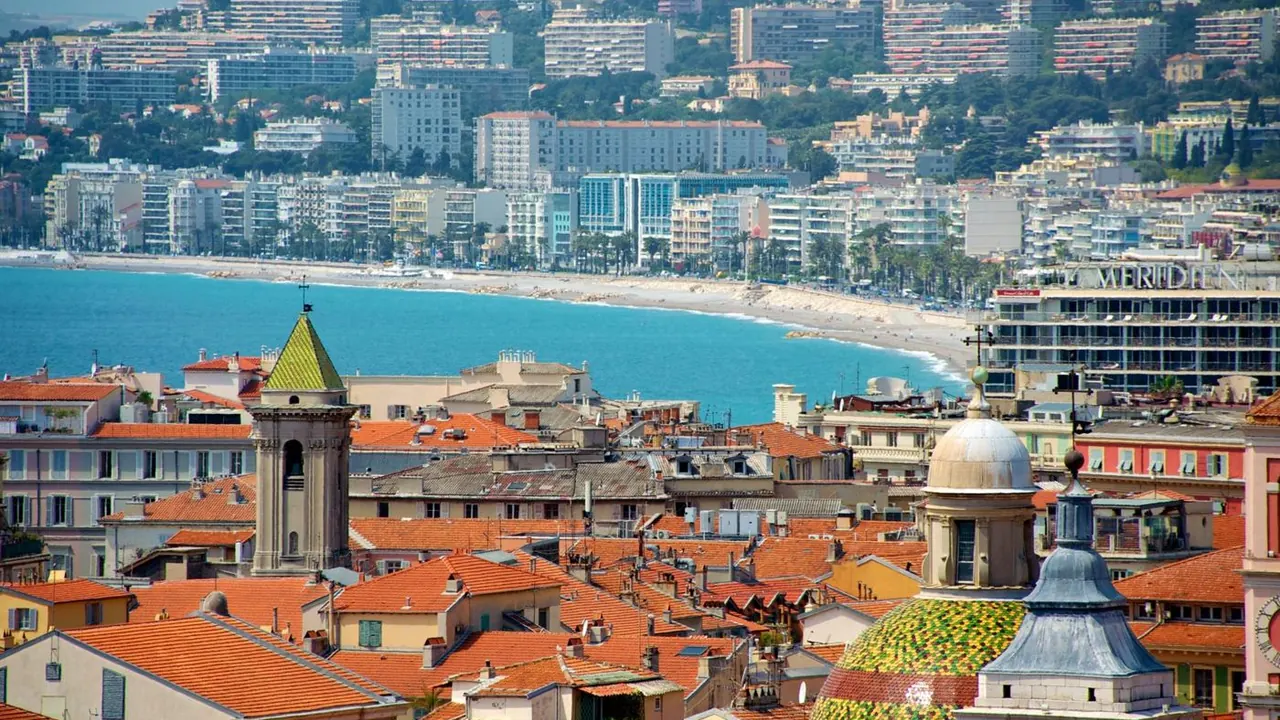
Photos: Dijon by Dennis G. Jarvis, CC BY-SA 2.0, cropped; Nice by Daniel Stockman, CC BY-SA 2.0, cropped.
Dijon or Nice?
Our verdict in twelve categories, each scored against the same fixed benchmark cities, and the climate month by month, so you can choose for your trip.
Choose Dijon for
- prices
- food and drink
Dijon suits travellers who want to eat and drink their way through Burgundy at an unhurried pace and a gentler cost. The Route des Grands Crus starts at the city's southern edge, Beaune is a short train ride away, and the small old centre around the Palace of the Dukes is a quiet base for a few days of tastings, market mornings and medieval stone.
Choose Nice for
- beaches
- nature and the outdoors
- families
If the sea is part of the plan, Nice is the obvious pick. It has a long swimming shore, the Alps within reach, livelier evenings in Vieux Nice and a string of coastal towns from Monaco to Cannes that you can reach by train. It costs more, especially in summer, but the trip it offers is far broader than an inland wine city can manage.
Scoreboard
Twelve categories on one fixed scale from 0 to 100. The shaded stretch is the gap between the two.
Your match
Pick a travel style or drag the sliders, and both match scores follow your weighting.
Wins on prices and food and drink with your weighting.
Wins on beaches and nature and the outdoors with your weighting.
What matters to you?
Category by category
What the scores mean for a trip.
Beaches & swimming
This is where the two cities are furthest apart. Dijon is hours from any coast, and its only open-air swimming is the supervised bathing lawn at Lac Kir, which is fine for a hot afternoon but not the reason for a trip.
Nice has about 7km of shore right below the promenade, with clear water you can swim in from early summer to autumn. The pebbles call for a lounger or water shoes, and for sand and calmer water you can take a short bus or train to Villefranche or Juan-les-Pins.
Food & drink
Both are very good places to eat, but in different ways. Dijon serves rich Burgundian cooking at the table: boeuf bourguignon, snails, Époisses from the stalls of Les Halles, and village wines poured by the glass from vineyards just south of town.
Nice eats lighter and more outdoors, leaning towards Liguria with socca hot from wood ovens, pissaladière and stuffed vegetables, bought from the Cours Saleya market. Dijon is better for wine and classic French cooking, Nice for simple street food, as long as you avoid the tourist terraces on the promenade.
Culture & sights
Each is worth two or three days of sightseeing, but from different eras. Dijon is a medieval capital, with the Valois tombs and their carved mourners in the ducal palace, Sluter's Well of Moses, and half-timbered lanes around Notre-Dame and its lucky owl.
Nice is at its best for modern art: Matisse in Cimiez, Chagall's biblical cycle and the Yves Klein rooms at MAMAC. Around these sit the Italianate old town and the Belle Époque villas and the Russian cathedral from the city's days as a winter resort.
Nightlife
Nice has the livelier evenings. The lanes of Vieux Nice fill with bars that spill into the street, the port adds a few calmer places, and in summer the promenade and beach clubs keep going late.
Dijon's nights depend on its students: the bars along Rue Berbisey and the terraces near Place Émile Zola, mostly wine and beer after a late dinner, and quiet streets by midnight out of term. Neither city is for clubbing. On the Riviera, people go to Monaco or Cannes for that.
Nature & outdoors
In Nice the Alps come down to the sea. You get coastal paths around Cap Ferrat, corniche roads for cyclists, the red rocks of the Esterel and the high lakes of the Mercantour, and in winter you can ski at Isola 2000 and be back by the sea the same day. Diving, kayaking and sailing are easy to arrange as well.
Dijon's countryside is gentler. There are climbing cliffs and trails in the combes just west of town, a flat canal towpath, the signed vineyard cycle route to Beaune and the granite hills of the Morvan. It is pleasant for easy walks and rides, but it has no drama.
Day trips
Both make excellent bases, but Nice has more variety and needs less planning. Monaco, Èze, Antibes, Cannes, Grasse, Saint-Paul-de-Vence and even Sanremo across the Italian border are all reachable by train or bus, mostly in under an hour.
Dijon's trips are more focused, mostly wine country and Cistercian heritage. Beaune is an easy train ride, but Gevrey-Chambertin, Vougeot, Meursault and Fontenay Abbey are much easier with a car, a bike or a small tour.
Good for families
Nice gives children more to do. The water jets and playgrounds of the Promenade du Paillon, the plants and animals of Parc Phoenix, the waterfall on Castle Hill and the sea itself fill several days. The pebbles and summer heat are the main drawbacks.
Dijon is safe and easy, with a small pedestrian centre, a planetarium in the Jardin de l'Arquebuse and paddling at Lac Kir. After that, though, most of the trip is tastings and fine-art museums, which interest parents more than children.
Getting around
Neither city needs a car. Dijon is the smaller of the two: the station, market, palace and cathedral are minutes apart on foot, two tram lines cover the outskirts, and the TGV reaches Paris in well under two hours.
Nice's centre is a flat half-hour walk end to end. Its tram runs straight from the airport to the port, and the coastal trains take you to Monaco and Cannes, though they get packed in summer. In each city, a car only becomes useful for the countryside: Dijon's wine villages away from the railway, and Nice's mountains.
Shopping & style
Nice offers more shops. There are chains and Galeries Lafayette on Avenue Jean Médecin, luxury labels around rue Paradis, Provençal soaps and olive oil in the old town, and a Monday antiques market on the Cours Saleya.
Dijon's shopping is mostly for the larder: mustard in dozens of flavours, cassis, pain d'épices, Burgundy from the wine merchants and cheese from Les Halles. Rue de la Liberté covers the basics, but there is little for anyone after fashion.
Affordability
Dijon is the cheaper stay. Hotel rooms are moderate, bistro lunch menus are fair, and wine costs less than in most of France. The bill only climbs with serious restaurants, guided tours and good bottles.
Nice is expensive for southern Europe, especially for sea-view rooms and beach loungers between June and September. Its cheap trams and coastal trains, low-cost city museums and socca help, and spring or late autumn are much easier on the budget.
Live music & performing arts
The two are on a par, but their seasons fall at different times of year. Dijon's Opéra uses the old Grand Théâtre and the Auditorium, known for its acoustics, and the programme follows the academic year before thinning to outdoor events in summer.
Nice has its red-and-gold opera house and its national theatre, but its biggest moments are fixed events: the Carnival in February and the long-running Nice Jazz Festival in July. In summer Nice has the more to offer, and the rest of the year the two are similar.
Wellness & relaxation
Nice has a little more for anyone who wants pampering. There are spas in the big seafront hotels, thalassotherapy centres along the coast, and the simple pleasure of an early swim and an evening stroll on the promenade, though high summer is far from calm.
Dijon has only a few hotel spas, some offering grape-based treatments. Its restfulness comes from long lunches, quiet squares and slow afternoons among the vines rather than from any treatment.
When should you go?
Pick your month. The climate figures are measured averages, not a forecast.
Dijon in July
Nice in July
Daytime high, °C
Rainfall in the month, mm
Temperature and rainfall are climate normals, averaged over the years shown. Dijon: 1991-2020 normals, Dijon (7 km from centre). Nice: 1991-2020 normals, Nice (8 km from centre).
Dijon has a proper continental year. Winters are cold and grey, with highs around 6°C and little sun, so November to February is a poor time for walking the vineyards. Late spring through September is the good stretch. Summer peaks near 27°C, warm enough for long evenings on the terraces, and July is the sunniest month. Rain falls fairly evenly through the year, with May, October and November a little wetter than the rest.
Nice is milder and much sunnier in every month, with winter days still pleasant for walking. Summer is close to rainless, July especially, and the sea warms to about 25°C by August, so swimming runs from June into October. The catch comes in autumn: October and November are the wettest months, with up to 138mm, while Dijon stays drier then. For walking in either city, May, June and September are the best months.
Which traveller are you?
On a beach and sun trip, Nice is the only real choice. You can swim straight from the city through a long, sunny and nearly rainless summer. Dijon has warm afternoons too, but its water is an inland lake, hours from any sea.
On a trip on a tight budget, Dijon lets your money go further without much planning. Eating well, sleeping centrally and walking everywhere all fit a modest sum. Nice works on the same budget only if you are disciplined, and best outside summer.
For a wine-touring trip, Dijon is the clear choice. You taste at the source of names like Gevrey-Chambertin and Nuits-Saint-Georges, get to the cellars by bike or on a small tour, and learn the region at the Cité de la Gastronomie. Next to that, Nice's small Bellet vineyards are a curiosity.
Before you go
| Measure | Dijon | Nice |
|---|---|---|
| Official language | French | French |
| Currency | Euro (EUR) | Euro (EUR) |
| Sockets | CE230 V, 50 Hz | CE230 V, 50 Hz |
| Driving side | Right | Right |
| Time zone | UTC+1, UTC+2 in summer | UTC+1, UTC+2 in summer |
| Emergency number | 112 | 112 |
| Elevation | 220 m | 0 m |
| Main airport | Lyon Saint-Exupéry Airport (LYS)178 km from centre141 non-stop destinations | Nice-Côte d'Azur Airport (NCE)6 km from centre130 non-stop destinations |
| Public holidays this year | 11 days | 11 days |
By the numbers
| Measure | Dijon | Nice |
|---|---|---|
| City population | 161,830 | 357,737 |
| People per km² | 3,890 | 4,975 |
| Museums within 10 km | 8 | 17 |
| UNESCO World Heritage sites within 50 km | 1 | 2 |
| Swim season, months above 21 °C | - | 4 months |
Where else could you go?
Every comparison below shares a destination with this one, so you can follow Dijon or Nice somewhere new.