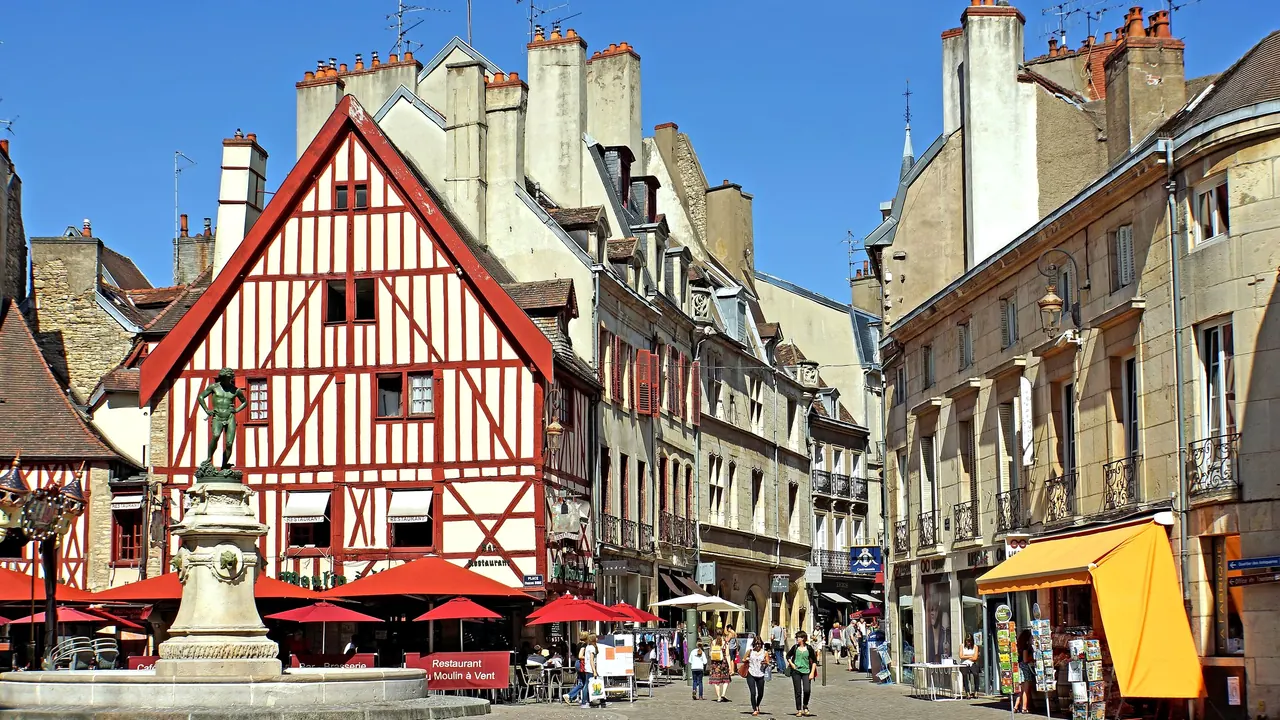
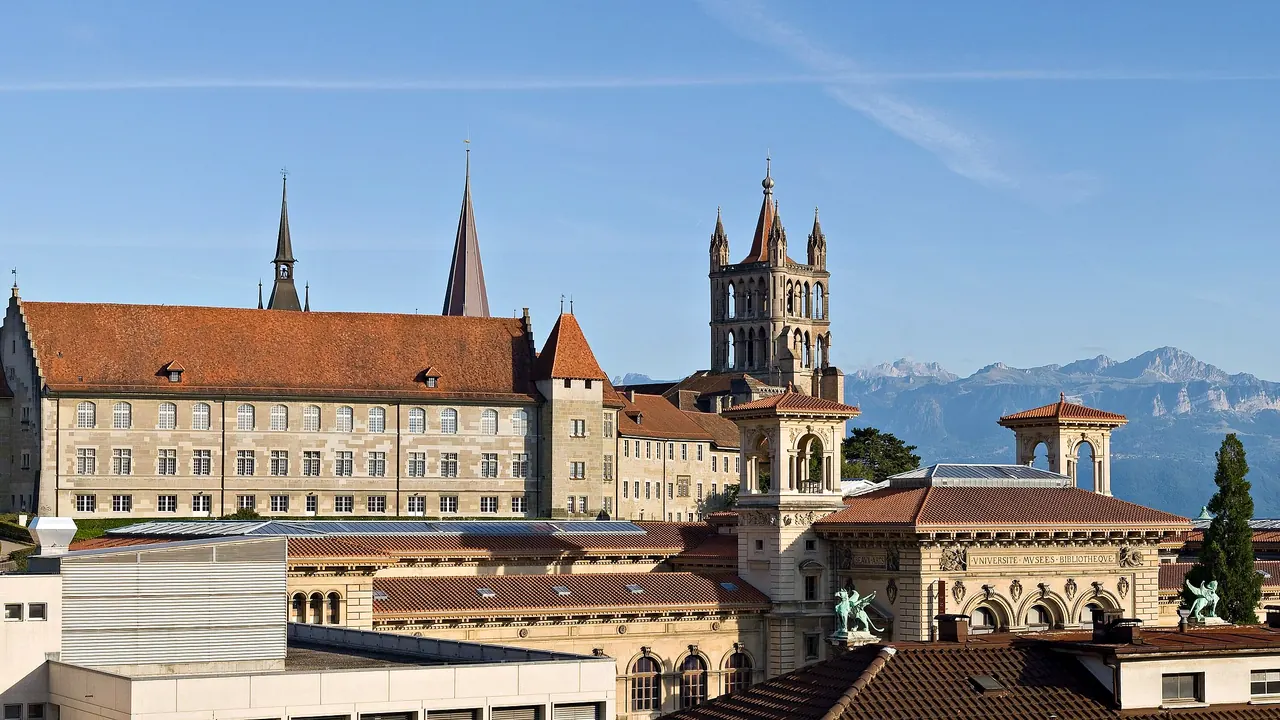
Photos: Dijon by Dennis G. Jarvis, CC BY-SA 2.0, cropped; Lausanne by Christian Mehlführer, CC BY-SA 3.0, cropped.
Dijon or Lausanne?
Our verdict in twelve categories, each scored against the same fixed benchmark cities, and the climate month by month, so you can choose for your trip.
Choose Dijon for
- prices
- food and drink
- culture and sights
Dijon is the choice for travellers who plan their days around the table and the wine list. The old ducal centre, the iron market hall and the Burgundy villages that begin at the city's southern edge make a compact, unhurried stay. It also costs far less than a Swiss city, so long lunches and cellar visits go further.
Choose Lausanne for
- nature and the outdoors
- beaches
- families
Lausanne suits those who want landscape as much as townscape: the lake for swimming and boating in summer, the Lavaux terraces for walking, and the Alps and the Jura within an hour. It also gives families more to do, has the stronger stage, and its trains make every outing easy. All of this comes at some of the steepest prices in Europe, so the budget has to absorb that.
Scoreboard
Twelve categories on one fixed scale from 0 to 100. The shaded stretch is the gap between the two.
Your match
Pick a travel style or drag the sliders, and both match scores follow your weighting.
Wins on prices and food and drink with your weighting.
Wins on nature and the outdoors and beaches with your weighting.
What matters to you?
Category by category
What the scores mean for a trip.
Beaches & swimming
Neither city has a coast, but Lausanne at least has proper summer bathing. Lake Geneva is warm enough from late June to early September to swim from the lawns and pebble shores at Vidy, Bellerive, Pully and Lutry, and the old Bellerive lido makes a full afternoon of it.
Dijon has the supervised bathing area at Lac Kir, a reservoir on the edge of town that suits local families on hot days, and otherwise municipal pools. Neither is a beach vacation, but in Lausanne a swim can be part of most summer days.
Food & drink
Dijon has the better table. Burgundian classics such as boeuf bourguignon, coq au vin and jambon persillé, its own mustard, cassis and pain d'épices, and the iron market hall of Les Halles make it one of France's defining regional kitchens. The wine bars also pour village Burgundies by the glass.
Lausanne's Vaudois cooking, with lake perch, papet vaudois and fondue in winter, is good but plainer. Its best moments come from Lavaux Chasselas in the growers' caveaux and from a handful of celebrated high-end tables. Neither city offers much international food or street food, but Dijon has far more good bistros at everyday level.
Culture & sights
Dijon has the richer historic fabric. The Palace of the Dukes holds the Musée des Beaux-Arts and its Valois tombs, and around it the half-timbered streets, Notre-Dame's gargoyles and its lucky owl make up a historic centre that is part of a UNESCO listing with the Burgundy vineyards. Sluter's Well of Moses at the Chartreuse de Champmol adds one more masterpiece of medieval sculpture. Here the city itself is the sight.
In Lausanne it works the other way round. The Gothic cathedral and the steep old town are attractive, but the museums are the main draw: the Olympic Museum at Ouchy, the cluster of museums at Plateforme 10 and the Collection de l'Art Brut. Each city fills two or three days well.
Nightlife
Both are student cities with modest scenes, but Lausanne has a proper centre for going out in the Flon. Clubs and late bars fill its old warehouses at weekends, and on summer evenings people spread along the waterfront at Ouchy.
Dijon's nights mostly mean wine bars and pubs along Rue Berbisey and terraces around Place Émile Zola. There are few clubs, and outside term time the streets are quiet by midnight. Expect to pay a good deal more per drink in Lausanne, though.
Nature & outdoors
This is Lausanne's greatest advantage. The French Alps rise straight out of the lake opposite the city, and the Lavaux terraces make one of Switzerland's finest walks. Within an hour, the Vaud Alps and the Jura offer skiing, glacier views and long hikes.
Dijon's surroundings are gentle by comparison. You can climb and walk in the combes west of town, cycle the Burgundy Canal towpath and the vineyard route towards Beaune, or head to the granite hills and lakes of the Morvan for something wilder. It is pleasant country for an easy ride, not for mountain days.
Day trips
Both are excellent bases, and the difference lies in what you go out to see. From Dijon nearly every trip leads to wine or monasteries: the Route des Grands Crus to Beaune, Fontenay Abbey, Semur-en-Auxois and Vézelay. Most of the vineyard villages, though, need a car, a bike or a tour.
Lausanne has a slight edge in range and ease. Trains reach Montreux and Chillon, Geneva, Bern, Fribourg, Gruyères and Murten without a car, and boats cross the lake to the French shore. The result is a mix of castles, cities and mountain villages rather than a single theme.
Good for families
Lausanne is better set up for children. Several of its museums and outings are made for them, and the lake is a summer playground. The drawbacks are the steep streets, which are hard going with a pushchair, and the cost of feeding a family.
Dijon is small, flat and largely pedestrian, which is easier on young legs. Beyond the natural history museum and planetarium in the Jardin de l'Arquebuse and the lawns of the Parc de la Colombière, though, its days of fine art and wine tastings are aimed at adults.
Getting around
Both centres are compact, and neither needs a car. Dijon is flat and mostly pedestrian, with two tram lines out to the suburbs. Lausanne climbs steeply from the lake and relies on the m2 metro to carry visitors more than 300m up to the upper town.
Lausanne pulls slightly ahead on connections, because the Swiss rail network and the lake boats reach most excursions on time. Dijon has the TGV to Paris and trains to Beaune, but the wine villages away from the line mean hiring a car or a bike.
Shopping & style
Neither city is a shopping destination, and both are best for things to take home and eat or drink. In Dijon that means mustard, cassis, pain d'épices, Burgundy from the cellars and cheese from Les Halles, plus antiques in the lanes off Rue de la Liberté. Lausanne offers chocolate, Lavaux wine, and Swiss watches and jewellery on Rue de Bourg, with more international fashion brands but few independent shops.
Affordability
The gap is widest in the ordinary parts of a day. In Dijon a hotel room and an everyday meal cost what you would expect in provincial France, and the bill only climbs when you choose to spend on what Burgundy is famous for: serious restaurants, cellar tastings, guided wine tours and good bottles.
In Lausanne the basics are already expensive before you add any treat, so a modest stay can cost more than an indulgent one in Dijon. Getting around costs little in both, since each centre is compact. Overall, the same money goes a good deal further in Burgundy than on Lake Geneva.
Live music & performing arts
Lausanne's stage has the wider reputation, and dance leads it. The city has the Béjart Ballet Lausanne, the Prix de Lausanne for young dancers and the Théâtre de Vidy, whose contemporary productions tour Europe, alongside an opera season and a respected chamber orchestra. In July the Montreux Jazz Festival is a short train ride away.
Dijon's season is solid for its size. It has opera, concerts and dance at the Grand Théâtre and the Auditorium, plus a national drama centre. It follows the academic year, though, and in summer it thins out to outdoor events.
Wellness & relaxation
Neither city has a bathing tradition of its own, but Lausanne is far better placed for a spa visit. The grand lakeside hotels have extensive spas, Yverdon-les-Bains is under half an hour by train, and the hot springs at Lavey-les-Bains are within an hour. Dijon offers only a few hotel spas, some in the wine villages with grape-based treatments.
What Dijon offers instead is rest through its pace: long lunches, quiet squares and slow afternoons among the vines. In Lausanne the calm is on the edges, along the promenades at Ouchy and Vidy and in the Lavaux vineyards, because the steep centre is busier than it looks.
When should you go?
Pick your month. The climate figures are measured averages, not a forecast.
Dijon in July
Lausanne in July
Daytime high, °C
Rainfall in the month, mm
Where the figures come from
Lausanne's temperatures are measured 40 km from the centre, at Payerne.
Lausanne has no rain gauge within 25 km of the centre, so its rainfall comes from a gridded climate dataset read at the city rather than from a gauge further away.
Temperature and rainfall are climate normals, averaged over the years shown. Dijon: 1991-2020 normals, Dijon (7 km from centre). Lausanne: 1991-2020 (sunshine 1961-1990) normals, Payerne (39.7 km from centre).
Both cities follow the same continental pattern: cold winters with short days, a gradual spring, and summer warmth that peaks in July at about 27°C in Dijon and 26°C in Lausanne. From late June to early September Lake Geneva is warm enough to swim in at Lausanne, and those same months are the time for Dijon's terraces and for cycling in the vineyards. The two get very similar amounts of sunshine through the year, and Lausanne is a little colder in midwinter, with highs of around 4°C in December and January.
Rain is the real difference. Lausanne is wetter in every month, and summer is its wettest stretch, with about 115mm in July against 65mm in Dijon. May, June and September are the most comfortable months for walking the streets in both cities. If you want to spend summer days outside without packing an umbrella, Dijon is the safer bet.
Which traveller are you?
On a trip on a tight budget, Dijon is the clear pick. Hotels are moderate, bistro set lunches are a fair way to eat well and wine by the glass is cheap. In Lausanne even a simple lunch out adds up quickly, and picnics become a necessity.
For an outdoors trip, Lausanne wins easily. The paths through the Lavaux terraces, sailing and paddleboarding on the lake, and hiking or skiing in the Vaud Alps and the Jura within an hour outclass Dijon's gentle combes, canal towpath and vineyard cycle route.
On a family trip with children, Lausanne offers more. The hands-on Olympic Museum, the aquarium-vivarium, the animal park and pedal boats at Sauvabelin and the paddle steamers fill the days. Dijon is safe and easy, but beyond its parks, planetarium and Lac Kir there is little for children.
Before you go
| Measure | Dijon | Lausanne |
|---|---|---|
| Official language | French | French, German, Italian, Romansh |
| Currency | Euro (EUR) | Swiss Franc (CHF) |
| Sockets | CE230 V, 50 Hz | CJ230 V, 50 Hz |
| Driving side | Right | Right |
| Time zone | UTC+1, UTC+2 in summer | UTC+1, UTC+2 in summer |
| Emergency number | 112 | 112 |
| Elevation | 220 m | 495 m |
| Main airport | Lyon Saint-Exupéry Airport (LYS)178 km from centre141 non-stop destinations | Geneva International Airport (GVA)52 km from centre150 non-stop destinations |
| Public holidays this year | 11 days | 9 days |
By the numbers
| Measure | Dijon | Lausanne |
|---|---|---|
| City population | 161,830 | 144,873 |
| People per km² | 3,890 | 3,499 |
| Museums within 10 km | 8 | 31 |
| UNESCO World Heritage sites within 50 km | 1 | 3 |
Where else could you go?
Every comparison below shares a destination with this one, so you can follow Dijon or Lausanne somewhere new.
- Genevavs Lausanne
- Chamonixvs Lausanne
- Bernvs Lausanne
- Annecyvs Lausanne
- Interlakenvs Lausanne
- Baselvs Lausanne