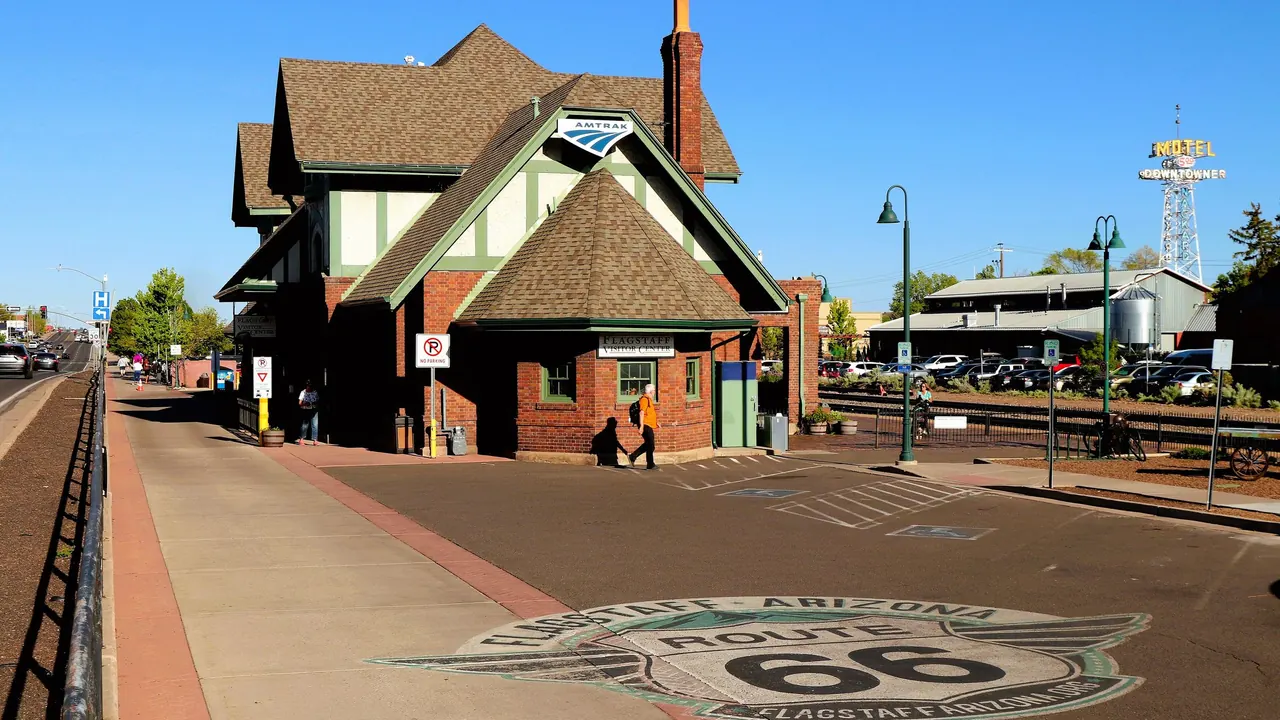
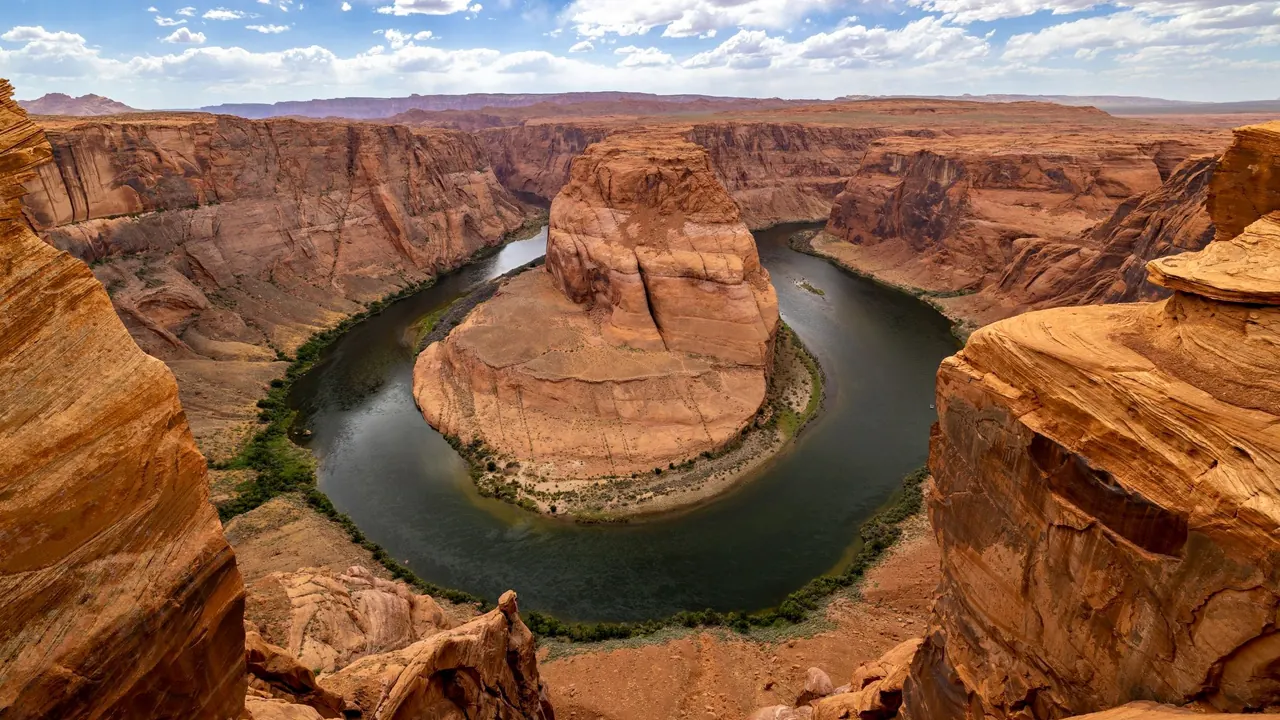
Photos: Flagstaff by Thank You (25 Millions) views, CC BY 2.0, cropped; Page, Arizona by Balazs Simon, Pexels License.
Flagstaff or Page, Arizona?
Our verdict in twelve categories, each scored against the same fixed benchmark cities, and the climate month by month, so you can choose for your trip.
Choose Flagstaff for
- day trips
- live music and the arts
- nightlife
Flagstaff is the better choice for a rounded mountain trip. It gives you pine forest, the San Francisco Peaks and the Grand Canyon within reach, and it also has a real town to come back to. There are brewery patios, Lowell Observatory, the Museum of Northern Arizona and a downtown you can walk. It suits travellers who want varied outings, a few evenings out and an easier time with children, and in winter it adds snow.
Choose Page, Arizona for
- beaches
- nature and the outdoors
Page is for people who came for the landscape and the water and need little else. Antelope Canyon, Horseshoe Bend and the red coves of Lake Powell are right on the doorstep, and in summer the lake gives you swimming that Flagstaff cannot. The town itself is thin. Expect early nights, plain food and long drives, so it works best as a few active days on a road trip rather than a base with something to do every evening.
Scoreboard
Twelve categories on one fixed scale from 0 to 100. The shaded stretch is the gap between the two.
Your match
Pick a travel style or drag the sliders, and both match scores follow your weighting.
Wins on day trips and live music and the arts with your weighting.
Wins on beaches and nature and the outdoors with your weighting.
What matters to you?
Category by category
What the scores mean for a trip.
Beaches & swimming
Page has real summer swimming and Flagstaff does not. Lake Powell gets warm enough for long, comfortable swims, and you can drive down to the sand at Lone Rock or take a boat into the sandstone coves and jump straight into deep water. There are no lifeguards, and the shoreline moves as the lake level changes.
From Flagstaff, the closest swimming is in Oak Creek Canyon, at Slide Rock and the creek pools. The water there is cold, the rocks are slippery and it gets crowded at weekends. Otherwise you are limited to a hotel pool.
Food & drink
Neither town is somewhere you go for the food, but Flagstaff gives you more choice. The craft breweries downtown and in the Southside are its strong point, and around them are coffee houses, New Mexican cooking and a few more ambitious restaurants.
Page mostly feeds tour groups, with diners, barbecue, pizza and chains along the main strip and no coffee culture to speak of. In both towns the dish to look for is the Navajo taco. In Page it is often sold at roadside stands on the reservation.
Culture & sights
Flagstaff has a short but worthwhile list of sights. Lowell Observatory's historic telescopes, the Native art at the Museum of Northern Arizona, Riordan Mansion and the railroad-era brick downtown are enough for a day or two.
Page was only founded in the 1950s, for the workers building the Glen Canyon Dam, and its sights reflect that. The dam's visitor centre and a small museum about John Wesley Powell make up most of it. The deeper culture comes from the Navajo Nation around the town, not from anything inside it.
Nightlife
Flagstaff has a modest but real night out. You can walk between brewery taprooms, cocktail bars and old Route 66 saloons, and university students liven up term-time weekends, though there are hardly any clubs.
Evenings in Page are short. There are a few bars and a brewpub, and the town is quiet before midnight. The best thing to do after dark is drive away from the lights and look at the stars.
Nature & outdoors
Both towns are superb bases for the outdoors, but the landscapes are very different. Flagstaff is a mountain base. It has the volcanic San Francisco Peaks, aspens turning in autumn, a huge ponderosa forest, the Arizona Trail and a ski area. Sunset Crater, Sedona's red rocks and the Grand Canyon's South Rim are all within easy reach.
Page is a desert and water base. Antelope Canyon's slot canyons and Horseshoe Bend are minutes away, and boats go up Lake Powell to Rainbow Bridge. Grand Canyon rafting starts at Lees Ferry, and the Vermilion Cliffs and the Wave are within reach. Flagstaff suits walkers and skiers, while Page suits people who want to spend time on the water and in slot canyons.
Day trips
Flagstaff has a wider choice of places to drive to. Sedona and the hillside mining town of Jerome are close, and so are the cliff dwellings at Montezuma Castle and the Sinagua ruins at Walnut Canyon and Wupatki. The historic railway runs from Williams to the Grand Canyon, and the Hopi mesas are about two hours away.
From Page, most trips are to landscapes rather than towns. The exceptions are Lees Ferry's pioneer ranch, Kanab's film-set history, Pipe Spring and the cliff dwellings at Betatakin. The drives between them are long.
Good for families
Flagstaff is easier with children. There are telescope evenings at Lowell Observatory, dinosaur displays at the Museum of Northern Arizona, rope courses in the pines in summer and sledding in winter. The steam train to the Grand Canyon is a treat too. Expect the altitude to tire small children for the first day or two.
Page is great fun for families on the lake, and the Antelope Canyon tours are short enough for any age. But there is nothing built for children, the summer sun is harsh, and the drops at Horseshoe Bend have mostly no fencing, so small children need close watching.
Getting around
You will want a car in both towns, but Flagstaff is a little more forgiving. Its downtown and Southside are pleasant on foot, a paved trail network makes cycling practical, there are local buses, and long-distance trains stop at the station.
In Page you can only walk the main strip, and there is no useful public transport. The lake, Horseshoe Bend and the parks further out are all reached by road, and the nearest big airports are hours away. Most visitors arrive by car on a road trip.
Shopping & style
In both towns the thing worth buying is Native American craft: Navajo rugs, silver and turquoise jewellery, and pottery. Flagstaff has more places to buy it, with downtown galleries, the museum shop and trading posts, and it also adds Hopi kachina carvings, outdoor gear shops, bookshops and boutiques.
In Page, beyond the trading posts and roadside stalls where you can buy straight from the maker, there are gift shops and supermarkets for stocking a houseboat.
Affordability
Neither town is cheap, but Flagstaff is easier on the budget. Chain motels along Route 66 keep a basic stay affordable, though rooms fill up and rates climb on summer weekends. It is still usually much cheaper to sleep there than in Sedona or at the canyon rim.
Page has fewer rooms, and its main sights cost money. Antelope Canyon can only be visited on a paid guided tour, and boat or houseboat hire is expensive. Camping at Lone Rock or Wahweap, or coming in winter, keeps the cost down.
Live music & performing arts
Flagstaff has a small but regular programme. The symphony orchestra and the university music school play on campus, the restored Orpheum Theater hosts touring folk and indie acts, and summer brings concerts in the pines. That is enough for a good evening.
Page has no theatre or concert venue. The most you will find is a Navajo dance presentation or dinner show for visitors, or an occasional band in a bar.
Wellness & relaxation
Neither town has a spa culture. Flagstaff makes for a calmer stay, as a slow mountain town with cool evenings and pine-scented air, and the resort spas and yoga studios of Sedona are about an hour's drive away.
Page has quiet evenings and very dark skies, but most visits there mean early canyon starts and long drives, so it leaves less time for doing nothing. Its spa options are limited to a few hotel treatments and the motel pool.
When should you go?
Pick your month. The climate figures are measured averages, not a forecast.
Flagstaff in July
Page, Arizona in July
Daytime high, °C
Rainfall in the month, mm
Where the figures come from
Flagstaff has no rain gauge within 25 km of the centre, so its rainfall comes from a gridded climate dataset read at the city rather than from a gauge further away.
Temperature and rainfall are climate normals, averaged over the years shown. Flagstaff: 1991-2020 normals, Flagstaff / Fort Tuthill (7.4 km from centre). Page, Arizona: 1991-2020 normals, Page Municipal Airport (5.2 km from centre).
These two towns have very different climates despite being only a couple of hours apart, because Flagstaff sits much higher. Flagstaff is at its best from late May to early October, when daytime highs reach about 27°C in July. From July to September the monsoon brings afternoon storms, and August is the wettest month at around 64mm. Winter is properly cold, with highs near 5°C in January and real snow, which suits the ski slopes but not long walks around town.
Page is warm and dry most of the year. Midsummer is very hot, at about 36°C in July, so hikes have to be done early and the afternoons belong to Lake Powell, whose water is warm enough for long swims from June to September. Spring and autumn are the best seasons for hiking the canyons and viewpoints, with April and October both around 22°C. Winter is cool and quiet and the lake is too cold for swimming. In short, go to Page in high summer for the water and in the shoulder seasons for walking, and go to Flagstaff when Page is too hot.
Which traveller are you?
On a beach and sun trip, skip Flagstaff, whose nearest water is a cold mountain creek. Choose Page between June and September, give at least one full day to a boat or kayak on Lake Powell, and see the canyons early, before the heat.
For a culture and arts trip, base yourself in Flagstaff. Two days cover the observatory and the museum, and the ancient ruins nearby fill a third, with a concert if your dates allow. Page has little indoors, so treat it as a short landscape stop.
On a food and nightlife trip, Flagstaff is the better pick, though neither town is worth travelling to for this alone. Plan your evenings around its breweries and look for green chile and Navajo tacos. Page offers plain meals and early nights, so keep your stay there short.
Before you go
| Measure | Flagstaff | Page, Arizona |
|---|---|---|
| Currency | US Dollar (USD) | US Dollar (USD) |
| Sockets | AB120 V, 60 Hz | AB120 V, 60 Hz |
| Driving side | Right | Right |
| Time zone | UTC-7 | UTC-7 |
| Emergency number | 911 | 911 |
| Elevation | 2,106 m | 1,255 m |
| Main airport | Flagstaff Pulliam Airport (FLG)7 km from centre2 non-stop destinations | Page Municipal Airport (PGA)5 km from centre3 non-stop destinations |
| Public holidays this year | 12 days | 12 days |
By the numbers
| Measure | Flagstaff | Page, Arizona |
|---|---|---|
| City population | 76,831 | 7,440 |
| People per km² | 464 | 173 |
| Museums within 10 km | 1 | 0 |
| UNESCO World Heritage sites within 50 km | 0 | 0 |
Where else could you go?
Every comparison below shares a destination with this one, so you can follow Flagstaff or Page, Arizona somewhere new.
- Sedonavs Flagstaff
- Scottsdalevs Flagstaff
- Phoenixvs Flagstaff
- Sedonavs Page, Arizona
- Moabvs Page, Arizona
- Durango, Coloradovs Page, Arizona