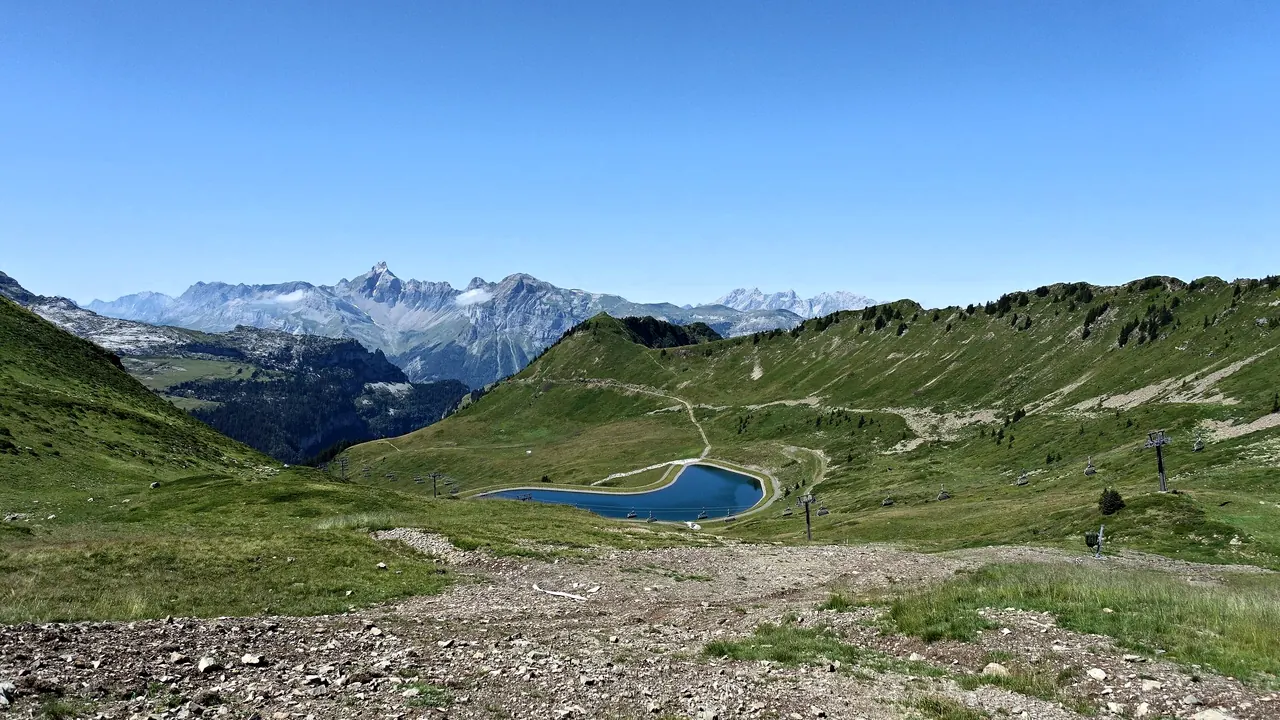
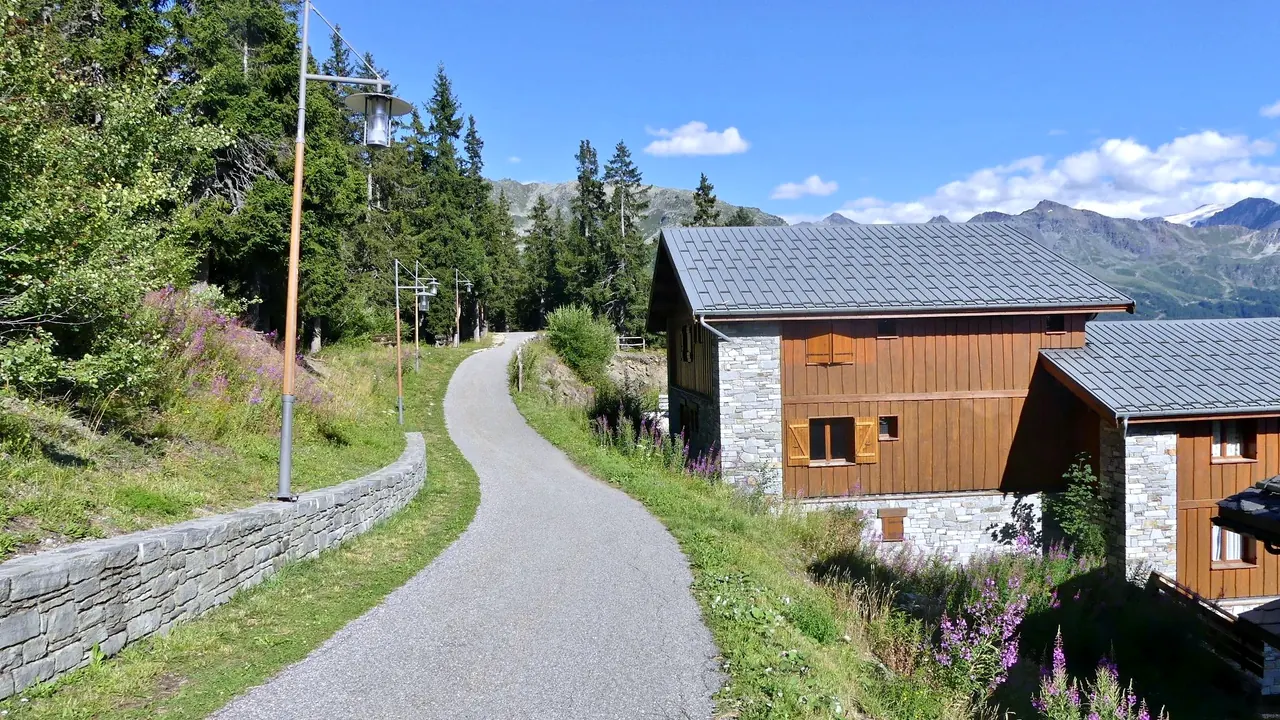
Photos: Flaine by Guilhem Vellut, CC BY 2.0, cropped; La Rosière by Florian Pépellin, CC BY-SA 4.0, cropped.
Flaine or La Rosière?
Our verdict in twelve categories, each scored against the same fixed benchmark cities, and the climate month by month, so you can choose for your trip.
Choose Flaine for
- day trips
- culture and sights
- getting around
Flaine is the better pick for a ski week with children, because its car-free centre puts the nursery slopes and ski schools right outside the apartments. It also gives more to anyone who cares about design: Marcel Breuer's modernist resort and the monumental Picasso and Dubuffet are a short walk apart. With a car, Annecy, Geneva and Chamonix are close enough for a day off the snow.
Choose La Rosière for
- wellness
- nature and the outdoors
- food and drink
La Rosière suits skiers who want sun on the slopes and the novelty of skiing over the border into Italy for pasta at lunch. It is the calmer of the two, a scatter of chalets among the larches where evenings end early. In summer the pass opens towards the Aosta valley and the thermal baths of Pré-Saint-Didier, which makes it the more restful choice.
Scoreboard
Twelve categories on one fixed scale from 0 to 100. The shaded stretch is the gap between the two.
Your match
Pick a travel style or drag the sliders, and both match scores follow your weighting.
Wins on day trips and culture and sights with your weighting.
Wins on wellness and nature and the outdoors with your weighting.
What matters to you?
Category by category
What the scores mean for a trip.
Beaches & swimming
Neither resort is any use for swimming, and that is as true in July as in February. Both come down to a hotel or residence pool in summer. The difference lies in the day out: from Flaine you can drive down to proper lakeside beaches on Lake Geneva or Lake Annecy, while La Rosière offers only a cold dip in an Alpine lake lower in the valley.
Food & drink
The food is much the same in both: fondue, raclette and tartiflette in resort restaurants and slope-side huts. In Flaine it comes with Reblochon and Abondance and a strong self-catering habit. La Rosière has its own twist, because you can ski over to La Thuile for pasta, polenta and espresso at lunch, while Flaine's alternatives mean driving to the valley or Annecy.
Culture & sights
Flaine has a real, if compact, sight in the resort itself. Marcel Breuer's stepped concrete blocks, the cantilevered building over the cliff, the modernist chapel and outdoor works by Picasso, Dubuffet and Vasarely make a rewarding hour or two for anyone who likes architecture.
La Rosière has nothing comparable in the resort, which is a modern village of wood and stone chalets. Its nearest sights are outside it: baroque churches in the Tarentaise villages, and in summer the Iron Age stone circle on the Little St Bernard Pass.
Nightlife
Both are early-to-bed resorts aimed at families, with après-ski in a handful of bars as the lifts close. Flaine has a little more to it, with its bars grouped around the Forum and one or two DJ nights at weekends. La Rosière's late bars only really stay open in peak weeks, so night owls are better off in the livelier Tarentaise resorts.
Nature & outdoors
Both are first-rate mountain settings, but the mountains feel different. Flaine sits in a north-facing limestone bowl in the Grand Massif, where the snow keeps well, with runs down to Samoëns and Sixt and Mont Blanc in view from the Grandes Platières. In summer the fissured karst of the Désert de Platé makes for unusual hiking.
La Rosière looks south from its sunny balcony towards the Vanoise glaciers. Its ski area crosses into Italy at La Thuile, which adds heli-skiing on the Italian side. Summer brings high pastures with marmots and ibex.
Day trips
Flaine's outings work in every season, and that is where it pulls ahead. Annecy is about an hour and a quarter away, against roughly two hours from La Rosière. Even in midwinter you can spend a day off the snow at the stone-built village of Samoëns just below, or by the lake at medieval Yvoire. The price is a slow drive down to the valley each time, and without a car there is little point trying.
La Rosière has the one outing Flaine cannot match: over the Little St Bernard Pass into Italy, for the Roman arch and theatre of Aosta and the castles along its valley. That road only opens in summer, though. For the rest of the year the towns on the French side are a long way off, so a winter day away tends to mean skiing at another Tarentaise resort rather than seeing a town.
Good for families
Both were built with families in mind, but Flaine works slightly better for young children. The car-free centre, the lodgings close to the snow and the wide gentle runs make the logistics of a ski week easy.
La Rosière's sunny slopes and central ski schools also suit children well, and older ones can roam the small village. Dog-sled outings are a treat Flaine does not mention. On bad-weather days both run short of things to do.
Getting around
Flaine is the easier place once you are there. It is compact and car-free, and lifts and a shuttle link Forum, Forêt and Front de Neige, though reaching it means a transfer from Geneva or the mountain road up from Cluses.
La Rosière is strung out along a hillside road. Its free shuttle and lifts cover winter needs, but walking between quarters is uphill and can be icy. Buses climb for about half an hour from the station at Bourg-Saint-Maurice.
Shopping & style
There is nothing to choose between them: ski hire, small supermarkets and local cheese and charcuterie in both. What differs is the escape route. Annecy and Geneva are within reach of Flaine for real shopping, while La Rosière's fallback is the modest high street of Bourg-Saint-Maurice.
Affordability
Costs are much the same: an expensive ski week driven by lift passes, hire and lessons, and kept in check by self-catering. Both are cheaper than the glamorous resorts nearby. In Flaine, lunch on the slope-side terraces adds up fastest. La Rosière's school-vacation accommodation is the thing to watch. In both, summer is far cheaper.
Live music & performing arts
Neither has a theatre or concert hall, and live music means a band at après-ski or an occasional seasonal event. From Flaine, at least, Annecy and Geneva are close enough for a proper evening of music or theatre. From La Rosière, any real programme is a long drive away.
Wellness & relaxation
La Rosière is the more restful of the two. Its chalets are scattered among the larches and the paths above the village stay quiet. In summer the historic thermal baths of Pré-Saint-Didier are an easy trip over the pass.
Flaine's calm comes from its car-free streets and clean air, but its wellness stops at residence pools and saunas. A true thermal bath means a drive down to the Chablais or Lake Geneva.
When should you go?
Pick your month. The climate figures are measured averages, not a forecast.
Flaine in July
La Rosière in July
Daytime high, °C
Rainfall in the month, mm
Where the figures come from
Flaine has no weather station within reach, so its figures come from a gridded climate model rather than a measured record, and read a broad area rather than one spot.
La Rosière has no weather station within reach, so its figures come from a gridded climate model rather than a measured record, and read a broad area rather than one spot.
Temperature and rainfall are climate normals, averaged over the years shown. Flaine: 2001-2020 normals, NASA POWER reanalysis grid, no weather station within 90 km. La Rosière: 2001-2020 normals, NASA POWER reanalysis grid, no weather station within 90 km.
Both resorts are winter places first. Days stay below freezing from December to February, with La Rosière the colder of the two at around -4°C in January, and the ski season runs into March. Neither ever gets warm enough to swim. Summer is for walking, and June to September is the window, with both peaking at about 18°C in July and August. Spring and autumn are cool and quiet in both, and many lifts close.
The real difference is the rain. Flaine is wetter in every month, at about 107mm in January against 73mm at La Rosière, and well over 100mm through much of the summer. La Rosière's drier, south-facing slopes make it the safer bet for settled hiking weather.
Which traveller are you?
On a family trip with young children, Flaine makes the week simpler. Geneva airport is about an hour away by transfer, the car can stay parked until you leave, and a parent who would rather not ski can sledge or snowshoe during lessons.
For a culture and arts trip, Flaine is the clear pick, though its art and architecture fill a morning rather than a week. The rest of the time goes on Annecy's old town and on Geneva, both close enough for a concert or play.
On a relaxing and wellness trip, La Rosière fits better. A slow summer day might be an unhurried walk through the high pastures, lunch on a sunny terrace facing the Vanoise, then a sauna. Flaine's pools sit in a wetter, shadier bowl.
Before you go
| Measure | Flaine | La Rosière |
|---|---|---|
| Official language | French | French |
| Currency | Euro (EUR) | Euro (EUR) |
| Sockets | CE230 V, 50 Hz | CE230 V, 50 Hz |
| Driving side | Right | Right |
| Time zone | UTC+1, UTC+2 in summer | UTC+1, UTC+2 in summer |
| Emergency number | 112 | 112 |
| Elevation | 1,600 m | 1,844 m |
| Main airport | Geneva International Airport (GVA)52 km from centre150 non-stop destinations | Geneva International Airport (GVA)89 km from centre150 non-stop destinations |
| Public holidays this year | 11 days | 11 days |
By the numbers
| Measure | Flaine | La Rosière |
|---|---|---|
| Museums within 10 km | 0 | 0 |
| UNESCO World Heritage sites within 50 km | 2 | 0 |
Where else could you go?
Every comparison below shares a destination with this one, so you can follow Flaine or La Rosière somewhere new.
- Les Arcsvs La Rosière
- Samoënsvs Flaine
- Saint-Gervais-les-Bainsvs Flaine
- Chamonixvs Flaine
- Les Getsvs Flaine
- Megèvevs Flaine