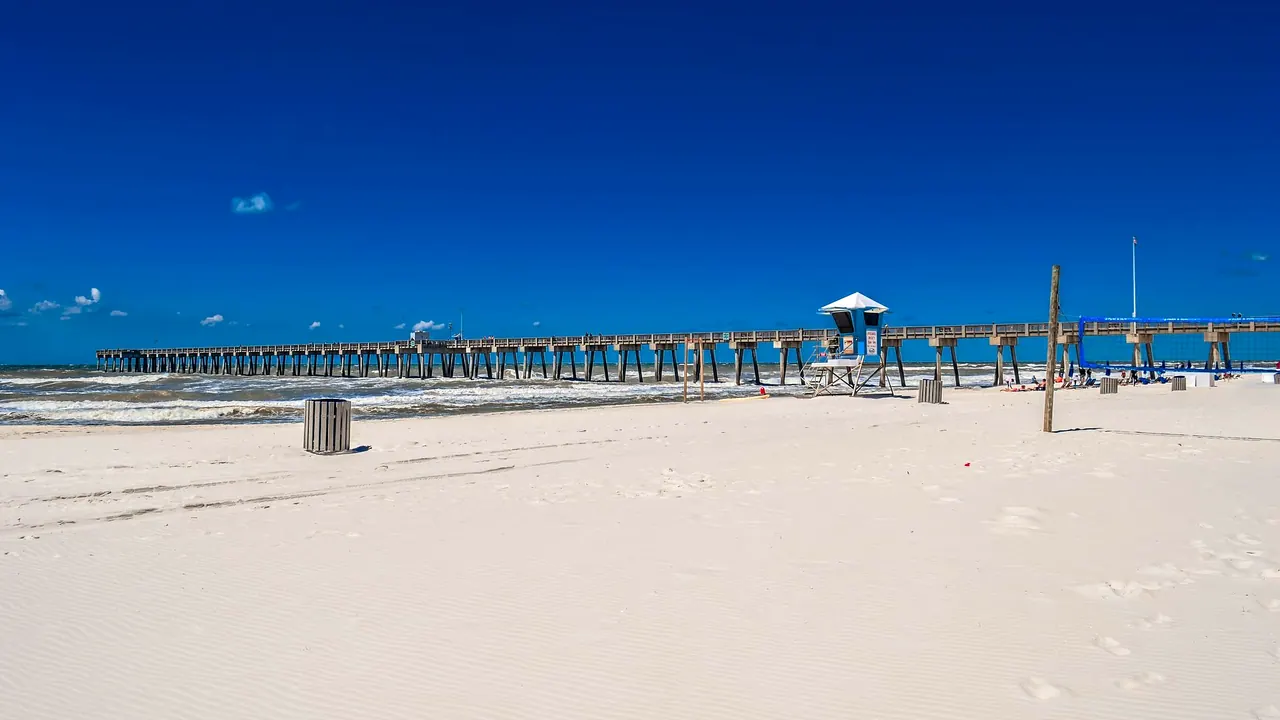
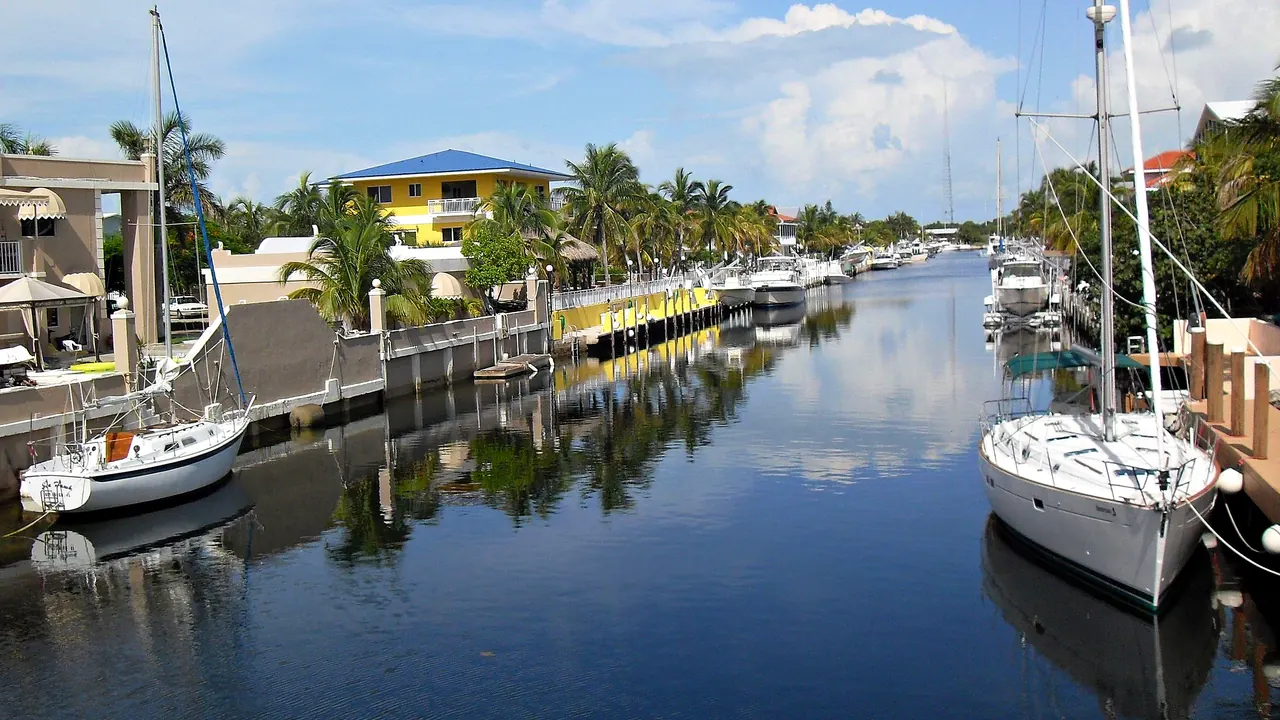
Photos: Florida Panhandle by Marco Membreno, Pexels License; Key Largo by Elmschrat, CC BY-SA 3.0, cropped.
Florida Panhandle or Key Largo?
Our verdict in twelve categories, each scored against the same fixed benchmark cities, and the climate month by month, so you can choose for your trip.
Choose Florida Panhandle for
- beaches
- shopping
- nightlife
The Florida Panhandle suits a classic beach vacation, especially for families. It has long runs of white quartz sand on the Gulf, condo and beach-house rentals with pools, and enough around them to fill the evenings and the odd rainy day: Pensacola's old Spanish quarter and aviation museum, beach bars and boardwalks, outlet shopping and theatre. The catch is that it is really a summer and early autumn coast, and it covers so much ground that you have to pick your stretch carefully.
Choose Key Largo for
- nature and the outdoors
- wellness
- getting around
Key Largo is the place to go when you want to be in the water rather than lying beside it. It offers the only living coral barrier reef in the continental United States, dive and snorkel boats leaving from marinas near your room, mangrove channels for kayaking, and a slow rhythm built around sunsets on a dock. There is very little to do on land and almost no beach, but it is warm all winter, and the Panhandle is not.
Scoreboard
Twelve categories on one fixed scale from 0 to 100. The shaded stretch is the gap between the two.
Your match
Pick a travel style or drag the sliders, and both match scores follow your weighting.
Wins on beaches and shopping with your weighting.
Wins on nature and the outdoors and wellness with your weighting.
What matters to you?
Category by category
What the scores mean for a trip.
Beaches & swimming
This is the widest gap between the two. The Panhandle has almost unbroken white quartz sand from Perdido Key to Mexico Beach, and you can choose your style of beach: empty National Seashore near Pensacola, resort beaches at Destin and Panama City Beach, low-rise 30A, or wilder St. George Island. You do need to watch the rip current flags.
Key Largo has almost no natural beach, because it sits on fossil reef. Swimming means small man-made coves in John Pennekamp, resort lagoons or jumping off a dive boat. Its advantage is the water itself, which stays warm enough to swim in through the winter, when the Gulf is not.
Food & drink
Both coasts live on seafood eaten casually by the water, but the Panhandle offers more range. Downtown Pensacola and the 30A towns have the more ambitious restaurants, and Apalachicola keeps its oyster tradition alive. There is also Southern cooking and barbecue, though the big resort strips are heavy on chains.
Key Largo does one thing well: snapper or mahi-mahi straight off the boat, conch fritters, stone crab in winter and Key lime pie. Beyond that formula there is little, and for a serious meal you have to drive to Miami.
Culture & sights
Neither is a cultural destination, but the Panhandle has real places to visit. Pensacola has its Spanish colonial streets and Seville Square, the huge National Naval Aviation Museum and brick forts across the bay. Further east there are Tallahassee's capitols, Mission San Luis and old Apalachicola.
Key Largo's sights fit into a single afternoon: the African Queen boat at its marina and a diving history museum down the road in Islamorada. Its best-known monument, the bronze Christ of the Abyss, can only be seen with a mask on.
Nightlife
The Panhandle offers a proper night out in summer. You can choose between bands on the sand-floored decks along Destin's harbour boardwalk, big beachfront clubs in Panama City Beach, and cocktail bars in old brick buildings on Palafox Street in Pensacola. If you want quiet, the 30A towns provide it.
Key Largo's evening revolves around one moment, sunset at a bay-side tiki bar with a guitarist. There are no clubs, and early dive boats mean most people are asleep by midnight.
Nature & outdoors
Key Largo has the stronger outdoor draw, and almost all of it is on or under the water. You can snorkel shallow reefs such as Molasses and French Reef, dive the wreck of the Spiegel Grove, paddle through mangroves past manatees and wading birds, and fish the flats of Florida Bay. The Everglades lie just across the bay.
The Panhandle has more variety on land, with dune lakes along 30A, longleaf pine forest, clear inland springs such as Wakulla, and canoeing on the Blackwater River. Its sea life is mostly charter fishing out of Destin and dolphins in the sounds.
Day trips
The day trips are about equally good but very different. From the Panhandle you mostly visit other parts of the same coast, such as Pensacola, Seaside or Apalachicola, often with long drives between them. Across the state line, Mobile has antebellum houses and its own Mardi Gras.
Key Largo has one strong option, Miami, about an hour and a half north, with South Beach, Little Havana and real museums. Closer by are Islamorada and Marathon's sea turtle hospital. Key West is too far to see properly in a day.
Good for families
For families with young children the Panhandle is easier. It has soft sand and shallow water on calm days, condos with kitchens and pools, two marine parks, a water park in Panama City Beach, plenty of mini-golf and go-karts, and car-free cycling between the 30A towns.
Key Largo comes into its own once children can snorkel. Glass-bottom boats, the small aquarium at John Pennekamp and dolphin programmes will keep them busy, but there are no theme parks and hardly any beach for toddlers.
Getting around
You need a car in both places, but the distances are very different. The Panhandle stretches for more than 300km, so crossing from one end to the other takes most of a morning, and the coast road through Destin and the bridges to the beaches back up on summer weekends. Each part of the coast has an airport close by, and once you have settled in, the trail along 30A makes bikes and golf carts a real alternative to the car.
Key Largo is one compact strip of the Overseas Highway, short enough to drive end to end in well under an hour, with addresses given by mile marker and few pavements for walking. Much of the day's travel happens by boat instead, from a marina near your room.
Shopping & style
Shopping is a sideline on the Panhandle, but there is enough of it. You will find a big designer outlet centre between Destin and 30A, boutiques selling resort wear and art in Seaside and Rosemary Beach, and independent shops and a weekly market on Palafox Street.
Key Largo has souvenir stands, a few galleries and good dive and fishing shops. For anything else you have to go to Florida City or Miami.
Affordability
Both are costly in season, but they peak at opposite times of year. The Panhandle is most expensive in summer, especially along 30A. You can save with older condo towers in Panama City Beach, rooms in Pensacola or a big house shared between families, and the beaches cost nothing.
Key Largo charges the most from December to April, and reef charters add to the bill quickly. Staying on the mainland in Homestead or Florida City saves a lot, but you then have a daily drive.
Live music & performing arts
Pensacola gives the Panhandle a real arts calendar, with a regional opera, a symphony and touring shows at the restored Saenger Theatre. There is also a repertory stage in Seaside and university concerts in Tallahassee. Many of these seasons largely avoid high summer.
In Key Largo, live performance means a singer on a bar deck at sunset and a small community theatre in the Upper Keys. For anything bigger you go to Miami.
Wellness & relaxation
Key Largo makes it easier to slow down. Its bay-side resorts have hammocks, quiet lagoons and full spas, yoga on a dock is common, and the day ends early with the sunset. The highway through the middle is the one intrusion, so stay on the bay side.
On the Panhandle, the calm depends on where you stay. Cape San Blas, St. George Island and the low-rise 30A towns are peaceful, while Destin and Panama City Beach are noisy in spring and midsummer.
When should you go?
Pick your month. The climate figures are measured averages, not a forecast.
Florida Panhandle in July
Key Largo in July
Daytime high, °C
Rainfall in the month, mm
Where the figures come from
Florida Panhandle's temperatures are measured 29 km from the centre, at Valparaiso / Eglin Air Force Base.
Florida Panhandle has no rain gauge within 25 km of the centre, so its rainfall comes from a gridded climate dataset read at the destination rather than from a gauge further away.
Key Largo's temperatures are measured 45 km from the centre, at Homestead / Homestead Base.
Key Largo has no rain gauge within 25 km of the centre, so its rainfall comes from a gridded climate dataset read at the destination rather than from a gauge further away.
Key Largo's sunshine is measured 79 km from the centre, at Miami International Airport.
Temperature and rainfall are climate normals, averaged over the years shown. Florida Panhandle: 1971-2000 (rainfall 1991-2020) normals, Valparaiso / Eglin Air Force Base (28.5 km from centre). Key Largo: 1971-2000 (sunshine 1981-2010, rainfall 1991-2020) normals, Homestead / Homestead Base (45.1 km from centre).
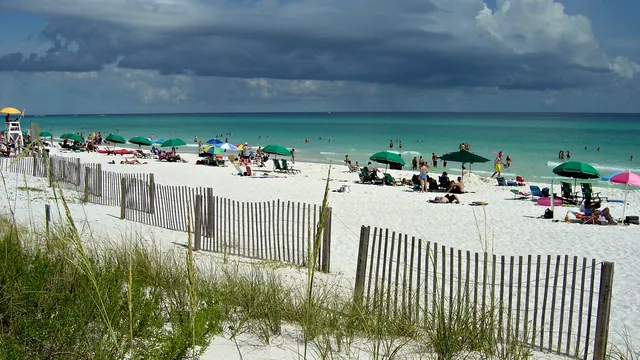
The two run on different calendars. On the Panhandle coast the beach season is May to October, when the Gulf warms to about 29°C at its peak. Winter is cool, with daytime highs around 15°C in January, and the sea is too cold for most swimmers. Midsummer is hot and the wettest part of the year, with frequent afternoon storms and up to 214mm of rain in August. Late spring and early autumn give the best mix of warm water and comfortable days for walking around Pensacola.
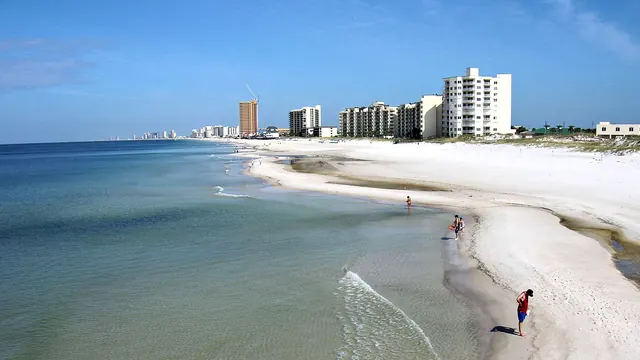
Key Largo stays warm all year. Even in January the days reach about 24°C and the sea is warm enough to swim. December to April is the dry, sunny season, with as little as 33mm of rain in December. From May to October the heat and humidity rise and the rain returns in heavy showers, although sunshine stays plentiful and calm seas then give the clearest water on the reef. As a rough guide, go to the Panhandle in summer and to Key Largo in winter.
Which traveller are you?
On a beach and sun trip, the Florida Panhandle is the clear choice from May to October. Its white quartz sand runs almost unbroken along emerald Gulf water, while Key Largo, built on coral, has only small man-made patches of sand.
For divers and snorkellers, Key Largo is the obvious pick. John Pennekamp protects living coral reefs shallow enough to snorkel, and a sunken naval ship, a short boat ride from the marinas. The Panhandle has wreck dives off Pensacola, but no coral reef.
On a family trip with young children, the Panhandle is easier. Small children want soft sand to dig in and gentle water to paddle in, and this coast has plenty of both. Key Largo pays off later, once children are old enough to snorkel.
Before you go
| Measure | Florida Panhandle | Key Largo |
|---|---|---|
| Currency | US Dollar (USD) | US Dollar (USD) |
| Sockets | AB120 V, 60 Hz | AB120 V, 60 Hz |
| Driving side | Right | Right |
| Time zone | UTC-6, UTC-5 in summer | UTC-5, UTC-4 in summer |
| Emergency number | 911 | 911 |
| Main airport | Destin-Fort Walton Beach Airport (VPS)45 non-stop destinations | Miami International Airport (MIA)197 non-stop destinations |
| Public holidays this year | 11 days | 11 days |
By the numbers
| Measure | Florida Panhandle | Key Largo |
|---|---|---|
| Swim season, months above 21 °C | 7 months | 12 months |
Where else could you go?
Every comparison below shares a destination with this one, so you can follow Florida Panhandle or Key Largo somewhere new.
- Islamoradavs Key Largo
- Evergladesvs Key Largo
- Marathonvs Key Largo
- Gulf Shoresvs Florida Panhandle
- Key Westvs Key Largo
- Sanibelvs Key Largo