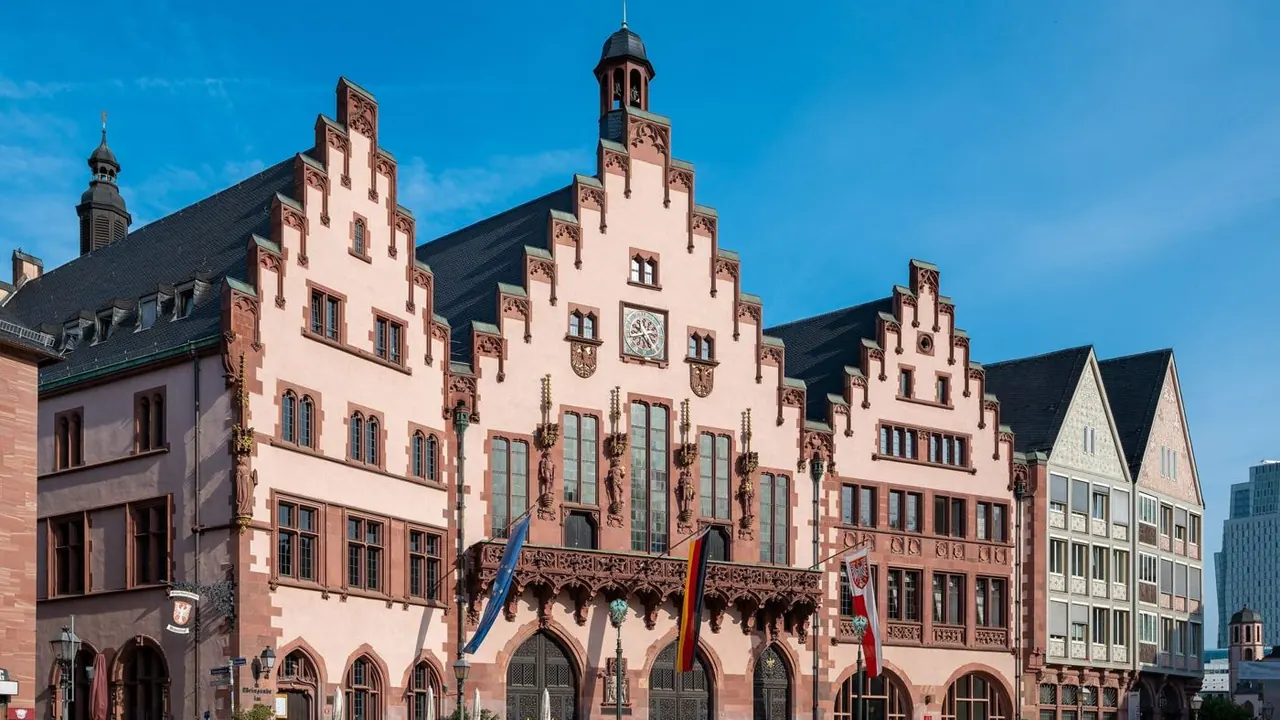
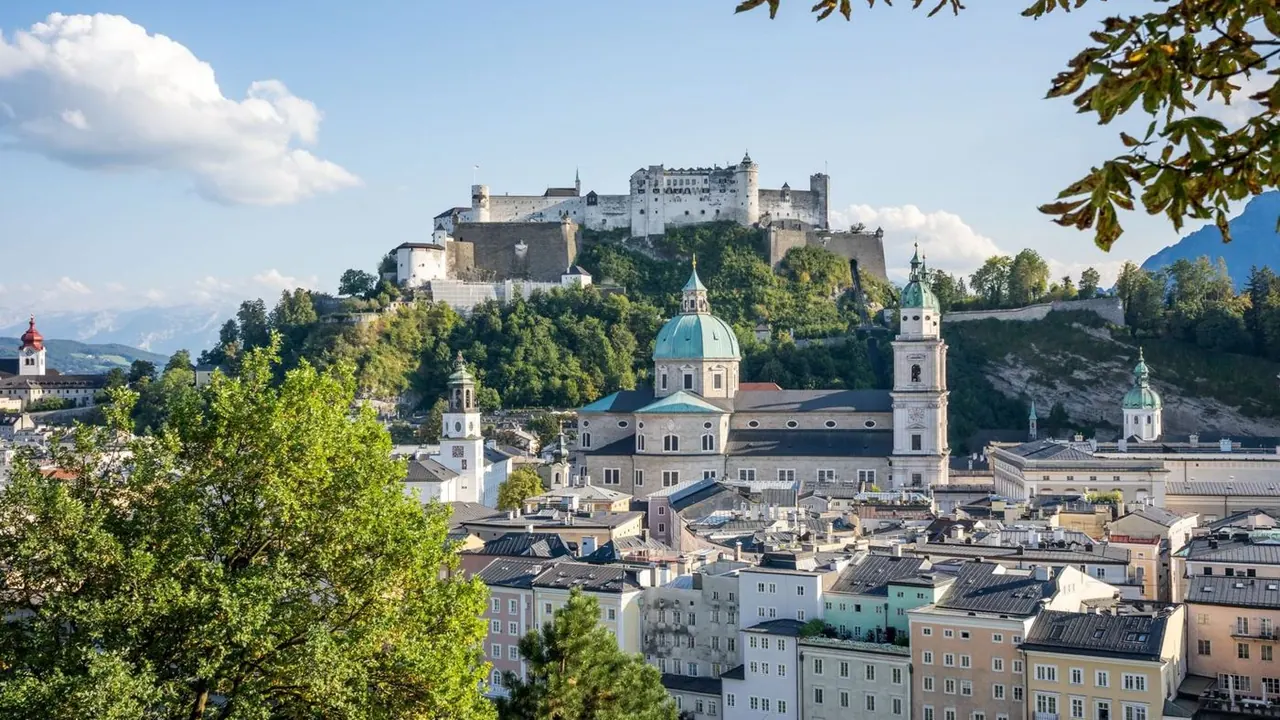
Photos: Frankfurt by Thomas Wolf, CC BY-SA 3.0 DE, cropped; Salzburg by Leonhard Niederwimmer, Pexels License.
Frankfurt or Salzburg?
Our verdict in twelve categories, each scored against the same fixed benchmark cities, and the climate month by month, so you can choose for your trip.
Choose Frankfurt for
- nightlife
- shopping
- food and drink
Frankfurt suits travellers who want a well-connected base with plenty going on after dark. Its riverside museum mile, apple-wine taverns and weekend club nights fill the evenings and the rainy days. The fast rail network puts Heidelberg, the Rhine Gorge and Cologne within easy reach without a car. It also works for a city break built around galleries, or a short stay on the way to somewhere else.
Choose Salzburg for
- nature and the outdoors
- beaches
- culture and sights
Salzburg is the better choice when the setting matters as much as the sights. The Baroque old town survives whole beneath its fortress, and classical music runs through the year. Real mountain and lake country starts at the edge of town. Come for concerts, unhurried walks and alpine days out, and don't expect much of a night out.
Scoreboard
Twelve categories on one fixed scale from 0 to 100. The shaded stretch is the gap between the two.
Your match
Pick a travel style or drag the sliders, and both match scores follow your weighting.
Too close to call, 2 points apart
Wins on nightlife and shopping with your weighting.
Wins on nature and the outdoors and beaches with your weighting.
What matters to you?
Category by category
What the scores mean for a trip.
Beaches & swimming
Neither city is for a beach trip, but Salzburg does better on a hot day. From late June the clear green water of Fuschlsee, Wolfgangsee and Mondsee is half an hour or so away. You get in from lawns, jetties and small pebble shores, with steep hills all around.
Frankfurt has only outdoor pools and gravel-pit lakes such as the Langener Waldsee. That lake does at least have sandy shores and warms up well in July and August. Nobody swims in the Main.
Food & drink
Frankfurt gives you more to eat. Its apple-wine taverns in Sachsenhausen serve Grüne Soße and Handkäs at shared tables, and the Kleinmarkthalle is good for picking up regional food. A big international mix, from Turkish grills to business-dinner restaurants, means you rarely eat the same thing twice.
Salzburg's best food moments are coffee and cake in the old coffee houses, a Salzburger Nockerl, and beer from wooden barrels in the monastery garden in Mülln. In the old town, though, many places serve the same menus to tour groups. For better cooking, head to the inns in the outer districts or up in the hills.
Culture & sights
The difference is between a townscape and a museum mile. Salzburg's prince-archbishops left a complete Baroque old town, with the cathedral, the Residenz and arcaded squares beneath Hohensalzburg. The town itself is the sight, and Mozart's houses, St Peter's catacombs and Hellbrunn add to it.
Frankfurt's old centre was largely destroyed in 1944, and the Römer and its lanes are reconstructions. The city's strength is the Museumsufer, where the Städel holds a collection Salzburg can't match. Add the Goethe house, the Paulskirche and the only real skyline in Germany.
Nightlife
Frankfurt is much better for going out, especially on Friday and Saturday. It has a club scene that grew out of the city's and Offenbach's techno and house history, cocktail bars and late kiosks in the rough-edged station district, and neighbourhood bars along Berger Straße. In summer, crowds drink outside on the Main riverbanks.
Salzburg's evenings usually mean a concert, dinner and a litre mug in a beer hall, and the old town is quiet by midnight. A few student pubs on Rudolfskai stay open later during term. For clubbing, locals take the train to Munich.
Nature & outdoors
Salzburg is surrounded by real alpine scenery. You can walk the Mönchsberg ridge in the centre, take the cable car up the Untersberg to about 1,800m, or paraglide from the Gaisberg. Sailing and paddling in the Salzkammergut, Berchtesgaden National Park and the ski areas are all within roughly an hour.
Frankfurt's countryside is greener and gentler. The Taunus rises to about 880m at the Großer Feldberg, and the Stadtwald and the long Main cycle paths are good for walking and riding. It is fine for walking and cycling, but there is nothing on Salzburg's scale.
Day trips
Both cities are excellent for day trips, and Frankfurt is slightly ahead because almost everything is easy by train. Heidelberg and the castle-lined Rhine Gorge are about an hour away, Cologne cathedral is an hour by high-speed train, and Mainz, Wiesbaden and the Rheingau vineyards are closer still.
Salzburg's trips are about lakes, salt and mountains: Hallstatt above its prehistoric mine, the salt mine at Hallein, the clifftop fortress at Werfen and the Kehlsteinhaus above Berchtesgaden. Munich is an hour and a half away by train. The lake villages are much easier to reach with a hire car.
Good for families
Both work well with children for a few days, and the differences are practical. Frankfurt is flat and pushchair-friendly. The dinosaur hall at the Senckenberg is the main draw, and there are also the central zoo, the Palmengarten glasshouses and boat trips past the towers.
Salzburg is calmer, and its highlights are more fun. Children love getting soaked by the trick fountains at Hellbrunn, and the salt mines have wooden miners' slides and underground lakes. The cobbles and steep lanes are hard going with a pushchair.
Getting around
Frankfurt has the fuller system. U-Bahn, S-Bahn and trams run on one network across the region, trains reach the airport in about a quarter of an hour, and the main station connects straight to the high-speed lines. The zones take a little working out.
Salzburg has no metro or trams, and doesn't really need them. The sights are within about fifteen minutes' walk of each other, and trolleybuses reach Hellbrunn and the Untersberg. The drawback is getting out of town, because buses to the lakes are slow.
Shopping & style
Frankfurt has more range. The Zeil has department stores and malls, Goethestraße has the luxury houses, and Berger Straße and Schweizer Straße have independent delis and design shops. What it lacks is anything you would travel specially to buy.
Salzburg has a speciality but less variety. Tracht workshops make dirndls and loden jackets to measure, and Getreidegasse hangs its wrought-iron guild signs over shops in old burgher houses. The Domplatz Advent market is one of the best known in the region. Luxury shopping is thin, and many old-town shops sell souvenirs.
Affordability
Both are expensive, and Frankfurt is a little easier on the budget. Its hotel prices depend on business travel, so weekends and summer are often noticeably cheaper outside the trade fairs, and cider taverns and Turkish grills keep meals cheap.
Salzburg's old-town hotels are expensive all year, and rooms get scarce during the summer festival and the Advent markets. Restaurants in the centre also cost well above the Austrian average. To save money, stay across the river, eat in the outer beer halls and buy the city card.
Live music & performing arts
Salzburg is one of the great music cities. In summer the Festival fills the Felsenreitschule and the festival halls, and Jedermann is played outdoors in front of the cathedral. Mozart Week and the Easter Festival add further seasons, and there are chamber concerts in Mirabell or the fortress on most evenings.
Frankfurt has a highly respected opera company, concerts at the Alte Oper, contemporary dance and jazz cellar clubs. Its season runs from autumn to early summer, so it goes quiet just when Salzburg is busiest.
Wellness & relaxation
For proper bathing, both cities send you out of town. From Frankfurt that means Wiesbaden's Art Nouveau Kaiser-Friedrich-Therme or the thermal baths at Bad Homburg. From Salzburg it means the brine spa at Bad Reichenhall or the radon springs of the Gastein valley.
The difference is the pace in town. Frankfurt is a working city where the Palmengarten is the main place to slow down. Salzburg is easier to relax in, with coffee-house afternoons, the wooded Mönchsberg in the evening and the Paracelsus Bad's pool looking out over the Kapuzinerberg.
When should you go?
Pick your month. The climate figures are measured averages, not a forecast.
Frankfurt in July
Salzburg in July
Daytime high, °C
Rainfall in the month, mm
Temperature and rainfall are climate normals, averaged over the years shown. Frankfurt: 1991-2020 normals, Frankfurt Westend (2 km from centre). Salzburg: 1991-2020 normals, Salzburg (3.4 km from centre).
The two cities follow almost the same temperatures through the year. Summer highs reach about 25°C in both, which is warm enough for lake swimming in July and August. Winters are cold in both, and Salzburg is a little colder. The real difference is rain. Frankfurt stays fairly dry all year and has the brighter summers, so May to September is reliable for walking the streets and sitting by the river, and April is also dry and sunny. From November to January it is grey and dark.
Salzburg's summer is its wettest season, with about 168mm of rain in June against about 60mm in Frankfurt. From May to August, plan around showers, and September is still fairly wet. For walking the old town, April and October are the better months. Both are mild at around 15°C and get roughly half the rain of high summer, and April is the sunnier of the two. In winter Salzburg gets clearly more sunshine than Frankfurt, and snow often reaches the town.
Which traveller are you?
On an outdoors trip, Salzburg is far ahead. A cable car runs up the Untersberg, paragliders launch from the Gaisberg, and the Salzkammergut lakes and the Königssee are close by. Frankfurt's Taunus forests and Main cycle paths are pleasant but gentle.
For a culture and arts trip, Salzburg suits most people better. It has an intact Baroque old town and the Salzburg Festival, with Mozart in the concert halls all year. Frankfurt is the pick only if paintings matter more than music, because the Städel and the riverside museums are stronger.
On a food and nightlife trip, Frankfurt wins clearly. You get apple-wine taverns in Sachsenhausen, cheap global food in the Bahnhofsviertel, techno clubs at the weekend and bars along Berger Straße. Salzburg's evenings are a beer hall and an early night.
Before you go
| Measure | Frankfurt | Salzburg |
|---|---|---|
| Official language | German | German, Austrian Sign Language |
| Currency | Euro (EUR) | Euro (EUR) |
| Sockets | CF230 V, 50 Hz | CF230 V, 50 Hz |
| Driving side | Right | Right |
| Time zone | UTC+1, UTC+2 in summer | UTC+1, UTC+2 in summer |
| Emergency number | 112 | 112 |
| Elevation | 101 m | 424 m |
| Main airport | Frankfurt Main Airport (FRA)13 km from centre281 non-stop destinations | Salzburg Airport (SZG)3 km from centre64 non-stop destinations |
| Public holidays this year | 10 days | 16 days |
By the numbers
| Measure | Frankfurt | Salzburg |
|---|---|---|
| City population | 760,656 | 155,021 |
| People per km² | 3,063 | 2,360 |
| Museums within 10 km | 53 | 38 |
| UNESCO World Heritage sites within 50 km | 4 | 3 |
Where else could you go?
Every comparison below shares a destination with this one, so you can follow Frankfurt or Salzburg somewhere new.