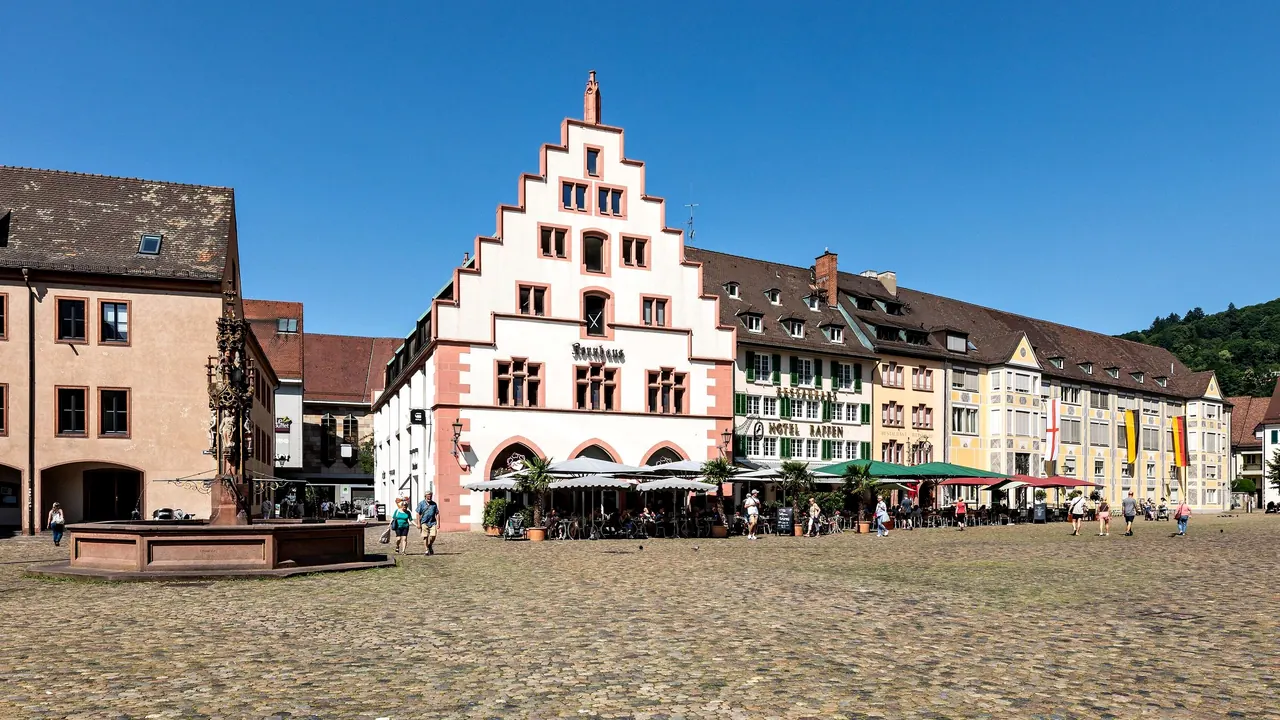
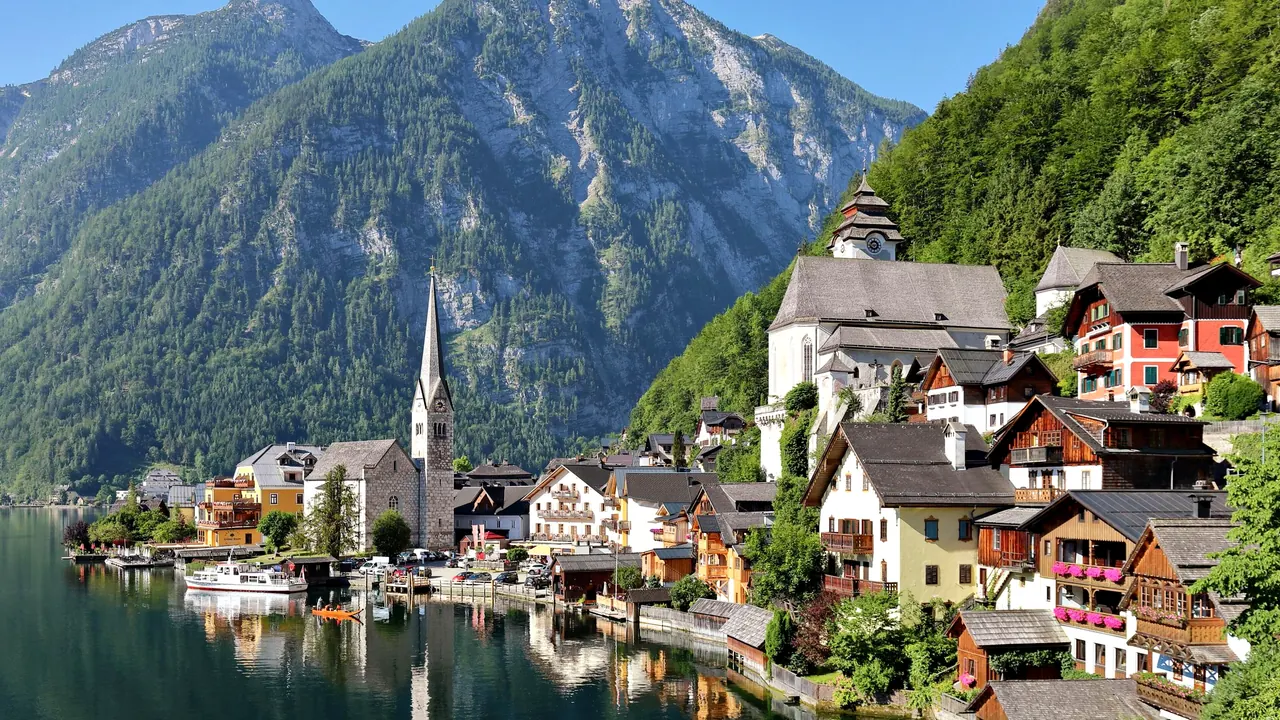
Photos: Freiburg by Dietmar Rabich, CC BY-SA 4.0, cropped; Hallstatt by C.Stadler/Bwag, CC BY-SA 4.0, cropped.
Freiburg or Hallstatt?
Our verdict in twelve categories, each scored against the same fixed benchmark cities, and the climate month by month, so you can choose for your trip.
Choose Freiburg for
- food and drink
- nightlife
- live music and the arts
Freiburg suits travellers who want a base with range. It has a walkable university town with wine taverns and a daily market around the cathedral, a real evening out and a proper concert programme. The Black Forest, Alsace and Basel are all within easy reach by tram, train or a short drive. It is the easier choice with children, on a tighter budget and without a car.
Choose Hallstatt for
- beaches
- nature and the outdoors
Hallstatt is for a smaller, quieter trip built around landscape. The Dachstein, the ice caves and the walk to the Gosausee give it the more dramatic mountain country, and the still lake at dawn and dusk rewards anyone who stays the night. Expect simple food, no nightlife, high room rates and steep lanes, and plan a few nights rather than a week.
Scoreboard
Twelve categories on one fixed scale from 0 to 100. The shaded stretch is the gap between the two.
Your match
Pick a travel style or drag the sliders, and both match scores follow your weighting.
Wins on food and drink and nightlife with your weighting.
Wins on beaches and nature and the outdoors with your weighting.
What matters to you?
Category by category
What the scores mean for a trip.
Beaches & swimming
Neither is a swimming destination, but Hallstatt has the edge because the water is right there. The bathing lawn at the north end of the village and the lido at Obertraun put you in a clear Alpine lake within minutes, even if it is a cold swim and only in high summer. Freiburg's swimming means cycling out to the gravel pits on the Rhine plain, which warm up well but have grassy banks, using the city's open-air pools, or a drive of about an hour to Titisee and Schluchsee.
Food & drink
Freiburg eats far better. Baden cooking has a French lightness, with Flammkuchen, Schäufele, Black Forest ham and spring asparagus. Dry Pinots come from the vineyards just outside town, and the morning market around the Münster and the wood-panelled taverns are both worth seeking out. The surrounding region has serious fine dining too, though there is little international range, and over a longer stay the menus start to repeat.
Hallstatt offers guesthouse dining rooms and lakeside terraces serving schnitzel and dumplings. The one local speciality is char or whitefish from the lake, and kitchens close early once the day visitors leave. For coffee and pastries worth the trip, people drive to Bad Ischl.
Culture & sights
Freiburg gives you more to see. You can climb the Münster's open-lace tower and walk past the Historisches Kaufhaus and the two medieval gates along streets lined with the Bächle. The Augustinermuseum holds fine medieval art. Most of it was rebuilt after the war, but it fills a full day or two.
Hallstatt's history goes much further back. Salt has been mined in the mountain for some seven thousand years, the burial ground gave its name to an Iron Age culture, and the painted skulls of the Beinhaus are unlike anything else in the region. Still, the salt mine, the small museum and the village itself take half a day to a day.
Nightlife
With its large student population, Freiburg has a relaxed but real evening scene. There are pubs and wine bars in the lanes around the Martinstor, summer crowds along the Dreisam and on the squares, and a few clubs for techno and indie nights. It is livelier in term-time. Hallstatt has nothing comparable: once the coaches leave, an evening means a long dinner and a walk along the dark lake.
Nature & outdoors
Both are excellent for the outdoors, but Hallstatt's scenery is grander. The village lies in a glacial trough under the Dachstein. The Krippenstein cable car leads to the Five Fingers platform and the giant ice caves, the Echerntal climbs past waterfalls towards the glacier, and the Gosausee is one of the classic Alpine views. The cost is wet weather and mist that can sit on the lake for days.
Freiburg's outdoors is gentler, more varied and sunnier. There is the Schlossberg behind the old town, ridge walks from the Schauinsland, summer hiking and winter skiing on the Feldberg, and the Ravenna gorge. Add easy cycling through the Kaiserstuhl vineyards, and the mountain biking is excellent.
Day trips
Freiburg's position where three countries meet makes it the better base. Basel is about 45 minutes by train, Colmar and the Alsace wine villages such as Riquewihr are about an hour's drive, and Strasbourg and Baden-Baden are both easy days out. Staufen, Breisach and the Kaiserstuhl fill the shorter outings.
Hallstatt has the Salzkammergut lake towns around it. These include the imperial Kaiservilla at Bad Ischl, St Wolfgang's altarpiece and Gmunden's lake castle, with Salzburg as a long day about an hour and a half away by car. Without a car, these trips take careful planning around buses and the lakeside railway.
Good for families
Freiburg is the far easier place with children. The centre is small, flat and car-free, children love sailing toy boats in the Bächle, the Mundenhof animal park is free, and Europa-Park, Germany's largest theme park, is about 40 minutes away.
Hallstatt has a few real highlights: the salt mine's wooden miners' slides and underground lake, boats on the lake, and the ice caves for older children who can manage the cold and the steps. The single steep lane is crowded at midday and awkward with a pushchair, so families usually stay in Obertraun and visit for a few hours.
Getting around
Freiburg is much simpler to manage without a car. Trams run to the suburbs and the cable car station, bike lanes are everywhere, and regional trains climb the Höllental and run to Basel, often covered by the guest card hotels in the region hand out.
Hallstatt itself takes only minutes to cross on foot, though its lanes and steps are steep. Getting there means taking a small boat from the station on the far shore, and buses to Obertraun, Gosau and Bad Ischl are thin outside summer, so many visitors find a car worth having.
Shopping & style
Neither is somewhere to shop seriously, but Freiburg at least gives you an afternoon. There are chains on Kaiser-Joseph-Strasse, independent boutiques and bookshops in the Gerberau and Konviktstrasse quarters, and wine, schnapps and ham at the Münster market. Hallstatt is a single lane of souvenir shops, where the one buy worth carrying home is salt from the local mine.
Affordability
Neither is cheap to sleep in, but Hallstatt is the dearer. Its few lakeside rooms draw visitors from around the world, meals are priced at Alpine-resort level, and the salt mine, funicular and Dachstein cable car soon add up. Budget travellers stay in Obertraun or Bad Goisern and visit for the day.
Freiburg's rooms are also tight and pricey in summer, and nearby Black Forest villages make a good fallback. Once you are there, though, market snacks, student-quarter restaurants and a free Münster keep daily spending modest.
Live music & performing arts
Freiburg has a genuine year-round programme. Theater Freiburg stages opera, drama and dance, the Freiburger Barockorchester plays at the Konzerthaus, and the summer Zelt-Musik-Festival fills a tent village with concerts. Hallstatt has only its brass band at feast days and the odd summer church concert. For a night of music, people travel to Salzburg or to Bad Ischl's operetta season.
Wellness & relaxation
Freiburg makes the better spa base. There is a thermal bath with saunas on the city's edge, Bad Krozingen's large outdoor pools are about twenty minutes away, Badenweiler pairs a modern bath with Roman ruins, and Baden-Baden is an easy train ride. The town's café terraces and Dreisam paths also keep the pace slow.
Hallstatt has little beyond hotel saunas, though Bad Ischl's historic brine baths are half an hour away. Its calm comes at the edges of the day, with mist on the lake at dawn and the empty village at dusk. At midday the lane is so crowded that it pays to be out on the water or up in the hills.
When should you go?
Pick your month. The climate figures are measured averages, not a forecast.
Freiburg in July
Hallstatt in July
Daytime high, °C
Rainfall in the month, mm
Where the figures come from
Hallstatt's temperatures are measured 56 km from the centre, at Salzburg.
Hallstatt has no rain gauge within 25 km of the centre, so its rainfall comes from a gridded climate dataset read at the city rather than from a gauge further away.
Temperature and rainfall are climate normals, averaged over the years shown. Freiburg: 1991-2020 normals, Freiburg (0.6 km from centre). Hallstatt: 1991-2020 normals, Salzburg (55.5 km from centre).
Freiburg is the warmer, sunnier and drier of the two. July reaches about 27°C, warm enough from June to August for the gravel-pit lakes and open-air pools, and summer days are long and bright. May is the wettest month at around 103mm, with July close behind, so April and September, mild and comparatively dry, are the best months for walking the old town and the Black Forest trails. Winters are grey and mild in town, with snow on the higher slopes.
Hallstatt runs a few degrees cooler all year, and its rain peaks in summer, at about 178mm in July. May and September are also very wet, so a hiking trip in those months needs spare days for mist and showers. July and August are the only months warm enough for a cold swim in the lake. April, at about 84mm, and October are much drier and give the steadiest walking weather, though both are cool. Winter is colder, with January highs around 3°C and snow for the Krippenstein, and it gets slightly more winter sunshine than Freiburg.
Which traveller are you?
On an outdoors trip, Hallstatt has the edge. The cable car up the Krippenstein, the ice caves, via ferratas and the walk to the Gosausee put high Alpine country right outside the door. Freiburg's Black Forest trails are gentler, though sunnier.
For a food and nightlife trip, Freiburg is the clear choice. Baden cooking, Kaiserstuhl wines, the Münster market and student pubs around the Martinstor fill both days and evenings. In Hallstatt, dinner is simple and the village is quiet by nightfall.
On a family trip with children, choose Freiburg as the base. It is calm and manageable with small children, and a week passes easily without long journeys. Hallstatt is better treated as a memorable outing for older children than as somewhere to stay with toddlers.
Before you go
| Measure | Freiburg | Hallstatt |
|---|---|---|
| Official language | German | German, Austrian Sign Language |
| Currency | Euro (EUR) | Euro (EUR) |
| Sockets | CF230 V, 50 Hz | CF230 V, 50 Hz |
| Driving side | Right | Right |
| Time zone | UTC+1, UTC+2 in summer | UTC+1, UTC+2 in summer |
| Emergency number | 112 | 112 |
| Elevation | 278 m | 511 m |
| Main airport | EuroAirport Basel–Mulhouse–Freiburg (BSL)50 km from centre112 non-stop destinations | Salzburg Airport (SZG)55 km from centre64 non-stop destinations |
| Public holidays this year | 12 days | 16 days |
By the numbers
| Measure | Freiburg | Hallstatt |
|---|---|---|
| City population | 238,299 | 741 |
| People per km² | 1,558 | 12 |
| Museums within 10 km | 13 | 3 |
| UNESCO World Heritage sites within 50 km | 2 | 2 |
Where else could you go?
Every comparison below shares a destination with this one, so you can follow Freiburg or Hallstatt somewhere new.
- Colmarvs Freiburg
- Baselvs Freiburg
- Salzburgvs Hallstatt
- Strasbourgvs Freiburg
- Zurichvs Freiburg
- Baden-Badenvs Freiburg