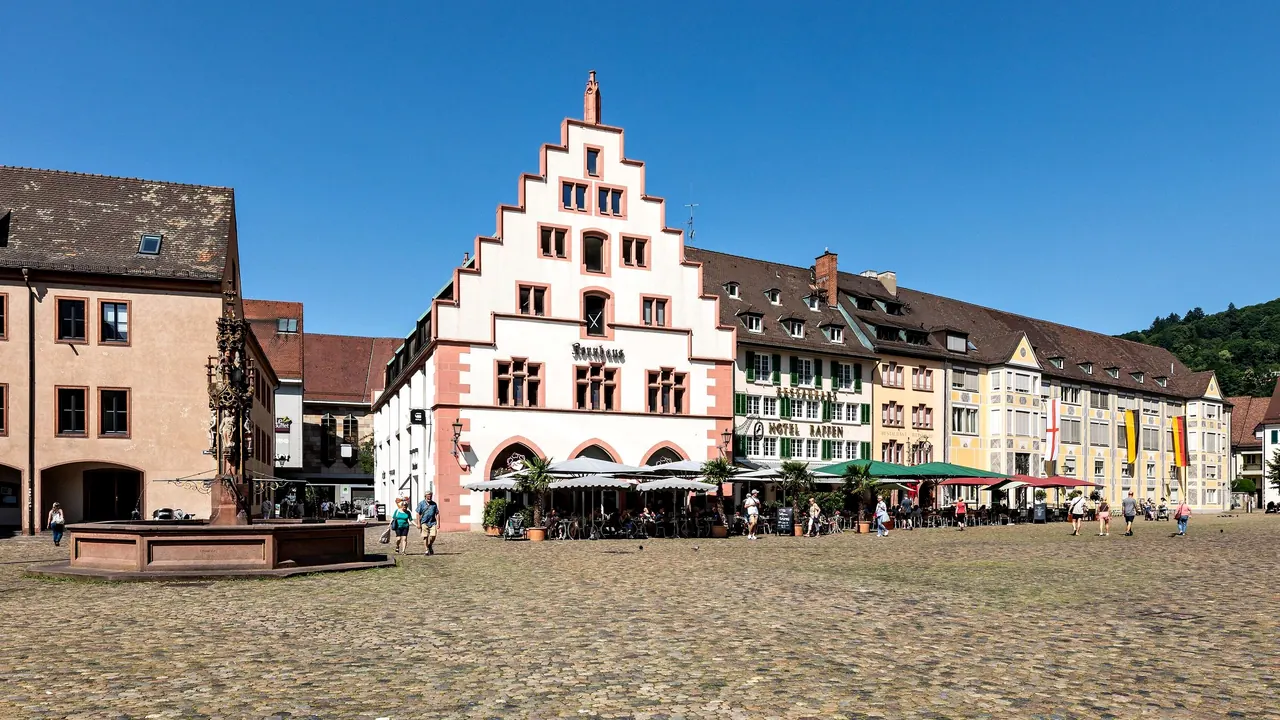
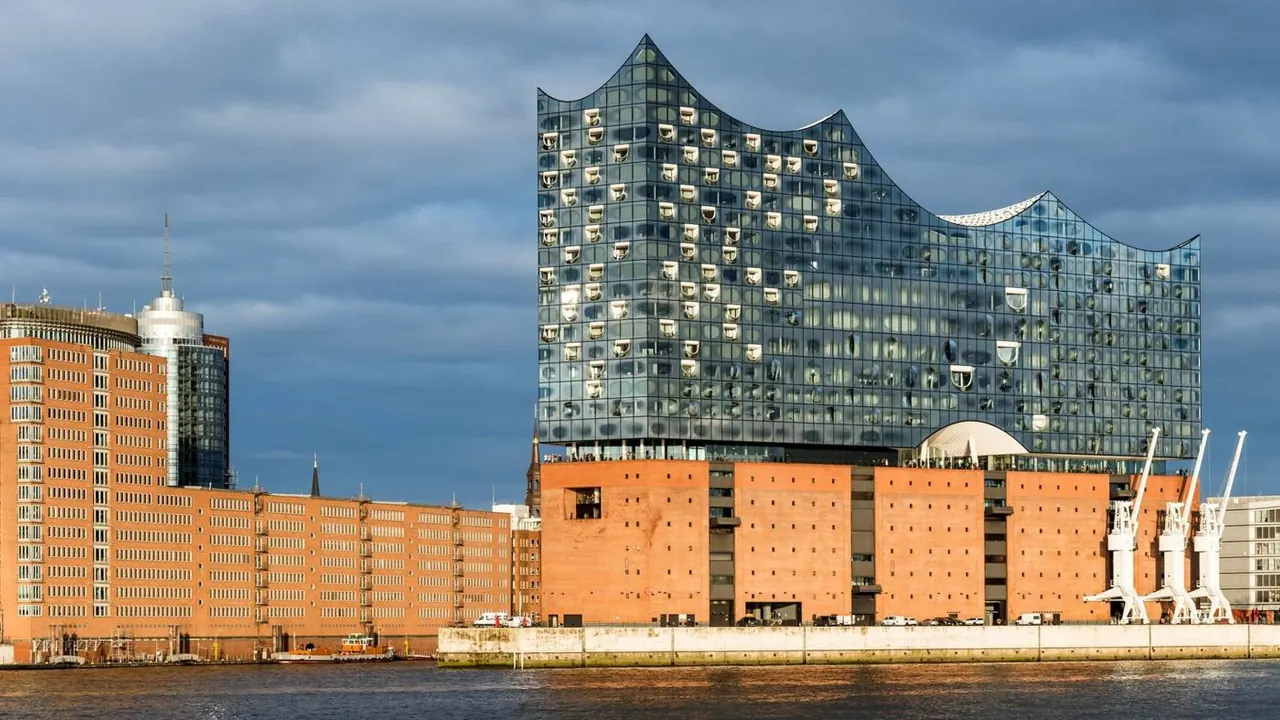
Photos: Freiburg by Dietmar Rabich, CC BY-SA 4.0, cropped; Hamburg by Wolfgang Weiser, Pexels License.
Freiburg or Hamburg?
Our verdict in twelve categories, each scored against the same fixed benchmark cities, and the climate month by month, so you can choose for your trip.
Choose Freiburg for
- nature and the outdoors
- wellness
- day trips
Freiburg is the choice for travellers who want the outdoors on the doorstep and an unhurried pace. The Black Forest begins at the edge of town, the Kaiserstuhl vineyards suit gentle cycling, thermal baths lie a short ride south, and the meeting point of Germany, France and Switzerland puts Basel, Colmar and Strasbourg within easy reach. Evenings mean wine taverns and student pubs rather than a big night out.
Choose Hamburg for
- nightlife
- live music and the arts
- shopping
Hamburg rewards a big-city trip built around the evenings. With the Elbphilharmonie, the State Opera and the Hamburg Ballet, it has a stage Freiburg cannot approach, the Reeperbahn and the Schanzenviertel run until dawn, and Neuer Wall gives shoppers real choice. The price is flat land, greyer skies and a more expensive stay.
Scoreboard
Twelve categories on one fixed scale from 0 to 100. The shaded stretch is the gap between the two.
Your match
Pick a travel style or drag the sliders, and both match scores follow your weighting.
Wins on nature and the outdoors and wellness with your weighting.
Wins on nightlife and live music and the arts with your weighting.
What matters to you?
Category by category
What the scores mean for a trip.
Beaches & swimming
Neither city is a beach destination, but Hamburg has the slight edge because real sea bathing is within reach. The Baltic resorts of Travemuende and Timmendorfer Strand are about an hour away, with wicker beach chairs and proper sand. The Elbe beaches in the city are for watching ships go by, not for swimming.
Freiburg has no sea at all. On hot days people head to the gravel-pit lakes on the Rhine plain, which have grassy shores and warm water, or to the cooler Titisee and Schluchsee in the hills.
Food & drink
The two cities eat about equally well, in very different ways. In Freiburg, the Baden cooking has a French lightness, with Flammkuchen, Schäufele, Black Forest ham and spring asparagus, and Kaiserstuhl Pinot from the vineyards just outside town. The market around the Münster is the daily highlight, but beyond Baden cooking the range is narrow.
Hamburg eats like the port it is, with fish rolls on the piers, Labskaus, Franzbroetchen for breakfast and a strong coffee-roasting habit. Its modern restaurants, from Portuguese places by the harbour to fine dining, give it a breadth Freiburg lacks.
Culture & sights
Hamburg offers more to see. The UNESCO-listed Speicherstadt and Kontorhaus district, the Elbphilharmonie's harbour plaza, the Rathaus and St Michael's make a full merchant-city itinerary, and the Kunsthalle, with Caspar David Friedrich among others, is backed by strong design and photography museums.
Freiburg's appeal is concentrated in one compact old town: the red sandstone Münster with its climbable tower, the Bächle channels, the medieval gates and the Augustinermuseum. Both centres were rebuilt after wartime bombing, but Freiburg's sights fill a day or two, while Hamburg's districts keep you busy for longer.
Nightlife
This is one of the widest gaps between the two. Hamburg goes out hard and late. The Reeperbahn mixes dive bars, music clubs and cabaret, bars have no fixed closing hour, and each district has its own crowd, from the alternative Schanzenviertel to the smarter bars around the Alster.
Freiburg's evenings are friendly and student-driven: pubs and wine bars around the Martinstor, beer gardens, and summer nights on the squares and by the Dreisam. There are only a handful of clubs, and the city is quieter outside term-time.
Nature & outdoors
Freiburg is far ahead here, because the Black Forest begins where the town ends. The Schlossberg rises behind the old town, the Schauinsland cable car climbs to about 1,280m with Alpine views, and the Feldberg offers summer hiking and winter skiing within an hour. The Kaiserstuhl and the Rhine plain add gentle cycling.
Hamburg's outdoors is flat and shaped by water: sailing and paddling on the Alster, the Elbe path to Blankenese, and spring blossom in the Altes Land orchards. Lueneburg Heath is the nearest larger landscape.
Day trips
Both cities make good bases, but Freiburg offers more variety. From the corner of three countries, you can reach Basel's museums by train in under an hour, Colmar and the Alsace wine villages by car, and Strasbourg's cathedral in about an hour and a half, with Staufen, Breisach and Baden-Baden nearer to home.
Hamburg's outings are excellent but more alike: Luebeck, Lueneburg, Bremen, Wismar and Stade share the brick and gabled look of the Hanseatic north. Schwerin's lake castle and summer days on the Baltic break the pattern, and nearly everything is reachable by train.
Good for families
Rain is what separates these two. Freiburg is a fair-weather city for children. They can put their feet in the Bächle, sail toy boats along the channels, visit the free Mundenhof animal park and ride the Schauinsland cable car, and Europa-Park, Germany's largest theme park, is about 40 minutes north. When it pours, though, there is little to do indoors.
Hamburg has more for a wet day, and its greyer climate means you will probably need it. Miniatur Wunderland can fill a whole afternoon, and Hagenbeck's tropical aquarium and the Stadtpark planetarium are good fallbacks. On a dry day, a harbour ferry, the museum ships and the walk through the old Elbe tunnel make a full outing.
Getting around
Both cities are easy without a car, but they work in different ways. Freiburg is compact enough that most of a stay happens on foot in and around the car-free old town, and the bicycle covers the rest: the centre is flat, bike lanes run everywhere, and trams reach the Schauinsland cable car. Its trains matter most for leaving town, up the Höllental into the Black Forest or along the Rhine to Basel.
Hamburg's walkable core is larger, taking in the Alster, the Speicherstadt and HafenCity, and beyond it the U-Bahn and S-Bahn take over, with Blankenese or Hagenbeck a single train ride away. The harbour ferries are something Freiburg cannot match: they run on the same ticket and show you the port from the water. Cycling is just as easy on the flat, though wind and rain make it less pleasant than in Freiburg.
Shopping & style
Hamburg is clearly the shopping city. Neuer Wall and the streets around the Jungfernstieg hold the luxury labels, covered arcades link them on wet days, and the Karolinenviertel and Schanzenviertel add vintage and streetwear. Tea, coffee and maritime goods make good things to take home.
Freiburg's shopping is modest: chains on Kaiser-Joseph-Strasse, independents in the Gerberau and Konviktstrasse, and wine, ham and cuckoo clocks from the market. Locals go to Basel for serious shopping.
Affordability
Neither is cheap, and Freiburg is only a little kinder on the wallet. Its problem is hotel rooms, which are scarce in a small city, so some visitors stay in Black Forest villages instead. Market food, wine taverns and free sights such as the Münster keep daily spending down.
In Hamburg, the expense is spread more widely, with hotels and central restaurants priced for a wealthy city. A day ticket covering trains and ferries, the free Elbphilharmonie plaza and fish rolls in Altona and St Pauli help balance it out.
Live music & performing arts
Hamburg is one of Germany's great stage cities, and Freiburg is not in the same league. The Elbphilharmonie and the Laeiszhalle carry full classical seasons, and the State Opera, the Hamburg Ballet, the Schauspielhaus and the Thalia rank among the country's best. Add the big musical theatres across the harbour and the St Pauli rock clubs where the Beatles started out.
Freiburg makes a good evening out rather than a reason to visit. Theater Freiburg, the Freiburger Barockorchester at the Konzerthaus and the summer Zelt-Musik-Festival are its highlights.
Wellness & relaxation
Freiburg is the better choice for slowing down, because it sits in spa country. A thermal bath lies on the city edge, Bad Krozingen's warm outdoor pools are about twenty minutes south, Badenweiler adds Roman ruins to its baths, and Baden-Baden is about an hour away by train.
Hamburg has no thermal springs. Its relaxation means sauna landscapes in public baths such as the art nouveau Holthusenbad, boat rides on the Alster and the Japanese garden in Planten un Blomen.
When should you go?
Pick your month. The climate figures are measured averages, not a forecast.
Freiburg in July
Hamburg in July
Daytime high, °C
Rainfall in the month, mm
Temperature and rainfall are climate normals, averaged over the years shown. Freiburg: 1991-2020 normals, Freiburg (0.6 km from centre). Hamburg: 1991-2020 normals, Hamburg Airport (9.3 km from centre).
Freiburg is the warmer and sunnier of the two from spring to autumn, with July highs around 27°C, against 23°C in Hamburg, and long sunny summer days. Summer is also its wettest stretch, with about 103mm in May and frequent showers through August. Late spring and September suit hiking and vineyard walks best, and June to August is the time for the swimming lakes. Winters are cold and grey in town but bring snow to the higher Black Forest slopes.
Hamburg stays mild and rarely gets hot, so summer is comfortable for walking the city, though too cool for much swimming outside the warmest weeks. April is its driest month at about 39mm, and May to August bring the most sunshine. From November to February the days are short and dark, with only around 36 hours of sun in December, so a winter trip there is best planned around concert halls, museums and saunas.
Which traveller are you?
On an outdoors trip, Freiburg is clearly the better base. You can take the Schauinsland cable car up from the suburbs, hike the Feldberg or the Ravenna gorge, and mountain-bike or cycle the Kaiserstuhl terraces, all within an hour. Hamburg's flat outdoors is mostly about water and orchards.
For a culture and arts trip, Hamburg comes out ahead. The Elbphilharmonie, the State Opera, the Hamburg Ballet and leading drama stages give you a full evening programme, and the UNESCO-listed Speicherstadt and the Kunsthalle fill the days. Freiburg's cathedral and museum take a day or two.
On a food and nightlife trip, Hamburg is the stronger pick. Both cities eat well, Freiburg with Baden wine and Hamburg with harbour fish, but Hamburg's nights are in another league: bars on the Reeperbahn with no closing time, the Schanzenviertel's busy pavements, and nights that end at the harbour at dawn.
Before you go
| Measure | Freiburg | Hamburg |
|---|---|---|
| Official language | German | German |
| Currency | Euro (EUR) | Euro (EUR) |
| Sockets | CF230 V, 50 Hz | CF230 V, 50 Hz |
| Driving side | Right | Right |
| Time zone | UTC+1, UTC+2 in summer | UTC+1, UTC+2 in summer |
| Emergency number | 112 | 112 |
| Elevation | 278 m | 6 m |
| Main airport | EuroAirport Basel–Mulhouse–Freiburg (BSL)50 km from centre112 non-stop destinations | Hamburg Helmut Schmidt Airport (HAM)9 km from centre120 non-stop destinations |
| Public holidays this year | 12 days | 10 days |
By the numbers
| Measure | Freiburg | Hamburg |
|---|---|---|
| City population | 238,299 | 1,869,473 |
| People per km² | 1,558 | 2,476 |
| Museums within 10 km | 13 | 77 |
| UNESCO World Heritage sites within 50 km | 2 | 1 |
Where else could you go?
Every comparison below shares a destination with this one, so you can follow Freiburg or Hamburg somewhere new.
- Colmarvs Freiburg
- Baselvs Freiburg
- Lubeckvs Hamburg
- Strasbourgvs Freiburg
- Zurichvs Freiburg
- Baden-Badenvs Freiburg