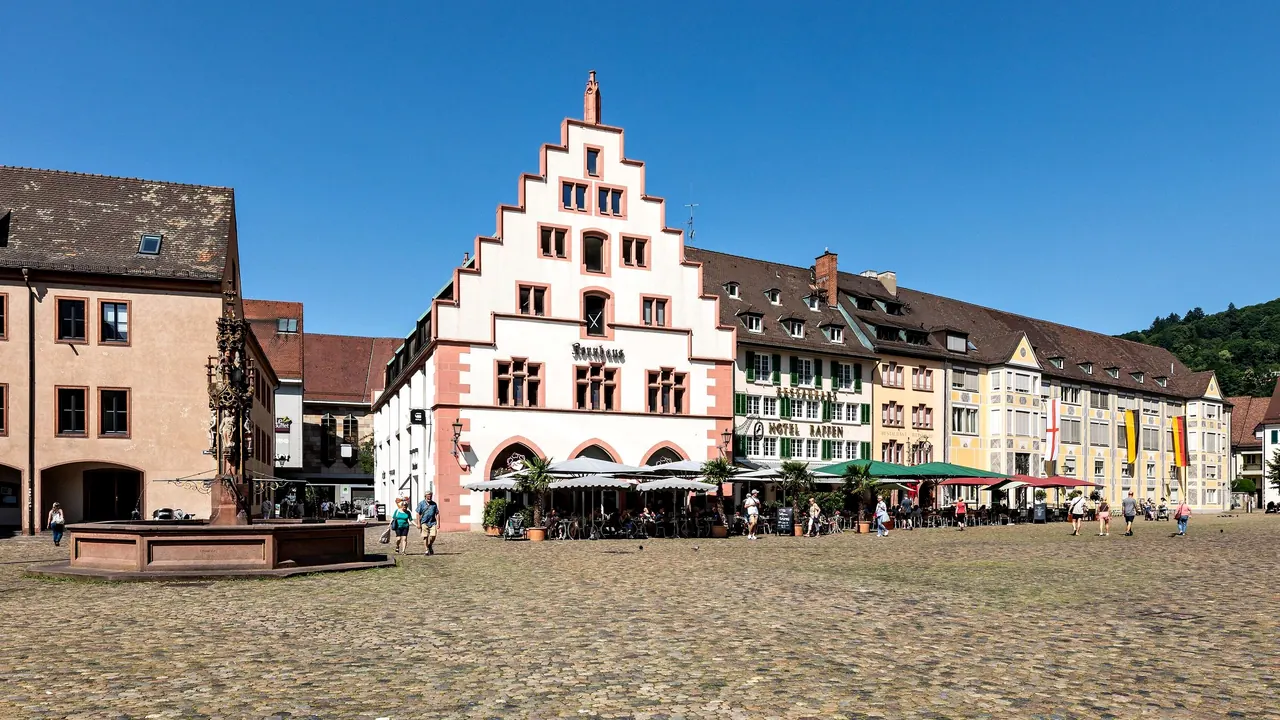
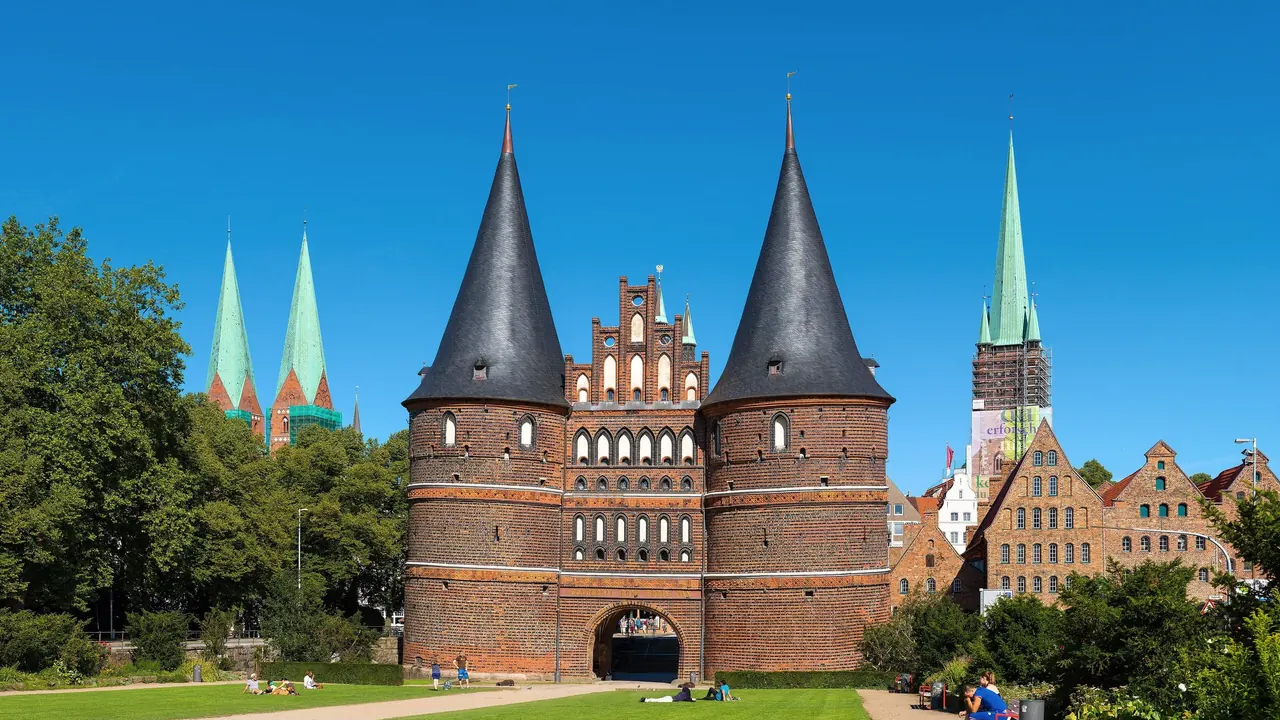
Photos: Freiburg by Dietmar Rabich, CC BY-SA 4.0, cropped; Lubeck by Christian Wolf (www.c-w-design.de), CC BY-SA 3.0 DE, cropped.
Freiburg or Lubeck?
Our verdict in twelve categories, each scored against the same fixed benchmark cities, and the climate month by month, so you can choose for your trip.
Choose Freiburg for
- nature and the outdoors
- wellness
- families
Freiburg suits travellers who want the city as a base for the landscape around it. The Black Forest starts at the edge of town, Alsace and Basel are close enough for an easy day out, and thermal baths, wine villages and a cheerful student evening fill the gaps. Families and walkers will find more to do here, and summers are warmer, though rooms are harder to find and cost more.
Choose Lubeck for
- beaches
- culture and sights
- prices
Lübeck is the better pick if the town itself is the reason to go. Its island old town of brick churches, gabled merchants' houses and hidden courtyards is the more complete historic place, and the Baltic beach at Travemünde adds seaside afternoons in summer. It is a quieter, slightly cheaper stay, best for travellers who like slow wandering more than mountains or late nights.
Scoreboard
Twelve categories on one fixed scale from 0 to 100. The shaded stretch is the gap between the two.
Your match
Pick a travel style or drag the sliders, and both match scores follow your weighting.
Wins on nature and the outdoors and wellness with your weighting.
Wins on beaches and culture and sights with your weighting.
What matters to you?
Category by category
What the scores mean for a trip.
Beaches & swimming
Neither city is a beach destination, but Lübeck at least has the sea. Travemünde is part of the city, with a long sandy beach, hooded wicker beach chairs and calm, shallow Baltic water that small children can paddle in. The swimming season is short, though, and the sea stays cool even in high summer.
Freiburg is far inland. Swimming there means grassy gravel-pit lakes on the Rhine plain, which get pleasantly warm, the cooler Black Forest lakes of Titisee and Schluchsee, or the city's busy open-air pools.
Food & drink
Freiburg eats better. Baden cooking has a French lightness: Flammkuchen, Schäufele, Black Forest ham, mountain trout and spring asparagus, served with dry Pinot from the Kaiserstuhl vineyards just outside town. The morning market around the Münster and the region's fine restaurants give it a depth that Lübeck lacks.
Lübeck's strengths are narrower: centuries of marzipan, North Sea and Baltic herring, fish rolls from harbour kiosks, and Rotspon wine aged in its cellars, with the old sea captains' guild house as a memorable place to eat. In both cities the international choice soon runs out.
Culture & sights
Lübeck has the richer historic centre. Almost the whole island old town is a World Heritage site, with seven brick spires, the leaning Holstentor and the Marienkirche, the model for brick Gothic churches across the Baltic. The Hansemuseum and the Buddenbrookhaus give it more depth than you would expect for its size.
Freiburg's highlight is its red sandstone Münster, whose tower you can climb, along with the Bächle channels running beside the streets and fine medieval art in the Augustinermuseum. Much of the centre was rebuilt after the war, though, and a day or so covers it.
Nightlife
Freiburg's large student population gives it the livelier evening. Pubs, wine bars and beer gardens fill the lanes around the Martinstor, there are a few clubs, and in summer people stay out late along the Dreisam. Lübeck is mostly in bed by midnight. Its old town has quiet bars and the Travemünde promenade picks up on summer nights, but anyone wanting a club goes to Hamburg.
Nature & outdoors
This is where the two differ most. Freiburg sits right against the Black Forest: the Schlossberg rises behind the old town, the Schauinsland ridge looks out to the Alps, gorges like the Ravenna valley make good day walks, and the Feldberg offers snow in winter. The mountain biking is excellent.
Lübeck's surroundings are gentle rather than dramatic. You can canoe on the reedy Wakenitz, walk the clay cliffs of the Brodtener Steilufer, go round the lakes of Holstein Switzerland or sail on the bay. It is pleasant cycling country, with no hills to speak of.
Day trips
Freiburg's position where Germany, France and Switzerland meet gives it more variety close by. Basel's art museums are a short train ride away, the half-timbered Alsace villages and Colmar are easy by car, and Strasbourg and Baden-Baden also make a good day out. Staufen and Breisach are closer still.
Lübeck has one big trip, Hamburg, with a strong supporting cast in Wismar, Schwerin's island castle and lakeside Ratzeburg. Beyond those, the choices thin out quickly.
Good for families
Freiburg gives children more to do. Europa-Park, Germany's largest theme park, is within easy reach, the Mundenhof animal park is free, and children love racing toy boats along the Bächle and riding the Schauinsland cable car. Add swimming lakes and the suspension bridge at Steinwasen, and a week passes easily.
Lübeck is at its best for families in summer, when Travemünde's shallow beach, the bay's aquarium and Hansa-Park take over. In colder months there is little made for children, though Freiburg is also short of indoor options on rainy days.
Getting around
Both centres are compact and easy to walk, but Freiburg does more beyond them. Trams reach the suburbs and the cable car, the city is made for cycling, and many hotels give guests a card for local buses and the regional trains into the Black Forest. Lübeck's old town is an island you cross on foot in minutes, with the station just across the river. Buses and a short train ride to Travemünde cover the rest, and the cobbles can be hard work with a buggy.
Shopping & style
Shopping is modest in both, and serious shoppers leave town: for Basel from Freiburg, for Hamburg from Lübeck. The difference is in what you take home. In Freiburg it is cuckoo clocks, wood carvings and Kaiserstuhl wine from the Münster market, bought among the organic shops of the Gerberau. In Lübeck it is boxed marzipan, with galleries and craft shops tucked into the courtyard passages off Hüxstrasse.
Affordability
Lübeck is the easier city on the budget. It has plenty of mid-range hotels and guesthouses in the old town and by the station, with the exception of the beach resorts in high summer.
Freiburg's problem is beds: rooms are scarce and expensive for a city its size, especially on summer weekends and during trade fairs, so some visitors stay in Black Forest villages instead. Once you are there, market snacks, wine taverns and largely free sights keep daily costs down.
Live music & performing arts
Both have a good municipal theatre for opera and drama, and both have little in the way of rock or pop. The difference is in what each does best. Freiburg's Barockorchester is a leading period-instrument ensemble, and the summer Zelt-Musik-Festival puts on concerts in a tent village. Lübeck has organ music in the Marienkirche, where Buxtehude played, and big names arrive with the Schleswig-Holstein Music Festival.
Wellness & relaxation
Freiburg is the better spa base. It has a thermal bath on its eastern edge, warm outdoor pools at Bad Krozingen nearby, Roman ruins beside the baths at Badenweiler, and the grand bathhouses of Baden-Baden a train ride away.
Lübeck has a seaside version instead: Travemünde's long spa-resort tradition, wellness hotels along the bay and a seawater pool complex at Scharbeutz. Its quiet courtyards are restful, but it is not the place for a dedicated spa trip.
When should you go?
Pick your month. The climate figures are measured averages, not a forecast.
Freiburg in July
Lubeck in July
Daytime high, °C
Rainfall in the month, mm
Temperature and rainfall are climate normals, averaged over the years shown. Freiburg: 1991-2020 normals, Freiburg (0.6 km from centre). Lubeck: 1991-2020 normals, Luebeck-Blankensee (6 km from centre).
Freiburg is the warmer of the two from spring to autumn, reaching about 27°C in July, with long sunny days from May to August. Late spring and summer are also its wettest stretch, with May bringing around 103mm, often as showers and thunderstorms. Spring and early autumn are the most comfortable times for walking the old town and hiking in the hills. Winters are cold and grey in the city, though the higher Black Forest slopes usually have snow.
Lübeck stays cooler, peaking at about 24°C in July and August, when the Baltic warms to around 19°C. That is fresh, but it is the only time for a swim. April is its driest month at about 37mm, and May and June bring long, bright days, so late spring is a fine time to explore the old town on foot. From November to February the days are short, dark and damp, and better spent in museums than on the streets.
Which traveller are you?
On an outdoors trip, Freiburg is the clear choice. A cable car runs up the Schauinsland from the edge of town, the Feldberg is close for summer hikes or winter skiing, and the Kaiserstuhl vineyards make good cycling. Around Lübeck the country is flat and gentle.
For a culture and arts trip, Lübeck has more to offer. Its UNESCO-listed Hanseatic old town, the Marienkirche, the Holstentor and museums on the Hanseatic League and Thomas Mann give two full days. Freiburg's cathedral and rebuilt centre fill less time.
On a family trip with children, Freiburg works better all year. Europa-Park, the free Mundenhof animal park, the Bächle channels and the cable car keep children busy. Lübeck's shallow beach is lovely in summer, but out of season there is much less for children.
Before you go
| Measure | Freiburg | Lubeck |
|---|---|---|
| Official language | German | German |
| Currency | Euro (EUR) | Euro (EUR) |
| Sockets | CF230 V, 50 Hz | CF230 V, 50 Hz |
| Driving side | Right | Right |
| Time zone | UTC+1, UTC+2 in summer | UTC+1, UTC+2 in summer |
| Emergency number | 112 | 112 |
| Elevation | 278 m | 13 m |
| Main airport | EuroAirport Basel–Mulhouse–Freiburg (BSL)50 km from centre112 non-stop destinations | Hamburg Helmut Schmidt Airport (HAM)53 km from centre120 non-stop destinations |
| Public holidays this year | 12 days | 10 days |
By the numbers
| Measure | Freiburg | Lubeck |
|---|---|---|
| City population | 238,299 | 217,061 |
| People per km² | 1,558 | 1,013 |
| Museums within 10 km | 13 | 23 |
| UNESCO World Heritage sites within 50 km | 2 | 1 |
| Swim season, months above 21 °C | - | None |
Where else could you go?
Every comparison below shares a destination with this one, so you can follow Freiburg or Lubeck somewhere new.
- Colmarvs Freiburg
- Baselvs Freiburg
- Hamburgvs Lubeck
- Strasbourgvs Freiburg
- Zurichvs Freiburg
- Baden-Badenvs Freiburg