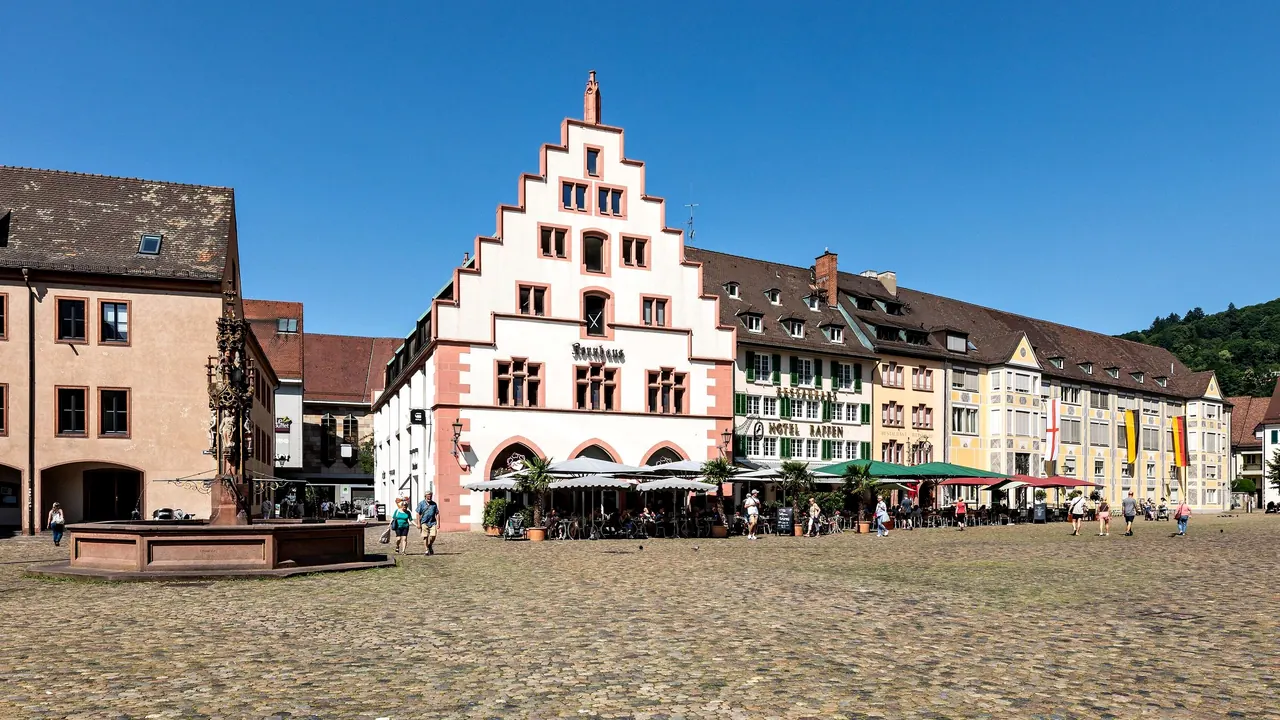
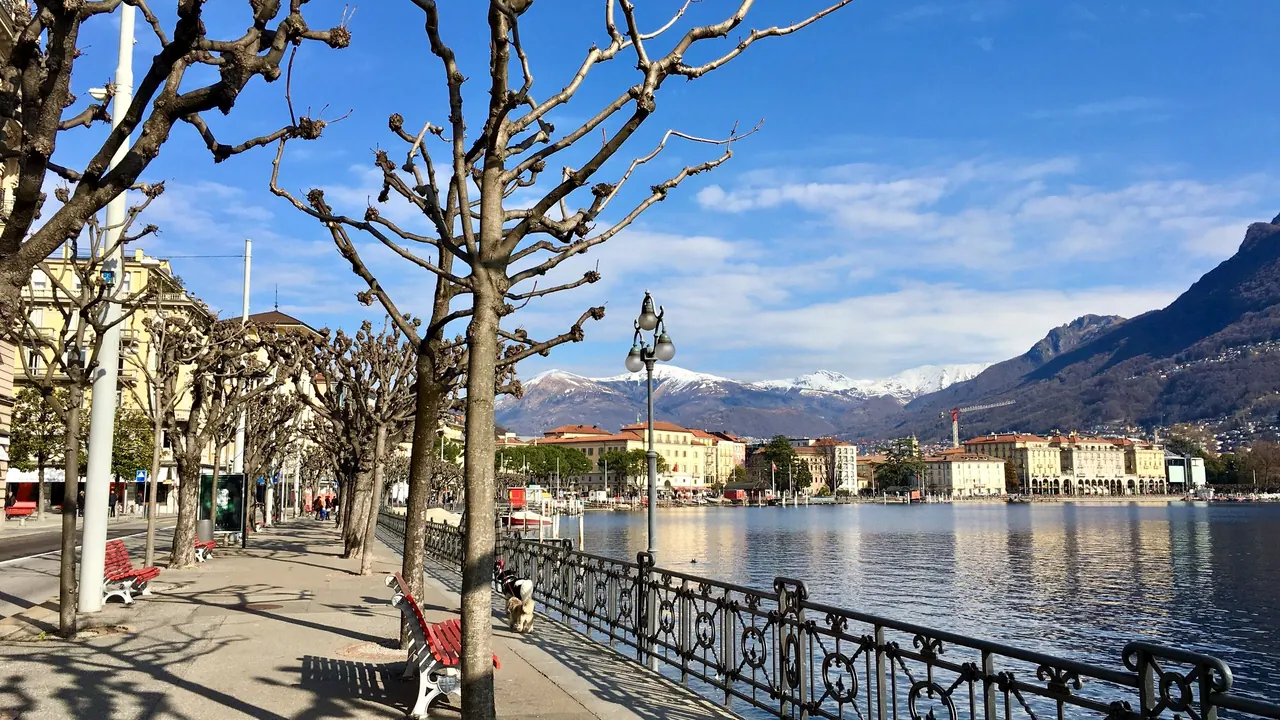
Photos: Freiburg by Dietmar Rabich, CC BY-SA 4.0, cropped; Lugano by Thomas Woodtli from Zürich, Switzerland, CC BY-SA 2.0, cropped.
Freiburg or Lugano?
Our verdict in twelve categories, each scored against the same fixed benchmark cities, and the climate month by month, so you can choose for your trip.
Choose Freiburg for
- prices
- families
- wellness
Freiburg is the better pick for a week that mixes Black Forest walking with an easy, good-value town base, especially with children. Its Gothic centre, student evenings, Baden wine taverns and the thermal baths around Bad Krozingen give you plenty to do after a hike. It also costs much less to stay than Lugano, so the trip stretches further.
Choose Lugano for
- beaches
- shopping
- day trips
If the lake itself is the point, Lugano wins. You get swimming from lidos, boats to Gandria and Morcote, funiculars up Monte Brè and San Salvatore, and day trips to Milan, Como and the islands of Lake Maggiore. It is a quieter, more polished stay. It suits travellers who don't need to watch costs and are happy with early nights.
Scoreboard
Twelve categories on one fixed scale from 0 to 100. The shaded stretch is the gap between the two.
Your match
Pick a travel style or drag the sliders, and both match scores follow your weighting.
Wins on prices and families with your weighting.
Wins on beaches and shopping with your weighting.
What matters to you?
Category by category
What the scores mean for a trip.
Beaches & swimming
Neither city has a sea, but Lugano's lake is the better place to swim. Lidos with lawns, wooden decks and ladders into the water line the shore from the Cassarate mouth towards Castagnola and Paradiso. Boats run to the village lake baths, so a swim fits easily into a city afternoon.
In Freiburg, a swim means cycling to the grassy gravel pits on the Rhine plain, or travelling an hour to Titisee and Schluchsee, where the water stays cool. The open-air pools are packed in high summer. It is a way to cool off rather than part of the plan.
Food & drink
Freiburg has the wider choice of food. Its Baden cooking has a French touch, with dishes such as Schäufele, Flammkuchen, mountain trout and spring asparagus, and it comes with Kaiserstuhl Pinot from vineyards just outside town. The Münster market runs six mornings a week, and the surrounding region is known for fine dining.
Lugano's best meals are in the grotti, rustic taverns that serve polenta, braised meats and Ticino Merlot under chestnut trees. The tradition is charming, but in town the choice is thin and costly. Many visitors save their serious eating for Italy.
Culture & sights
Freiburg gives you a fuller day or two. You can climb the tower of the red sandstone Münster, see the Historisches Kaufhaus on the market square, walk through two medieval gates and visit the medieval sculpture in the Augustinermuseum, with the Bächle running alongside the streets. Much of it was rebuilt after the war, yet it still feels like a historic centre.
Lugano's arcaded Lombard old town, San Lorenzo cathedral and Luini's Passion fresco in Santa Maria degli Angioli are fine but quickly seen. LAC and the Hesse museum at Montagnola fill out roughly a single day.
Nightlife
Thanks to its students, Freiburg has the livelier evenings. There are pubs and wine bars around the Martinstor, beer gardens, summer crowds along the Dreisam and a few clubs for techno and indie nights, though things calm down during the semester break.
In Lugano, a night out means an aperitivo under the arcades and a long dinner. The local crowd is well dressed, prices are high and the town is mostly quiet before midnight.
Nature & outdoors
Both cities have serious walking country right on the doorstep, but the landscapes are very different. Freiburg's is upland forest: the Schlossberg behind the old town, the Schauinsland cable car up to about 1,280m and the Feldberg for summer hikes and winter snow. Its flat Rhine plain bike paths and Kaiserstuhl vineyards add cycling and mountain biking.
Lugano's landscape is water and steep mountainside. Funiculars climb Monte Brè and San Salvatore, a lakeside path leads to Gandria, and the ridge from Monte Lema to Tamaro makes a classic day hike, with kayaks and paddleboards on the lake below. Cyclists and winter visitors will prefer Freiburg, while walkers who want a lake in view all day will prefer Lugano.
Day trips
From Freiburg, day trips stay in the corner of the upper Rhine where Germany, France and Switzerland meet. Basel's art museums and Rhine-side old town are about 45 minutes by train, Colmar and the half-timbered Alsace wine villages such as Riquewihr and Eguisheim are about an hour by car, and Strasbourg's cathedral and Petite France quarter are roughly an hour and a half away. Nearer to town you have Breisach's hilltop minster, the Renaissance wine town of Staufen and the abbey of St. Peter. The spa town of Baden-Baden is about an hour north by fast train, so cathedral cities, wine routes and old spa towns are all within easy reach.
Lugano has a little more range and the bigger headline sights. Milan, with its cathedral, The Last Supper and the Brera gallery, is just over an hour by train, and Como is about half an hour away. Bellinzona's three castles lead on to Lake Maggiore and the palace gardens of the Borromean Islands, which opens up a second lake district. For a great Italian city and island gardens, Lugano is the better base. For Alsace towns and wine villages, choose Freiburg.
Good for families
Freiburg is the easier city with children. The centre is flat and full of families on bikes. Children can sail toy boats in the Bächle, visit the free Mundenhof animal park, ride the Schauinsland cable car, and Europa-Park, Germany's largest theme park, is about 40 minutes away.
Lugano suits younger children who enjoy boats, lido slides, funicular rides and the miniature Swiss landmarks park at Melide. Its steep streets are tiring with a pushchair, though. With no zoo or big museum, teenagers soon run out of things to do.
Getting around
Both cities are easy without a car, and both centres are small enough to walk. The difference is the ground underfoot. Freiburg's old town is flat and mostly car-free, with trams and some of Germany's best cycling. Lugano rises steeply from the lake, so you will use the station funicular, the hillside buses and the lake boats.
Regional trains are excellent from both. From Freiburg they run up through the Höllental into the Black Forest, and from Lugano the Swiss network reaches Bellinzona, Como and Milan. Hotels in both regions often include local transport.
Shopping & style
Lugano has the more polished shopping street. The arcades of Via Nassa hold Swiss watchmakers, jewellers and Italian fashion houses, and the designer outlet village near Mendrisio adds more labels, though there is little for younger or cheaper tastes.
Freiburg is more modest and more everyday. Chains line Kaiser-Joseph-Strasse, the Gerberau and Konviktstrasse quarters have independent bookshops and organic stores, and cuckoo clocks and Black Forest ham make good souvenirs. Serious shoppers leave both cities, heading for Basel from Freiburg and Milan from Lugano.
Affordability
Freiburg is by far the cheaper stay. Its hotels do cost more than you might expect for its size and fill up on summer weekends and during trade fairs. Market food, student-quarter restaurants and free sights keep daily spending low.
Lugano has Swiss prices for everything, from lakeside hotels to boat trips and mountain railways. Grotti, set lunches and the regional transport that comes with your hotel help a little, and some visitors eat on the Italian side. Even so, there is no budget way to stay in town.
Live music & performing arts
Both give you a good evening out rather than a reason to travel, and both lean towards classical music. Freiburg spreads its programme more widely. Theater Freiburg runs opera alongside drama and dance, and the Freiburger Barockorchester is one of Europe's leading period-instrument ensembles. Student jazz clubs and the summer Zelt-Musik-Festival tent village add more.
Lugano puts almost everything under one roof at LAC, home of the Orchestra della Svizzera italiana, where much of the theatre is in Italian. Its high point is Estival Jazz, a free summer festival on Piazza della Riforma, while opera lovers head to La Scala in Milan.
Wellness & relaxation
Freiburg sits in real spa country. There is a thermal bath on the city's eastern edge, and Bad Krozingen's warm outdoor pools are twenty minutes south. Badenweiler has a modern bath next to Roman ruins, and Baden-Baden is an hour away by train.
Lugano has no bathing tradition, so relaxing there means afternoons at the lido, benches in Parco Ciani and long grotto lunches. Its spas are mostly inside the large hotels, with one big indoor pool and sauna complex near Rivera.
When should you go?
Pick your month. The climate figures are measured averages, not a forecast.
Freiburg in July
Lugano in July
Daytime high, °C
Rainfall in the month, mm
Temperature and rainfall are climate normals, averaged over the years shown. Freiburg: 1991-2020 normals, Freiburg (0.6 km from centre). Lugano: 1991-2020 normals, Lugano (1.2 km from centre).
Freiburg is best for walking in April and September. April is mild with little rain, and September stays around 21°C with plenty of sun, which is good weather for the old town and the Black Forest trails. July and August are the months for a lake swim, with highs of about 27°C and some showers but no long wet spells. May is Freiburg's wettest month at about 103mm, though that is still moderate. Winters are cold and grey, and there is little sunshine from November to January.
Lugano is just as warm in high summer, and its lido season runs from June to early September. From April to November, though, it is much wetter than Freiburg. May brings about 178mm, and spring and autumn are similarly damp, so walks in those seasons often end in a downpour. Lugano's drier, brighter season is late winter and early spring. March is mild, sunny and far less rainy than the months after it, and even in January Lugano is a little milder than Freiburg and gets roughly twice the sunshine.
Which traveller are you?
On a trip on a tight budget, Freiburg is far easier on the wallet. Hotels are pricey for its size, but market sausages, student-quarter restaurants and the free Münster keep daily costs low. Lugano has Swiss prices throughout and no cheap way to stay.
On a family trip with children, Freiburg has more aimed at them: toy boats in the Bächle, the free Mundenhof animal park and Europa-Park forty minutes away. Lugano's lidos and funiculars please small children, but its steep streets are hard work with pushchairs.
For a beach and sun trip, Lugano is the better of these two inland cities. Its lake warms enough for proper swimming from lidos and decks, and its winters are sunnier. In Freiburg, swimming means gravel-pit lakes, crowded pools or cool Black Forest water.
Before you go
| Measure | Freiburg | Lugano |
|---|---|---|
| Official language | German | French, German, Italian, Romansh |
| Currency | Euro (EUR) | Swiss Franc (CHF) |
| Sockets | CF230 V, 50 Hz | CJ230 V, 50 Hz |
| Driving side | Right | Right |
| Time zone | UTC+1, UTC+2 in summer | UTC+1, UTC+2 in summer |
| Emergency number | 112 | 112 |
| Elevation | 278 m | 283 m |
| Main airport | EuroAirport Basel–Mulhouse–Freiburg (BSL)50 km from centre112 non-stop destinations | Milan Malpensa International Airport (MXP)46 km from centre208 non-stop destinations |
| Public holidays this year | 12 days | 15 days |
By the numbers
| Measure | Freiburg | Lugano |
|---|---|---|
| City population | 238,299 | 63,495 |
| People per km² | 1,558 | 837 |
| Museums within 10 km | 13 | 17 |
| UNESCO World Heritage sites within 50 km | 2 | 5 |
Where else could you go?
Every comparison below shares a destination with this one, so you can follow Freiburg or Lugano somewhere new.