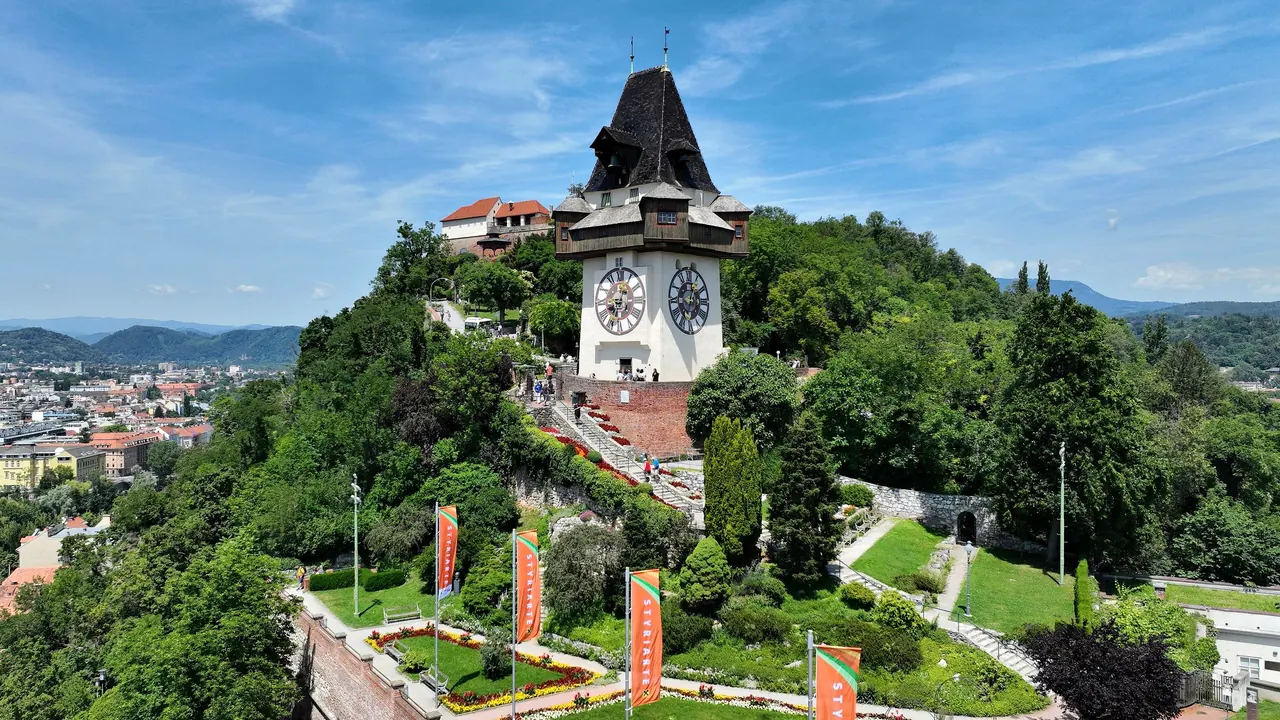
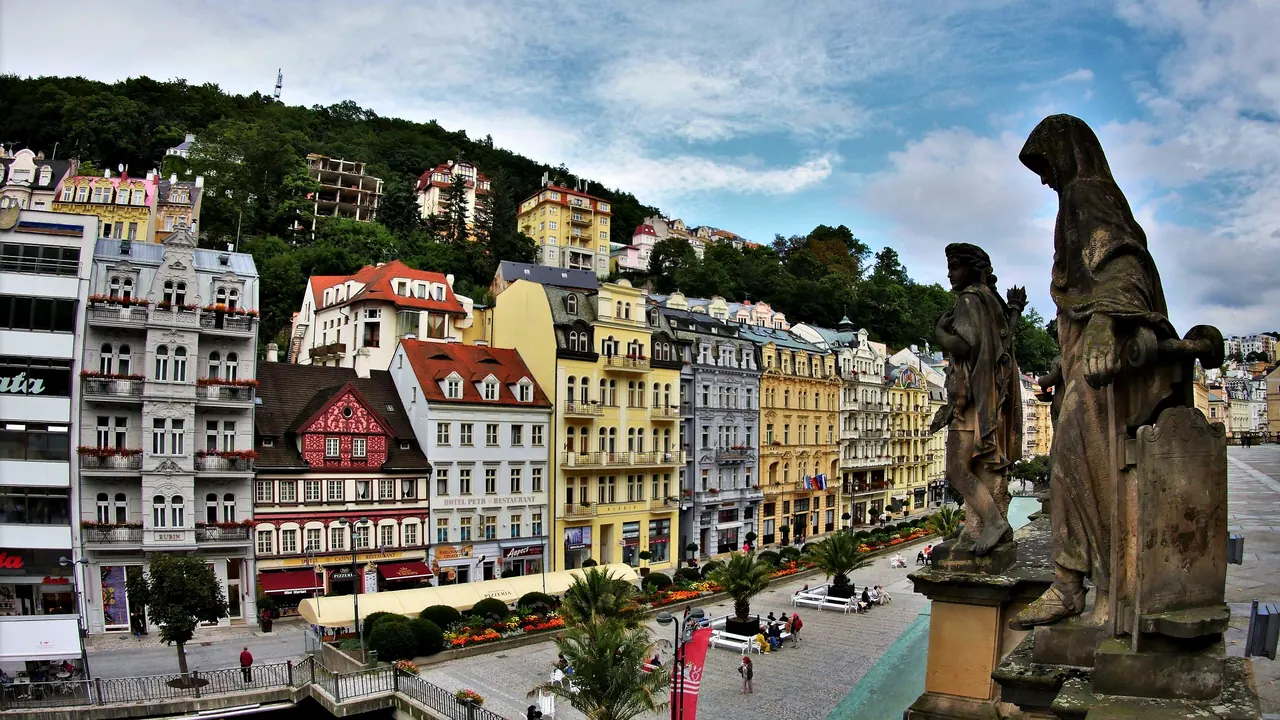
Photos: Graz by C.Stadler/Bwag, CC BY-SA 4.0, cropped; Karlovy Vary by Rolf Dietrich Brecher from Germany, CC BY-SA 2.0, cropped.
Graz or Karlovy Vary?
Our verdict in twelve categories, each scored against the same fixed benchmark cities, and the climate month by month, so you can choose for your trip.
Choose Graz for
- food and drink
- nightlife
- live music and the arts
Graz is the more rounded city break. Its old town, castle hill and great armoury fill two or three days of sightseeing, and the Styrian kitchen and the wine hills to the south make eating a highlight. The students keep the evenings going with bars and jazz, and there is a proper opera house. It is also easier with children and simpler to get around, with trams and a flat centre you can walk.
Choose Karlovy Vary for
- wellness
- prices
Choose Karlovy Vary if you want to slow down. The town exists to take the waters. A stay built around a spa hotel, the drinking cure along the colonnades and the forest paths is something Graz can only offer by sending you out to its thermal villages. The evenings are quieter, the food is plainer and it costs a little less, which suits couples and older travellers who want calm, grand architecture and restful days rather than a full programme.
Scoreboard
Twelve categories on one fixed scale from 0 to 100. The shaded stretch is the gap between the two.
Your match
Pick a travel style or drag the sliders, and both match scores follow your weighting.
Wins on food and drink and nightlife with your weighting.
Wins on wellness and prices with your weighting.
What matters to you?
Category by category
What the scores mean for a trip.
Beaches & swimming
Neither town is a place for swimming, and in summer the locals in both go to old gravel pits or flooded mines. The Schwarzlsee and its neighbours on the flat land south of Graz have more facilities, with jetties, kiosks and grassy banks, and they warm up well in the hotter Styrian summer.
Karlovy Vary has Lake Medard near Sokolov, about half an hour away. Its more unusual swim is the warm outdoor pool on the hillside, fed by the springs.
Food & drink
Graz has a regional kitchen with real character. Pumpkin seed oil goes on almost everything, Styrian pork is boiled with root vegetables and horseradish, and there are farmers' markets every morning except Sunday at Kaiser-Josef-Platz and Lendplatz. White wines from the southern hills are poured in rustic Buschenschank taverns less than an hour away.
Karlovy Vary's food is narrower: Czech roast pork, dumplings and svíčková with good beer. Its own specialities are the warm spa wafers and Becherovka. It has no real market and only a few ambitious kitchens, so food lovers will find much more in Graz.
Culture & sights
Both are handsome historic towns, but Graz has more to see and holds you longer. Its old town of Renaissance courtyards and red roofs climbs to the Schlossberg and the Uhrturm. The Landeszeughaus armoury and Schloss Eggenberg are major sights, and the Kunsthaus adds a modern contrast across the river.
Karlovy Vary is one complete townscape: Belle Époque hotels stacked up the Teplá valley, the colonnades and the Vřídlo geyser, listed by UNESCO among the Great Spa Towns of Europe. Its museums are small and specialised, and a day or two covers it.
Nightlife
Thanks to its students, Graz has a real if small going-out scene: the bars of the Bermuda Triangle around Mehlplatz, artier places in Lend and a few clubs open late at weekends. Karlovy Vary barely competes. Spa guests go to bed early and a late night usually means the hotel bar. The exception is the film festival week in early summer, when the valley fills with crowds and parties.
Nature & outdoors
Graz has more ambitious outdoors on its doorstep. The Schöckl has a cable car, trails and paragliding right above the city, and the Mur cycle path runs straight through it. Within about two hours, the Gesäuse and the Hochschwab offer serious alpine hiking.
In Karlovy Vary the forest starts at the edge of the colonnades. Gentle, well-graded spa paths lead up to the Diana tower, and the Slavkov Forest moors lie further out. Karlovy Vary does have one advantage: skiing at Klínovec in the Ore Mountains, about forty minutes away, is closer than the slopes are to Graz.
Day trips
Both make good bases for day trips, but of different kinds. From Graz you head into the countryside: the South Styrian Wine Road and its taverns, Riegersburg on its volcanic crag, the Lipizzaners at Piber and Admont's huge monastic library. Maribor is across the Slovenian border, but a car helps for most of these.
Karlovy Vary's outings are mostly castles and other spa towns. Loket sits in its river loop only twenty minutes away, Mariánské Lázně and Františkovy Lázně are about an hour off, and Bečov castle keeps the reliquary of St Maurus. Plzeň's breweries are about an hour or more away, and Prague works as a long day by coach.
Good for families
Graz is the far better place for a family. The Schlossberg alone can fill a morning, with its glass lift, underground slide and the Märchenbahn train through the rock. On top of that come the FRida & freD children's museum, trams that take buggies and the Herberstein wildlife park outside town.
Karlovy Vary is safe and clean but made for adults taking cures. The geyser, the spouted spring-water cups, the funicular and the outdoor thermal pool keep children happy for an afternoon or two, and the steep streets are hard work with a pushchair.
Getting around
Graz is easier to get around: a small, flat, largely pedestrianised centre, trams on one simple ticket and easy cycling along the river. Karlovy Vary's promenades are also pleasant to walk, but the narrow valley means steep climbs to many hotels and viewpoints, so you rely on buses and the funicular, and its regional trains are slow. In both towns a car only matters for the countryside beyond.
Shopping & style
Neither is a shopping destination, and the best buys in both are local specialities. Graz has a wider everyday mix along the Herrengasse and Sporgasse, plus its nineteenth-century department store and Lend's design and vintage shops. To take home there is pumpkin seed oil, Styrian wine and craft chocolate.
Karlovy Vary's promenades are more upmarket and more geared to souvenirs. Jewellers and boutiques serve the spa guests, and the local specialities are Moser crystal, local porcelain and Bohemian garnets.
Affordability
Karlovy Vary is the cheaper stay, but only once you step away from the colonnades. The grand hotels charge for the setting, while the pubs and canteens one street back charge local Czech prices, and buses and the funicular cost little. If cost matters, avoid the festival week.
Graz is fair rather than cheap. Student lunch menus and bakeries keep daytime eating reasonable, but dinners and wine cost the usual Austrian amounts.
Live music & performing arts
Graz is the place for a night at the opera or a concert. Its opera house, the second largest in Austria, runs a full season. There is also the Schauspielhaus, the Musikverein's concerts, the Styriarte and steirischer herbst festivals, and a strong jazz scene fed by the music university.
Karlovy Vary's symphony orchestra plays pleasant light classical concerts, sometimes outdoors on the colonnades. Its Fellner and Helmer theatre hosts touring productions, and an autumn Dvořák festival adds a few highlights. It makes an enjoyable evening, but the town's famous festival is for film, not the stage.
Wellness & relaxation
Wellness is the reason Karlovy Vary exists. Thirteen main springs supply the colonnades for the drinking cure, and the spa hotels and sanatoria offer carbonated baths, peat wraps, doctors' consultations and pools of warm spring water. You get the most from it by booking a full spa stay.
Graz has no bathing tradition of its own, so for thermal baths you go about an hour east, to Bad Blumau's Hundertwasser resort or to Loipersdorf. In the city itself, the calm comes from the coffee houses, the Stadtpark and the shaded paths of the Schlossberg.
When should you go?
Pick your month. The climate figures are measured averages, not a forecast.
Graz in July
Karlovy Vary in July
Daytime high, °C
Rainfall in the month, mm
Where the figures come from
Karlovy Vary's station stands 156 m above the city centre, so the centre is likely a little warmer than the figures say.
Karlovy Vary has no rain gauge within 25 km of the centre, so its rainfall comes from a gridded climate dataset read at the city rather than from a gauge further away.
Karlovy Vary's sunshine is measured 37 km from the centre, at Cheb.
Temperature and rainfall are climate normals, averaged over the years shown. Graz: 1991-2020 normals, Graz Airport (7.9 km from centre). Karlovy Vary: 1999-2020 (sunshine 1981-2010, rainfall 1991-2020) normals, Karlovy Vary (4.6 km from centre).
Graz is the warmer of the two, reaching about 27°C in July against Karlovy Vary's 22°C. That makes Graz's bathing lakes worth a swim from late June to August, while Karlovy Vary's mild summers are comfortable for walking all day. Graz pays for its heat with a wet summer, with rainfall around 125mm a month from June to August. Its winters are dry and noticeably sunnier. Karlovy Vary's rain is spread more evenly through the year and peaks more gently in July.
May, June and September are the best months for exploring on foot in both towns. Winter is cold in both and close to freezing in Karlovy Vary. The Czech town also has very little sunshine from November to January, so in those months it is a place for warm pools and cafés rather than sightseeing.
Which traveller are you?
For a relaxing and wellness trip, Karlovy Vary is the clear choice. The springs, the colonnades and the spa hotels with medical treatments and warm thermal pools are the town's whole purpose. From Graz you have to travel an hour east to its spa villages.
On a food and nightlife trip, Graz wins easily. Pumpkin seed oil, cold fried chicken salad, the morning farmers' markets and white wine from nearby hills beat Czech roasts and dumplings. Its student bars stay busy long after the spa town has gone to bed.
On a family trip with young children, Graz has far more to fill the days: the underground slide inside the Schlossberg, the Märchenbahn, a children's museum and summer toboggan runs. Karlovy Vary's geyser and funicular entertain for an afternoon, but its steep slopes are hard going with a pushchair.
Before you go
| Measure | Graz | Karlovy Vary |
|---|---|---|
| Official language | German, Austrian Sign Language | Czech |
| Currency | Euro (EUR) | Czech Koruna (CZK) |
| Sockets | CF230 V, 50 Hz | CE230 V, 50 Hz |
| Driving side | Right | Right |
| Time zone | UTC+1, UTC+2 in summer | UTC+1, UTC+2 in summer |
| Emergency number | 112 | 112 |
| Elevation | 353 m | 447 m |
| Main airport | Graz Airport (GRZ)9 km from centre26 non-stop destinations | Václav Havel Airport Prague (PRG)100 km from centre178 non-stop destinations |
| Public holidays this year | 16 days | 13 days |
By the numbers
| Measure | Graz | Karlovy Vary |
|---|---|---|
| City population | 306,971 | 49,073 |
| People per km² | 2,406 | 830 |
| Museums within 10 km | 29 | 2 |
| UNESCO World Heritage sites within 50 km | 1 | 3 |
Where else could you go?
Every comparison below shares a destination with this one, so you can follow Graz or Karlovy Vary somewhere new.
- Dresdenvs Karlovy Vary
- Praguevs Karlovy Vary
- Bledvs Graz
- Leipzigvs Karlovy Vary
- Ljubljanavs Graz
- Viennavs Graz