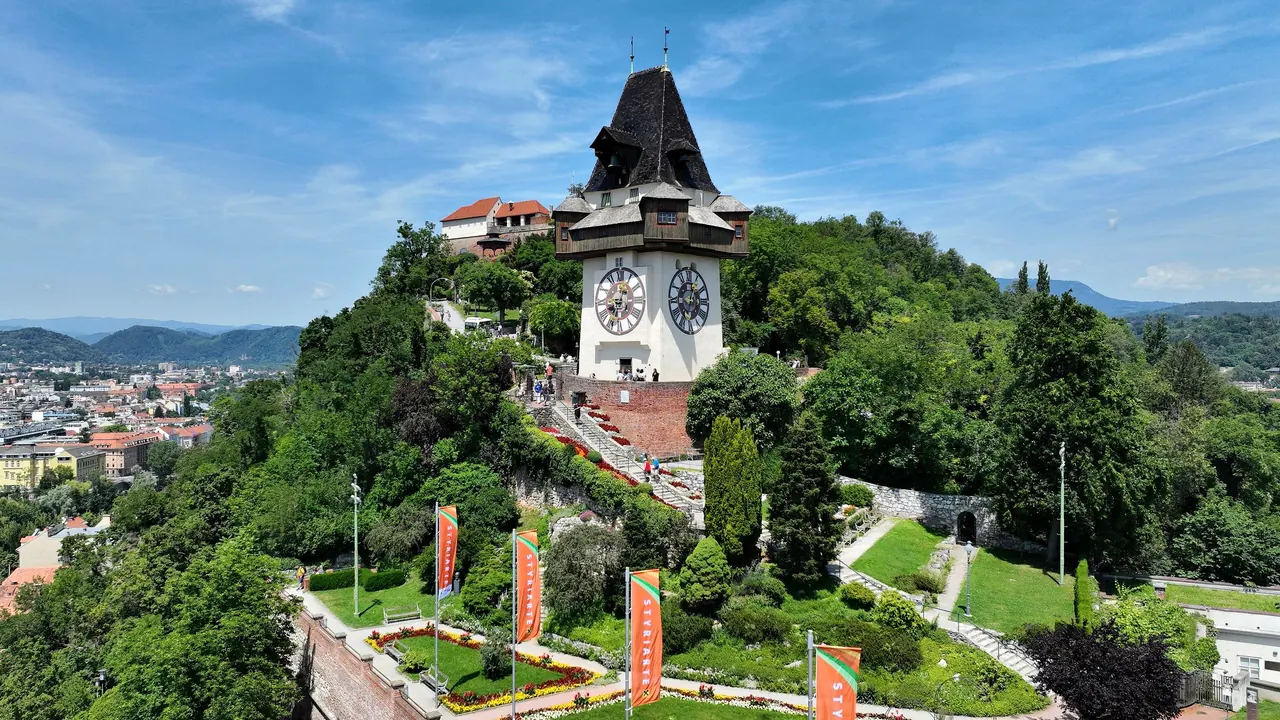
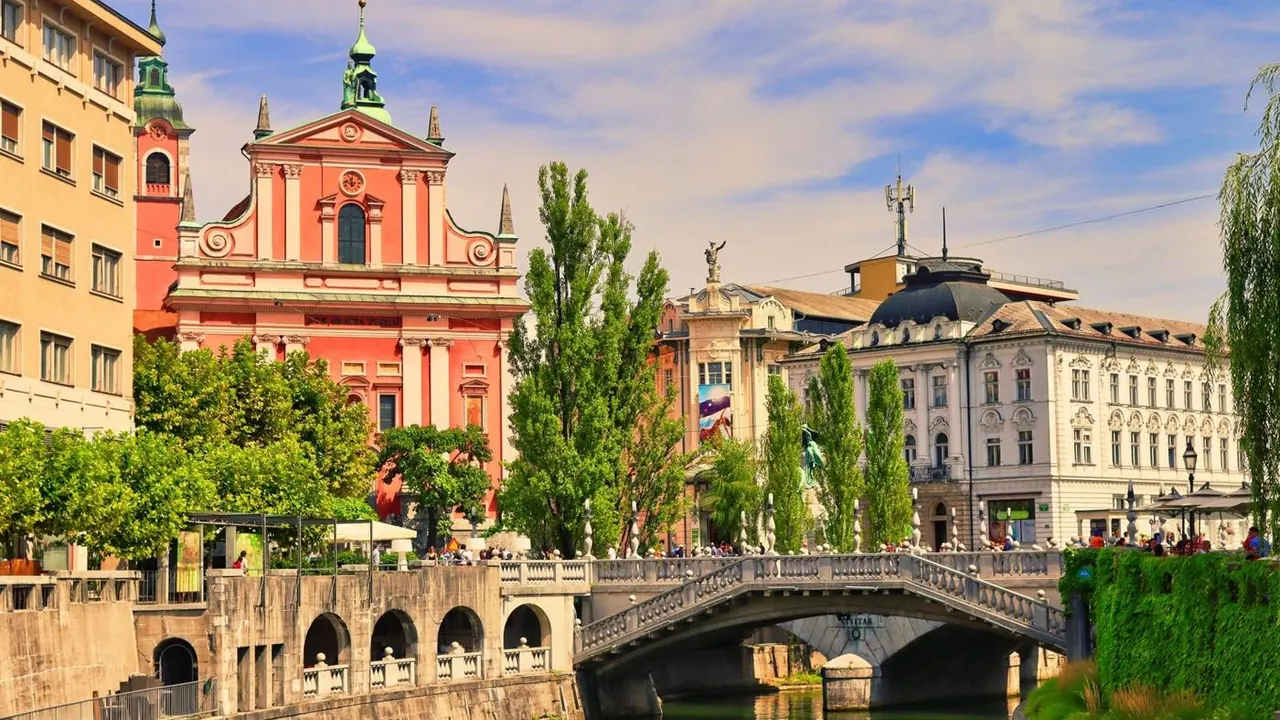
Photos: Graz by C.Stadler/Bwag, CC BY-SA 4.0, cropped; Ljubljana by detait, Pexels License.
Graz or Ljubljana?
Our verdict in twelve categories, each scored against the same fixed benchmark cities, and the climate month by month, so you can choose for your trip.
Choose Graz for
- shopping
- live music and the arts
- culture and sights
Graz suits the traveller who wants a historic city with real depth behind the façades. There is the armoury still stacked with armour, Schloss Eggenberg and the Kunsthaus by the river, an opera house with a full season and two well-known festivals. Trams make it effortless to get around. It is the slightly easier pick with children, thanks to the slide inside the Schlossberg, and the Styrian thermal spas and wine roads are close by when you want a slower day.
Choose Ljubljana for
- day trips
- beaches
- nature and the outdoors
Choose Ljubljana if the country around the city matters as much as the city itself. The Julian Alps, Bled, the Soča valley and the karst caves are all within easy reach, so it makes a good base for active days out, and eating out and sightseeing cost a little less. The capital itself is small and walkable, shaped by Plečnik's riverside architecture, and best enjoyed over a few unhurried days.
Scoreboard
Twelve categories on one fixed scale from 0 to 100. The shaded stretch is the gap between the two.
Your match
Pick a travel style or drag the sliders, and both match scores follow your weighting.
Too close to call, 1 point apart
Wins on shopping and live music and the arts with your weighting.
Wins on day trips and beaches with your weighting.
What matters to you?
Category by category
What the scores mean for a trip.
Beaches & swimming
Neither city is a swimming destination, but Ljubljana has more water within reach. Lake Bled, about an hour away, is a proper Alpine lake for a summer swim, and the Adriatic at Piran is close enough for a day by the sea, even if the shore there is concrete platforms and pebble rather than sand.
Graz has to make do with the former gravel pits south of town, such as the Schwarzlsee. They have grassy banks and jetties, which is fine for a hot afternoon, but there is no sea or big lake within easy reach.
Food & drink
The two eat much alike and share a good deal of their larder, since Slovenian Styria runs right up to the border. Pumpkin seed oil and wines from the Styrian hills appear in both. Graz leans harder on its regional dishes, with oil-dressed chicken salad and Wurzelfleisch, and has farmers' markets at Kaiser-Josef-Platz and Lendplatz every morning except Sunday.
Ljubljana's strength is wine by the glass from Vipava and Goriška Brda, including the western orange wines, poured at bars along the river. You eat štruklji or jota in gostilna inns, and on warm days the street-food gathering takes over the market square.
Culture & sights
Graz has more to see. Its old town of arcaded Renaissance courtyards runs up to the cathedral and the Mausoleum of Ferdinand II, and it has two genuine standouts in the Landeszeughaus armoury and the Baroque Schloss Eggenberg. The Kunsthaus and the Murinsel bring a modern counterpoint across the river.
Ljubljana is more about the city as a whole than any single sight. It is Plečnik's city of bridges, colonnades and embankments, with a castle reached by funicular and Metelkova's murals for an alternative streak. Its museums are pleasant but less of a draw.
Nightlife
Evenings out are on much the same modest, student-driven scale in both cities, and neither is built for serious clubbing. Graz goes out in the tight old-town lanes of the Bermuda Triangle around Mehlplatz, with artier bars in Lend, though it empties noticeably when the students leave for the summer.
Ljubljana does its drinking on the riverside terraces along the Ljubljanica. Late nights mean Metelkova, the former barracks where small, scruffy clubs run into the early hours at weekends.
Nature & outdoors
Ljubljana has the bigger landscape on its doorstep. The Kamnik-Savinja Alps start about 40 minutes out, and the Julian Alps, Triglav National Park and the Soča's rafting water are about an hour or a little more away. Postojna and Škocjan caves add a world underground. Šmarna Gora gives locals a climb before work.
Graz's outdoors is gentler. It has the Schöckl with its cable car and paragliders, the Mur cycle path, the ladders of the Bärenschützklamm and the rolling South Styrian wine hills. For serious alpine hiking you have to drive about two hours to the Gesäuse.
Day trips
Ljubljana sits in the middle of a small country, and it shows. Bled, Škofja Loka, Predjama Castle in its cliff, Idrija and the coast at Piran are all easy outings, and Trieste and Zagreb add a second country. Buses and trains reach the main ones.
Graz's excursions are mostly rural Styria: the South Styrian Wine Road, Riegersburg on its volcanic crag, Admont Abbey's library and Maribor across the border. A car makes most of them much easier. Lipizzaner fans can visit the stud at Piber from Graz or the breed's original home at Lipica from Ljubljana.
Good for families
Both cities are calm, safe and compact with a pushchair, but Graz has more aimed squarely at children. The Schlossberg alone fills a morning: a glass lift up, the underground slide down and the Märchenbahn train through fairytale tunnels. It also has a dedicated children's museum in the Augarten, and summer toboggan runs on the Schöckl.
Ljubljana offers the castle funicular, the dragons on Dragon Bridge and a modest zoo on Rožnik hill. The puppet theatre puts on shows small children can follow without knowing Slovene.
Getting around
Both centres are flat, mostly pedestrianised and easy on foot, but Graz has the better public transport. Trams run along the Herrengasse to the station and Eggenberg on one simple ticket, and a lift and funicular climb the Schlossberg.
Ljubljana has no tram or metro, only buses and electric shuttles in the centre, though you will rarely need them because everything is within about 20 minutes' walk. For the countryside, intercity buses beat its slow trains, and a car helps in both cities.
Shopping & style
Graz is the better place for shopping, even if it is not a reason to go. It has proper high-street and traditional shops in historic buildings along the Herrengasse and Sporgasse, a grand nineteenth-century department store with a rooftop terrace, Lend's vintage and design shops, and specialist shops for loden and traditional costume.
Ljubljana is smaller still: the Central Market for honey and coastal salt, Idrija lace, a few boutiques on Trubarjeva and the Sunday flea market on the embankment. In both, the best things to take home are edible.
Affordability
Ljubljana is the somewhat cheaper stay. Set lunch menus at the inns, fairly priced local wine and sights that cost little to enter all help, and you will spend almost nothing on transport. The exception is summer rooms in the old town, so stay outside the centre or come outside July and August.
Graz is fair rather than cheap. Its students keep lunches and bakeries good value, but sit-down dinners and wine cost what they do anywhere in Austria.
Live music & performing arts
Graz offers the richer stage. Its opera house, the second largest in Austria, runs a full season, and the calendar has two well-known festivals: Styriarte for early and classical music, and steirischer herbst for avant-garde work in autumn. The music university's jazz programme also keeps a live jazz scene going.
Ljubljana has the Slovenian Philharmonic, the National Opera and Ballet and Cankarjev dom. Its high point is the summer festival in Plečnik's open-air Križanke courtyard, but most theatre is in Slovene.
Wellness & relaxation
Graz has the edge thanks to the Styrian thermal spa villages an hour to the east. Bad Blumau's grass-roofed Hundertwasser resort is the most striking, and Loipersdorf and Bad Radkersburg welcome day visitors to their warm pools.
Ljubljana relies on a water park with a sauna complex on the city's edge, with Slovenia's mineral spa towns about an hour's drive away. Both capitals of calm make up for it with car-free centres and long café afternoons, by the river in Ljubljana and in the Stadtpark in Graz.
When should you go?
Pick your month. The climate figures are measured averages, not a forecast.
Graz in July
Ljubljana in July
Daytime high, °C
Rainfall in the month, mm
Temperature and rainfall are climate normals, averaged over the years shown. Graz: 1991-2020 normals, Graz Airport (7.9 km from centre). Ljubljana: 1991-2020 (sunshine 1981-2010, rainfall 1981-2010) normals, Ljubljana / Bezigrad (1.9 km from centre).
Through the warm half of the year the two run almost in step. Graz peaks at about 27°C in July and Ljubljana a degree warmer, with a little more sunshine in high summer, so July and August are the months for a lake swim near either. May, June and September are the most comfortable for walking the streets in both. From December to February both are cold, only a few degrees above freezing by day.
Rain is where they part. In summer they are broadly level, though Ljubljana swings from 171mm in June to 80mm in July. Outside summer, Graz is much the drier. Its winters are notably dry, with just 20mm in January, which makes a crisp winter or early-spring visit appealing. Ljubljana is wetter in winter, spring and autumn, and its wettest month is October at 176mm, so Graz is the safer pick for an autumn walk in the wine hills.
Which traveller are you?
On an outdoors trip, Ljubljana is the clear choice. Graz offers the Schöckl and the gentle wine hills, but its real alpine hiking is two hours off. From Ljubljana, Triglav National Park is about an hour away, with Soča rafting a longer drive west.
For a culture and arts trip, Graz gives more. The Landeszeughaus armoury and Schloss Eggenberg outweigh Ljubljana's museums, and the evenings bring a large opera house, Styriarte in early summer and the avant-garde steirischer herbst in autumn.
On a trip on a tight budget, Ljubljana goes a little further. Graz is fair rather than cheap, with dinners and wine at Austrian levels, while Ljubljana's set lunches at the inns and low-cost sights stretch the money, especially outside July and August.
Before you go
| Measure | Graz | Ljubljana |
|---|---|---|
| Official language | German, Austrian Sign Language | Slovene |
| Currency | Euro (EUR) | Euro (EUR) |
| Sockets | CF230 V, 50 Hz | CF230 V, 50 Hz |
| Driving side | Right | Right |
| Time zone | UTC+1, UTC+2 in summer | UTC+1, UTC+2 in summer |
| Emergency number | 112 | 112 |
| Elevation | 353 m | 309 m |
| Main airport | Graz Airport (GRZ)9 km from centre26 non-stop destinations | Ljubljana Jože Pučnik Airport (LJU)20 km from centre32 non-stop destinations |
| Public holidays this year | 16 days | 21 days |
By the numbers
| Measure | Graz | Ljubljana |
|---|---|---|
| City population | 306,971 | 284,293 |
| People per km² | 2,406 | 1,736 |
| Museums within 10 km | 29 | 14 |
| UNESCO World Heritage sites within 50 km | 1 | 3 |
Where else could you go?
Every comparison below shares a destination with this one, so you can follow Graz or Ljubljana somewhere new.