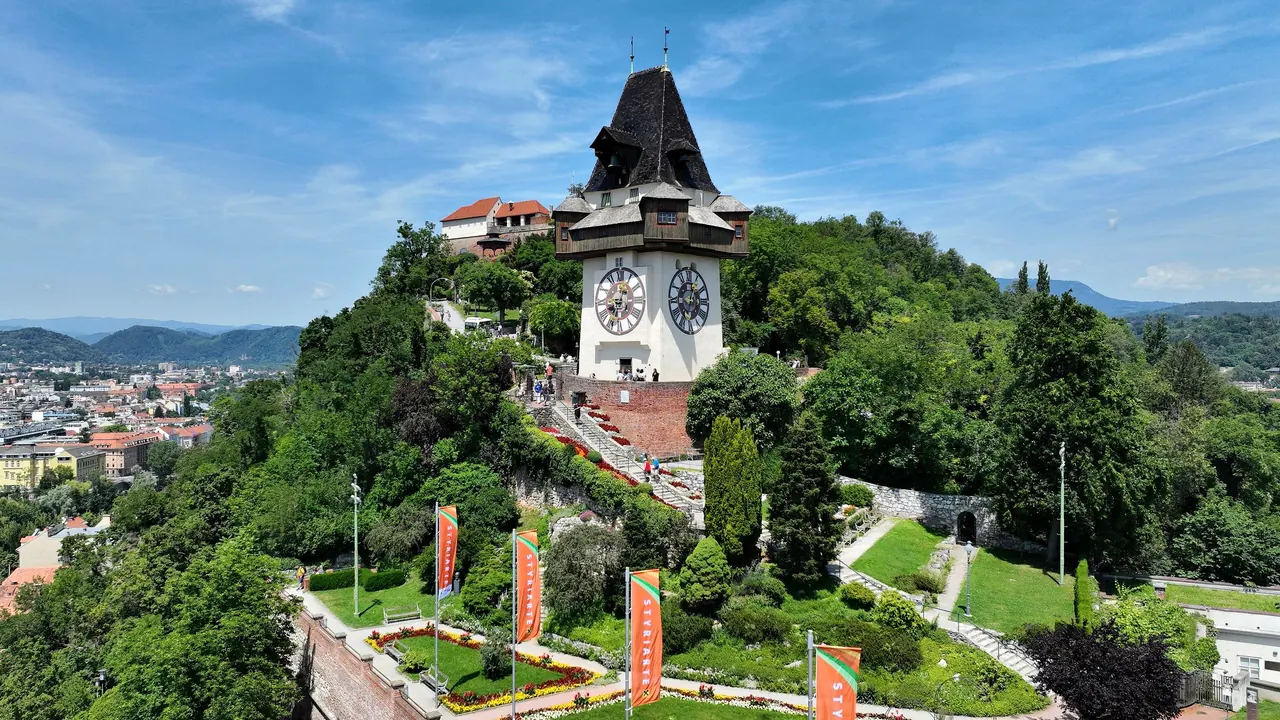
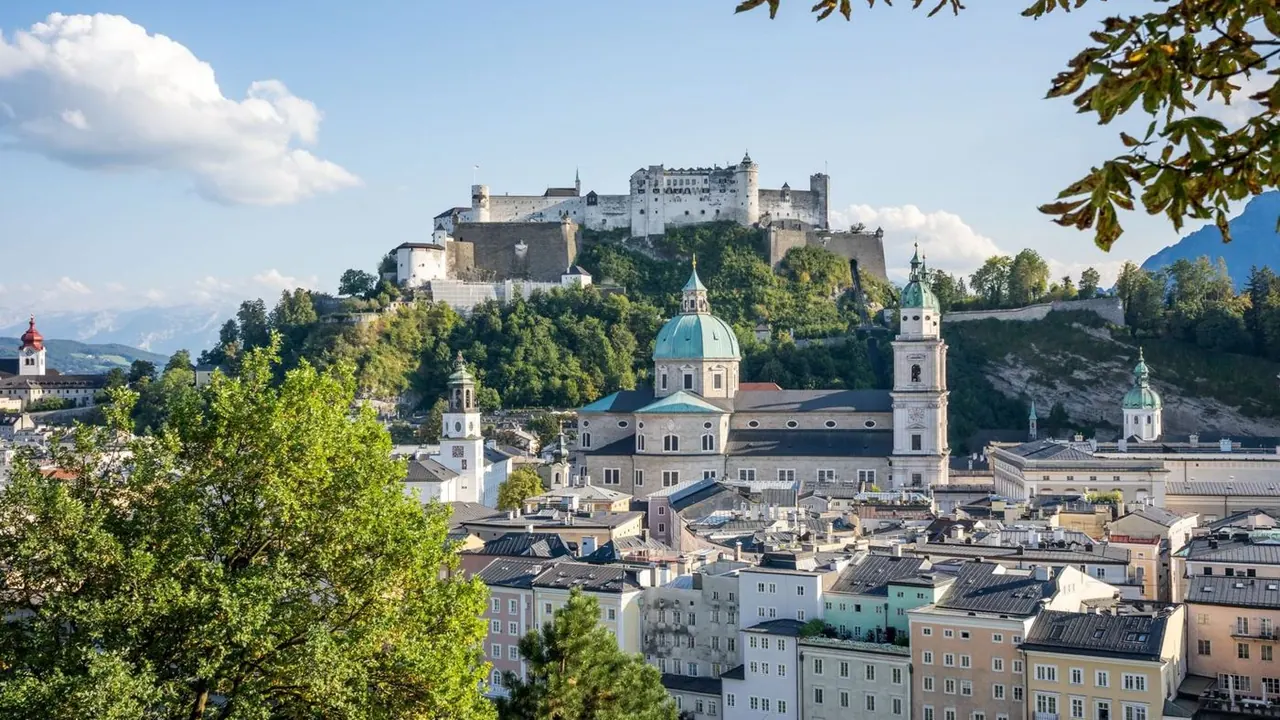
Photos: Graz by C.Stadler/Bwag, CC BY-SA 4.0, cropped; Salzburg by Leonhard Niederwimmer, Pexels License.
Graz or Salzburg?
Our verdict in twelve categories, each scored against the same fixed benchmark cities, and the climate month by month, so you can choose for your trip.
Choose Graz for
- food and drink
- nightlife
- prices
Graz suits travellers who would rather eat, drink and wander than queue. Its Styrian cooking, morning farmers' markets and wine taverns in the hills to the south are a real reason to come. A student crowd keeps the old town lanes lively after dark, and the flat centre with its trams is effortless to get around. It also costs noticeably less than Salzburg, so a longer, slower stay stretches further.
Choose Salzburg for
- beaches
- live music and the arts
- day trips
Salzburg is the stronger pick for classical music, grand Baroque set pieces and mountain scenery. The summer festival, the Mozart houses and the fortress above the domes give it a cultural weight Graz cannot match. The Alps, the Salzkammergut lakes and Berchtesgaden are all close, so it also makes the better base for scenic outings. Expect higher prices, quieter nights and plainer food.
Scoreboard
Twelve categories on one fixed scale from 0 to 100. The shaded stretch is the gap between the two.
Your match
Pick a travel style or drag the sliders, and both match scores follow your weighting.
Wins on food and drink and nightlife with your weighting.
Wins on beaches and live music and the arts with your weighting.
What matters to you?
Category by category
What the scores mean for a trip.
Beaches & swimming
Neither city has a coast, and you cannot swim in either city's river. Lake swimming is a hot-day extra in both. Salzburg's lakes are the more appealing ones: Fuschlsee, Wolfgangsee and Mondsee have clear green water among steep hills, and you get in from lawns and wooden jetties, all within about forty-five minutes.
Graz has to make do with former gravel pits on the flat land south of town, the Schwarzlsee above all. They have grassy banks and kiosks and are fine for an afternoon, but the scenery is much less striking.
Food & drink
Graz eats better. Styrian cooking has its own identity, built on dark pumpkin seed oil, cold fried chicken salad and pork boiled with horseradish. The markets on Kaiser-Josef-Platz and Lendplatz trade every morning except Sunday, and the Buschenschank wine taverns are less than an hour away.
Salzburg's best moments are coffee and cake in the old coffee houses and beer from wooden barrels at the Augustiner monastery brewery in Mülln. Most old-town restaurants serve the same schnitzel-and-dumpling menus to tour groups, so good meals mean heading to the outer districts.
Culture & sights
Salzburg has more to see. Its UNESCO-listed old town was built in one sweep by the prince-archbishops, with the cathedral, the Residenz and the arcaded squares a few minutes apart. Hohensalzburg fortress stands on the cliff above, and the Mozart houses, the St Peter catacombs and the Mirabell gardens fill out a classic itinerary.
Graz's old town is just as well kept but less famous. Its highlights are more unusual: the Landeszeughaus armoury with its thousands of suits of armour, the astronomically planned Schloss Eggenberg, and the blue Kunsthaus by the river. Each city takes two or three days.
Nightlife
Graz has more going on at night, thanks to its large student population. Bars around Mehlplatz and Färbergasse spill into the lanes on summer nights, Lend has artier places across the river, and a few clubs stay open late at weekends. It goes quiet in the long summer break, though.
In Salzburg, a night out usually means a concert, then a litre of beer at a long table in a beer hall. A few student pubs on Rudolfskai stay open later. Anyone wanting clubs takes the train to Munich.
Nature & outdoors
Salzburg is surrounded by more dramatic country. You can walk on the wooded Mönchsberg and Kapuzinerberg ridges in the middle of town, take the Untersberg cable car up to limestone ridge walks, or reach Königssee and Berchtesgaden National Park in about half an hour. Ski areas are about an hour's drive away.
Graz sits among gentler hills. The Schöckl, the city's home mountain, has a cable car and is popular with paragliders, and the Bärenschützklamm gorge climbs past waterfalls on wooden ladders. The South Styrian wine hills are lovely for autumn walks. For high Alps like the Gesäuse, you need about two hours.
Day trips
Salzburg has the better day trips. Hallstatt and its prehistoric salt mine, the Wolfgangsee villages, Bad Ischl, the salt mine at Hallein, the Werfen fortress and Berchtesgaden are all within easy reach. Munich is about an hour and a half away by train.
Graz's outings are quieter and more rural. You can go to the South Styrian Wine Road, Riegersburg castle on its volcanic crag, the Lipizzaner stud at Piber or the Admont Abbey library. Maribor in Slovenia is an hour away by train. From either city, a car makes most of these much easier.
Good for families
Both cities are small, safe and calm with children. Salzburg has the slightly broader range of attractions: the trick fountains and zoo at Hellbrunn, the hands-on Haus der Natur, and salt mines nearby with miners' slides and underground boat rides. Its cobbles and steep lanes are hard going with a pushchair, though.
Graz is easier with a buggy, thanks to its flat streets and trams. Its own highlights are inside the Schlossberg: a long underground slide down through the hill and the Märchenbahn, a little train through fairytale scenes. There is also the FRida & freD children's museum in the Augarten.
Getting around
Graz is the easier city to get around. Its centre is small, flat and largely pedestrianised, and trams run along the Herrengasse to the station and Eggenberg, all on one simple ticket. Cycling along the Mur is easy.
Salzburg's main sights are all within about fifteen minutes' walk of each other. Beyond them you rely on trolleybuses and buses, as there are no trams. It does have good train links to Munich and Vienna. In both places, the countryside is far easier to explore by car.
Shopping & style
Neither city is a shopping destination, and neither has much luxury retail. The difference is in what you take home. In Salzburg it is Tracht: dirndls and loden jackets, often made to measure, from workshops around Getreidegasse with its wrought-iron guild signs, plus the Advent market on Domplatz.
In Graz the best things to buy are edible. Pumpkin seed oil, Schilcher rosé, apple brandies and regional chocolate come from the markets and delicatessens. Lend's small design and vintage shops add some variety.
Affordability
Graz is the cheaper city. Hotels are reasonably priced for Austria, and the students keep plenty of good-value lunch menus, bakeries and casual places in business, although dinners and wine still cost the usual Austrian amounts.
Salzburg is expensive for its size. Old-town hotels and centre restaurants charge a premium all year, and costs climb further during the festival and Advent. Staying across the river and eating in the outer districts' inns helps, as does the city card for museums and transport.
Live music & performing arts
Salzburg is one of the great classical music cities. The summer festival fills the Grosses Festspielhaus and the Felsenreitschule, a riding school carved into the cliff, and Jedermann is played in front of the cathedral. Mozart Week and the Easter Festival extend the calendar, and the Marionette Theatre's Mozart operas and the Mozarteum's concerts run year-round.
Graz takes a more varied approach. It has Austria's second-largest opera house, the Styriarte early-music festival and the avant-garde steirischer herbst in autumn. Its jazz scene, fed by the music university, is something Salzburg lacks.
Wellness & relaxation
Both cities are relaxing places, and neither has thermal springs of its own, but they differ in what is close by. Salzburg has the Paracelsus Bad, a public bath with saunas in the city park, and the historic brine spa of Bad Reichenhall is twenty minutes away. The Gastein valley's Belle Époque spas are further out.
From Graz, Styria's thermal villages are about an hour east. They have large warm pools open to day visitors, including Hundertwasser's grass-roofed resort at Bad Blumau. In town, there are shady paths on the Schlossberg.
When should you go?
Pick your month. The climate figures are measured averages, not a forecast.
Graz in July
Salzburg in July
Daytime high, °C
Rainfall in the month, mm
Temperature and rainfall are climate normals, averaged over the years shown. Graz: 1991-2020 normals, Graz Airport (7.9 km from centre). Salzburg: 1991-2020 normals, Salzburg (3.4 km from centre).
The two cities have much the same seasons. Both are cold in winter, with January highs of about 3°C, and both are warm in July and August, when the lakes near each city are warm enough for a swim. Graz runs slightly warmer, reaching about 27°C in July against Salzburg's 25°C. For walking the streets, May, June and September are pleasant in both, and early October still works well.
The big difference is rain. Salzburg is the wetter city in every month. From May to August each month brings roughly 160mm, so a summer visit needs an umbrella and some indoor plans. Its winters are damp too, and snow often reaches the town. Graz has a drier, sunnier winter, with only about 20mm in January, and more sunshine all year. That makes it the more dependable choice for crisp, bright days in the colder months.
Which traveller are you?
On a culture and arts trip, choose Salzburg. The Salzburg Festival, Mozart Week and the Easter Festival bring world-class opera and concerts, and outside the festivals there are chamber concerts nearly every evening. The prince-archbishops' UNESCO-listed Baroque centre makes the setting hard to beat.
For a food and nightlife trip, Graz is the clear choice. You get Styrian dishes dressed with pumpkin seed oil, crisp local wines and daily markets. After dinner, the students fill the bars around Mehlplatz and in Lend, while Salzburg's old town has mostly gone quiet by midnight.
On an outdoors trip, Salzburg puts you closer to real mountains. The Untersberg cable car starts at the city's edge, Königssee and Berchtesgaden National Park are about half an hour away, and the Salzkammergut lakes are good for paddling and lakeside walks. From Graz, proper alpine hiking is about two hours away.
Before you go
| Measure | Graz | Salzburg |
|---|---|---|
| Official language | German, Austrian Sign Language | German, Austrian Sign Language |
| Currency | Euro (EUR) | Euro (EUR) |
| Sockets | CF230 V, 50 Hz | CF230 V, 50 Hz |
| Driving side | Right | Right |
| Time zone | UTC+1, UTC+2 in summer | UTC+1, UTC+2 in summer |
| Emergency number | 112 | 112 |
| Elevation | 353 m | 424 m |
| Main airport | Graz Airport (GRZ)9 km from centre26 non-stop destinations | Salzburg Airport (SZG)3 km from centre64 non-stop destinations |
| Public holidays this year | 16 days | 16 days |
By the numbers
| Measure | Graz | Salzburg |
|---|---|---|
| City population | 306,971 | 155,021 |
| People per km² | 2,406 | 2,360 |
| Museums within 10 km | 29 | 38 |
| UNESCO World Heritage sites within 50 km | 1 | 3 |
Where else could you go?
Every comparison below shares a destination with this one, so you can follow Graz or Salzburg somewhere new.