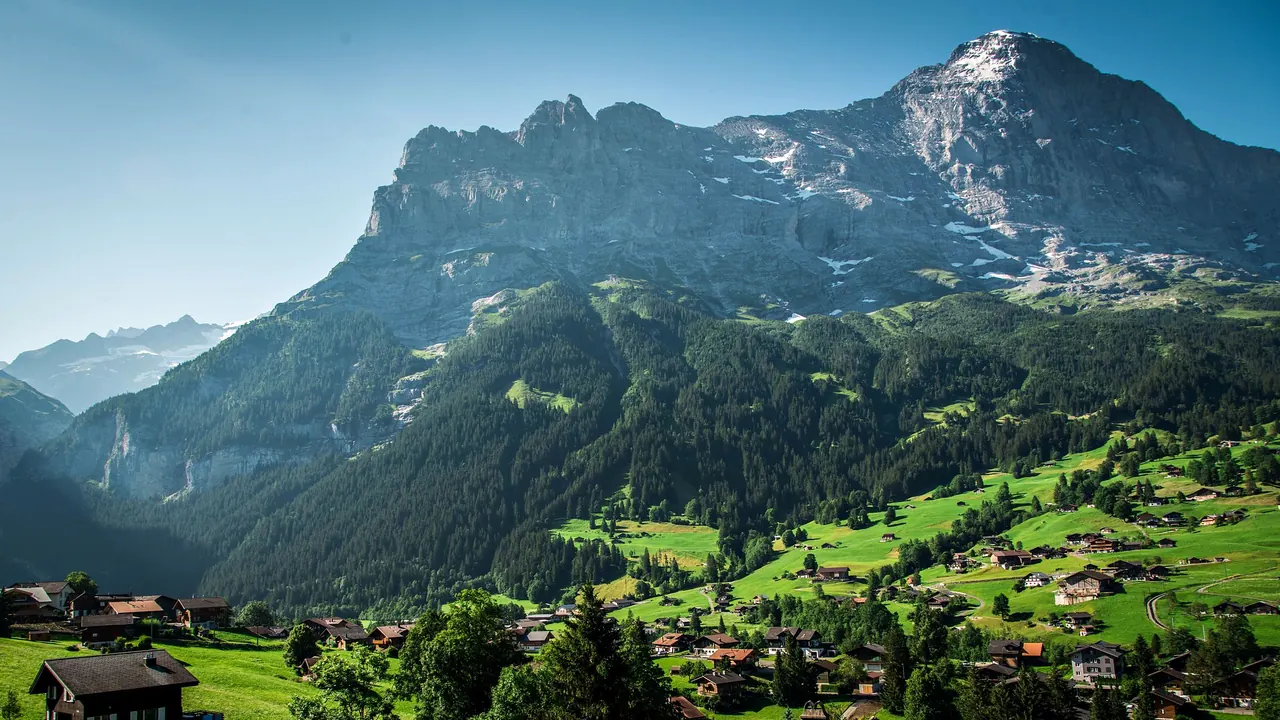
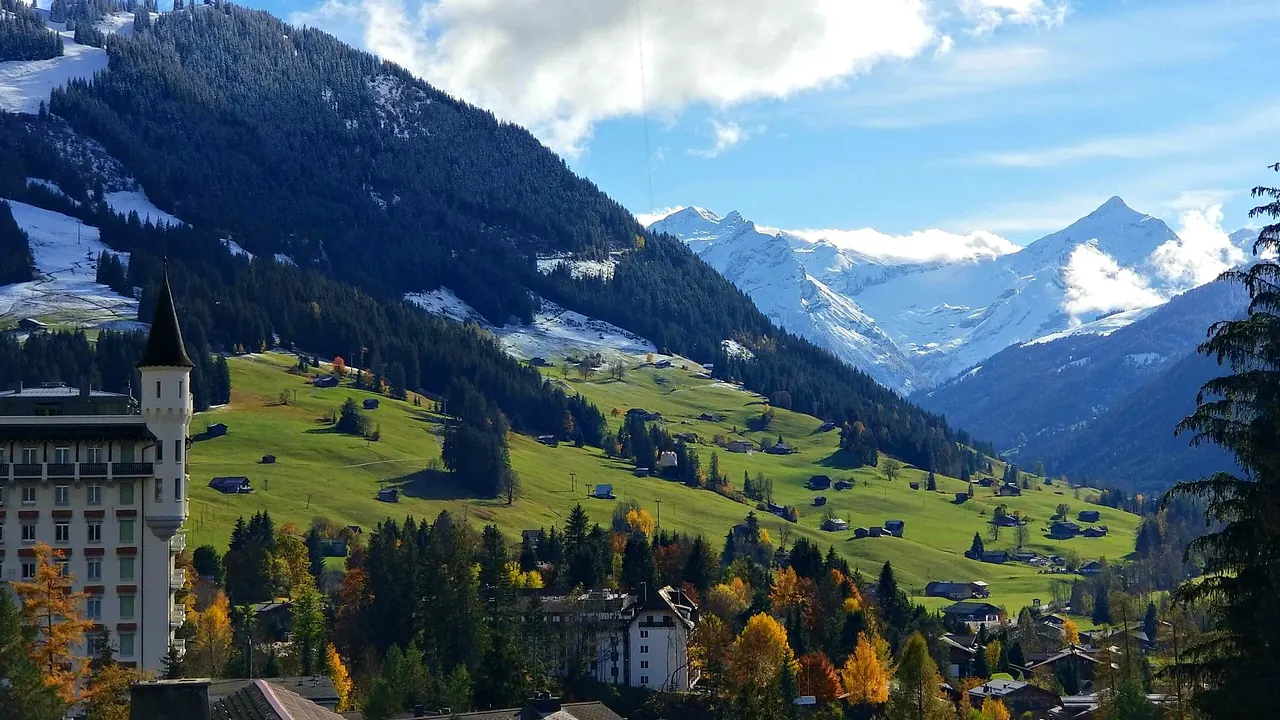
Photos: Grindelwald by Christopher Becke, Pexels License; Gstaad by Samuel Barlow, CC BY-SA 4.0, cropped.
Grindelwald or Gstaad?
Our verdict in twelve categories, each scored against the same fixed benchmark cities, and the climate month by month, so you can choose for your trip.
Choose Grindelwald for
- families
- nature and the outdoors
- getting around
Grindelwald is for people who come to be in the high mountains. The Eiger north face rises straight above the village, and trains and gondolas take you to glaciers, lakes and ridge paths without a car. Families with active children will find plenty to fill the days, and getting around the region is simple. Evenings are early and quiet, though, and there is little to eat or see beyond the scenery.
Choose Gstaad for
- live music and the arts
- shopping
- food and drink
Gstaad suits travellers who want comfort and polish with their Alpine views. The landscape is gentler and more pastoral. In return you get gourmet hotel dining, large hotel spas, a short street of luxury shops and, each summer, a major classical music festival in old village churches. It costs even more than Grindelwald, and it works best for a slow, stylish stay rather than a packed programme of excursions.
Scoreboard
Twelve categories on one fixed scale from 0 to 100. The shaded stretch is the gap between the two.
Your match
Pick a travel style or drag the sliders, and both match scores follow your weighting.
Wins on families and nature and the outdoors with your weighting.
Wins on live music and the arts and shopping with your weighting.
What matters to you?
Category by category
What the scores mean for a trip.
Beaches & swimming
Neither is a place for swimming, but the water you can reach is different. From Grindelwald, a train and bus take half an hour to an hour to the lidos on Lake Thun, which can feel genuinely pleasant in a warm July, or to the cold turquoise of Lake Brienz.
Gstaad's nearby lakes at Lauenen and Arnensee are good for a quick, cold dip from a grassy shore. Real lakeside bathing means the long trip over the pass to Montreux, so most swimming there happens in the heated valley pool or the hotel pool.
Food & drink
Gstaad eats better. Several of its grand hotels run serious gourmet kitchens, and the valley dairies sell two fine local cheeses, long-aged Saanen Hobelkäse and wood-fired L'Etivaz, which make good things to take home.
Grindelwald's food is fondue, rösti and Älplermagronen in hotel dining rooms and summit restaurants, plus a few pizza and Asian places. The best meal is usually a terrace lunch facing the Eiger. Neither village has much casual, everyday eating.
Culture & sights
Both villages are thin on sights, so any culture here comes in small doses. Grindelwald's contribution is a modest local museum telling the story of farming, early tourism and the Eiger north face climbers.
Gstaad's lies in its buildings: dark-timbered Saanenland chalets and the late-Gothic church in Saanen with its medieval wall paintings, plus the old church at Rougemont nearby. Either way, museums and historic towns mean leaving the valley.
Nightlife
Gstaad has more going on after dark, though only in season. Between Christmas and February there is après-ski in huts and hotel bars, a couple of dressy late clubs in grand-hotel cellars, and a private chalet party circuit.
Grindelwald's evenings are a handful of après-ski bars that fill as the lifts close in winter. In summer the village is full of hikers who go to bed early, and there are no clubs at all.
Nature & outdoors
Grindelwald is high-Alpine on a scale Gstaad cannot match. The Eiger, Wetterhorn and Schreckhorn rise right above the village, the Panoramaweg runs beneath the Eiger, Mönch and Jungfrau, and the rack railway climbs to the Jungfraujoch above the Aletsch Glacier. The Glacier Canyon is just below the village.
Gstaad's countryside is softer: green valleys, the Lauenensee, the Geltental waterfalls, rafting on the Saane. Its home ski slopes are gentle and fairly low, so serious altitude means the half-hour trip to Glacier 3000.
Day trips
Both make good bases for day trips, but they look towards different parts of Switzerland. From Grindelwald everything goes through Interlaken, leading to car-free Wengen and Mürren above the Lauterbrunnen valley, the castles and steamers of Lakes Thun and Brienz, the Ballenberg open-air museum, and Bern, about an hour and a half away.
Gstaad looks west to French-speaking Switzerland. The GoldenPass line runs down to Montreux, the Castle of Chillon and the Lavaux vineyard terraces, and Gruyères is within reach by car. It is the better base if you want lake and wine country rather than more mountains.
Good for families
Grindelwald gives children far more to do. First has mountain carts, scooter-bikes and a cliff walk, and there are adventure playgrounds at the mid-stations, a summer toboggan run below Pfingstegg and easy themed walks, with ski schools and long sledging runs in winter.
Gstaad is just as safe and calm, with beginner slopes, sleigh rides and farm animals along short walks. Beyond that it offers little aimed at children. In both places a wet day is hard to fill.
Getting around
Neither needs a car in season, but they work in different ways. Grindelwald's trains and gondolas run on linked timetables from the village centre, so long days across the Jungfrau region are easy. The village itself stretches up and down a steep slope, and the walk back to some hotels is a climb.
Gstaad's centre is a short, mostly car-free promenade, the easier of the two to stroll around. The resort as a whole is spread across several valleys, though, and buses become sparse in the quiet months, which is why many visitors end up using hotel shuttles or a car.
Shopping & style
Gstaad is the place for shopping. Its Promenade packs fine watchmakers, jewellers, international fashion labels and cashmere into one chalet-lined street, alongside local cheese, wood carving and the papercut art of the Pays-d'Enhaut.
Grindelwald's main street is practical: ski and hiking gear, rental counters, army knives, chocolate and cowbells. It is good for a forgotten fleece but not for a day's browsing.
Affordability
Both are among the most expensive places you could choose, and the bill grows in different ways. In Grindelwald the biggest costs are the lifts and the Jungfraujoch railway, which you will use all the time. Swiss travel passes, self-catering flats and supermarket picnics take the edge off.
In Gstaad it is the beds. The grand hotels and chalets dominate and mid-range rooms are scarce, so the usual way to save is to stay down the valley in Saanen or Zweisimmen and come outside the Christmas and February peak.
Live music & performing arts
Gstaad has a real musical identity that Grindelwald lacks. The Menuhin Festival, founded by Yehudi Menuhin, fills a festival tent and the intimate churches of Saanen, Rougemont and Lauenen with leading soloists and orchestras each summer, and a chamber-music festival follows in winter.
Grindelwald's performances are folk: yodelling choirs, alphorns and brass bands on summer evenings. They are charming if you happen to catch one, but theatre or a concert hall means a trip down the valley.
Wellness & relaxation
Gstaad does pampering better. For a village this size it has an unusual number of large grand-hotel spas with indoor and outdoor pools and sauna areas, some of which sell day passes, and the quiet village sets a slow pace of walk, lunch and sauna.
Grindelwald's wellness is more modest: a few hotel spas with windows facing the Eiger and a public pool and sauna at the sports centre. Its calm comes more from cowbells and evenings on a balcony than from pampering.
When should you go?
Pick your month. The climate figures are measured averages, not a forecast.
Grindelwald in July
Gstaad in July
Daytime high, °C
Rainfall in the month, mm
Where the figures come from
Grindelwald has no weather station within reach, so its figures come from a gridded climate model rather than a measured record, and read a broad area rather than one spot.
Gstaad's temperatures are measured 78 km from the centre, at Les Eplatures.
Gstaad has no rain gauge within 25 km of the centre, so its rainfall comes from a gridded climate dataset read at the destination rather than from a gauge further away.
Temperature and rainfall are climate normals, averaged over the years shown. Grindelwald: 1991-2020 normals, TerraClimate 4 km grid at the town, no weather station within 90 km. Gstaad: 2010-2020 (rainfall 1991-2020) normals, Les Eplatures (77.5 km from centre).
Gstaad sits lower and is the milder of the two all year. In midsummer Grindelwald peaks at about 17°C by day and Gstaad at about 21°C, so Gstaad's summer afternoons feel properly warm, while Grindelwald stays fresh and is better suited to long hikes than lazing about. Grindelwald's high trails are only clear of snow from around June, which makes July to September its real walking season. Gstaad's valley walks open up a little earlier in spring and stay pleasant later into autumn.
Both places are wet in summer, with rainfall peaking at around 119mm a month in Grindelwald in June and July and nearly as much in Gstaad, so expect cloud and showers between the clear days. In winter Grindelwald's daytime highs hover around freezing, colder than Gstaad, which helps snow at village level. Gstaad gets its heaviest rain or snow in December, at around 125mm.
Which traveller are you?
For an outdoors trip, Grindelwald is the clear choice. Lifts and trains leave the village for glacier-level hiking, via ferratas and paragliding, with long red runs in winter, while Gstaad's pastoral valleys and low home slopes are gentler and less dramatic.
On a family trip with children, Grindelwald comes out ahead, at least in summer. Its lift stations double as outdoor playgrounds for active children, whereas Gstaad offers calm and beginner slopes but little built with children in mind.
On a culture and arts trip, Grindelwald has little beyond yodelling choirs, alphorns and a small museum. Gstaad is the better bet, particularly in summer, when the Menuhin Festival brings leading soloists to Saanen's painted medieval church and other village churches.
Before you go
| Measure | Grindelwald | Gstaad |
|---|---|---|
| Official language | French, German, Italian, Romansh | French, German, Italian, Romansh |
| Currency | Swiss Franc (CHF) | Swiss Franc (CHF) |
| Sockets | CJ230 V, 50 Hz | CJ230 V, 50 Hz |
| Driving side | Right | Right |
| Time zone | UTC+1, UTC+2 in summer | UTC+1, UTC+2 in summer |
| Emergency number | 112 | 112 |
| Elevation | 1,034 m | 1,050 m |
| Main airport | Zürich Airport (ZRH)100 km from centre226 non-stop destinations | Geneva International Airport (GVA)94 km from centre150 non-stop destinations |
| Public holidays this year | 10 days | 10 days |
By the numbers
| Measure | Grindelwald | Gstaad |
|---|---|---|
| Population | 3,942 | 2,960 |
| People per km² | 23 | - |
| Museums within 10 km | 0 | 0 |
| UNESCO World Heritage sites within 50 km | 2 | 4 |
Where else could you go?
Every comparison below shares a destination with this one, so you can follow Grindelwald or Gstaad somewhere new.
- Wengenvs Grindelwald
- Mürrenvs Grindelwald
- Interlakenvs Grindelwald
- Adelbodenvs Gstaad
- Crans-Montanavs Gstaad
- Leukerbadvs Gstaad