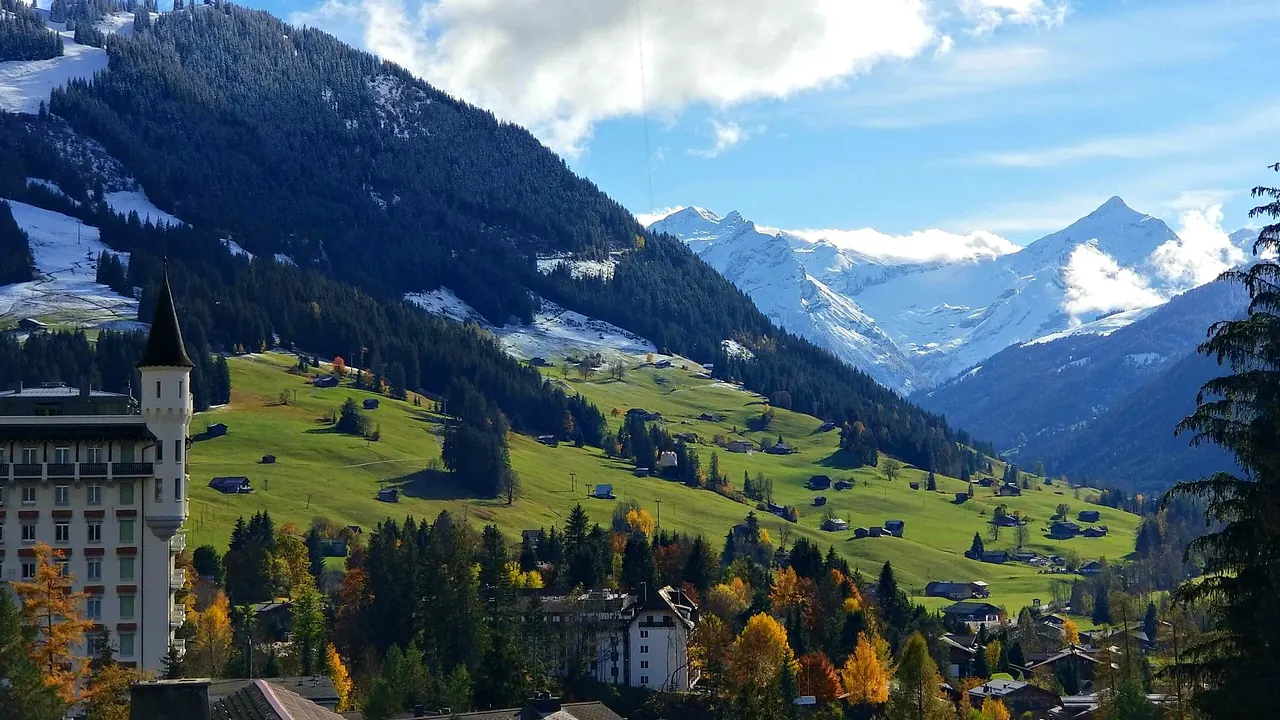
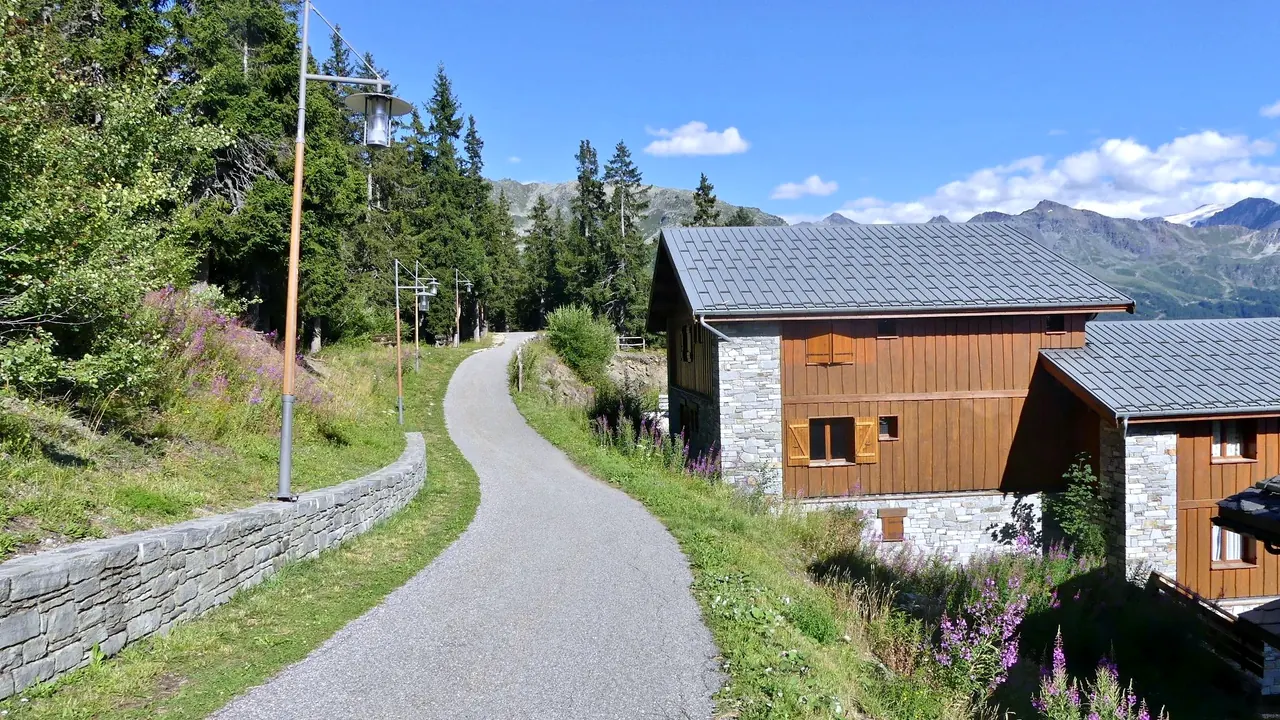
Photos: Gstaad by Samuel Barlow, CC BY-SA 4.0, cropped; La Rosière by Florian Pépellin, CC BY-SA 4.0, cropped.
Gstaad or La Rosière?
Our verdict in twelve categories, each scored against the same fixed benchmark cities, and the climate month by month, so you can choose for your trip.
Choose Gstaad for
- shopping
- live music and the arts
- getting around
Gstaad suits travellers who want an Alpine stay with polish: grand-hotel spas, gourmet dining rooms, the luxury chalets of the Promenade and, in summer, the Menuhin Festival in the village churches. It is also the easier base for outings, because the GoldenPass line runs down to Montreux and Lake Geneva and the other way towards Bern, so a week can mix mountain days with towns.
Choose La Rosière for
- prices
- families
- nature and the outdoors
For a family ski week or a summer of high walking on a sensible budget, La Rosière is the better choice. Its sunny slopes, central ski schools and ski-in, ski-out chalets keep days simple with children, and the link to La Thuile adds Italian runs. Self-catering keeps costs well below those of the glamorous resorts. Expect quiet evenings and very little beyond the mountains.
Scoreboard
Twelve categories on one fixed scale from 0 to 100. The shaded stretch is the gap between the two.
Your match
Pick a travel style or drag the sliders, and both match scores follow your weighting.
Wins on shopping and live music and the arts with your weighting.
Wins on prices and families with your weighting.
What matters to you?
Category by category
What the scores mean for a trip.
Beaches & swimming
Neither is a place to swim, but Gstaad gives you a little more. There are grassy shores for a quick cold dip at Lauenen and Arnensee, a heated outdoor pool in the valley, and Lake Geneva at Montreux as a long day out.
In La Rosière, swimming means a hotel or chalet pool, or a chilly Alpine lake lower down the valley. In both places, plan on a pool.
Food & drink
Gstaad eats better and more widely. The grand hotels have serious gourmet kitchens, the huts on the slopes serve rösti and raclette, and you can buy the valley's own Hobelkäse and nearby L'Etivaz straight from small dairies. There is little casual eating, though, and many kitchens close in the shoulder seasons.
La Rosière sticks to Savoyard cooking: tartiflette, fondue and Beaufort. It is satisfying after skiing, but the menus start to repeat after a few nights. For variety, ski across the border for lunch on the Italian side, where you get proper pasta and espresso.
Culture & sights
Neither has enough sights for a sightseeing programme, so the difference is in kind. Gstaad's heritage is its carved and painted Saanenland chalets and the late-Gothic church at Saanen with its medieval wall paintings, all things you pass on a walk. La Rosière is a modern ski station with little history, so its sights lie outside the resort: baroque churches in the Tarentaise villages and, in summer, the Iron Age stone circle on the Little St Bernard Pass.
Nightlife
Gstaad has more of a night scene, but only in winter. Between Christmas and February there is après-ski in huts and hotel bars and a couple of dressy late clubs in grand-hotel cellars, and much of the social life happens at private chalet parties. In summer, evenings end by the fire.
La Rosière is quieter still. A few bars fill up as the lifts close, and most guests are back in their chalets after dinner. The resort is built around families, and anyone after big après-ski will be happier in the livelier Tarentaise resorts.
Nature & outdoors
Both are first-rate mountain bases, and the difference lies in the terrain. Gstaad's linked Saanenland ski areas are gentle and fairly low, with Glacier 3000 nearby for high snow. Its pastoral summer of lake walks, Geltental waterfalls and rafting on the Saane may be its better season.
La Rosière sits higher, on a sunny balcony facing the Vanoise glaciers. Its ski area crosses into Italy at La Thuile, with off-piste and heli-skiing on the Italian side, so keen skiers get the bigger winter terrain here. In summer there is high-pasture hiking among ibex and marmots, with Mont Blanc just over the border.
Day trips
Gstaad is much better placed for outings because the railway does the work. The GoldenPass line reaches Montreux, Chillon Castle and the Lavaux terraces, Gruyères is under an hour away by car, and Thun and Bern lie in the other direction. Each trip still takes up most of a day.
La Rosière's one strong outing depends on the season: in summer you can cross the Little St Bernard Pass to Roman Aosta and Courmayeur. In winter the pass closes and Annecy and Chambéry are around two hours away by car, so days off the slopes usually mean visiting other ski resorts.
Good for families
La Rosière is the more natural family choice, because it is designed around families. Its sunny nursery slopes and children's ski schools are in the centre, much of the accommodation is ski-in, ski-out, and the village is small enough for older children to roam. Dog-sled outings and snow play areas fill the afternoons.
Gstaad works well for a calm stay with children, with gentle beginner slopes, sleigh rides and summer walks past cows and goats, but it does less to cater for them. On a wet day, neither has much to offer beyond a pool.
Getting around
Gstaad is on a railway line. GoldenPass trains stop in Saanen, Schönried and Saanenmöser near the lifts, PostBuses run up the side valleys to Lauenen and Glacier 3000, and the centre is a short car-free promenade. Services thin out in the quiet months, though, and many visitors still rely on hotel shuttles.
La Rosière is easy once you arrive, with lifts and a free shuttle linking its hillside quarters. The nearest station, however, is at Bourg-Saint-Maurice, half an hour down a winding road. For anything beyond the slopes, a car makes life much simpler.
Shopping & style
Gstaad's Promenade is a real shopping street, if a rarefied one: watchmakers, jewellers, fashion labels and cashmere in chalet shopfronts, plus local cheese, carved wood and Pays-d'Enhaut papercuts. There is nothing for a modest budget.
La Rosière has ski hire, outdoor gear and small supermarkets, with a couple of shops selling cheese and charcuterie. For anything more, you go down to Bourg-Saint-Maurice.
Affordability
La Rosière is far easier on the wallet. A winter week is still expensive, but self-catering apartments and chalets keep it well below the cost of the glamorous resorts nearby, and summer, priced for walkers, is much cheaper.
Gstaad charges the very top of Swiss prices for rooms, meals, lift passes and transport, and mid-range rooms are scarce. To soften the bill, stay down the valley in Saanen or Zweisimmen, or come outside the Christmas and February peak.
Live music & performing arts
Gstaad has a real musical calendar. The Menuhin Festival, founded by Yehudi Menuhin, brings leading soloists and orchestras to a festival tent and the village churches each summer, and winter adds chamber music and New Year concerts. Between those seasons there is little.
La Rosière has no concert or theatre life, only occasional live music in bars and seasonal resort events.
Wellness & relaxation
Gstaad is the place for spa days. For a village its size it has an unusual number of large grand-hotel spas, with indoor and outdoor pools, sauna landscapes and mountain views, and some sell day passes. The quiet village sets an unhurried pace.
La Rosière's pools and saunas are smaller, in hotels and apartment residences, and welcome after skiing. Its strength is an outing: in summer, the historic thermal baths of Pré-Saint-Didier lie just over the pass below La Thuile, offering the kind of bathing tradition Gstaad lacks.
When should you go?
Pick your month. The climate figures are measured averages, not a forecast.
Gstaad in July
La Rosière in July
Daytime high, °C
Rainfall in the month, mm
Where the figures come from
Gstaad's temperatures are measured 78 km from the centre, at Les Eplatures.
Gstaad has no rain gauge within 25 km of the centre, so its rainfall comes from a gridded climate dataset read at the destination rather than from a gauge further away.
La Rosière has no weather station within reach, so its figures come from a gridded climate model rather than a measured record, and read a broad area rather than one spot.
Temperature and rainfall are climate normals, averaged over the years shown. Gstaad: 2010-2020 (rainfall 1991-2020) normals, Les Eplatures (77.5 km from centre). La Rosière: 2001-2020 normals, NASA POWER reanalysis grid, no weather station within 90 km.
Both are mountain places, but Gstaad lies about 800m lower and is the milder of the two. Summer highs reach 21°C in July and August, warm enough for long walks and a brief, cold dip at Lauenensee, and June and September are pleasant too. It is wet all year, though. Summer is as rainy as winter and December is wettest, so pack for showers in any month. Winter highs sit only a few degrees above freezing, which is why early snow on its lower slopes can be thin.
La Rosière is colder all year. Daytime highs stay below freezing from December to February and fall to -4°C in January, which keeps the snow in good condition at altitude. Summer peaks at around 18°C in July, cooler weather for hiking, and it is drier than Gstaad in most months. Outside the ski season it is at its best in July and August, when the pass into Italy is open.
Which traveller are you?
For a shopping trip, Gstaad is the only real choice. You can come home with a Swiss watch or a cashmere coat chosen in a chalet shopfront, or a slab of long-aged Hobelkäse from a valley dairy. La Rosière's best souvenir is a wedge of Beaufort.
On a trip on a tight budget, Gstaad is hard to make work even with careful planning. La Rosière is the realistic pick. Book an apartment, cook most evenings and avoid school vacation weeks, or come in summer, when walkers pay far less than skiers.
On a family trip with children, Gstaad suits a gentle mixed stay of sleigh rides and summer farm walks, but its low home slopes can run thin early in winter. For a school vacation ski week, La Rosière is the safer bet, because its higher, colder slopes hold snow more reliably.
Before you go
| Measure | Gstaad | La Rosière |
|---|---|---|
| Official language | French, German, Italian, Romansh | French |
| Currency | Swiss Franc (CHF) | Euro (EUR) |
| Sockets | CJ230 V, 50 Hz | CE230 V, 50 Hz |
| Driving side | Right | Right |
| Time zone | UTC+1, UTC+2 in summer | UTC+1, UTC+2 in summer |
| Emergency number | 112 | 112 |
| Elevation | 1,050 m | 1,844 m |
| Main airport | Geneva International Airport (GVA)94 km from centre150 non-stop destinations | Geneva International Airport (GVA)89 km from centre150 non-stop destinations |
| Public holidays this year | 10 days | 11 days |
By the numbers
| Measure | Gstaad | La Rosière |
|---|---|---|
| Population | 2,960 | - |
| Museums within 10 km | 0 | 0 |
| UNESCO World Heritage sites within 50 km | 4 | 0 |
Where else could you go?
Every comparison below shares a destination with this one, so you can follow Gstaad or La Rosière somewhere new.
- Les Arcsvs La Rosière
- Tignesvs La Rosière
- La Plagnevs La Rosière
- Adelbodenvs Gstaad
- Val d'Isèrevs La Rosière
- Crans-Montanavs Gstaad