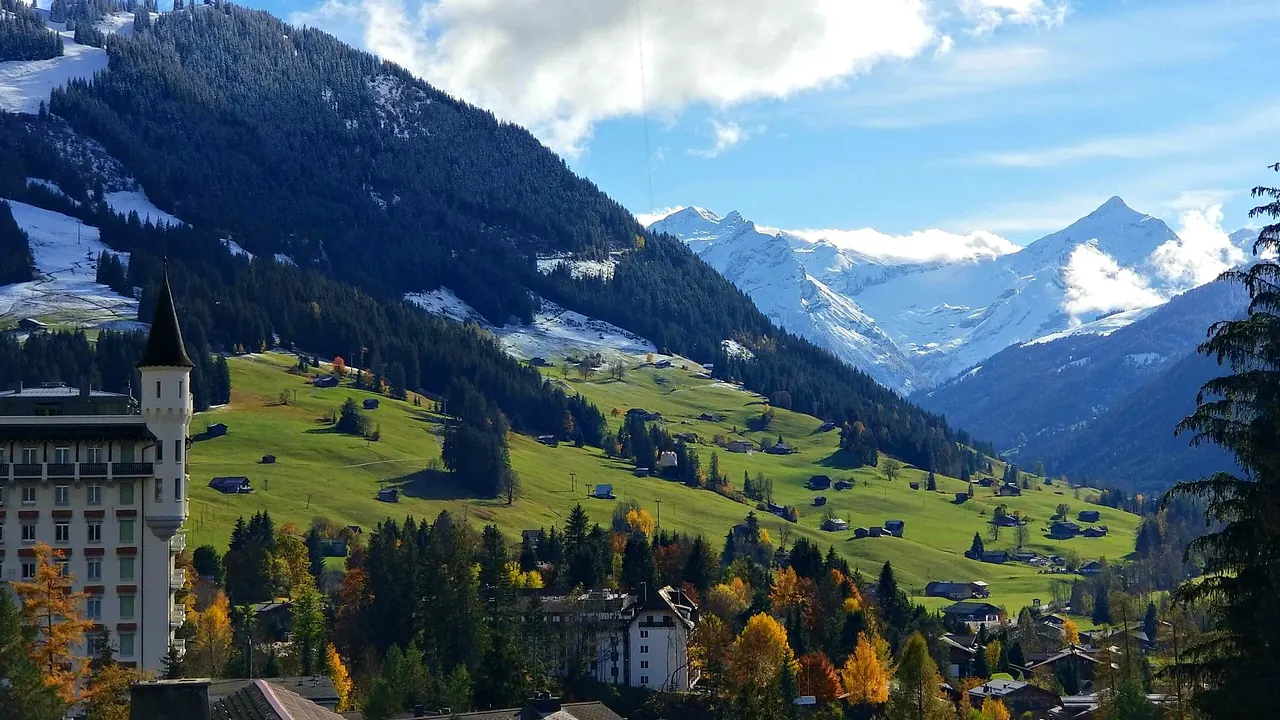
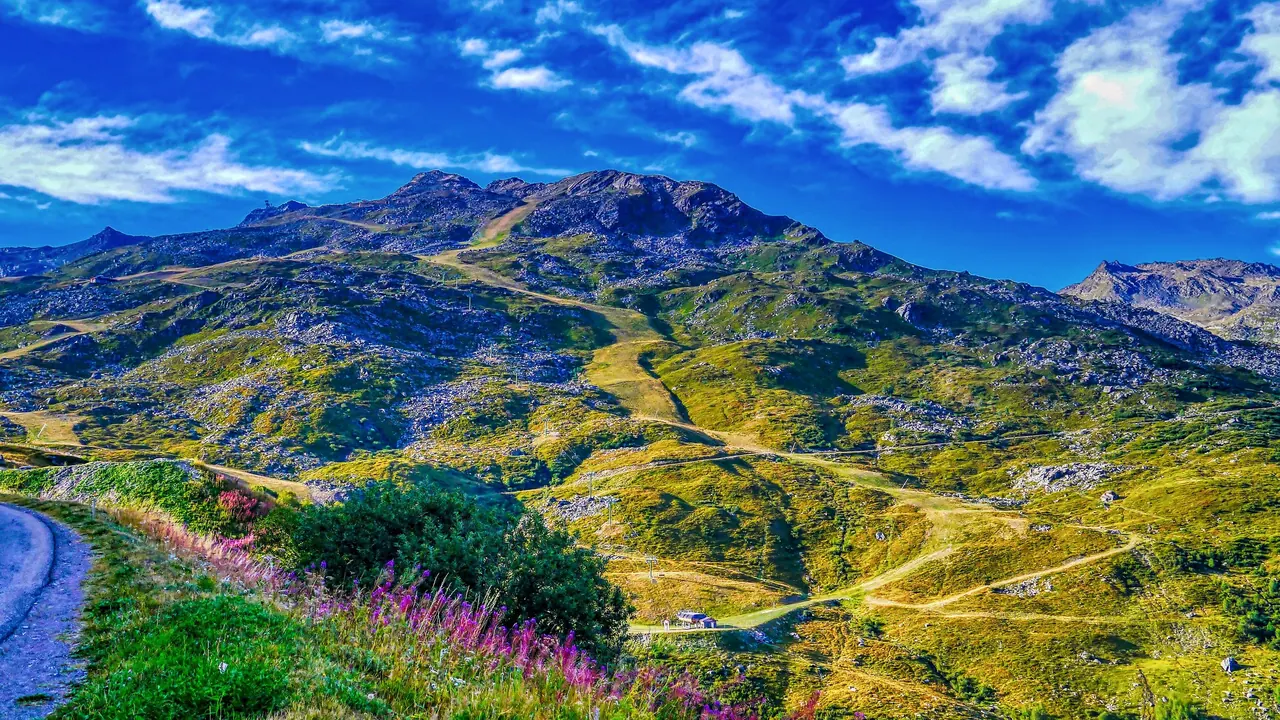
Photos: Gstaad by Samuel Barlow, CC BY-SA 4.0, cropped; Val Thorens by Zairon, CC BY-SA 4.0, cropped.
Gstaad or Val Thorens?
Our verdict in twelve categories, each scored against the same fixed benchmark cities, and the climate month by month, so you can choose for your trip.
Choose Gstaad for
- day trips
- live music and the arts
- shopping
Gstaad is the choice for an unhurried Alpine stay where the mountain is only part of the point. Summer walks over green pastures, a concert in a village church during the Menuhin Festival, a long hotel spa afternoon and a train ride down to Lake Geneva all fit naturally into a week here. It suits couples and families who want calm, polish and a pretty valley, and who can absorb some of the steepest prices in the Alps.
Choose Val Thorens for
- nightlife
- prices
- nature and the outdoors
Serious skiers, and groups of friends who want their evenings as busy as their days, will be happier in Val Thorens. Its height gives reliable snow for most of the winter, the lifts open onto the whole Three Valleys, and après-ski carries on well past dark. Away from the slopes there is little to see or do, so this is a resort for a ski week, not for touring.
Scoreboard
Twelve categories on one fixed scale from 0 to 100. The shaded stretch is the gap between the two.
Your match
Pick a travel style or drag the sliders, and both match scores follow your weighting.
Wins on day trips and live music and the arts with your weighting.
Wins on nightlife and prices with your weighting.
What matters to you?
Category by category
What the scores mean for a trip.
Beaches & swimming
Neither resort is a place to swim, but Gstaad at least gives you a cold summer dip. Lauenensee and Arnensee have grassy banks for a quick plunge on a hot afternoon, and there is a heated outdoor pool in the valley.
Val Thorens lies above the treeline, where the glacier-fed lakes are too cold to enter even in August, so swimming means the pool at the sports centre or your hotel.
Food & drink
Both eat well on a narrow menu built around cheese, with a few serious gourmet kitchens in the upmarket hotels. The difference is the tradition. Gstaad is Swiss, with fondue, rösti and the shaved curls of aged Saanen Hobelkäse, and valley dairies sell L'Etivaz to take home.
Val Thorens is Savoyard: tartiflette, diots sausages and Beaufort, often eaten on a sunny slope-side terrace mid ski day. More visitors there cook in their apartments, and the everyday options lean on pizza and burgers.
Culture & sights
Gstaad has no museums, but it does have a sense of place. The dark-timbered Saanenland chalets with painted fronts, the late-Gothic church of St Mauritius in Saanen and the old church at Rougemont make pleasant stops on a walk. Val Thorens was put up as a ski station in the 1970s on a bare slope and has nothing historic at all; for Savoyard heritage you have to drive down to the valley.
Nightlife
Val Thorens is the livelier choice by a wide margin. Après-ski starts on the mountain terraces as the lifts close, moves into the village pubs and ends in clubs that run into the early hours, with a young crowd of students and friends. It is still one small village, so a week can feel repetitive.
Gstaad's evenings are quieter and smarter: hotel bars, a couple of exclusive cellar clubs and private chalet parties around Christmas and February. In both places, nights after the winter season shrink to dinner and a drink.
Nature & outdoors
Both are outstanding mountain bases, but for different trips. Val Thorens is built for skiing: at about 2,300m it is the highest resort in Europe, with snow from late November into May and the whole Three Valleys linked by lift. Its summer is short and stark, all rock, glaciers and the edge of the Vanoise.
Gstaad's home slopes are lower and gentler, with Glacier 3000 nearby for reliable snow, and it comes into its own in summer. Green valleys, Lauenensee, the Geltental waterfalls, rafting on the Saane and paragliding make it the better place to walk among pastures rather than ski hard.
Day trips
Gstaad sits on the GoldenPass line, which makes it a far better base for excursions. Montreux, the Castle of Chillon and the Lavaux vineyard terraces are a scenic train ride away, Gruyères is under an hour by car, and Bern's arcaded old town can be reached by rail.
From Val Thorens, most "outings" are ski runs over to Méribel and Courchevel. Annecy and Chambéry are rewarding, but they mean a long drive down hairpin bends and back.
Good for families
For families the two are broadly level, and the choice turns on the children's ages and how much skiing matters. Gstaad is lower and calmer, with gentle home slopes and ski schools for beginners, sledging and horse-drawn sleigh rides in winter, and summer walks to lakes and pastures where cows and goats graze. Its weak spot is a wet day, because there is no zoo, aquarium or indoor attraction to fall back on.
Val Thorens is the more practical base for a ski week. The streets are largely car-free, most beds are close to the slopes, the children's clubs are well run and the sports centre pool fills a day off the snow. The cost is the altitude: cold, wind, lifts closed by bad weather and poor sleep for small children, plus a young party crowd that sets the tone.
Getting around
Gstaad is the easier of the two to reach and to explore. Trains on the GoldenPass line stop in the village and its neighbours, and PostBuses climb the side valleys, though the spread-out resort still pushes many visitors towards a car or hotel shuttle.
Val Thorens is simple once you arrive, with free shuttles and doors that open onto the slopes, but getting there means an hour of hairpins by bus or taxi from Moûtiers, and there is little transport beyond the resort.
Shopping & style
Gstaad's single Promenade carries an unusual cluster of luxury watchmakers, jewellers, fashion labels and cashmere for a village, plus carved wood and the papercut art of the Pays-d'Enhaut. Val Thorens offers ski hire, technical gear, delis and supermarkets, and nothing to browse for its own sake.
Affordability
Both are expensive, but Val Thorens is the more manageable. Sharing a self-catering apartment and cooking in brings a ski week within reach for groups, and the resort is less exclusive than Courchevel next door.
Gstaad sits at the very top of Swiss prices, with grand hotels and chalets dominating and mid-range rooms scarce. The usual workaround is to stay in Saanen or Zweisimmen, or to come in summer rather than at Christmas.
Live music & performing arts
Here Gstaad has something real. The summer Menuhin Festival fills a large tent and the intimate churches of Saanen, Rougemont and Lauenen with top orchestras and soloists, and winter adds chamber music and New Year concerts; outside those seasons it is quiet.
Val Thorens has no stage at all, only cover bands and DJs in the après-ski bars.
Wellness & relaxation
Gstaad is the better place to slow down. Its grand hotels have large, lavish spas with mountain views, and the still evenings and short walks set a gentle pace, though the offer is aimed mainly at hotel guests.
In Val Thorens, saunas and pools are for loosening up after skiing, and the après-ski crowd keeps the resort far from restful. For a true spa tradition you would drive an hour down to the thermal town of Brides-les-Bains.
When should you go?
Pick your month. The climate figures are measured averages, not a forecast.
Gstaad in July
Val Thorens in July
Daytime high, °C
Rainfall in the month, mm
Where the figures come from
Gstaad's temperatures are measured 78 km from the centre, at Les Eplatures.
Gstaad has no rain gauge within 25 km of the centre, so its rainfall comes from a gridded climate dataset read at the destination rather than from a gauge further away.
Val Thorens has no weather station within reach, so its figures come from a gridded climate model rather than a measured record, and read a broad area rather than one spot.
Temperature and rainfall are climate normals, averaged over the years shown. Gstaad: 2010-2020 (rainfall 1991-2020) normals, Les Eplatures (77.5 km from centre). Val Thorens: 1991-2020 normals, TerraClimate 4 km grid at the town, no weather station within 90 km.
Gstaad is a two-season place. Winter is cold, with January highs around 3°C, and summer is mild, peaking at about 21°C in July and August, warm enough for long walks and a brief dip in a mountain lake. Rain is spread fairly evenly through the year, with no truly dry month, so a wet afternoon is possible in any season. Late spring and autumn are cool and quiet in between.
Val Thorens, far higher, is colder in every month. Winter highs sit below freezing, around -3°C in January and February, which keeps the snow in good condition from late in the year well into spring. Even August reaches only about 16°C, so summer here means a short, fresh hiking window rather than warm days. Late autumn is the wettest stretch, with about 180mm in November, most of it falling as snow at that altitude.
Which traveller are you?
On a culture and arts trip, Gstaad is the clear pick. The Menuhin Festival brings leading orchestras and soloists to the valley's old churches each summer, and the carved chalets and medieval wall paintings at Saanen give walks some substance. Val Thorens offers neither.
For a food and nightlife trip, Val Thorens has much more energy after dark. The cheese-heavy menus are on a par in both resorts, but table-dancing on the terraces at last lift, packed village bars and late clubs suit a young crowd far better than Gstaad's dressy hotel cellars.
On a tight budget, Val Thorens is the more realistic of two costly resorts. Groups sharing a self-catering apartment and cooking for themselves can cut the bill considerably, whereas Gstaad's grand hotels and chalets push most visitors to sleep down the valley instead.
Before you go
| Measure | Gstaad | Val Thorens |
|---|---|---|
| Official language | French, German, Italian, Romansh | French |
| Currency | Swiss Franc (CHF) | Euro (EUR) |
| Sockets | CJ230 V, 50 Hz | CE230 V, 50 Hz |
| Driving side | Right | Right |
| Time zone | UTC+1, UTC+2 in summer | UTC+1, UTC+2 in summer |
| Emergency number | 112 | 112 |
| Elevation | 1,050 m | 1,710 m |
| Main airport | Geneva International Airport (GVA)94 km from centre150 non-stop destinations | Geneva International Airport (GVA)111 km from centre150 non-stop destinations |
| Public holidays this year | 10 days | 11 days |
By the numbers
| Measure | Gstaad | Val Thorens |
|---|---|---|
| Population | 2,960 | - |
| Museums within 10 km | 0 | 0 |
| UNESCO World Heritage sites within 50 km | 4 | 1 |
Where else could you go?
Every comparison below shares a destination with this one, so you can follow Gstaad or Val Thorens somewhere new.
- Les Menuiresvs Val Thorens
- Méribelvs Val Thorens
- Courchevelvs Val Thorens
- Adelbodenvs Gstaad
- Crans-Montanavs Gstaad
- La Plagnevs Val Thorens