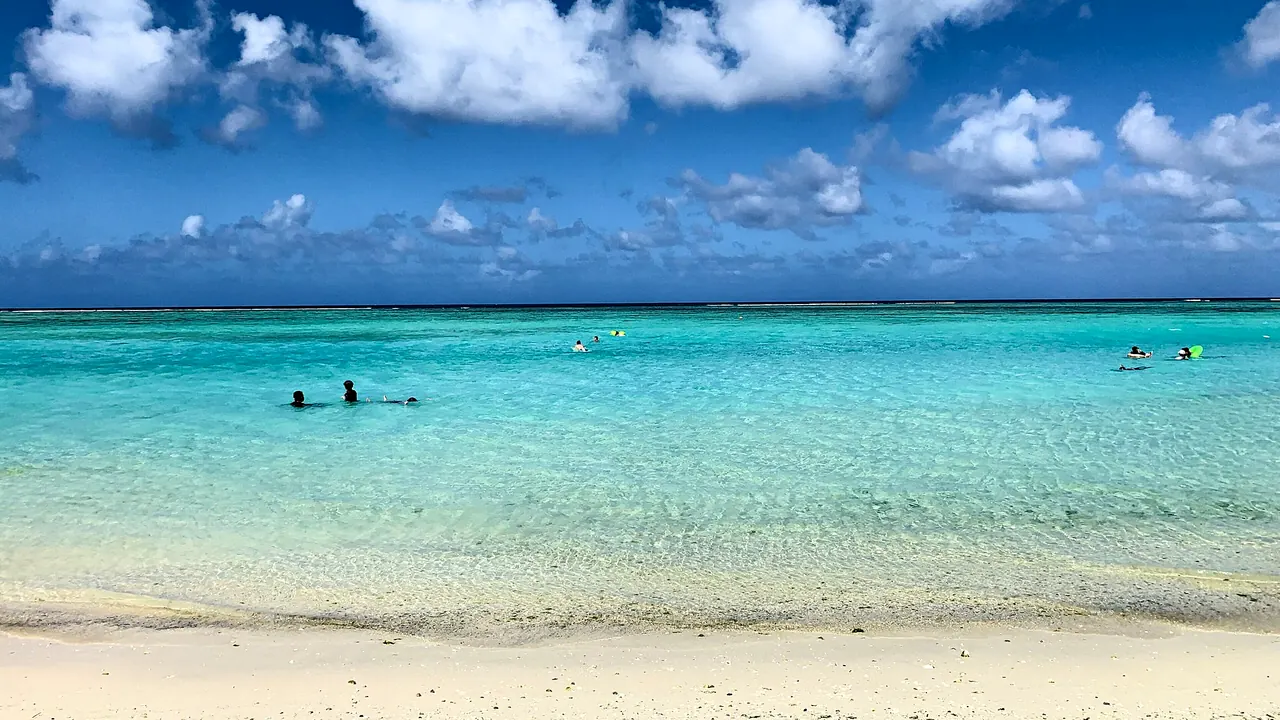
Photos: Guam by Daniel Ramirez from Honolulu, USA, CC BY 2.0, cropped.
Guam or Okinawa?
Our verdict in twelve categories, each scored against the same fixed benchmark cities, and the climate month by month, so you can choose for your trip.
Choose Guam for
- getting around
- shopping
Guam is the easier, simpler trip. Everything a short beach stay needs sits along Tumon Bay: a calm reef lagoon, resort pools, duty-free shopping and restaurants, all within walking distance or a hotel shuttle. The sea stays warm through every month, so it works as winter sun when Okinawa's water has turned cool. Choose it for a few days of swimming, shopping and rest with little planning, and accept that the food, culture and evenings are thin once you leave the beach.
Choose Okinawa for
- day trips
- live music and the arts
- nature and the outdoors
Okinawa gives a richer trip in almost every other respect. It has its own Ryukyu heritage and cuisine, folk music in Naha's izakaya most nights, and some of the best diving and snorkelling in Asia around the Kerama Islands and Ishigaki. It also costs less day to day. The trade-off is effort: the finest beaches are on outer islands reached by ferry or flight, the main island needs a car, and the swimming season runs only from late spring to autumn.
Scoreboard
Twelve categories on one fixed scale from 0 to 100. The shaded stretch is the gap between the two.
Your match
Pick a travel style or drag the sliders, and both match scores follow your weighting.
Wins on getting around and shopping with your weighting.
Wins on day trips and live music and the arts with your weighting.
What matters to you?
Category by category
What the scores mean for a trip.
Beaches & swimming
Both are serious beach destinations, with Okinawa slightly ahead at its best. Guam puts nearly everything into Tumon Bay, a single curve of coral sand where the reef keeps the water flat and shallow, with Gun Beach for snorkelling and quieter local spots around Agat and Cocos Island. Its advantage is that the sea stays warm every month.
Okinawa's finest sand is spread across the outer islands: the pale blue bays of Tokashiki and Zamami in the Keramas and the long white beaches of Miyako. The main island's strands near Naha and Chatan are mostly built resort beaches, so getting the best means a ferry or a flight, and swimming is limited to roughly May to October.
Food & drink
Okinawa is the much better place to eat. Its cooking of pork, bitter melon and tofu, rafute and Okinawa soba is easy to find everywhere, and Naha's Makishi Public Market, where cooks upstairs prepare the fish you buy below, and the small izakaya in the lanes around it make eating a highlight of the trip, with awamori to drink.
Guam's Chamorro food, red rice, kelaguen and fiesta barbecue, is just as distinctive but harder to reach. Around Tumon the meals are mostly ramen, Korean barbecue, hotel buffets and American chains, so a visitor has to seek out the Chamorro Village night market and roadside barbecue stands.
Culture & sights
Okinawa has more to see. The Ryukyu Kingdom left Shuri and its royal tombs and garden above Naha, plus a string of curving stone gusuku castles across the main island at Nakijin, Katsuren and Nakagusuku, and the sacred grove of Sefa-utaki. It gives a few rewarding days of a heritage quite unlike mainland Japan.
Guam's past is in smaller pieces: latte stones and the Spanish plaza and cathedral in Hagåtña, and Fort Soledad above Umatac bay. Both islands carry heavy memories of 1944 and 1945, and the war sites are the most moving part of each, at Asan and Agat on Guam and at Mabuni and the underground naval headquarters on Okinawa.
Nightlife
Neither is a place for big nights out, but Okinawa has more going on. Naha's Kokusai-dori and its side lanes fill with izakaya where a sanshin player often performs and conversation with strangers comes easily, and Matsuyama and the Sakaemachi market alleys keep going later, with American Village at Chatan for a more Western weekend crowd.
Guam's evenings run along one road in Tumon, Pale San Vitores, with hotel lounges, sports bars, karaoke and a couple of clubs. It is much the same every night, and most visitors settle for a sunset drink by the bay.
Nature & outdoors
Okinawa is far ahead, above all underwater. The Kerama marine park has coral gardens and turtles close to Naha, mantas gather off Ishigaki, Miyako has caverns for divers and humpback whales calve around the Keramas in winter. On land there is the Yanbaru forest with its rare birds and the mangroves and rivers of Iriomote.
Guam has good diving of its own, notably the Blue Hole and the two wartime wrecks lying together in Apra Harbor. Its land offers Two Lovers Point, the Ritidian refuge and short walks to southern waterfalls, but the forests are quiet since introduced snakes killed most native birds.
Day trips
Okinawa offers a real choice of outings, even if most lead to another island. Taketomi, a short ferry ride from Ishigaki, keeps its red-tiled village and coral-stone walls intact, Kudaka is a sacred island off the main island's southeast coast, and Bise's lanes under fukugi trees make a gentle stop on the Motobu peninsula.
Guam has little beyond the drive round Umatac, Merizo and Inarajan in the south. Rota and Saipan are close by air, but they need an overnight stay rather than a day.
Good for families
Both suit young families, and Okinawa has more to keep children busy. The Churaumi Aquarium with its whale sharks, the playgrounds of Ocean Expo Park, Okinawa World's cave and Neo Park in Nago fill the days between netted, shallow beaches.
Guam's strength is ease: one calm lagoon with hotel pools, kids' clubs, shops and food all along the same stretch, and the Fish Eye observatory at Piti for reef fish. With no zoo, theme park or big aquarium, though, a longer stay comes down to water and sand, while Okinawa's sights usually mean an hour or two in the car.
Getting around
Guam is the simpler island to cover. It is only about 50km long, nothing is much more than an hour's drive, roads are quiet outside the Tumon rush hours, and hotel shuttles link the resort strip with the shops and Hagåtña. Buses beyond that are sparse, so a hire car is still needed to see the rest.
Okinawa's Naha has a monorail from the airport to Shuri, but the main island is car country with slow traffic along the west coast. The outer islands add ferries, which bad seas can cancel, and flights to Miyako and Ishigaki, so moving around takes more planning and time.
Shopping & style
Guam has the edge for shopping as a goal in itself. With no sales tax, Tumon's duty-free gallery and luxury boutiques and the American malls and outlet centre in Tamuning and Dededo suit brand-name hunters, though there is little local craft beyond Chamorro Village.
Okinawa is the opposite: weak on fashion and luxury, but better for things made there. Tsuboya's yachimun pottery, the kilns of Yomitan, Ryukyu glass and bingata textiles make worthwhile souvenirs, along with brown sugar, sea salt and awamori.
Affordability
Okinawa is the cheaper trip. A stay in Naha with business hotels, soba shops, izakaya and the monorail is reasonably priced, and costs rise mainly with summer resort stays, diving and island flights.
Guam asks a resort budget throughout. Tumon's beach hotels charge developed-world rates, nearly all food is imported so eating out costs more than on the American mainland, and a hire car comes on top. The night market and roadside barbecue soften this only a little.
Live music & performing arts
Okinawa has a living music tradition that Guam lacks. Sanshin folk songs play most nights in Naha's live-music izakaya, the National Theatre Okinawa in Urasoe stages Ryukyu court dance and kumiodori, eisa drumming fills summer festivals, and Koza keeps a rock scene.
On Guam, performance mostly means hotel dinner shows of Chamorro and Pacific dance and the music at village fiestas, with only occasional symphony or university theatre productions.
Wellness & relaxation
Neither has a bathing tradition, so the difference is in pace. Okinawa's small outer islands such as Taketomi and Kohama, and the quiet corners of Miyako, slow the days to cycling and sitting in the shade, and the west-coast resorts add large baths and spas, some facing the sea.
Guam's rest is the resort kind: hotel spas and massage shops along the Tumon road. It is easy and unhurried for a few days, but there is no quieter place to retreat to beyond the bay.
When should you go?
Pick your month. The climate figures are measured averages, not a forecast.
Guam in July
Okinawa in July
Daytime high, °C
Rainfall in the month, mm
Temperature and rainfall are climate normals, averaged over the years shown. Guam: 1991-2020 normals, Agana, Guam International Airport (3.1 km from centre). Okinawa: 1991-2020 normals, Naha (1.4 km from centre).
Guam barely changes temperature through the year, with highs of 30°C or 31°C every month and a sea warm enough to swim in at any time. What changes is the rain. January to May is the drier, sunnier stretch, with March and April the best of it. From June the rain builds, peaking at 445mm in August, and the wet months from July to October are also the typhoon season. The midday heat makes long walks hard work all year.
Okinawa has real seasons. Winter highs sit around 20°C and the sea drops to 22°C, which is pleasant for walking around Shuri and the castle ruins but too cool for most swimmers. The beach season runs from May to October, though May and June bring the rainy season at up to 285mm a month. July and August are the sunniest, hottest months for the sea, while September brings heavy rain and typhoons again. For sightseeing in comfort, October, November and early spring suit Okinawa best. For a winter beach trip, Guam is the warmer choice.
Which traveller are you?
On a beach and sun trip between December and April, Guam is the better bet. Tumon's calm lagoon is warm and swimmable right through the winter, while Okinawa's sea is too cool then and its best beaches only come into their own in summer.
For an outdoors trip, Okinawa is the clear choice. Turtles and coral in the Kerama marine park, manta rays off Ishigaki, winter whale-watching and the jungles of Yanbaru and Iriomote give far more range than Guam's wreck dives and short southern hikes.
On a family trip with children, Okinawa offers more to fill the days. The Churaumi Aquarium with its whale sharks, netted shallow beaches and caves and parks add variety, whereas Guam's compact resort strip is easy but mostly a matter of pool and sand.
Before you go
| Measure | Guam | Okinawa |
|---|---|---|
| Official language | English, Chamorro | Japanese |
| Currency | US Dollar (USD) | Yen (JPY) |
| Sockets | AB110 V, 60 Hz | AB100 V, 50 and 60 Hz depending on the region |
| Driving side | Right | Left |
| Time zone | UTC+10 | UTC+9 |
| Emergency number | 911 | Police 110, fire 119 |
| Main airport | Antonio B. Won Pat International Airport (GUM)17 non-stop destinations | Naha International Airport (OKA)37 non-stop destinations |
| Public holidays this year | - | 16 days |
By the numbers
| Measure | Guam | Okinawa |
|---|---|---|
| Population | 153,836 | 1,224,726 |
| People per km² | 283 | 1,013 |
| Swim season, months above 21 °C | 12 months | 12 months |
Where else could you go?
Every comparison below shares a destination with this one, so you can follow Guam or Okinawa somewhere new.