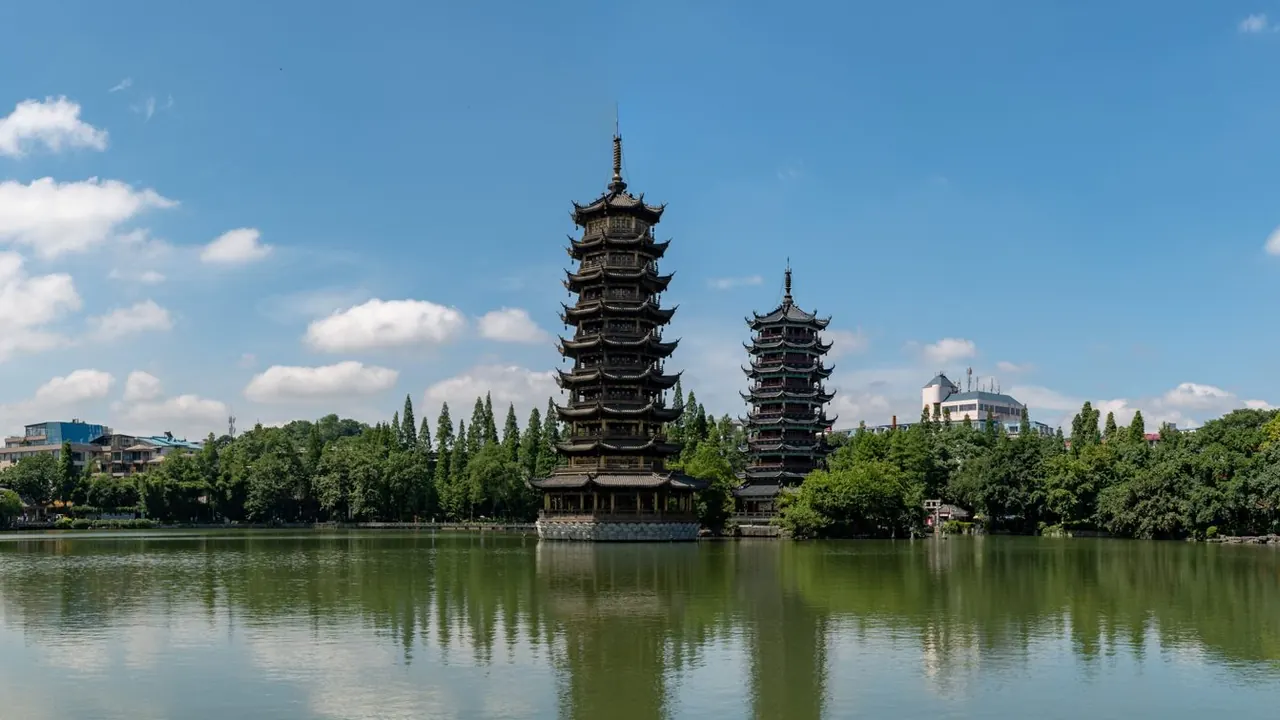
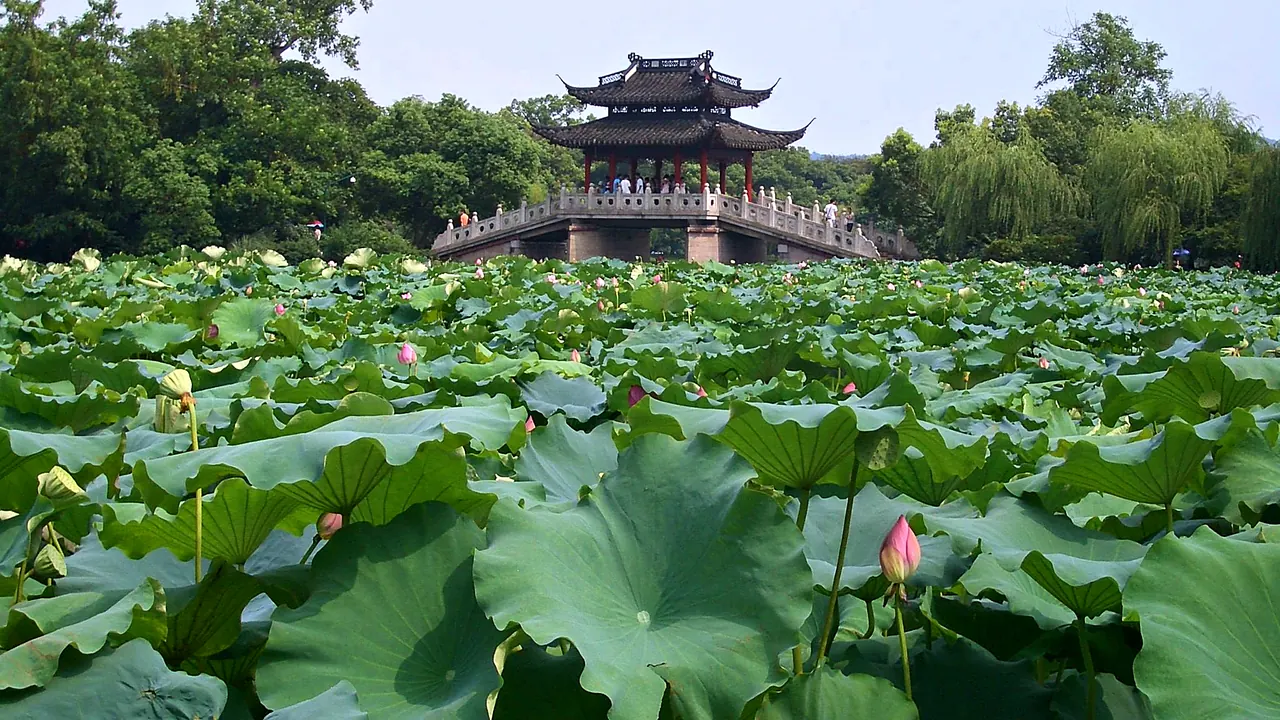
Photos: Guilin by xiquinhosilva, CC BY 2.0, cropped; Hangzhou by Vmenkov, CC BY-SA 3.0, cropped.
Guilin or Hangzhou?
Our verdict in twelve categories, each scored against the same fixed benchmark cities, and the climate month by month, so you can choose for your trip.
Choose Guilin for
- nature and the outdoors
- prices
- beaches
Guilin is the choice for travellers who come for scenery above everything else. The karst peaks along the Li River, rafting on the Yulong, the cycling lanes and climbing crags around Yangshuo and the Longji rice terraces are the reasons to go, and everyday costs are low. In return you get a narrow menu, quiet evenings and a city whose own sights take only a day or two.
Choose Hangzhou for
- culture and sights
- day trips
- shopping
Pick Hangzhou for a fuller trip where landscape, history and food come together. West Lake and Lingyin Temple, good museums, refined local cooking and tea villages within walking distance give you much more to do in town. The metro makes it easy to get about, and the water towns, Suzhou and Shanghai are a short train or drive away.
Scoreboard
Twelve categories on one fixed scale from 0 to 100. The shaded stretch is the gap between the two.
Your match
Pick a travel style or drag the sliders, and both match scores follow your weighting.
Wins on nature and the outdoors and prices with your weighting.
Wins on culture and sights and day trips with your weighting.
What matters to you?
Category by category
What the scores mean for a trip.
Beaches & swimming
Neither city is a beach destination. In Guilin, swimming means a summer wade at shallow, calm spots on the Yulong and Li rivers around Yangshuo, often from a bamboo raft. In Hangzhou the estuary is tidal and unswimmable and West Lake is only for boats, so the nearest swimming is at designated summer areas on Qiandao Lake, about two hours away. In both cities the hotel pool is the realistic option, and anyone who wants the sea should add a stay on the coast.
Food & drink
Guilin's food is good but limited. Breakfast is mifen rice noodles with the local fermented chilli sauce, and the rest of the local menu is river snails, stuffed vegetables, Yangshuo's beer fish and night-market skewers. There is little international food or fine dining, and many restaurants near the sights cater to tour groups.
Hangzhou eats better and with more polish. Its refined, slightly sweet cooking runs from Dongpo pork and West Lake fish in vinegar sauce to shrimp with Longjing tea, often served banquet-style by the lake. Drinking spring tea where it grows, in Meijiawu, is a pleasure Guilin has no equivalent for. Only lovers of chilli may prefer Guilin's sharper flavours.
Culture & sights
Guilin's sights are mostly hills and caves turned into parks: Elephant Trunk Hill, Seven Star Park and Reed Flute Cave in its coloured lights. Add the walled Ming palace of the Jingjiang Princes' City and the carved calligraphy at Longyin Cave, and a mostly modern city is covered in a day or two.
Hangzhou has far more depth. West Lake is a landscape designed over centuries and listed by UNESCO, and around it stand Lingyin Temple, the Feilai Feng carvings and the Leifeng and Six Harmonies pagodas. The Provincial, Silk and Tea museums, the Grand Canal and Neolithic Liangzhu add further layers of history. Neither city has an intact old town, but Hangzhou's heritage fills several days.
Nightlife
Neither city is made for late nights, but Hangzhou has more going on. A Guilin evening means a walk by the lakes, skewers and a beer around Zhengyang Street, with karaoke for locals, and the only real bar strip is West Street in Yangshuo, which is loud and aimed at tourists. Hangzhou adds lakeside terraces around Hubin, craft beer bars kept busy by students and young workers, and bigger clubs in Wulin, though serious night owls still head to Shanghai.
Nature & outdoors
This is Guilin's great strength. The karst peaks along the Li River between Guilin and Yangshuo are among China's most famous landscapes. You can see them from a four-hour cruise, a bamboo raft on the Yulong or a bicycle on the lanes between the peaks, and Yangshuo's limestone is among Asia's best-known sport-climbing terrain. The Longji rice terraces, two hours north, add a quite different landscape.
Hangzhou's nature is gentler and closer to hand. Wooded ridges, tea slopes and the Nine Creeks valley rise straight from West Lake, the Xixi wetland is just west of the city, and Moganshan, Qiandao Lake and Tianmushan lie further out. The walking is lovely, but it is not as dramatic as Guilin.
Day trips
Guilin's outings stay within its own region. The choices are Yangshuo, which many visitors use as a second base, the old riverside villages of Xingping and Daxu, the ancient Lingqu Canal at Xing'an, and the Zhuang and Yao villages of Ping'an and Dazhai among the terraces. After those, the options run out.
Hangzhou sits in the Yangtze delta, with fast trains in every direction. Shaoxing is under half an hour away, Shanghai about an hour and Suzhou's classical gardens a little further, while the canal towns of Wuzhen, Xitang and Nanxun are an hour or so by road. Ningbo, and at a stretch Huangshan, give you more than a week of possible outings.
Good for families
In Guilin, the best things for children are outdoors: the coloured caves, the river cruise, rafting on the Yulong and, for older children, cycling around Yangshuo. There is no major zoo, aquarium or theme park, and the summer heat and rain are hard on young families.
Hangzhou has more to fill the days. There are pedal boats and island ferries on West Lake, lakeside paths for scooters, a zoo in the hills, an aquarium with penguins and belugas, and theme parks with Song-dynasty shows. In both cities, though, summers are humid and little English is spoken.
Getting around
Guilin's centre, set around its rivers and lakes, is compact and easy to walk. There is no metro, though, and bus signs are mostly in Chinese. To reach the countryside you take a train to Yangshuo, a river boat, or a hired driver on winding roads up to the terraces.
Hangzhou is easier. A clean metro reaches the railway stations and the airport, shared bikes and the lakeside cycle lanes cover the scenic core, and cheap taxis fill the gaps in a spread-out city. In both cities, mobile payment apps are close to essential and English is scarce away from hotels.
Shopping & style
Shopping in Guilin means souvenirs and local food and drink to take home: chilli sauce, osmanthus tea and sweets, Sanhua rice liquor, and Zhuang and Yao embroidery from the villages. Beyond that there are chain stores on Zhengyang Street and stalls along West Street in Yangshuo.
Hangzhou gives shoppers a real reason to come. It sells silk as fabric, scarves and qipao, and you can buy Longjing tea from the growers in the hills. Wulin and the eastern lakeshore add department stores and luxury malls, and the lanes near Wushan sell fans and silk parasols.
Affordability
Both are cheap by Western standards, and Guilin is slightly cheaper day to day, with noodles, taxis and trains costing very little and good-value guesthouses in the countryside around Yangshuo. The catch is that the river cruise, the caves and the hill parks all charge entry. Hangzhou is the reverse: the lake, the causeways and most hill walks are free and museum fees are modest, but lakeside hotels and banquet dining push the bill up, and room rates jump during the national festival weeks.
Live music & performing arts
Both cities put on big staged shows for visitors, but only Hangzhou has a stage life beyond them. In Guilin the highlight is Impression Liu Sanjie, performed on the Li River at Yangshuo by hundreds of local performers with the karst peaks lit up behind them. The city adds evening acrobatics, folk dance and the odd night of Gui opera, while concerts and theatre are almost absent.
Hangzhou matches the spectacle with an evening show on West Lake and Song-dynasty extravaganzas at the theme parks. Beyond those, Yue opera, Zhejiang's lyrical and mostly female-cast form, plays in local theatres, though rarely with English surtitles, and the Hangzhou Grand Theatre hosts the city orchestra, touring ballet and concerts. It is a modest scene, but a real one.
Wellness & relaxation
For a restful trip Hangzhou is the better choice, because calm is part of city life there rather than something you travel out to find. Guilin itself is noisy and crowded with tour groups in season, so rest means leaving it: guesthouses among the rice fields and peaks near Yangshuo, with cycling, tea and early nights, or the Longsheng hot springs about two hours away. Cheap foot and body massage is on almost every street.
In Hangzhou the slow pace starts at the lakeshore, with tai chi and water calligraphy in the mornings, and carries on over a long pot of Longjing in the hill tea houses. Secluded retreat hotels in the tea valleys add spas. Weekends crowd the lake, so the quiet is found in the early mornings and the side valleys.
When should you go?
Pick your month. The climate figures are measured averages, not a forecast.
Guilin in July
Hangzhou in July
Daytime high, °C
Rainfall in the month, mm
Temperature and rainfall are climate normals, averaged over the years shown. Guilin: 1991-2020 normals, Guilin (7.6 km from centre). Hangzhou: 1991-2020 normals, Hangzhou (1.9 km from centre).
The two cities follow the same pattern through the year: hot, humid summers, damp and cool winters, and the best walking weather in spring and autumn. Guilin's rain is heavier and arrives earlier. It builds through April to a peak of around 442mm in June, when mist often hides the peaks. By October it is dry and still warm, so October and November are the best months for the river and the terraces. June is Hangzhou's wettest month too, though less extreme, and July reaches 34°C, too hot for long days around the lake.
Winter separates them a little. Hangzhou is the colder of the two, with January highs near 9°C, while Guilin stays a few degrees milder. Spring suits Hangzhou well: April and May are warm with moderate rain, the season of the tea harvest. Neither is a place to swim. The sea off Hangzhou's coast reaches 29°C in August, but getting to it means a separate trip to the coast.
Which traveller are you?
On an outdoors trip, Guilin is the stronger pick. The Li River cruise, bamboo rafting on the Yulong, flat cycling lanes between the peaks around Yangshuo, well-known limestone climbing and the Longji terraces offer scenery that Hangzhou's gentler hills cannot match.
For a culture and arts trip, Hangzhou wins clearly. West Lake's causeways and pagodas, Lingyin Temple and the Feilai Feng carvings, the silk and tea museums and Yue opera fill several days. Guilin's Ming palace and cave parks need only one or two.
On a food and nightlife trip, Hangzhou offers far more. Dongpo pork, West Lake fish and shrimp with Longjing tea, tea in the hill villages and craft beer bars near the lake outdo Guilin's noodle counters, skewers and touristy West Street.
Before you go
| Measure | Guilin | Hangzhou |
|---|---|---|
| Official language | Putonghua | Putonghua |
| Currency | Yuan Renminbi (CNY) | Yuan Renminbi (CNY) |
| Sockets | ACI220 V, 50 Hz | ACI220 V, 50 Hz |
| Driving side | Right | Right |
| Time zone | UTC+8 | UTC+8 |
| Emergency number | Police 110, ambulance 120, fire 119 | Police 110, ambulance 120, fire 119 |
| Elevation | 153 m | 19 m |
| Main airport | Guilin Liangjiang International Airport (KWL)25 km from centre43 non-stop destinations | Hangzhou Xiaoshan International Airport (HGH)25 km from centre131 non-stop destinations |
| Public holidays this year | 6 days | 6 days |
By the numbers
| Measure | Guilin | Hangzhou |
|---|---|---|
| City population | 4,931,137 | 11,936,010 |
| People per km² | - | 708 |
| Museums within 10 km | 1 | 13 |
| UNESCO World Heritage sites within 50 km | 1 | 3 |
| Swim season, months above 21 °C | - | 5 months |
Where else could you go?
Every comparison below shares a destination with this one, so you can follow Guilin or Hangzhou somewhere new.