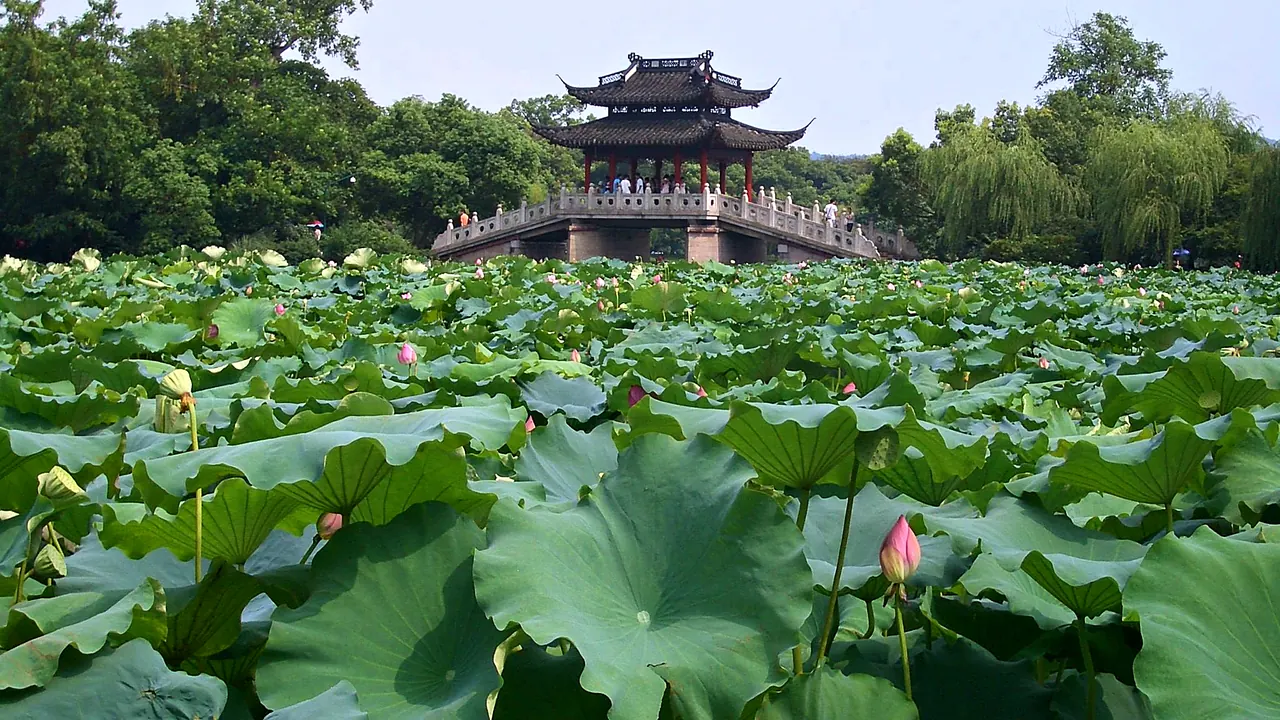
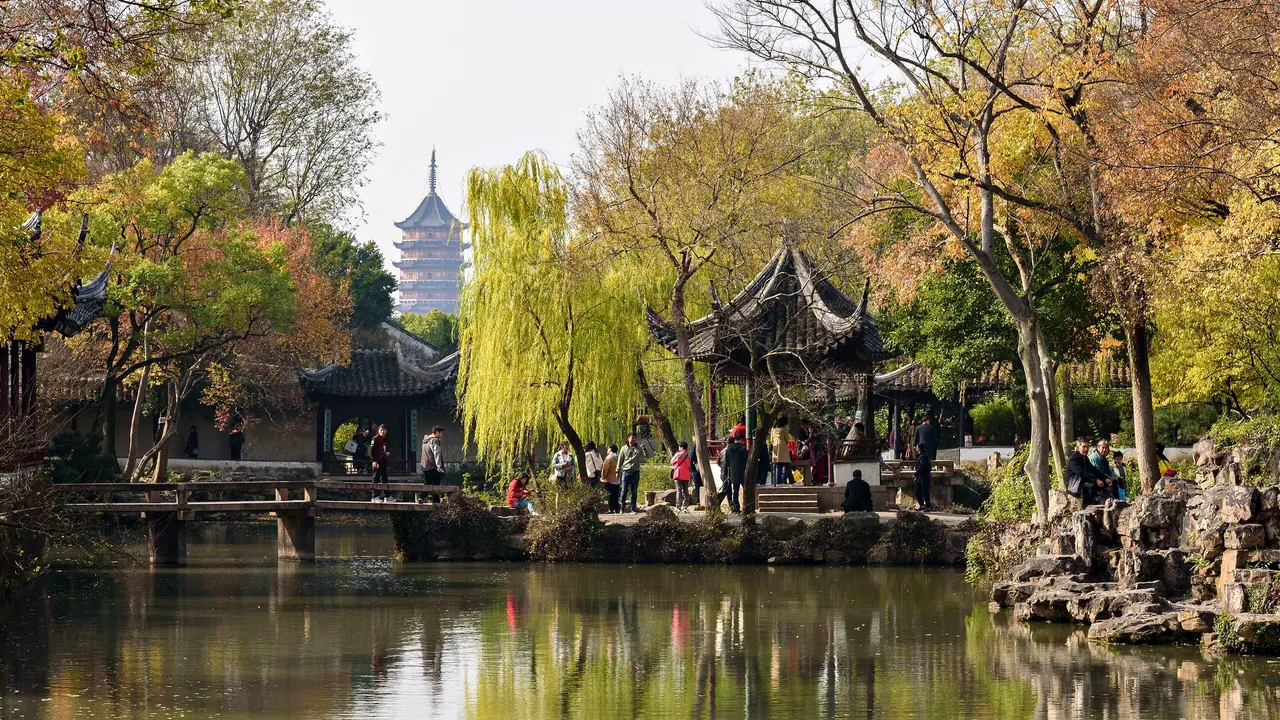
Photos: Hangzhou by Vmenkov, CC BY-SA 3.0, cropped; Suzhou by King of Hearts, CC BY-SA 4.0, cropped.
Hangzhou or Suzhou?
Our verdict in twelve categories, each scored against the same fixed benchmark cities, and the climate month by month, so you can choose for your trip.
Choose Hangzhou for
- nature and the outdoors
- families
- beaches
Hangzhou suits travellers who want scenery as much as monuments. West Lake, Lingyin Temple and the tea hills of Longjing make walking, cycling and boating the heart of the trip. The open lakeshore also makes it the easier choice with children in tow.
Choose Suzhou for
- culture and sights
- getting around
- day trips
For a trip built around classical gardens and old-town atmosphere, Suzhou is the stronger pick. Its UNESCO gardens and canal streets lie close together inside the moat, so a few days on foot cover a great deal. Shanghai and Nanjing are also near enough for easy day trips by train.
Scoreboard
Twelve categories on one fixed scale from 0 to 100. The shaded stretch is the gap between the two.
Your match
Pick a travel style or drag the sliders, and both match scores follow your weighting.
Too close to call, 1 point apart
Wins on nature and the outdoors and families with your weighting.
Wins on culture and sights and getting around with your weighting.
What matters to you?
Category by category
What the scores mean for a trip.
Beaches & swimming
Neither city is a place to swim. Hangzhou at least has one option within reach: Qiandao Lake, about two hours away, opens designated swimming areas in high summer. Around Suzhou, Lake Tai and the muddy Yangtze shore are not for bathing, so a hotel pool is the realistic answer. Anyone who wants sand should add a coastal leg to the trip.
Food & drink
The two kitchens are close cousins and equally rewarding: both lean sweet, build on freshwater fish and follow the seasons. Hangzhou's signatures are Dongpo pork, West Lake fish in vinegar and shrimp with Longjing tea, and its special pleasure is drinking the spring tea where it grows, in Longjing and Meijiawu.
Suzhou puts more weight on everyday rituals: the breakfast bowl of noodles in dark broth, osmanthus cakes from old pastry shops, and the autumn rush for Yangcheng Lake hairy crab. In both cities, spicy food and international choice are thin.
Culture & sights
Where Suzhou's heritage is mostly built, Hangzhou's is scenery shaped by people over centuries: the causeways, islands and pagodas of West Lake, Lingyin Temple with the Buddhist carvings of Feilai Feng in the cliffs beside it, and the Neolithic earthworks of Liangzhu on the edge of town. The silk, tea and provincial museums are well worth an afternoon. The sights are spread around a large lake and up into the hills, though, so a day covers fewer of them.
Suzhou's sightseeing is denser and more varied. The Humble Administrator's Garden, the Lingering Garden and the Master of the Nets Garden sit in or just outside the moat, along with the Panmen water gate, while the leaning pagoda on Tiger Hill and Hanshan Temple are a short ride out. I. M. Pei's museum adds a modern landmark. Much of both old towns has been rebuilt, but Suzhou's canal grid survives, so the walk along Pingjiang Road from one garden to the next is part of the visit rather than a gap between sights.
Nightlife
Both are quiet after dark, and in both a serious night out means the train to Shanghai. Hangzhou has slightly more range: lakeside terraces around Hubin, larger clubs in Wulin, and a student-driven scene of craft beer bars and karaoke. Suzhou's evenings are smaller in scale: a lit-up canal walk along Pingjiang Road or Shantang Street, a few bars on Shiquan Street, then rooftop lounges by Jinji Lake.
Nature & outdoors
Hangzhou is far ahead outdoors. Wooded ridges and tea terraces climb straight up from West Lake, the Nine Creeks valley and the Xixi wetland are within the city, and Moganshan, Tianmushan and Qiandao Lake are real trips into hills and forest.
Suzhou sits in flat delta country. The orchard roads on Lake Tai's Dongshan and Xishan peninsulas make pleasant cycling and Lingyan Hill gives a short climb, but there are no mountains nearby, so walkers have much less to do.
Day trips
Both are excellent bases for the Yangtze delta. The difference is which places each puts within easy reach. Hangzhou is the better base for Shaoxing, the canal city of rice wine and Lu Xun, which is under half an hour by train. It is also closer to the southern water towns of Wuzhen, Xitang and Nanxun, and to Ningbo. Huangshan and the Huizhou villages of Hongcun and Xidi are just possible in a long day, though they are better as an overnight stay.
Suzhou is the better base for the big cities and the northern water towns. Nanjing's Ming walls are about an hour away by train and Yangzhou's gardens are within two hours, while Tongli and Luzhi are under an hour by road. Each city is also an easy day out from the other.
Good for families
Hangzhou is the easier city with children, mostly because West Lake doubles as a playground. It has pedal boats, island ferries and wide paths for scooters, plus a zoo in the hills and an aquarium with belugas and penguins.
Suzhou's main sights, the gardens, are narrow and contemplative, and young children soon tire of them. Canal boats, the Jinji Lake parks and the water parks west of the old town go down better. Summer humidity and festival crowds are hard work in both cities.
Getting around
Suzhou is a little easier to get around. The old town inside the moat is compact enough to walk or cycle from garden to garden, and the metro has signs in English.
Hangzhou's metro is just as modern, but its sights are spread around a large lake and into the hills, so most days combine walking with taxis or buses, and little English is used away from the metro. In both cities, setting up mobile payment before you arrive saves trouble.
Shopping & style
Silk is what links the two, but each has its own speciality. Hangzhou pairs silk scarves and qipao with Longjing tea bought straight from the growers in the hill villages, best in spring.
Suzhou's distinctive buy is embroidery. In the workshops of Zhenhu village you can watch double-sided pieces being stitched, and the long-established shops on Guanqian Street sell silk. Both cities have large modern malls, and neither is the place for designer boutiques.
Affordability
Day-to-day costs are much the same: noodles, transport and taxis are cheap in both, and hotel rates rise sharply in both during the national festival weeks. The difference is the cost of sightseeing. Hangzhou's lake, causeways and hill walks are free, while every Suzhou garden charges entry, and a full day of gardens adds up.
Live music & performing arts
Neither has a deep stage scene, but they offer very different evenings. Hangzhou's strength is spectacle: the staged show on the surface of West Lake and the Song-dynasty extravaganzas at the theme parks, with Yue opera in local theatres for the curious.
Suzhou offers older and more intimate traditions. Kunqu opera is staged at its museum and sung in garden pavilions on summer evenings, and Pingtan storytelling is heard in small teahouses. Both are in Chinese, so visitors take them in as atmosphere.
Wellness & relaxation
Both cities have an old reputation for unhurried leisure, massage parlours on every street and no tradition of public bathing. Hangzhou's calm is in the hills: teahouses above the lake, retreat hotels in the tea valleys and tai chi under the willows at dawn. In Suzhou you find it in an early garden visit before the crowds and in the canal-side teahouses, with the resorts on Lake Tai for a proper spa stay.
When should you go?
Pick your month. The climate figures are measured averages, not a forecast.
Hangzhou in July
Suzhou in July
Daytime high, °C
Rainfall in the month, mm
Where the figures come from
Suzhou's temperatures are measured 79 km from the centre, at Shanghai / Hongqiao.
Suzhou has no rain gauge within 25 km of the centre, so its rainfall comes from a gridded climate dataset read at the city rather than from a gauge further away.
Suzhou's sunshine is measured 81 km from the centre, at Shanghai.
Temperature and rainfall are climate normals, averaged over the years shown. Hangzhou: 1991-2020 normals, Hangzhou (1.9 km from centre). Suzhou: 1991-2020 normals, Shanghai / Hongqiao (78.8 km from centre).
Both cities share the same hot, humid delta climate, so spring and autumn are the best seasons in both. April and May, and then October and November, bring mild days for walking around gardens and lakeshores. July and August reach 34°C in Hangzhou and almost as much in Suzhou. That sticky heat is better spent indoors at midday. Winter highs of around 9°C make January damp and chilly in both, though not freezing.
The real difference is rain. Hangzhou is noticeably wetter all year, with about 254mm in June against 146mm in Suzhou. Suzhou's October is especially kind: it is dry, with about 25mm, and fairly sunny, which makes it the best single month for visiting the gardens. The estuary off Hangzhou warms through the summer, but neither city is a place to swim.
Which traveller are you?
On an outdoors trip, Hangzhou is the clear choice. Paths lead from West Lake straight into tea terraces and bamboo valleys, the Xixi wetland is close, and Moganshan and Tianmushan offer proper hill country. Suzhou's flat delta suits cycling more than walking.
On a culture and arts trip, Suzhou gives you more for each day. Its UNESCO gardens, Tiger Hill and canal streets lie close together, and Kunqu opera and Pingtan storytelling add old living traditions to the museums.
On a family trip with young children, Hangzhou works better. West Lake has pedal boats, island ferries and open paths, and the zoo and the beluga aquarium help too. Young children quickly lose interest in Suzhou's narrow, contemplative gardens.
Before you go
| Measure | Hangzhou | Suzhou |
|---|---|---|
| Official language | Putonghua | Putonghua |
| Currency | Yuan Renminbi (CNY) | Yuan Renminbi (CNY) |
| Sockets | ACI220 V, 50 Hz | ACI220 V, 50 Hz |
| Driving side | Right | Right |
| Time zone | UTC+8 | UTC+8 |
| Emergency number | Police 110, ambulance 120, fire 119 | Police 110, ambulance 120, fire 119 |
| Elevation | 19 m | 5 m |
| Main airport | Hangzhou Xiaoshan International Airport (HGH)25 km from centre131 non-stop destinations | Shanghai Hongqiao International Airport (SHA)69 km from centre82 non-stop destinations |
| Public holidays this year | 6 days | 6 days |
By the numbers
| Measure | Hangzhou | Suzhou |
|---|---|---|
| City population | 11,936,010 | 12,748,262 |
| People per km² | 708 | 1,473 |
| Museums within 10 km | 13 | 9 |
| UNESCO World Heritage sites within 50 km | 3 | 1 |
| Swim season, months above 21 °C | 5 months | - |
Where else could you go?
Every comparison below shares a destination with this one, so you can follow Hangzhou or Suzhou somewhere new.
- Shanghaivs Suzhou
- Shanghaivs Hangzhou
- Beijingvs Suzhou
- Shenzhenvs Hangzhou
- Hong Kongvs Hangzhou
- Guilinvs Hangzhou