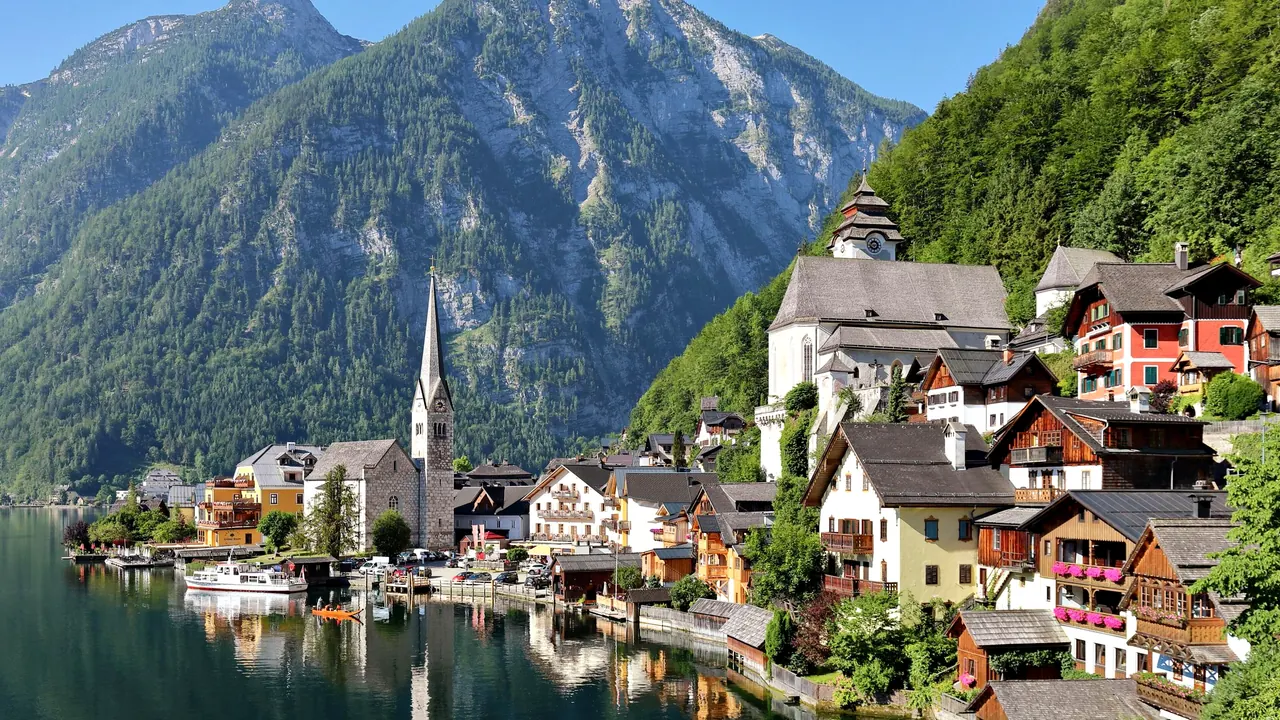
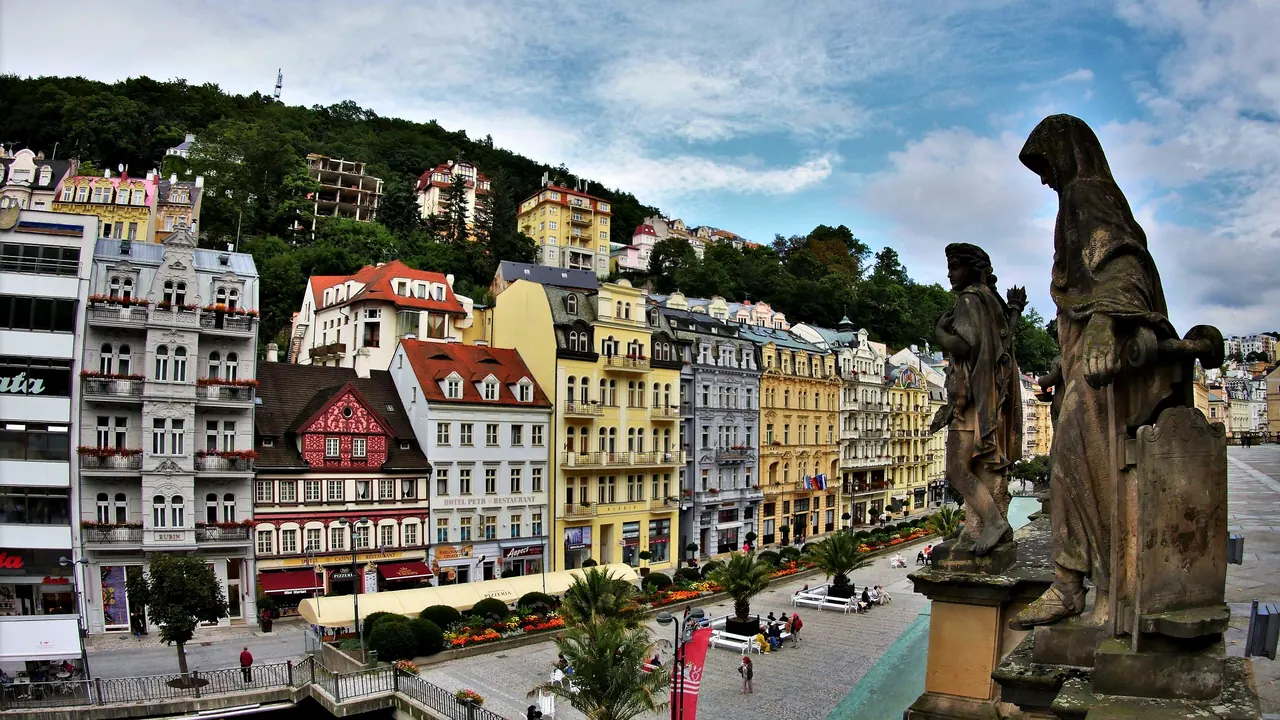
Photos: Hallstatt by C.Stadler/Bwag, CC BY-SA 4.0, cropped; Karlovy Vary by Rolf Dietrich Brecher from Germany, CC BY-SA 2.0, cropped.
Hallstatt or Karlovy Vary?
Our verdict in twelve categories, each scored against the same fixed benchmark cities, and the climate month by month, so you can choose for your trip.
Choose Hallstatt for
- nature and the outdoors
- beaches
- families
Hallstatt is the choice for travellers who come for mountains rather than towns. The Dachstein starts at the edge of the village, with the Krippenstein cable car, the ice caves, the Echerntal waterfalls and the walk to the Gosausee all close by. In the evenings you get a silent lake. In return you pay a lot for a room, eat simply and find little to do indoors, so it works best as a base for active days, or as a cheaper stay in Obertraun or Bad Ischl.
Choose Karlovy Vary for
- wellness
- prices
- shopping
For a slower, softer stay, Karlovy Vary makes more sense. The town exists for taking the waters: you sip from the springs along the colonnades, book treatments in a spa hotel, go to an evening concert in a grand Belle Époque setting and walk the forest paths between meals. It costs noticeably less than the Austrian village and has more to see in town. The countryside is gentle, though, not dramatic.
Scoreboard
Twelve categories on one fixed scale from 0 to 100. The shaded stretch is the gap between the two.
Your match
Pick a travel style or drag the sliders, and both match scores follow your weighting.
Wins on nature and the outdoors and beaches with your weighting.
Wins on wellness and prices with your weighting.
What matters to you?
Category by category
What the scores mean for a trip.
Beaches & swimming
Neither is a place for swimming, but Hallstatt at least has water at its door. The deep, cold Hallstätter See has a small bathing lawn at the north end of the village and a larger lido at Obertraun, good for a quick plunge after a hike in July or August.
Karlovy Vary has no natural swimming in town. The nearest lake is Lake Medard, a flooded mine near Sokolov, so most swimming happens in the warm outdoor pools fed by the springs.
Food & drink
Karlovy Vary offers more to eat, though neither is a food destination. Its Czech cooking runs from svíčková and roast pork to Pilsner-style beer. It also has two specialities of its own: warm spa wafers from the colonnade stalls and Becherovka, still distilled in town. The cafés along the Teplá add coffee and cake at any hour.
Hallstatt has one dish worth seeking out, char or whitefish from the lake. Beyond that you get guesthouse schnitzel and goulash, and kitchens that close early once the day visitors leave.
Culture & sights
Karlovy Vary has more to look at. The whole spa quarter is the sight: tiers of pastel Belle Époque hotels, three very different colonnades, the Vřídlo geyser shooting hot water into the air, and the baroque and Russian Orthodox churches. It fills a day or two of easy sightseeing.
Hallstatt's history goes back further, but there is less of it to visit. Salt mining here goes back thousands of years and gave its name to the Iron Age Hallstatt culture. You see that story in the salt mine, the small museum and the painted skulls of the Beinhaus, which together make a rich half day.
Nightlife
Both are early-to-bed places, but Karlovy Vary has a little more after dark. There are hotel and wine bars, Czech pubs and casinos, and the town comes properly alive during the film festival week in early summer. Hallstatt has nothing after the tour groups leave apart from dinner, a terrace and a walk by the lake.
Nature & outdoors
Hallstatt wins easily. The village sits beneath the Dachstein massif. A cable car climbs the Krippenstein to a platform over a sheer drop and to the giant ice caves, and the Echerntal and the Gosausee walk lead into some of the classic scenery of the Alps. Via ferratas in summer and freeride skiing in winter round it out.
Karlovy Vary's outdoors is green and gentle. Graded spa paths climb through beech forest to the Diana tower, with the Slavkov Forest moors, canoeing on the Ohře and skiing at Klínovec further out. It suits easy walking much better than mountain days.
Day trips
The day trips are equally good but very different. From Hallstatt you tour Salzkammergut lake towns: the Habsburg Kaiservilla in Bad Ischl, St Wolfgang's altarpiece, Gmunden's lake castle, with Salzburg as a long day. Buses and the lakeside railway make these slow, so a car helps.
Karlovy Vary's outings are more about castles and towns. Loket's castle on its river loop is only twenty minutes away, and the sister spa towns of Mariánské Lázně and Františkovy Lázně, the St Maurus reliquary at Bečov, mining Jáchymov and brewing Plzeň are all within reach. Prague is a long day by coach.
Good for families
Hallstatt has the bigger draws for children. The salt mine, with its funicular, wooden miners' slides and underground lake, is a real adventure, and older children remember the ice caves and the Krippenstein cable car. The catch is the single steep lane, crowded at midday, so families often stay in Obertraun.
Karlovy Vary is calm and safe but built around adults. Children enjoy the geyser, sipping from spouted spring cups, the funicular to the Diana lookout with its animal enclosure, and a trip to Loket castle. After that, ideas run out quickly.
Getting around
Karlovy Vary is a little easier. The spa quarter is one long walk along the promenades. Local buses and the funicular take you up the steep sides, and the town has two railway stations and coaches to Prague, so you can manage without a car.
Hallstatt is tiny and largely car-free, but getting in and out takes effort. The railway station is across the lake, reached by a small boat, and buses to Obertraun, Gosau and Bad Ischl thin out outside summer. That is why many visitors drive.
Shopping & style
Karlovy Vary is the better place to shop. Stará louka and Tržiště have jewellers and fashion boutiques, and there are local crafts worth buying: Moser crystal from its own showroom, Karlovy Vary porcelain and Bohemian garnets. Hallstatt has one souvenir lane, where the only buy that belongs to the place is salt from the mine above.
Affordability
Karlovy Vary is much easier on the wallet. The grand hotels and colonnade restaurants charge for the setting, but pubs and canteens a street back serve Czech food and beer at local prices, and the springs themselves are free. The film festival week is the time to avoid if you are watching costs.
Hallstatt is expensive. It has few rooms for visitors from all over the world, meals are priced like an Alpine resort, and the salt mine, funicular and cable car add up. Budget travellers usually sleep in Obertraun, Bad Goisern or Bad Ischl.
Live music & performing arts
Karlovy Vary offers a modest but real programme. Its symphony orchestra, descended from the old spa orchestras, plays light classical concerts, some outdoors on the colonnades in summer. The ornate Fellner and Helmer theatre stages operetta and touring drama, and an autumn Dvořák festival adds a few highlights.
Hallstatt has the village brass band and the odd church concert. For a real evening of music you need Bad Ischl's summer operetta or Salzburg.
Wellness & relaxation
This is Karlovy Vary's whole reason for being. You walk the colonnades with a spouted porcelain cup, drinking from thirteen springs. Sanatoria offer carbonated baths, peat wraps and medical consultations, and there are pools of warm spring water, indoors and on the hillside. Booking a spa stay gets you the full experience.
Hallstatt has only a few hotel saunas. For brine baths you go half an hour to Bad Ischl. The village's restful side is its misty early mornings and empty evenings by the lake, provided you escape the crowded middle of the day.
When should you go?
Pick your month. The climate figures are measured averages, not a forecast.
Hallstatt in July
Karlovy Vary in July
Daytime high, °C
Rainfall in the month, mm
Where the figures come from
Hallstatt's temperatures are measured 56 km from the centre, at Salzburg.
Hallstatt has no rain gauge within 25 km of the centre, so its rainfall comes from a gridded climate dataset read at the city rather than from a gauge further away.
Karlovy Vary's station stands 156 m above the city centre, so the centre is likely a little warmer than the figures say.
Karlovy Vary has no rain gauge within 25 km of the centre, so its rainfall comes from a gridded climate dataset read at the city rather than from a gauge further away.
Karlovy Vary's sunshine is measured 37 km from the centre, at Cheb.
Temperature and rainfall are climate normals, averaged over the years shown. Hallstatt: 1991-2020 normals, Salzburg (55.5 km from centre). Karlovy Vary: 1999-2020 (sunshine 1981-2010, rainfall 1991-2020) normals, Karlovy Vary (4.6 km from centre).
Hallstatt has the warmer summer, with highs around 25°C in July and August, warm enough for a bracing swim in the lake. It is also by far the wetter of the two. Rain is heavy from May right through August and peaks at about 178mm in July, so even the warmest hiking weeks come with frequent downpours. September is still mild and noticeably drier, which makes it the most reliable month for mountain walks. April is drier still but cooler. November and March are cool and grey, and in December and January the village sits close to freezing with little sun, when the Krippenstein turns to skiing.
Karlovy Vary is cooler and much drier all year. Summer highs reach about 22°C and even its wettest month gets only around 95mm. From May to September the weather is comfortable for strolling the colonnades and the forest paths, and May to August is the sunniest stretch. From December to February the town is grey and close to freezing, with very little sunshine. Even so, the warm spring water and indoor spa treatments make the cold months easier to enjoy here than in Hallstatt.
Which traveller are you?
On an outdoors trip, choose Hallstatt. Serious Alpine country starts at the edge of the village. You can take the cable car to the Five Fingers, explore the Dachstein ice caves, hike from hut to hut, climb via ferratas and do the classic Gosausee walk. Karlovy Vary's forest paths are pleasant but much tamer.
For a relaxing and wellness trip, Karlovy Vary is the clear answer. You can follow a drinking cure from thirteen springs, book carbonated baths and peat wraps in the sanatoria, and swim in warm spring-fed pools. Hallstatt's calm lasts only for its quiet mornings and evenings, and its spas are half an hour away.
On a tight budget, Karlovy Vary goes much further. Czech pubs one street back from the promenade charge local prices, and the colonnades and springs cost nothing. In Hallstatt rooms are scarce and expensive, and the salt mine and cable car fares soon add up.
Before you go
| Measure | Hallstatt | Karlovy Vary |
|---|---|---|
| Official language | German, Austrian Sign Language | Czech |
| Currency | Euro (EUR) | Czech Koruna (CZK) |
| Sockets | CF230 V, 50 Hz | CE230 V, 50 Hz |
| Driving side | Right | Right |
| Time zone | UTC+1, UTC+2 in summer | UTC+1, UTC+2 in summer |
| Emergency number | 112 | 112 |
| Elevation | 511 m | 447 m |
| Main airport | Salzburg Airport (SZG)55 km from centre64 non-stop destinations | Václav Havel Airport Prague (PRG)100 km from centre178 non-stop destinations |
| Public holidays this year | 16 days | 13 days |
By the numbers
| Measure | Hallstatt | Karlovy Vary |
|---|---|---|
| City population | 741 | 49,073 |
| People per km² | 12 | 830 |
| Museums within 10 km | 3 | 2 |
| UNESCO World Heritage sites within 50 km | 2 | 3 |
Where else could you go?
Every comparison below shares a destination with this one, so you can follow Hallstatt or Karlovy Vary somewhere new.
- Salzburgvs Hallstatt
- Dresdenvs Karlovy Vary
- Praguevs Karlovy Vary
- Leipzigvs Karlovy Vary
- Bledvs Hallstatt
- Grazvs Hallstatt