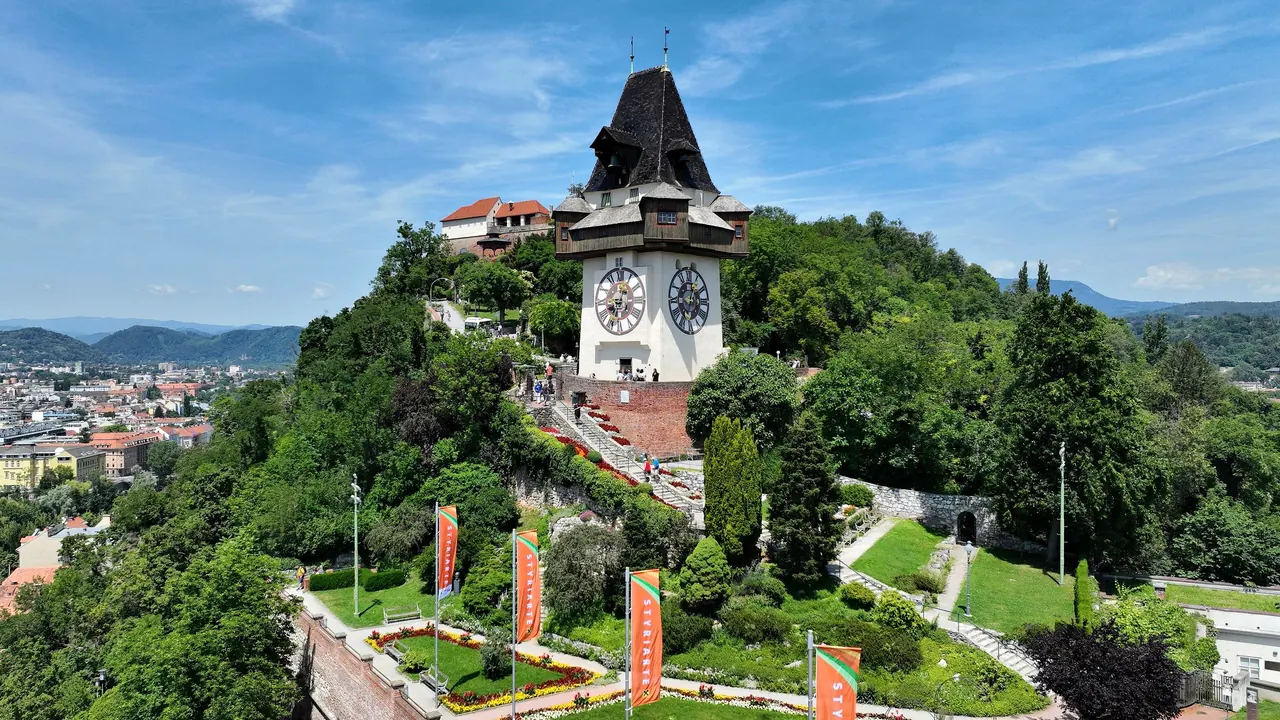
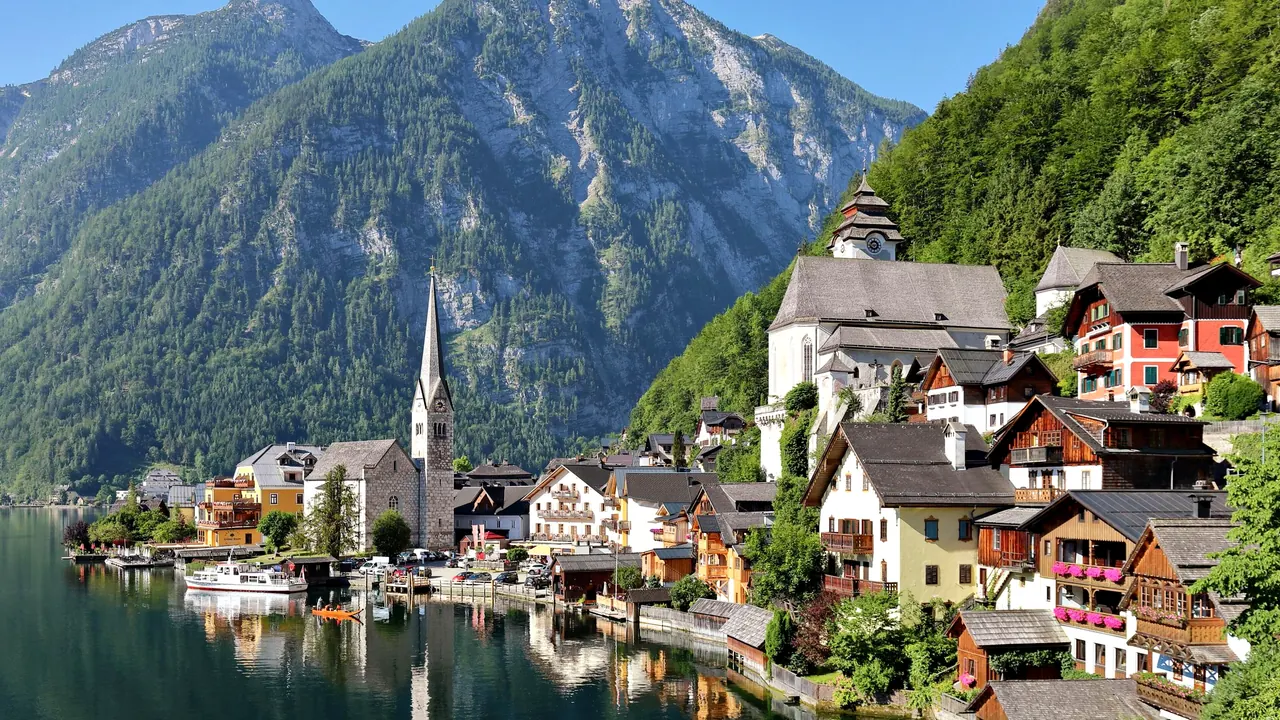
Photos: Graz by C.Stadler/Bwag, CC BY-SA 4.0, cropped; Hallstatt by C.Stadler/Bwag, CC BY-SA 4.0, cropped.
Graz or Hallstatt?
Our verdict in twelve categories, each scored against the same fixed benchmark cities, and the climate month by month, so you can choose for your trip.
Choose Graz for
- live music and the arts
- food and drink
- nightlife
Graz suits travellers who want a proper city with plenty to fill several days. You get a fine old town and a castle hill, Styrian cooking with markets and wine taverns close by, an opera house, and student bars for the evenings. It is also easier with children, simpler to get around and kinder to the budget. The countryside is still close, with wine hills and a home mountain within easy reach.
Choose Hallstatt for
- nature and the outdoors
- beaches
Hallstatt is for a slower vacation built around mountain scenery. The village on its ledge above a dark Alpine lake is the sight, and the Dachstein starts at its edge, with cable cars, ice caves and walks to the Gosausee. Choose it to hike by day and spend quiet evenings by the water. Accept that the food is simple, there is no nightlife and rooms are expensive.
Scoreboard
Twelve categories on one fixed scale from 0 to 100. The shaded stretch is the gap between the two.
Your match
Pick a travel style or drag the sliders, and both match scores follow your weighting.
Wins on live music and the arts and food and drink with your weighting.
Wins on nature and the outdoors and beaches with your weighting.
What matters to you?
Category by category
What the scores mean for a trip.
Beaches & swimming
Neither is a place to come for swimming, but Hallstatt has the water right on the doorstep. You can swim in the lake from the small lawn and jetty in the village or at the larger lido in Obertraun, a cold, clear dip with the mountains above, ideal after a hike.
From Graz, a swim means going out to the former gravel pits on the flat land south of the city, such as the Schwarzlsee. The water there is warmer and the grassy banks have more space, but it is a break on a hot afternoon rather than part of the setting.
Food & drink
Graz is the place to eat. Styrian cooking has real character, from cold fried chicken salad dressed with dark pumpkin seed oil to pork boiled with root vegetables and horseradish. The markets at Kaiser-Josef-Platz and Lendplatz are worth a morning, and the crisp white wines of the southern hills are poured all over town.
Hallstatt has a handful of guesthouse dining rooms serving Austrian standards. The lake char and whitefish are worth trying once, and the terraces have lovely views, but kitchens can close early. For anything more, you would drive to Bad Ischl.
Culture & sights
Graz has a full city's worth of sights. The red-roofed old town runs from the Hauptplatz to the cathedral and the imperial mausoleum. The seventeenth-century armoury is still stacked with thousands of suits of armour, and Schloss Eggenberg and the blue Kunsthaus show two very different ages of the city.
In Hallstatt the history is deep but compact. Salt has been mined in the mountain for some seven thousand years, the finds here gave their name to an Iron Age culture, and the charnel house holds rows of painted skulls. A day covers all of it, while Graz rewards a longer stay.
Nightlife
Graz has a real night out, if not a big one. Thanks to its students, the bars in the lanes around Mehlplatz spill outside on summer evenings, and Lend has artier places across the river. It thins out in the summer break, though. In Hallstatt, an evening means dinner and a walk by the dark lake, nothing more.
Nature & outdoors
Hallstatt is mountain country from the moment you step outside. The Krippenstein cable car climbs to the Five Fingers platform and the Dachstein ice caves, paths lead up the Echerntal past waterfalls, and the Gosausee is one of the classic views of the Alps. In winter there is ski touring and freeride on the same slopes.
Graz has easy green escapes instead: the Schöckl with its cable car and paragliders, the Mur cycle path and the gorge at Bärenschützklamm. For alpine hiking on Hallstatt's scale, you need to travel about two hours from Graz to the Gesäuse or the Hochschwab.
Day trips
Both are good bases for outings, but the outings differ. From Graz you head into the wine country to the south, with vineyard taverns, Riegersburg castle on its volcanic crag, the Lipizzaner stud at Piber, or across the border to Maribor by train.
From Hallstatt the trips are to lake towns: imperial Bad Ischl, St Wolfgang and Gmunden, and Salzburg for a long but rewarding day. Without a car, they take more planning than the trips from Graz.
Good for families
Graz is the easier city with children. It is compact and calm, the trams take buggies, and the Schlossberg alone fills a day: a lift up, a fairytale train in the tunnels and a long underground slide back down. The children's museum in the Augarten adds a rainy-day option.
Hallstatt's salt mine, with its wooden miners' slides, is a real hit, and older children enjoy the ice caves. But the steep, single lane is crowded at midday and hard work with a pushchair, so families usually stay in Obertraun.
Getting around
Graz is simple. The flat, largely pedestrianised centre is easy to walk, trams and buses run on one ticket, and cycling along the Mur is easy.
Hallstatt is tiny, so the problem is getting in and out. The station is on the far shore and a boat crosses to the village, the lanes and steps are steep, and buses are thin outside summer. In both places, a car helps for exploring the wider region.
Shopping & style
Graz has enough for an afternoon. The Herrengasse and the sloping Sporgasse have shops in historic buildings, a grand old department store has a roof terrace over the old town, and Lend has small design and vintage shops. The best things to take home are pumpkin seed oil, wine and chocolate from the markets.
In Hallstatt, shopping means half an hour along the souvenir lane, where the one buy with a real story is salt from the mine.
Affordability
Neither is cheap, but Graz is fairly priced for Austria. Its students mean plenty of good-value lunches and bakeries, and you can walk the centre for free.
Hallstatt has few rooms and visitors from all over the world, so beds and meals cost well above the norm. The salt mine and cable car add up too. Many visitors on a budget stay in Obertraun or Bad Goisern and come in for the day.
Live music & performing arts
Graz has a full programme of performances. The opera house runs a season of opera, ballet and operetta, the Musikverein hosts concerts, Styriarte focuses on early music in summer, and steirischer herbst brings avant-garde work in autumn. The music university's jazz programme also keeps a club scene going.
In Hallstatt, music means the brass band on feast days or the odd church concert. For a real evening out, you go to the operetta in Bad Ischl or to Salzburg.
Wellness & relaxation
Both rely on a nearby spa region rather than baths of their own. From Graz, the thermal villages in the hills to the east are about an hour away, including Bad Blumau with its Hundertwasser design. From Hallstatt, the salt-brine baths of Bad Ischl are half an hour away.
The calm differs too. Graz is unhurried all day, with time in coffee houses and the Stadtpark. In Hallstatt the quiet comes early in the morning and in the evening, with mist on the lake, while the midday crowds are best avoided by heading into the hills.
When should you go?
Pick your month. The climate figures are measured averages, not a forecast.
Graz in July
Hallstatt in July
Daytime high, °C
Rainfall in the month, mm
Where the figures come from
Hallstatt's temperatures are measured 56 km from the centre, at Salzburg.
Hallstatt has no rain gauge within 25 km of the centre, so its rainfall comes from a gridded climate dataset read at the city rather than from a gauge further away.
Temperature and rainfall are climate normals, averaged over the years shown. Graz: 1991-2020 normals, Graz Airport (7.9 km from centre). Hallstatt: 1991-2020 normals, Salzburg (55.5 km from centre).
Graz is warmest in July and August, with highs around 27°C, and summer is also its wet season: June to August bring the most rain, much of it in heavy showers. From late autumn to early spring it is far drier, with as little as 20mm in January. Hallstatt is a little cooler at its peak, at about 25°C, and wet all year. Its heaviest rain falls from May to August, reaching about 178mm in July, and winter is wet too. Graz gets more sunshine for most of the year, most clearly in summer, but by November the two are much the same.
May and September are the most comfortable months for walking the streets of Graz. They are warm and a little less rainy than high summer. In July and August, the bathing lakes south of the city are a good escape on a hot afternoon. Hallstatt is at its best from June to September, when the mountain paths and cable cars are most rewarding and the lake is just warm enough for a bracing swim. Pack for mist and rain whichever month you go. Both are cold in winter, with highs only a few degrees above freezing.
Which traveller are you?
On an outdoors trip, Hallstatt is the clear choice. You can walk from the village into high mountain country, take the Krippenstein cable car to the ice caves, hike to the Gosausee or go hut to hut, all without a long drive first.
For a food and nightlife trip, choose Graz. Its morning farmers' markets, pumpkin seed oil and wine taverns in the southern hills make it a place to eat well. The student bar lanes keep evenings going, while Hallstatt goes quiet once the day visitors leave.
On a culture and arts trip, Graz offers far more. Its arcaded old town, the armoury and Schloss Eggenberg fill two or three days, and the opera and festivals fill the evenings. Hallstatt's salt mine and charnel house make a rich half day at most.
Before you go
| Measure | Graz | Hallstatt |
|---|---|---|
| Official language | German, Austrian Sign Language | German, Austrian Sign Language |
| Currency | Euro (EUR) | Euro (EUR) |
| Sockets | CF230 V, 50 Hz | CF230 V, 50 Hz |
| Driving side | Right | Right |
| Time zone | UTC+1, UTC+2 in summer | UTC+1, UTC+2 in summer |
| Emergency number | 112 | 112 |
| Elevation | 353 m | 511 m |
| Main airport | Graz Airport (GRZ)9 km from centre26 non-stop destinations | Salzburg Airport (SZG)55 km from centre64 non-stop destinations |
| Public holidays this year | 16 days | 16 days |
By the numbers
| Measure | Graz | Hallstatt |
|---|---|---|
| City population | 306,971 | 741 |
| People per km² | 2,406 | 12 |
| Museums within 10 km | 29 | 3 |
| UNESCO World Heritage sites within 50 km | 1 | 2 |
Where else could you go?
Every comparison below shares a destination with this one, so you can follow Graz or Hallstatt somewhere new.