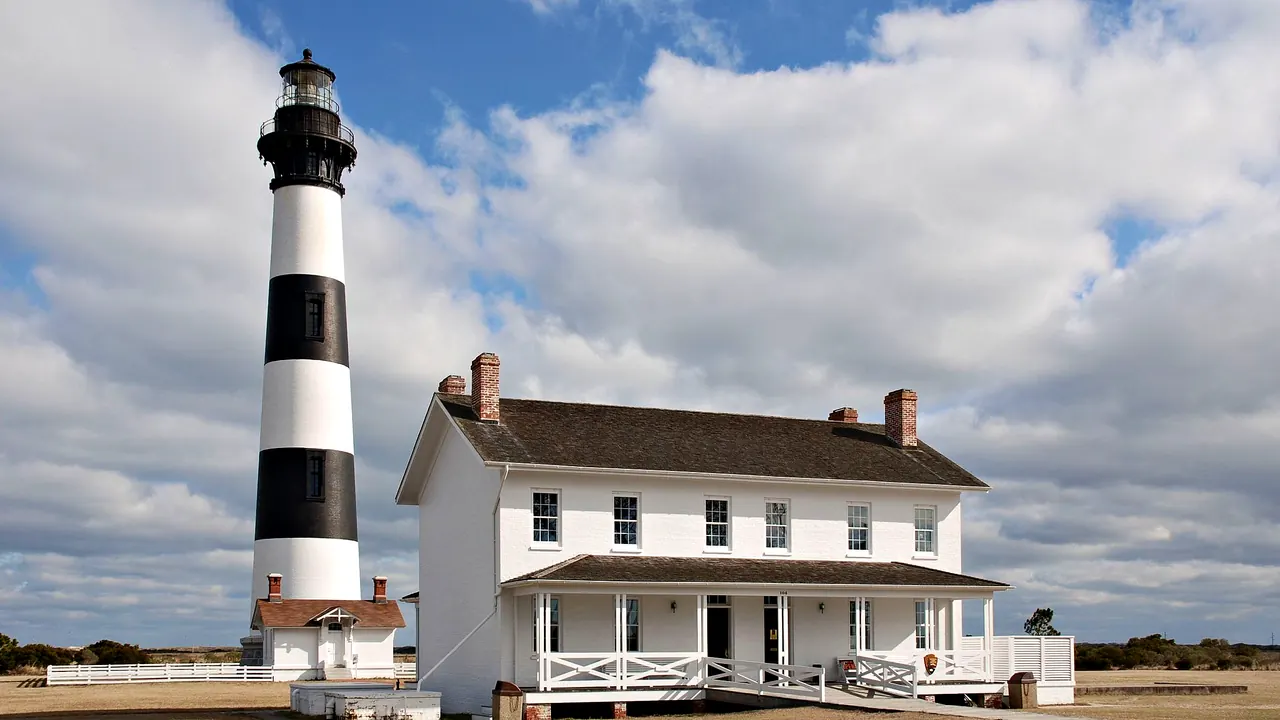
Photos: Outer Banks by Jarek Tuszyński, CC BY-SA 3.0, cropped.
The Hamptons or Outer Banks?
Our verdict in twelve categories, each scored against the same fixed benchmark cities, and the climate month by month, so you can choose for your trip.
Choose The Hamptons for
- shopping
- nightlife
- food and drink
The Hamptons suit travellers who want the beach as the centre of a polished summer, with something to do after it. The villages of East Hampton, Southampton and Sag Harbor give you farm-stand produce and serious restaurants, boutiques and antiques dealers, a small but real stage season and loud summer bars in Montauk. The cost is very high, and the sea is cooler.
Choose Outer Banks for
- prices
- beaches
- families
Outer Banks are the better pick for a long, easy beach week, especially with children or a big family group sharing a house. The sand runs further and wilder down to Cape Hatteras, the sea is warmer, and the dunes, wild horses and sound-side shallows keep children busy. Evenings are quiet and the food is simple, but the bill, while still not small, is far less punishing.
Scoreboard
Twelve categories on one fixed scale from 0 to 100. The shaded stretch is the gap between the two.
Your match
Pick a travel style or drag the sliders, and both match scores follow your weighting.
Wins on shopping and nightlife with your weighting.
Wins on prices and beaches with your weighting.
What matters to you?
Category by category
What the scores mean for a trip.
Beaches & swimming
Both are Atlantic surf beaches of pale sand backed by dunes, but the Outer Banks have more of it and warmer water. Their 100-mile chain runs from the lifeguarded house-lined stretches of Kill Devil Hills and Nags Head to the empty national seashore around Rodanthe, Buxton and Ocracoke, and swimming stays comfortable from June into September.
The Hamptons' beaches, from Cooper's Beach in Southampton to Main Beach in East Hampton and Ditch Plains near Montauk, are broad and clean, but the swimming season is shorter and parking permits complicate things. Both have calm bay or sound sides for small children, and both need respect for rip currents.
Food & drink
The Hamptons eat better. Bay scallops, Peconic oysters, lobster rolls in Montauk and farm-stand tomatoes and strawberries feed polished village restaurants in Sag Harbor, Bridgehampton and East Hampton, with North Fork wine on the table. The catch is the gap between farm stand and white tablecloth.
On the Outer Banks the food is honest and casual: steamed shrimp, soft-shell crab and hushpuppies in dockside shacks, or fish from the Wanchese and Hatteras markets cooked in your rental. Beyond seafood and a few ambitious places in Duck and Nags Head, the choice thins out fast.
Culture & sights
Neither is a sightseeing destination, and the two are about level, but the stories differ. The Hamptons offer old English villages with windmills and saltbox houses, whaling history in Sag Harbor and an art thread running through the Pollock-Krasner House and the Parrish Art Museum.
The Outer Banks hold two landmark American moments: the Wright brothers' first flight at Kill Devil Hills and the vanished Lost Colony on Roanoke Island. Add the striking lighthouses of Bodie Island and Cape Hatteras, and the sights are more dramatic but spread far apart.
Nightlife
The Hamptons have a real if seasonal night scene: Montauk's bars fill with a young crowd on summer weekends, and Southampton and Bridgehampton add clubs and lounges with door policies. It fades quickly after Labor Day.
The Outer Banks barely compete. A sunset drink on a sound-side deck or a brewery taproom in Kill Devil Hills is the usual evening out, there are almost no clubs, and most nights end on the rental-house porch.
Nature & outdoors
Both are low, gentle coasts with no hills, and the outdoors are broadly comparable, the Outer Banks having slightly more to offer and wilder in character. Jockey's Ridge's giant dunes, wild mustangs north of Corolla, bird and turtle refuges at Pea Island and world-class flat-water kiteboarding off Rodanthe and Avon give them more variety.
The Hamptons are tamer: farmland, vineyards and salt ponds, with the best walking on the Montauk bluffs, Hither Hills and Shelter Island's Mashomack Preserve. Flat back roads suit cycling between villages, and Montauk matches Hatteras as a sport-fishing harbour.
Day trips
The Hamptons have the better range of outings. Small ferries via Shelter Island reach the North Fork vineyards and the harbour town of Greenport, a summer ferry from Montauk reaches Block Island, and moving between Sag Harbor, Southampton and Montauk is a day out in itself.
From the Outer Banks, the standout is the ferry to remote Ocracoke. Beyond that, colonial Edenton, Elizabeth City and Norfolk are each a long drive inland or north, pleasant rather than compelling.
Good for families
Both work well for a beach-house summer with children, but the Outer Banks are the more natural family choice. Sliding down the dunes at Jockey's Ridge, wild-horse tours in Corolla, the aquarium on Roanoke Island, lighthouse climbs and crab-catching on the shallow sound give children more to do, and the multi-generation house week is a tradition here.
The Hamptons offer calm bay beaches, pick-your-own fields and the Montauk Point Lighthouse climb, but fewer attractions and more slow driving. Neither has a theme park, so rainy days are a challenge in both.
Getting around
You need a car in both, but the Outer Banks are a little less of a struggle day to day. The central towns from Kitty Hawk to Nags Head sit close together with multi-use bike paths, though Corolla to Hatteras village is a couple of hours, and Saturday changeover traffic on the bridges is notorious.
In the Hamptons, everything funnels onto Montauk Highway, where summer traffic crawls and 30km can take over an hour. The rail and coach links to New York help with arriving, but local buses are sparse and taxis scarce, so a bicycle for the beach run is worth having.
Shopping & style
The Hamptons are a genuine shopping destination in season. Main Street and Newtown Lane in East Hampton and Jobs Lane in Southampton carry fashion labels and resortwear, Sag Harbor has bookshops, and the antiques and interiors dealers around Bridgehampton and Water Mill are the real draw.
The Outer Banks offer beach-town browsing: surf and kite shops, souvenir stores, a small outlet centre in Nags Head and local pottery and decoys in the galleries of Duck, Manteo and Ocracoke.
Affordability
Neither is cheap in summer, but the Hamptons are in a class of their own for cost, with rentals and hotels pricier than New York and even a deli sandwich priced for the wealthy. Coming in June or September, or staying on the North Fork, softens it only so far.
The Outer Banks are expensive in season too, yet a shared beach house with home cooking spreads the bill, and the beaches, national seashore and Ocracoke ferry are free. Late spring and autumn bring much lower rents.
Live music & performing arts
The Hamptons have more on stage in summer: plays and concerts at Guild Hall and Bay Street Theater, touring acts in Westhampton Beach, the Bridgehampton Chamber Music Festival in village churches and an international film festival in autumn.
The Outer Banks rest on one tradition, The Lost Colony, the outdoor drama played on Roanoke Island since 1937 where the settlers lived. Otherwise it is bands on bar decks and a few community festivals.
Wellness & relaxation
The Hamptons give more for someone who wants pampering: resort spas in Montauk and Southampton with seawater pools, and yoga in every village in summer. The catch is that midsummer weekends feel social and crowded, so June and September are the restful time.
The Outer Banks have few spas, but offer simpler slowness: unplanned beach-house days, porch evenings and the hushed villages of Hatteras Island and Ocracoke, best in the shoulder seasons.
When should you go?
Pick your month. The climate figures are measured averages, not a forecast.
The Hamptons in July
Outer Banks in July
Daytime high, °C
Rainfall in the month, mm
Where the figures come from
The Hamptons has no rain gauge within 25 km of the centre, so its rainfall comes from a gridded climate dataset read at the destination rather than from a gauge further away.
Outer Banks has no rain gauge within 25 km of the centre, so its rainfall comes from a gridded climate dataset read at the destination rather than from a gauge further away.
Outer Banks's sunshine is measured 77 km from the centre, at Cape Hatteras.
Temperature and rainfall are climate normals, averaged over the years shown. The Hamptons: 2016-2025 (rainfall 1991-2020) normals, Easthampton / Midhampton (5.6 km from centre). Outer Banks: 2009-2025 (sunshine 1981-2010, rainfall 1991-2020) normals, Manteo / Sunny Side (7.7 km from centre).
Both coasts are summer places, but the Outer Banks stay warm for longer. In the Hamptons the ocean is properly swimmable from July into September. It peaks around 22°C in August and holds up well through September, so the beach season runs past the end of summer. June is mild and good for walking the villages, but the sea is still too cold for most swimmers. From November to March it is cold, fit for little more than a brisk walk on the sand. Rain falls evenly through the year, so there is no wet season to plan around.
The Outer Banks are several degrees warmer. The sea reaches 26°C in July and August and is comfortable from June to September, and in October it is still about 21°C, fine for hardier swimmers. Daytime highs touch 30°C in midsummer, which is hot for long walks. Late summer is the wettest stretch, with August and September each bringing around 160mm, yet there is still plenty of sunshine. May is pleasant for walking the dunes and bird refuges, but the water is still too cool for most people to swim.
Which traveller are you?
For a food and nightlife trip, the Hamptons are the clear choice. You can follow a serious dinner with a late bar on a summer weekend, though evenings are formal and costly. The Outer Banks give up both for relaxed meals and early nights.
On a shopping trip, choose the Hamptons. A few hours in the villages can furnish a wardrobe or a whole house, as long as you come in season, because some shops close afterwards. On the Outer Banks you shop for a souvenir or a piece of local craft, not for whole days.
For a trip on a tight budget, the Outer Banks are far kinder, though nowhere here is cheap in summer. A group splitting costs can make a week work, and the best days cost little. In the Hamptons even modest choices strain the budget.
Before you go
| Measure | The Hamptons | Outer Banks |
|---|---|---|
| Currency | US Dollar (USD) | US Dollar (USD) |
| Sockets | AB120 V, 60 Hz | AB120 V, 60 Hz |
| Driving side | Right | Right |
| Time zone | UTC-5, UTC-4 in summer | UTC-5, UTC-4 in summer |
| Emergency number | 911 | 911 |
| Main airport | John F. Kennedy International Airport (JFK)189 non-stop destinations | Norfolk International Airport (ORF)44 non-stop destinations |
| Public holidays this year | 13 days | 14 days |
By the numbers
| Measure | The Hamptons | Outer Banks |
|---|---|---|
| Swim season, months above 21 °C | 1 month | 4 months |
Where else could you go?
Every comparison below shares a destination with this one, so you can follow The Hamptons or Outer Banks somewhere new.
- Virginia Beachvs Outer Banks
- Martha's Vineyardvs The Hamptons
- Cape Codvs The Hamptons
- Nantucketvs The Hamptons
- Catskillsvs The Hamptons
- Poconosvs The Hamptons