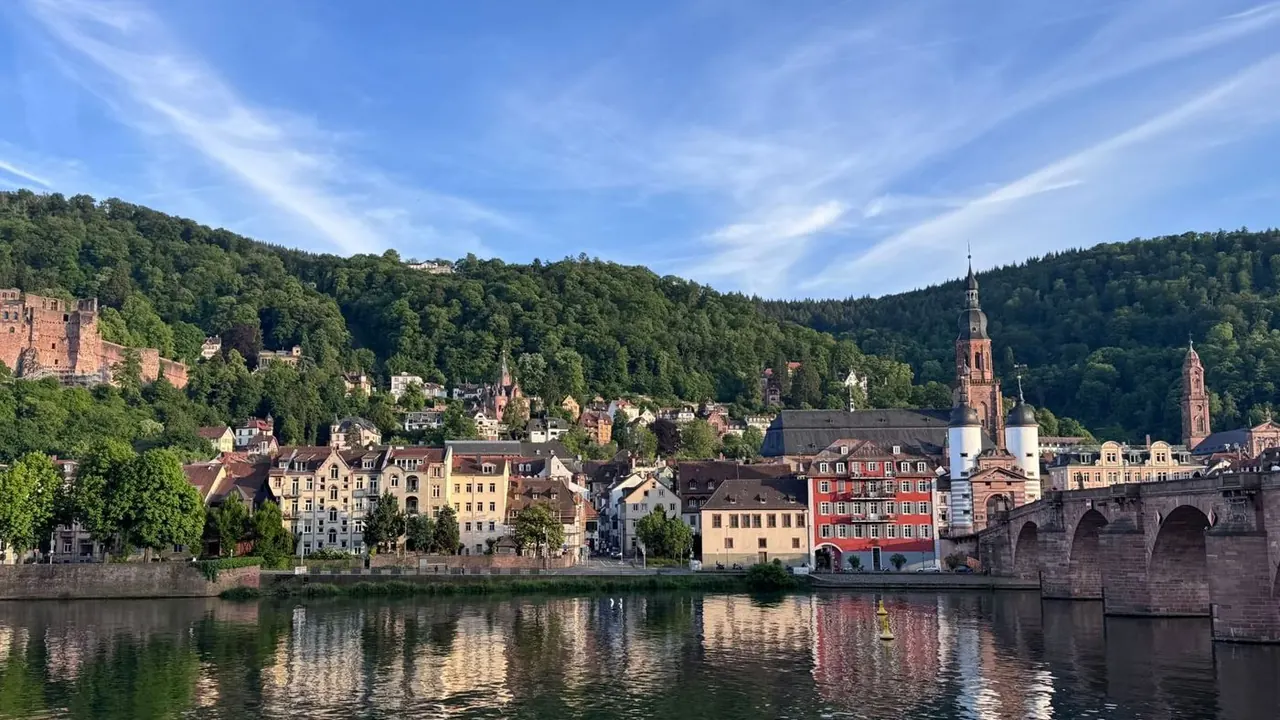
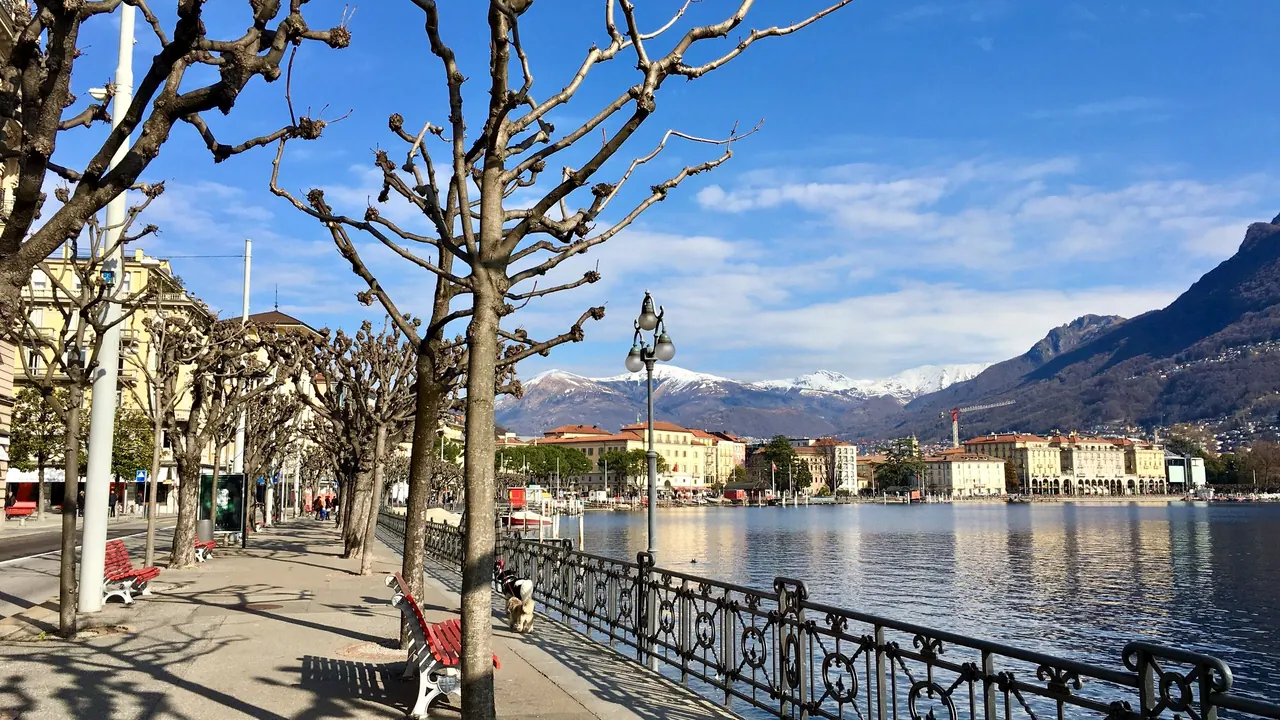
Photos: Heidelberg by Kuanling Chen, Pexels License; Lugano by Thomas Woodtli from Zürich, Switzerland, CC BY-SA 2.0, cropped.
Heidelberg or Lugano?
Our verdict in twelve categories, each scored against the same fixed benchmark cities, and the climate month by month, so you can choose for your trip.
Choose Heidelberg for
- prices
- culture and sights
- nightlife
Heidelberg suits a traveller who wants history and student life in one compact old town: the castle ruin, the oldest university in Germany, a proper theatre season and pubs that fill up late in term. It is also by far the cheaper of the two. A single regional ticket covers Speyer, Worms and the Palatinate wine villages, so you can see them without a car.
Choose Lugano for
- beaches
- nature and the outdoors
- day trips
Choose Lugano for the lake and the mountains around it. Funiculars run from the edge of town up to summits with long views, lidos let you swim on hot afternoons, and Milan, Como and Lake Maggiore are all within a day. In return it is expensive, the evenings are quiet and the sights are few. It works best for a slow vacation built around the scenery, not a busy sightseeing one.
Scoreboard
Twelve categories on one fixed scale from 0 to 100. The shaded stretch is the gap between the two.
Your match
Pick a travel style or drag the sliders, and both match scores follow your weighting.
Too close to call, 1 point apart
Wins on prices and culture and sights with your weighting.
Wins on beaches and nature and the outdoors with your weighting.
What matters to you?
Category by category
What the scores mean for a trip.
Beaches & swimming
Neither has a coast. In Heidelberg the Neckar is for boats, not swimming, so on a hot day you go to an outdoor pool or a gravel-pit lake on the Rhine plain about half an hour out.
Lugano is much better for swimming. In July and August the lake is warm enough for full days at the lidos, on lawns and wooden decks at the mouth of the Cassarate or along the shore towards Castagnola and Paradiso, and boats run to small village baths. Still, if you want sand, choose neither.
Food & drink
The two eat in different ways. Heidelberg's cooking is German and hearty: Maultaschen, Schäufele and white asparagus in spring, with Riesling and Pinot from the Bergstrasse vineyards. Its students keep cheap kebab and pizza easy to find, and the better meals are away from the Hauptstrasse, in Neuenheim and the village wine taverns.
Lugano is Italian at heart, with polenta, braised meats and risotto at granite tables in the hillside grotti, drunk with Ticino Merlot. It is the better place for a long lunch but harder for a cheap bite, with little street food and not much international cooking.
Culture & sights
Heidelberg has a good deal more to see. The castle ruin stands above one of Germany's best-preserved old towns, and together with the Old Bridge, the Great Tun and the Student Prison of a university founded in 1386 it easily fills two days.
Lugano's arcaded old town, the Cathedral of San Lorenzo, Luini's Passion fresco in Santa Maria degli Angioli and the art collection at LAC are worth an unhurried look. Even so, one day covers them.
Nightlife
Neither is a place for big nights out, but Heidelberg has more going on after dark. In term time the small pubs of the Untere Strasse fill up late and the old student taverns have plenty of character. Out of term it goes quiet early, and for clubs people take the train to Mannheim or Frankfurt.
A Lugano evening means an aperitivo on the lakefront and a long dinner among a well-dressed local crowd, and most nights the town is quiet before midnight. Young people go to Milan.
Nature & outdoors
Heidelberg's countryside is green and gentle. Forest starts at the edge of the old town, the Philosophers' Walk and the Königstuhl trails have fine views, and the Neckar cycle path and the Palatinate Forest give easy walking and riding rather than mountain hiking.
Lugano is the stronger choice for the outdoors. Steep wooded mountains rise straight out of the lake, and funiculars and a rack railway take you up Monte Brè, San Salvatore and Monte Generoso. The green rivers of the Verzasca and Maggia valleys are about an hour away.
Day trips
Both make excellent bases. From Heidelberg, Speyer's cathedral, Schwetzingen's palace, Worms, Maulbronn and the Palatinate wine villages are easy outings, all within one regional fare system, and Strasbourg works for a long day.
Lugano has a slight edge because its trips cross a border. Milan and The Last Supper are just over an hour away, and Lake Como, the castles of Bellinzona and the gardens of the Borromean Islands are also within reach.
Good for families
Both are safe, calm and manageable with children, and both have steep streets that are hard work with a pushchair. Heidelberg has more attractions built for children: a zoo by the Neckar, a fairy-tale park on the Königstuhl and, nearby, the Technik Museum Speyer with a space shuttle to climb into, which older children enjoy.
Lugano relies on the lake instead. Children get slides at the lidos, boat trips, mountain railways and the miniature Swiss landmarks at Melide, so it works best for younger children and outdoor days.
Getting around
Both centres are walkable, and in both the station sits away from the old town. Heidelberg's Altstadt is a long strip along the pedestrian Hauptstrasse, which you reach from the station by tram. Its streets are cobbled and the walk up to the castle is steep.
Lugano is slightly easier. A short funicular links the station to the old town, lake boats serve the villages and Swiss trains run smoothly to Locarno, Como and Milan. The hillside means most walks involve some climbing.
Shopping & style
Heidelberg's Hauptstrasse, one of the longest pedestrian streets in Germany, is an everyday high street, with chains and department stores at the western end and souvenirs, beer steins and Studentenkuss chocolates towards the market square. Bergstrasse wine is the best thing to take home, and for more choice Mannheim and Frankfurt are a short train ride away.
Via Nassa in Lugano is aimed at wealthier shoppers, with Swiss watchmakers, jewellers and Italian fashion houses under its arcades and delicatessens in the lanes around it. There is a designer outlet near Mendrisio, and for anything more serious people go to Milan.
Affordability
Heidelberg is far easier on the wallet. Hotels are the main cost and rooms can be scarce, but many people stay in Mannheim and come in by train. Student cafés, bakeries and the regional transport ticket keep everything else reasonable.
Lugano is expensive at every turn, from lakeside hotels to boat trips and mountain railways. Grotti, set lunches and the free regional transport included with most hotel stays help a little, but there is no cheap way to stay in the town itself.
Live music & performing arts
Heidelberg has a little more on stage. Its municipal theatre puts on opera, drama and dance, the Heidelberger Frühling festival brings chamber music in spring, and in summer the castle courtyard hosts open-air plays and concerts. Mannheim's larger opera and theatre house is twenty minutes away.
In Lugano almost everything happens at LAC, home of the Orchestra della Svizzera italiana, and much of the theatre is in Italian. The summer highlight is the Estival Jazz festival, with free concerts on Piazza della Riforma. Opera lovers go to La Scala in Milan.
Wellness & relaxation
If you want proper thermal bathing, Heidelberg has it nearby. The Kraichgau's large bath complexes, with saunas and warm saline pools, are about half an hour away, and Baden-Baden is about an hour. In town you relax on the Neuenheim river meadows, on the forest paths above the Philosophers' Walk and in quiet wine taverns, away from the midday crowds around the castle.
Lugano relaxes you through its pace: coffee under the arcades, afternoons at a lido or in Parco Ciani, and grotto lunches that last into the evening. Its spas are in the big lakeside hotels, and there is a large indoor complex with pools and saunas near Rivera.
When should you go?
Pick your month. The climate figures are measured averages, not a forecast.
Heidelberg in July
Lugano in July
Daytime high, °C
Rainfall in the month, mm
Temperature and rainfall are climate normals, averaged over the years shown. Heidelberg: 1991-2020 (sunshine 1971-2000) normals, Heidelberg (4.5 km from centre). Lugano: 1991-2020 normals, Lugano (1.2 km from centre).
Both are warmest in July and August, when Heidelberg reaches about 26°C and Lugano about 27°C. Heidelberg is good for walking the Altstadt and the forest paths from May to September. From November to February it is cold and very grey, with little sunshine. Its rain is spread evenly through the year and is never heavy.
Lugano is milder at both ends of the year and sunnier in every month. Its winter days are often dry and bright, which suits lakeside walks. The drawback is rain: from April to November it gets two to three times as much as Heidelberg, with a peak of 178mm in May. Because it stays so sunny, that rain tends to come in heavy downpours rather than long grey spells. July and August are the months for swimming in the lake. Late spring and early autumn are better for hiking than the humid height of summer.
Which traveller are you?
For a culture and arts trip, Heidelberg is the clear choice. The castle ruin, the Old University with its Student Prison and a municipal theatre with opera and drama give you far more to see and hear than Lugano's few churches and its arts centre.
On a tight budget, Heidelberg is again the better pick. It costs what western Germany costs, student cafés and taverns keep meals reasonable and the regional ticket covers day trips. Lugano has Swiss prices and no cheap way to stay.
On an outdoors trip, Lugano is the better base. Funiculars climb Monte Brè and San Salvatore, the ridge from Monte Lema to Monte Tamaro makes a fine day hike and the Verzasca valley is an hour away. Heidelberg has gentler forest walks and cycling.
Before you go
| Measure | Heidelberg | Lugano |
|---|---|---|
| Official language | German | French, German, Italian, Romansh |
| Currency | Euro (EUR) | Swiss Franc (CHF) |
| Sockets | CF230 V, 50 Hz | CJ230 V, 50 Hz |
| Driving side | Right | Right |
| Time zone | UTC+1, UTC+2 in summer | UTC+1, UTC+2 in summer |
| Emergency number | 112 | 112 |
| Elevation | 114 m | 283 m |
| Main airport | Frankfurt Main Airport (FRA)69 km from centre281 non-stop destinations | Milan Malpensa International Airport (MXP)46 km from centre208 non-stop destinations |
| Public holidays this year | 12 days | 15 days |
By the numbers
| Measure | Heidelberg | Lugano |
|---|---|---|
| City population | 156,092 | 63,495 |
| People per km² | 1,433 | 837 |
| Museums within 10 km | 17 | 17 |
| UNESCO World Heritage sites within 50 km | 4 | 5 |
Where else could you go?
Every comparison below shares a destination with this one, so you can follow Heidelberg or Lugano somewhere new.
- Comovs Lugano
- Milanvs Lugano
- Bergamovs Lugano
- Frankfurtvs Heidelberg
- Stuttgartvs Heidelberg
- Baden-Badenvs Heidelberg