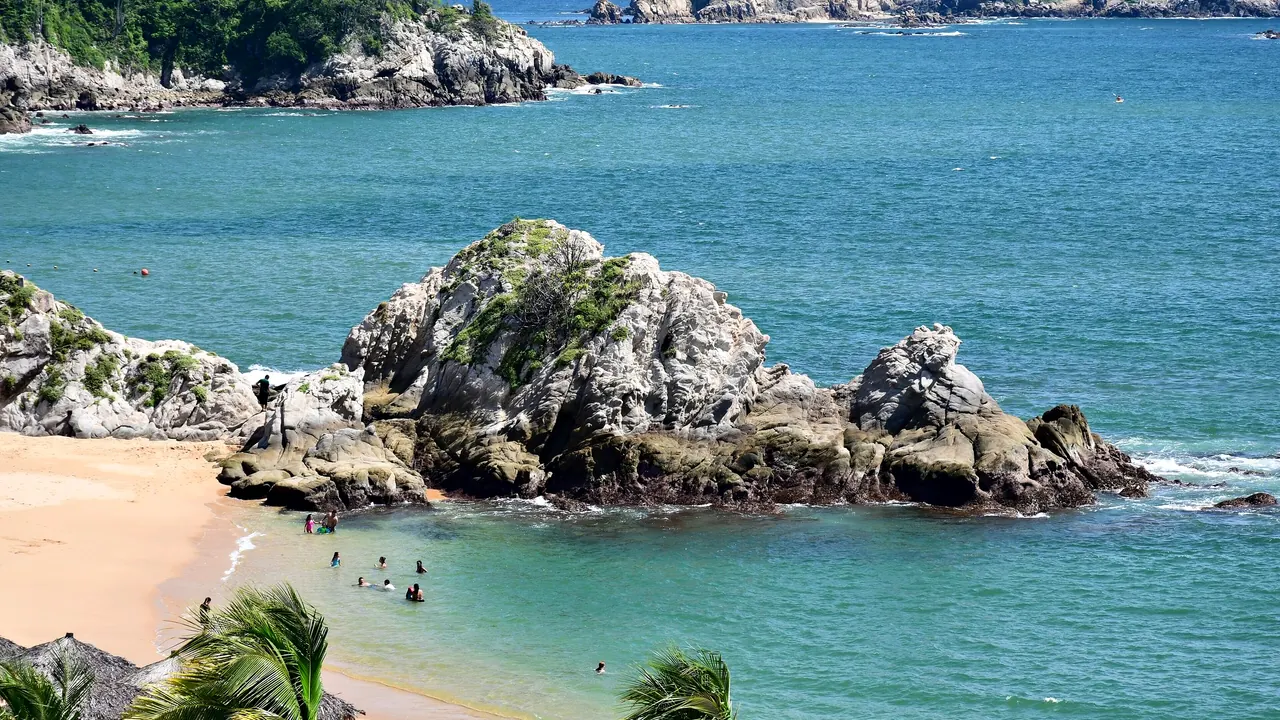
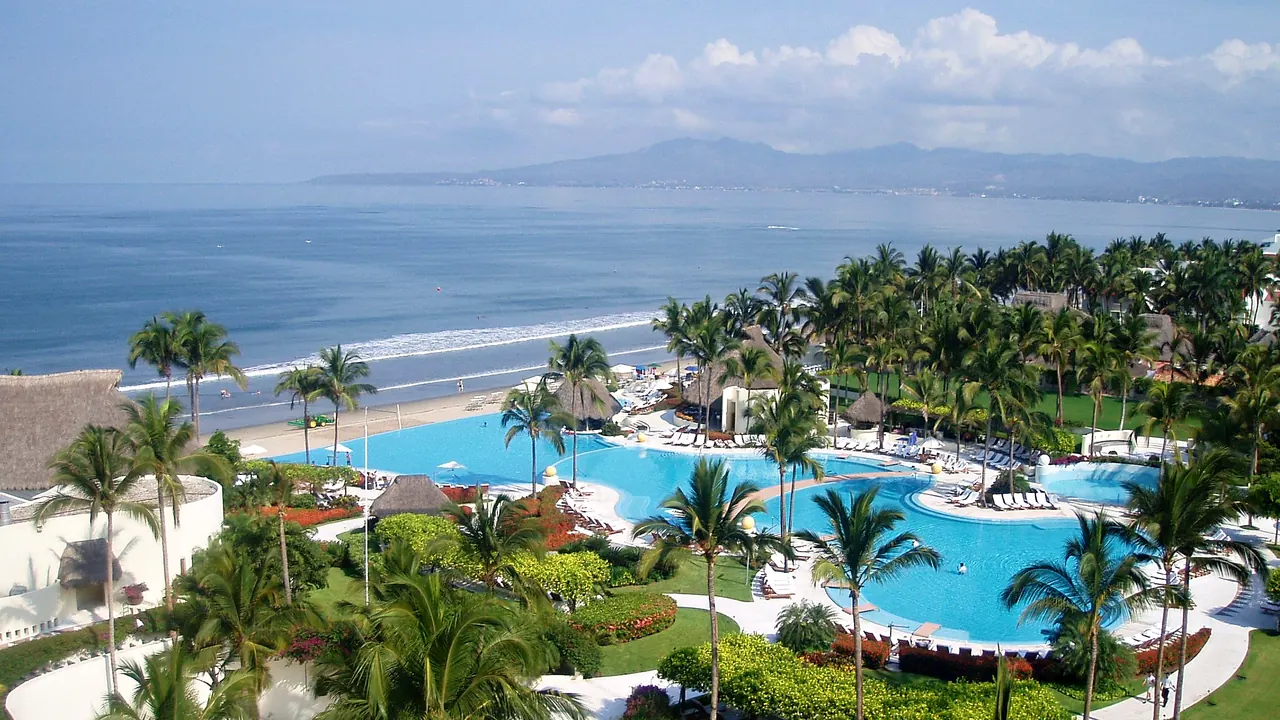
Photos: Huatulco by Gzzz, CC BY-SA 4.0, cropped; Nuevo Vallarta by Harpqueen, Public domain.
Huatulco or Nuevo Vallarta?
Our verdict in twelve categories, each scored against the same fixed benchmark cities, and the climate month by month, so you can choose for your trip.
Choose Huatulco for
- prices
- culture and sights
- nightlife
Huatulco suits travellers who want the beach without the resort bubble. Its nine bays give you a different cove for each day, with clear water and coral to snorkel just offshore. A real Mexican town, La Crucecita, is close enough to walk to for dinner on the plaza, and a stay there costs noticeably less. Couples, independent travellers and anyone who likes to wander out in the evening will feel more at home here.
Choose Nuevo Vallarta for
- day trips
- families
- live music and the arts
Nuevo Vallarta is the easier choice for families and for anyone who wants everything arranged. Its resorts are built around children, the long beach slopes gently, and in winter whales calve right inside Banderas Bay. Puerto Vallarta, Sayulita and Bucerias are all close, so there is plenty to fill the days away from the pool. You pay more for it, but it suits people who want a comfortable base with good outings nearby.
Scoreboard
Twelve categories on one fixed scale from 0 to 100. The shaded stretch is the gap between the two.
Your match
Pick a travel style or drag the sliders, and both match scores follow your weighting.
Too close to call, level with your weighting
Wins on prices and culture and sights with your weighting.
Wins on day trips and families with your weighting.
What matters to you?
Category by category
What the scores mean for a trip.
Beaches & swimming
Both places are beach places first, and both are very good, but the beaches are a different shape. Huatulco is a chain of small sheltered coves with golden sand and rocky headlands. The water is clear enough to snorkel straight from the shore at La Entrega, and some bays, such as Cacaluta, can only be reached by boat or on foot.
Nuevo Vallarta has one long, wide strand that runs for kilometres in front of the resorts. It is ideal for long walks and slopes gently into the sea, but the water is cloudier and can turn murky near the river mouth after storms. For variety you drive out to Punta Mita or Sayulita, whereas in Huatulco a morning boat trip takes you round several bays.
Food & drink
The two are close for eating, and in both places the best food comes from the region rather than the hotel. Huatulco serves Oaxacan cooking: mole, tlayudas, tamales in banana leaf and mezcal from the hills. You find it in La Crucecita's market and in the family fondas around the square, which are easy to reach from most places you might stay.
Nuevo Vallarta's local dishes are pescado zarandeado grilled over wood, aguachile and raicilla. To eat them, though, you usually have to leave the resort strip for the seafood shacks of Bucerias or the much larger restaurant scene in Puerto Vallarta.
Culture & sights
Neither place is for sightseeing, but Huatulco at least has a few things to see. There is the church in La Crucecita with the huge Virgin painted across its dome, the small pre-Hispanic ceremonial site at Copalita with its forest walk to a clifftop lookout, and a quiet colonial church inland at Santa María Huatulco.
Nuevo Vallarta has no historic centre or landmarks of its own, just hotels, golf courses and a marina. For any history you have to go out to Puerto Vallarta's cobbled old streets and crowned parish church.
Nightlife
Evenings are quiet in both, but Huatulco has a town to go out in. La Crucecita's plaza has mezcal bars, a few places to dance, and beach bars down by the Santa Cruz marina. It is quiet by midnight for most of the year, and anyone after a party heads up the coast to Zipolite.
In Nuevo Vallarta, evenings mostly mean lobby bars and poolside shows. Puerto Vallarta's malecon clubs and the Zona Romántica, home to one of Mexico's best-known gay scenes, keep going much later, but getting there always takes a taxi ride.
Nature & outdoors
Both have excellent outdoors, of different kinds. Huatulco's national park runs from dry forest down to cliffs, blowholes and coral patches that are good for snorkelling and diving. Inland you can raft or kayak the Copalita River, or go up into the hills to the waterfalls and shade-grown coffee farms.
Nuevo Vallarta's highlight is the bay itself. Humpbacks come right into Banderas Bay to calve in winter, rather than just passing along the coast, and the Marietas Islands offer snorkelling among seabirds and arches. There are also crocodiles in the Ameca mangroves, surf at Punta Mita and Sayulita, and jungle zip-lines in the Sierra Madre foothills.
Day trips
Nuevo Vallarta has far more within easy reach. Puerto Vallarta's old town is half an hour away. To the north are Bucerias with its galleries, surfy Sayulita, quieter San Pancho and Punta Mita. There is also boat-only Yelapa across the bay, or the silver-mining village of San Sebastián del Oeste up in the pine-covered mountains.
From Huatulco, the main outing is an hour west to Mazunte's turtle centre, San Agustinillo, Puerto Ángel and Zipolite. Puerto Escondido is a longer day out, and Oaxaca city is too far to visit without staying the night.
Good for families
Nuevo Vallarta is more clearly set up for children. The resorts have shallow pools, water slides and food all day, the gated enclave feels safe, and there are water parks and a dolphin centre nearby. Turtle hatchling releases and winter whale trips are the kind of outing children remember.
Huatulco works well for a simpler beach stay. Young children can watch fish close to shore at La Entrega, and the small town is easy to manage. With nothing built for children beyond the sand and the kids' clubs, though, older ones may get restless before the week is out.
Getting around
Huatulco has a walkable town at its centre, and Nuevo Vallarta does not. La Crucecita is compact, Santa Cruz is an easy walk down from it, and Tangolunda, Chahué or Maguey are short taxi or colectivo rides away. You only really need a boat or a car for the remoter bays and the coffee hills.
Nuevo Vallarta stretches along a boulevard of resorts and gated condominiums, and getting from the beach to the buses on the highway can mean a long, hot walk. Most people rely on taxis, resort shuttles and tours. On the plus side, the airport is only about twenty minutes away.
Shopping & style
Shopping is limited in both, and what is worth buying is regional craft. In Huatulco that means Oaxacan textiles, embroidered blouses, black pottery and alebrijes from the stalls around La Crucecita's plaza.
Nuevo Vallarta itself has resort boutiques and a modest mall. The Huichol beadwork, yarn paintings, silver and Talavera worth taking home are found in Bucerias or in Puerto Vallarta's old town and river market.
Affordability
Huatulco is the cheaper of the two. A guesthouse in La Crucecita, meals at the market and short taxi rides keep costs low, though the big all-inclusive resorts in Tangolunda are another matter.
Nuevo Vallarta is one of Mexico's pricier coastal stays. Nearly all the accommodation is resorts and condominiums, with prices to match. An all-inclusive package at least makes spending predictable, and local buses and tacos in Bucerias bring the cost down.
Live music & performing arts
Nuevo Vallarta has a little more to watch in the evening. There is mariachi and folk dance at the resorts, a permanent acrobatic dinner show in one of the large resorts, and cabaret and drag stages in Puerto Vallarta.
Huatulco has resort folk dance shows, a few bar bands and music on La Crucecita's plaza during festivals, and not much more.
Wellness & relaxation
Both are made for slowing down, and both offer the temazcal, the traditional pre-Hispanic steam bath. Huatulco's calm comes from the place itself: low-rise, uncrowded and quiet, with temazcales at eco-centres as well as at the spas.
In Nuevo Vallarta the calm is mostly provided by the resorts. The larger spas have hydrotherapy circuits, and yoga on the beach is easy to find, but how much you get depends on the hotel you book.
When should you go?
Pick your month. The climate figures are measured averages, not a forecast.
Huatulco in July
Nuevo Vallarta in July
Daytime high, °C
Rainfall in the month, mm
Where the figures come from
Huatulco's temperatures are measured 42 km from the centre, at Puerto Angel, Oax..
Huatulco's station stands 177 m below the city centre, so the centre is likely a little cooler than the figures say.
Huatulco has no rain gauge within 25 km of the centre, so its rainfall comes from a gridded climate dataset read at the city rather than from a gauge further away.
Nuevo Vallarta has no weather station within reach, so its figures come from a gridded climate model rather than a measured record, and read a broad area rather than the city itself.
Temperature and rainfall are climate normals, averaged over the years shown. Huatulco: 1991-2020 normals, Puerto Angel, Oax. (42.2 km from centre). Nuevo Vallarta: 1991-2020 normals, TerraClimate 4 km grid at the town, no weather station within 90 km.
Both coasts are hot all year, with dry winters and wet summers, but the seasons don't quite line up. Huatulco's temperature barely changes, with highs close to 33°C in every month, so walking the streets at midday is hot work whatever the season. It is dry and very sunny from November to April. The rain starts building in May, and June and September are the wettest months, with about 270mm falling in June. The sea is warm enough for a long swim all year.
Nuevo Vallarta has milder winters, with highs near 30°C, though the sea cools to about 24°C in February and March, which some swimmers find fresh. Its driest spell runs from March to May, so late spring is more reliable here, just as Huatulco is turning wet. From June to October the rain is heavy and the days reach 34°C, too hot for much walking in the daytime. For a winter trip Huatulco has the warmer sea, and from December to April both are dependable.
Which traveller are you?
On a family trip with young children, Nuevo Vallarta is the stronger pick. The resorts have shallow pools, water slides and kids' clubs. Beyond the hotel there are water parks, turtle releases at dusk and winter whale trips, so the children have more to do than in Huatulco.
For a trip on a tight budget, Huatulco is the better fit. Small guesthouses in La Crucecita, market breakfasts and cheap taxi hops between bays keep costs down. Nuevo Vallarta is almost all resorts and condominiums priced for North American visitors.
For a food and nightlife trip, Huatulco gives you more on the doorstep. There are Oaxacan fondas, mole and mezcal bars around a lively town square. In Nuevo Vallarta, a good meal or a late night usually means a taxi to Bucerias or Puerto Vallarta.
Before you go
| Measure | Huatulco | Nuevo Vallarta |
|---|---|---|
| Official language | Spanish, Nahuatl, Yucatec Maya | Spanish, Nahuatl, Yucatec Maya |
| Currency | Mexican Peso (MXN) | Mexican Peso (MXN) |
| Sockets | AB127 V, 60 Hz | AB127 V, 60 Hz |
| Driving side | Right | Right |
| Time zone | UTC-6 | UTC-6 |
| Emergency number | 911 | 911 |
| Elevation | 220 m | 3 m |
| Main airport | Bahías de Huatulco International Airport (HUX)15 km from centre13 non-stop destinations | Puerto Vallarta International Airport (PVR)4 km from centre52 non-stop destinations |
| Public holidays this year | 9 days | 9 days |
By the numbers
| Measure | Huatulco | Nuevo Vallarta |
|---|---|---|
| City population | 7,409 | 1,301 |
| Museums within 10 km | 0 | 0 |
| UNESCO World Heritage sites within 50 km | 0 | 1 |
| Swim season, months above 21 °C | 12 months | 12 months |
Where else could you go?
Every comparison below shares a destination with this one, so you can follow Huatulco or Nuevo Vallarta somewhere new.