Photos: Huatulco by Gzzz, CC BY-SA 4.0, cropped; Oaxaca by Öskr Rck, CC BY-SA 3.0, cropped.
Huatulco or Oaxaca?
Our verdict in twelve categories, each scored against the same fixed benchmark cities, and the climate month by month, so you can choose for your trip.
Choose Huatulco for
- beaches
- families
- nature and the outdoors
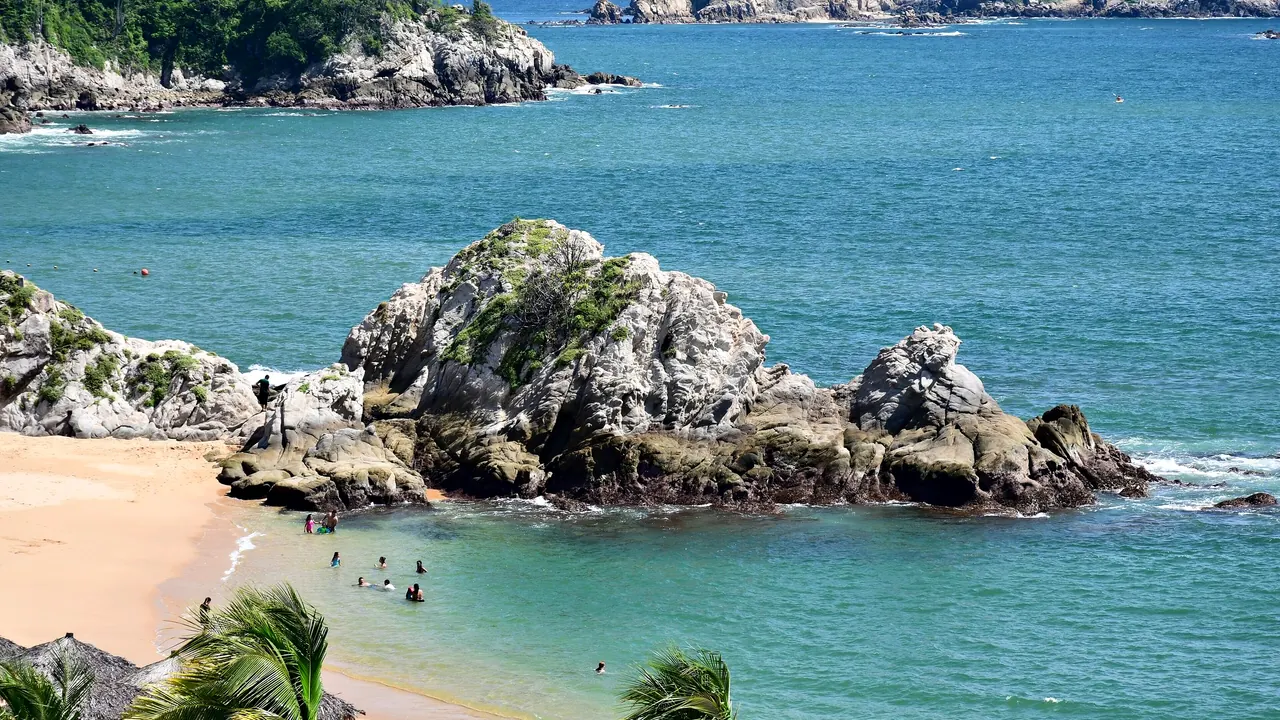
Huatulco suits a trip where the sea is the point. It has sheltered coves with warm, clear water, snorkelling over coral at La Entrega, boat days to bays with no road and a national park running down to the shore. It is also the easier choice with young children, and for anyone happy to give up sights and evenings out for a slow week on the sand.
Choose Oaxaca for
- culture and sights
- shopping
- food and drink
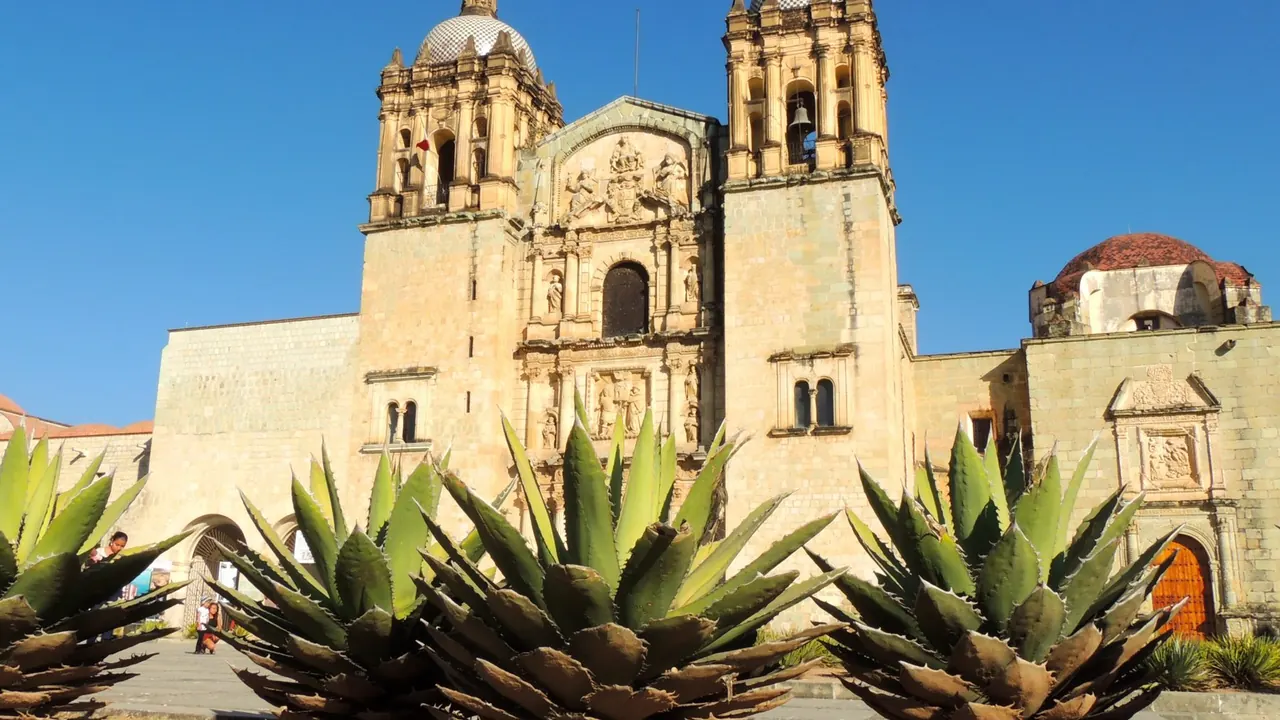
Pick Oaxaca if you travel to eat, look and buy. The colonial centre around Santo Domingo, Monte Albán on its mountaintop, markets full of mole and tlayudas, mezcal from the valley villages and the weaving and pottery towns within an hour give you far more to do each day, and for less money. There is no beach, which is why many people finish a stay here with a few days on the coast.
Scoreboard
Twelve categories on one fixed scale from 0 to 100. The shaded stretch is the gap between the two.
Your match
Pick a travel style or drag the sliders, and both match scores follow your weighting.
Wins on beaches and families with your weighting.
Wins on culture and sights and shopping with your weighting.
What matters to you?
Category by category
What the scores mean for a trip.
Beaches & swimming
Here the gap is as wide as it gets. Huatulco is a beach destination first. It has sheltered golden-sand coves such as Santa Cruz and La Entrega, wilder bays like Cacaluta reached by boat or a forest path, and sea warm enough to swim in all year.
Oaxaca sits in a highland valley at about 1,550m, with mountains between it and the coast, so in the city swimming means a hotel pool. The usual answer is to end a Oaxaca stay on the coast, and Huatulco is one of the places people go.
Food & drink
Both cook from the same Oaxacan tradition, but the city is where it is done best. Oaxaca has its many moles, the smoke-filled grill aisle of the 20 de Noviembre market, village mezcal poured in tasting rooms, and a group of chefs running tasting menus built on heirloom maize.
Huatulco brings that cooking to the coast, with whole fish grilled at beach palapas and honest fondas in La Crucecita. The choice is narrow, though, and Tangolunda's resorts lean on buffets. On the coast you eat well and simply. Oaxaca is the place to travel to for food.
Culture & sights
Huatulco was built as a resort. Its sights, the painted dome of La Crucecita's church and the small Copalita site, fit into a morning.
Oaxaca is a UNESCO-listed colonial city built in green stone. It has the gilded Baroque interior of Santo Domingo, the gold from Monte Albán's Tomb 7 in the museum next door and a long tradition of painting and printmaking, and the Zapotec capital itself is twenty minutes away. In Oaxaca culture is a reason to go, while in Huatulco it is an afterthought.
Nightlife
Neither is a place for clubbing, but Oaxaca gives you more of an evening. Mezcal bars in the centre and Jalatlaco, rooftops facing the domes of Santo Domingo and the lively pedestrian Macedonio Alcalá keep people out later, with salsa and DJs at weekends.
In Huatulco an evening means dinner and a drink around La Crucecita's plaza or by the Santa Cruz marina. It is livelier in the winter high season, but for most of the year the town is quiet by midnight. Anyone after a party goes up the coast to Zipolite.
Nature & outdoors
Huatulco has the edge, because its nature starts at the hotel door. There is a national park of dry tropical forest and cliffs, coral to snorkel and dive, humpback whales offshore from December to March and rafting on the Copalita River.
In Oaxaca the outdoors means mountains rather than sea. The Sierra Norte, an hour and a half away, has village-to-village walks through pine-oak and cloud forest, and the mineral cliffs of Hierve el Agua make a half-day out. Walkers will be content in Oaxaca, but for water and wildlife Huatulco is better.
Day trips
Oaxaca is far better placed for outings. Within an hour lie the great cypress at Tule, the rugs of Teotitlán del Valle, the stone fretwork of Mitla and the mezcal distilleries of Santiago Matatlán, and the monasteries of the Mixteca Alta make a longer day.
From Huatulco the choice is mostly along the coast. Mazunte's turtle centre, Puerto Ángel and Zipolite are about an hour west and Puerto Escondido is about two, or you can spend a slow half day in the coffee hills. Oaxaca city is too far to visit from the coast in a day.
Good for families
Huatulco makes the easier family vacation. Children can snorkel among fish in the calm shallows at La Entrega and Santa Cruz, Tangolunda's resorts have pools and kids' clubs, and the small town is simple to manage.
Oaxaca welcomes children just as warmly, and older ones may enjoy painting alebrijes or a chocolate-making session. The main outings, though, are ruins with little shade, and the cobbles are hard work with a pushchair. Neither city has a zoo, aquarium or theme park.
Getting around
Oaxaca is the easier city to get around. Nearly everything lies within twenty minutes' walk of the zócalo, and colectivos or a hired driver make the valley villages straightforward.
Huatulco is spread across separate bays. Beyond compact La Crucecita and the walk down to Santa Cruz, you take taxis, colectivos or a boat, and a hire car helps for the coast villages. Distances are short, but you will rarely walk from one beach to the next.
Shopping & style
Shopping in Huatulco means a stroll past the stalls around La Crucecita's plaza and in Santa Cruz. There, embroidered blouses, hammocks, mezcal and hill coffee share space with beach souvenirs. It is fine for a few gifts, but keen craft buyers keep their budget for later.
Oaxaca is where that budget gets spent. Cooperative galleries along the Macedonio Alcalá sell handwoven textiles and contemporary Oaxacan design, and the workshops are close by: black pottery at San Bartolo Coyotepec, alebrije carving at Arrazola and the weekly markets at Tlacolula and Ocotlán. Neither place has fashion brands or luxury streets.
Affordability
Your money goes further in Oaxaca. Market meals, cheap taxis and colectivos to the villages, modest entry to the ruins and inexpensive guesthouses keep daily costs low. Only boutique hotels, tasting menus and the festival weeks push them up.
Huatulco can be done cheaply too, by staying in La Crucecita and eating at fondas, but beach life adds its own costs: Tangolunda's all-inclusives, boat tours and taxis between bays. Overall it is dearer than inland Oaxaca.
Live music & performing arts
Oaxaca has a real performing tradition. The Guelaguetza each July brings dance groups from across the state to a hillside auditorium, and the Day of the Dead fills the streets with comparsas. Through the year the state band and marimba players perform in the zócalo, and the ornate Teatro Macedonio Alcalá hosts concerts.
Huatulco offers folk-dance shows in the resorts and the odd festival night on the plaza, but no theatre or concert hall. Outside the festivals, neither is a place to plan a trip around performances.
Wellness & relaxation
For rest the two are about level, and both offer the temazcal steam bath. In Huatulco it comes with full resort spas in Tangolunda and Conejos and a beach town that goes quiet once the boats are in, so the sea and the slow pace do much of the unwinding.
In Oaxaca the temazcal is often a ceremony led by a traditional healer, in the city or the valley villages, and there are also yoga studios, shaded courtyards and the gardens of Jalatlaco. Its festival weeks, though, bring fireworks and crowds.
When should you go?
Pick your month. The climate figures are measured averages, not a forecast.
Huatulco in July
Oaxaca in July
Daytime high, °C
Rainfall in the month, mm
Where the figures come from
Huatulco's temperatures are measured 42 km from the centre, at Puerto Angel, Oax..
Huatulco's station stands 177 m below the city centre, so the centre is likely a little cooler than the figures say.
Huatulco has no rain gauge within 25 km of the centre, so its rainfall comes from a gridded climate dataset read at the city rather than from a gauge further away.
Temperature and rainfall are climate normals, averaged over the years shown. Huatulco: 1991-2020 normals, Puerto Angel, Oax. (42.2 km from centre). Oaxaca: 1961-1990 normals, Oaxaca, Oax. (1.1 km from centre).
Huatulco is hot every month, with highs around 33°C, so the question is rain rather than warmth. November to April is almost dry and very sunny, and the sea never drops below about 27°C. These are the months for clear water and calm bays. From May the wet season sets in, peaking at around 270mm in June, and humid afternoons make midday walking heavy going until October.
Oaxaca sits in a highland valley and is a little milder. Highs around 28°C from October to January make the cobbled centre comfortable for long days on foot, while March to May are the warmest months. The rains start in May and follow the same summer pattern as the coast but are lighter, topping out near 134mm in June. Both places have steady sunshine through the dry winter, so if you are combining the two, November to March suits both well.
Which traveller are you?
For a beach and sun trip, Huatulco wins without contest. Its nine bays have warm, sheltered water for swimming and snorkelling, and boat tours reach wild coves. In Oaxaca the only swimming is a hotel pool, several hours from the sea.
On a culture and arts trip, Oaxaca is the clear choice. The UNESCO-listed centre, Santo Domingo and its museum, the Tamayo collection and nearby Monte Albán fill several days. Huatulco's handful of sights take a single morning.
For a food and nightlife trip, Oaxaca comes out ahead again. It has market grills, many moles and chef-led tasting menus, then mezcal bars in Jalatlaco and rooftops over Santo Domingo. Huatulco offers good, simple grilled fish and a plaza that is quiet by midnight.
Before you go
| Measure | Huatulco | Oaxaca |
|---|---|---|
| Official language | Spanish, Nahuatl, Yucatec Maya | Spanish, Nahuatl, Yucatec Maya |
| Currency | Mexican Peso (MXN) | Mexican Peso (MXN) |
| Sockets | AB127 V, 60 Hz | AB127 V, 60 Hz |
| Driving side | Right | Right |
| Time zone | UTC-6 | UTC-6 |
| Emergency number | 911 | 911 |
| Elevation | 220 m | 1,555 m |
| Main airport | Bahías de Huatulco International Airport (HUX)15 km from centre13 non-stop destinations | Xoxocotlán International Airport (OAX)7 km from centre14 non-stop destinations |
| Public holidays this year | 9 days | 9 days |
By the numbers
| Measure | Huatulco | Oaxaca |
|---|---|---|
| City population | 7,409 | 258,913 |
| People per km² | - | 3,028 |
| Museums within 10 km | 0 | 10 |
| UNESCO World Heritage sites within 50 km | 0 | 2 |
| Swim season, months above 21 °C | 12 months | - |
Where else could you go?
Every comparison below shares a destination with this one, so you can follow Huatulco or Oaxaca somewhere new.