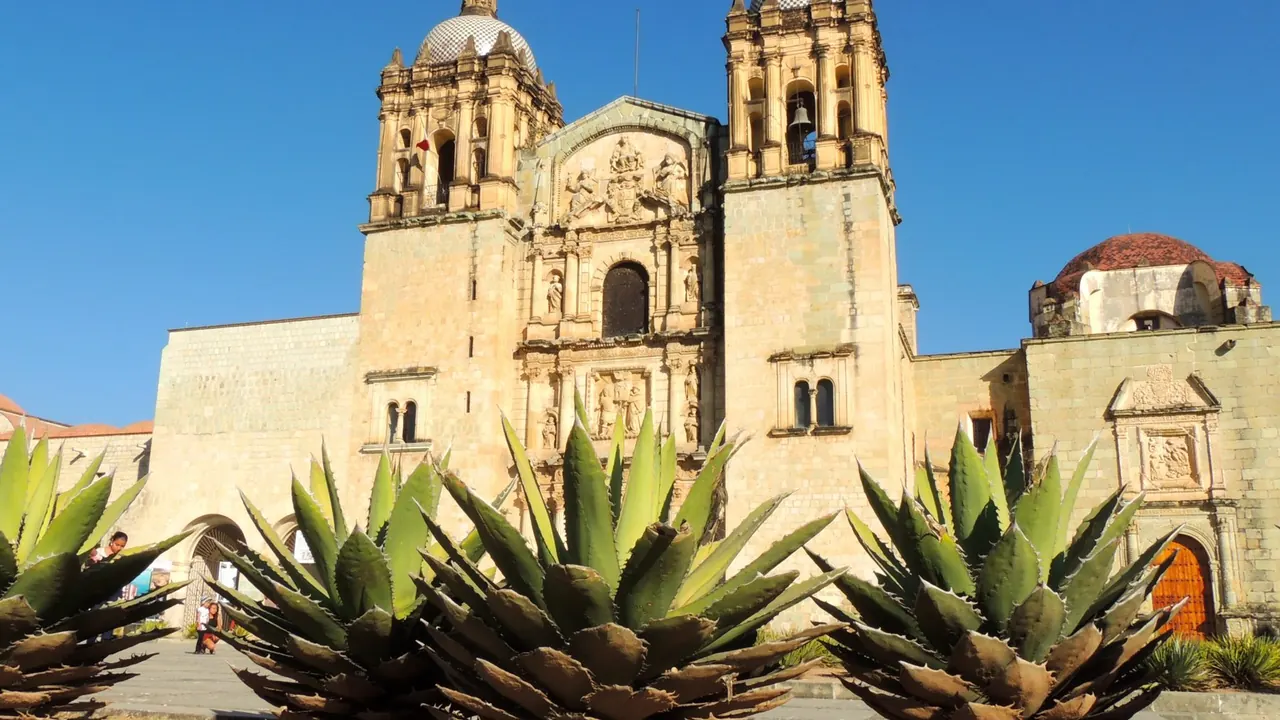
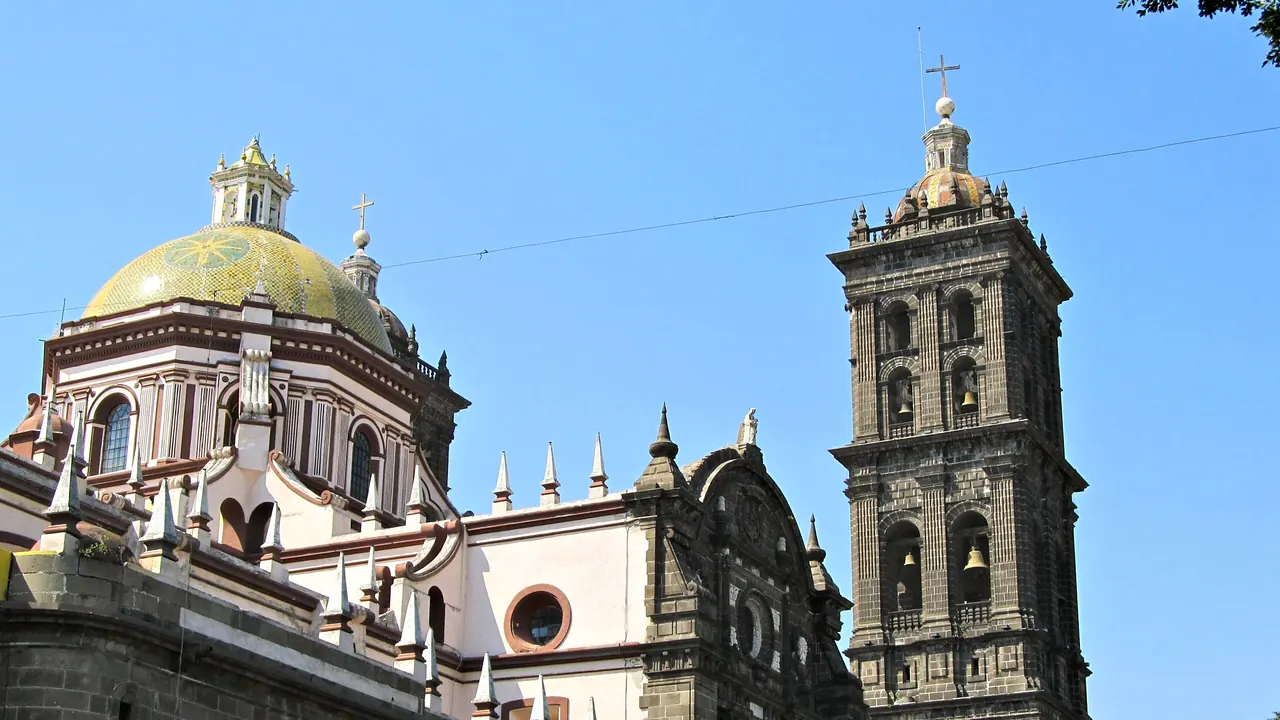
Photos: Oaxaca by Öskr Rck, CC BY-SA 3.0, cropped; Puebla by Octavio Alonso Maya …, CC BY-SA 3.0, cropped.
Oaxaca or Puebla?
Our verdict in twelve categories, each scored against the same fixed benchmark cities, and the climate month by month, so you can choose for your trip.
Choose Oaxaca for
- wellness
- shopping
- getting around
Oaxaca suits travellers who want to slow down and buy into a place. The centre is compact and easy to walk, the valley villages where rugs, pottery and alebrijes are made are a short colectivo ride away, and evenings run on mezcal from small local distilleries. A temazcal led by a traditional healer adds something Puebla only offers in a lighter form. Choose it for crafts, food markets and an unhurried week.
Choose Puebla for
- families
- day trips
- prices
Puebla makes more sense if you want to cover ground or have children with you. Cholula's Great Pyramid is half an hour away, Tlaxcala and the Cacaxtla murals make another easy outing, and Mexico City is close enough for a long day. Africam Safari gives younger children a real highlight. Its milder climate and lower costs also suit a longer, busier itinerary.
Scoreboard
Twelve categories on one fixed scale from 0 to 100. The shaded stretch is the gap between the two.
Your match
Pick a travel style or drag the sliders, and both match scores follow your weighting.
Too close to call, 2 points apart
Wins on wellness and shopping with your weighting.
Wins on families and day trips with your weighting.
What matters to you?
Category by category
What the scores mean for a trip.
Beaches & swimming
Neither city has a beach. Both sit high in the mountains, and swimming in town means a hotel pool.
What differs is the coast you could add on. From Oaxaca, Puerto Escondido, Mazunte or Huatulco are a short flight away and make a natural few days of beach to end the trip. Puebla's nearest coast, around Veracruz, is a longer journey by road, but its spring-fed balnearios on the edge of the city give a more local kind of swim.
Food & drink
These are two of the places Mexican cooking comes from, and either will feed you superbly. Oaxaca has the wider range of moles, tlayudas grilled over charcoal and the smoky grill aisle of the 20 de Noviembre market. It also has a drinking culture built on village mezcal and morning hot chocolate, and a group of chefs serving tasting menus, which give it the slight edge.
Puebla is the birthplace of mole poblano, and its strength is street eating. There are cemitas, small chalupas and tacos árabes, chiles en nogada in late summer, and the convent sweets of the Calle de los Dulces.
Culture & sights
Both have UNESCO-listed colonial centres you can see properly in two or three days, so the difference is in character. Oaxaca's pale green stone streets lead to Santo Domingo and the Tomb 7 gold, and Monte Albán is twenty minutes away. Its printmaking workshops and Textile Museum make the Zapotec past and today's art feel connected.
Puebla is about density and ornament. It has red brick and Talavera house fronts, more churches per block, the gilded Capilla del Rosario and the Palafoxiana library. The Museo Amparo and the forts from the 1862 battle add history Oaxaca cannot match.
Nightlife
Evenings are low-key in both cities. Oaxaca's are the more intimate: mezcal tasting bars in the centre and Jalatlaco, rooftops over the domes of Santo Domingo, and only a few salsa or DJ nights at weekends.
Puebla has a little more reach thanks to its students. Its own centre offers cantinas around the Callejón de los Sapos, but the real going-out is a taxi ride away, in the bars and small clubs of Cholula from Thursday to Saturday or in the clubs of Angelópolis.
Nature & outdoors
Oaxaca is for walking from village to village through forest, and Puebla is for climbing volcanoes. Oaxaca has the slight edge because of the Sierra Norte, about an hour and a half away. There the Zapotec Pueblos Mancomunados run cabins, local guides and trails through pine-oak and cloud forest, for a single long hike or several days on foot. Closer in, the mineral cliffs of Hierve el Agua make an easy half-day, and the valley floor is good for mountain biking among the agave fields.
Puebla's outdoors is about altitude. Popocatépetl and Iztaccíhuatl dominate the skyline, La Malinche is a long climb through pine forest to above 4,400m, and the Izta-Popo national park has high trails on Iztaccíhuatl's flanks. The city's own parks are modest, though, and almost every outing needs a car, a tour or an early bus.
Day trips
Puebla has the stronger and more varied day trips. Cholula's Great Pyramid and the tiled churches of Tonantzintla and Acatepec are barely half an hour away, and Huejotzingo's convent is on the way to the volcano. Tlaxcala is a second colonial city and pairs well with the Cacaxtla murals, and even Mexico City is within reach.
Oaxaca's outings are smaller but have their own appeal: the Tule cypress, Mitla's stone fretwork, Yagul, the mezcal distilleries and the craft villages, with the Mixteca Alta monasteries for a longer day. What it lacks is another historic city nearby.
Good for families
Puebla is clearly the better pick with children, mainly because of Africam Safari, where animals walk around the car. The observation wheel at Angelópolis, the open grounds of the forts and the pyramid tunnels at Cholula fill out the days.
Oaxaca makes children welcome in its squares and pedestrian streets, and older ones enjoy painting alebrijes or making chocolate. But it has no zoo or theme park, the ruins offer little shade, and younger children may find it slow.
Getting around
In both cities the sights cluster within a twenty-minute walk of the zócalo, though Puebla's flat grid is a little kinder on the feet than Oaxaca's narrow, uneven pavements. The gap is what happens beyond the centre.
Oaxaca is easier. Colectivos and second-class buses to the valley villages leave from the edge of the old town, and cheap taxis or a day driver cover the rest. Puebla spreads out further, so getting to Angelópolis, Cholula or Africam usually means a taxi or ride-hailing app, and day trips often need a long-distance bus or a tour.
Shopping & style
Oaxaca is the better place to fill a suitcase. Galleries along the Macedonio Alcalá sell textiles, huipiles, barro negro and tin work, and you can buy straight from the makers in Teotitlán, Atzompa or San Martín Tilcajete. The weekly markets at Tlacolula and Ocotlán are worth a morning of their own.
Puebla's shopping centres on one thing done well, Talavera pottery, which you can watch being painted in its workshops. It also has the weekend antiques stalls on the Callejón de los Sapos and the malls of Angelópolis for the brands Oaxaca lacks.
Affordability
Both are easy on the budget, with very cheap market lunches and street food, and Puebla is slightly cheaper overall. Its comfortable hotels in restored colonial houses near the zócalo are good value, and some museums are free on certain days.
Oaxaca costs more at the top end. Its boutique hotels and chef-led tasting menus are priced with foreign visitors in mind, and rooms climb during the Guelaguetza and the Day of the Dead.
Live music & performing arts
Neither city is a reason to travel for performance alone, but they differ in timing. Oaxaca's highlights depend on festivals: the Guelaguetza dances in the hillside auditorium and the Day of the Dead processions are memorable. Outside them it offers marimba and the state band in the zócalo, plus the odd evening at the Teatro Macedonio Alcalá.
Puebla has a steadier stage calendar, with plays at the historic Teatro Principal and touring dance and orchestras at the university's cultural complex. Most evenings, though, its music means mariachis and trios on the squares.
Wellness & relaxation
Oaxaca is the better place to unwind. The temazcal sweat lodge is still part of daily life in nearby Zapotec and Mixtec communities, and you can join a ceremony led by a healer, followed by herbal rubs. Yoga studios and shaded gardens in Jalatlaco add to its easy pace.
Puebla offers temazcales at small spas around the city and Cholula, and a swim in the sulphurous pools at Agua Azul. Beyond that it comes down to hotel spas and quiet plazas, and traffic outside the centre spoils some of the calm.
When should you go?
Pick your month. The climate figures are measured averages, not a forecast.
Oaxaca in July
Puebla in July
Daytime high, °C
Rainfall in the month, mm
Temperature and rainfall are climate normals, averaged over the years shown. Oaxaca: 1961-1990 (rainfall 1991-2020) normals, Oaxaca, Oax. (1.1 km from centre). Puebla: 1991-2020 normals, Puebla, Pue. (5.4 km from centre).
Both cities are at their best in the dry, sunny months from November to March, when rain almost stops and the skies stay clear. Oaxaca is the warmer of the two all year, and by April afternoons reach about 33°C, which makes long walks round the ruins hard going. Puebla sits higher and stays cooler, with winter days around 23°C and a peak of only about 29°C in spring. That makes April and May more comfortable there, and the dry winter air brings the best views of the snow-capped volcanoes.
The rainy season runs from June to September in both cities and is heavier in Puebla, where September brings about 190mm against Oaxaca's summer peak of around 150mm. Summer afternoons in both often end in storms, though mornings stay usable for sightseeing. October is a transition month in both. Neither city has a beach season to plan around.
Which traveller are you?
On a family trip with children, Puebla is the easier choice. Africam Safari lets animals wander around the car, the tunnels inside Cholula's pyramid feel like an adventure, and the flat centre is simpler to manage than Oaxaca's shadeless ruins and uneven pavements.
For a shopping trip, go to Oaxaca. Its handwoven textiles, black barro negro pottery and carved alebrijes can be bought straight from the villages that make them, at Teotitlán, Coyotepec and Arrazola. Puebla's buying centres mostly on Talavera ceramics and its malls.
On a relaxing and wellness trip, Oaxaca offers more. The temazcal is a living Zapotec and Mixtec custom, led by healers in the city and the valley villages, and Jalatlaco's gardens and quiet courtyards set an easy pace. In Puebla, traffic outside the centre spoils the calm.
Before you go
| Measure | Oaxaca | Puebla |
|---|---|---|
| Official language | Spanish, Nahuatl, Yucatec Maya | Spanish, Nahuatl, Yucatec Maya |
| Currency | Mexican Peso (MXN) | Mexican Peso (MXN) |
| Sockets | AB127 V, 60 Hz | AB127 V, 60 Hz |
| Driving side | Right | Right |
| Time zone | UTC-6 | UTC-6 |
| Emergency number | 911 | 911 |
| Elevation | 1,555 m | 2,153 m |
| Main airport | Xoxocotlán International Airport (OAX)7 km from centre15 non-stop destinations | Hermanos Serdán International Airport (PBC)20 km from centre14 non-stop destinations |
| Public holidays this year | 9 days | 9 days |
By the numbers
| Measure | Oaxaca | Puebla |
|---|---|---|
| City population | 258,913 | 1,542,232 |
| People per km² | 3,028 | 2,825 |
| Museums within 10 km | 10 | 17 |
| UNESCO World Heritage sites within 50 km | 2 | 2 |
Where else could you go?
Every comparison below shares a destination with this one, so you can follow Oaxaca or Puebla somewhere new.
- Mexico Cityvs Puebla
- Puerto Escondidovs Oaxaca
- Huatulcovs Oaxaca
- Acapulcovs Puebla
- San Miguel de Allendevs Puebla
- Acapulcovs Oaxaca